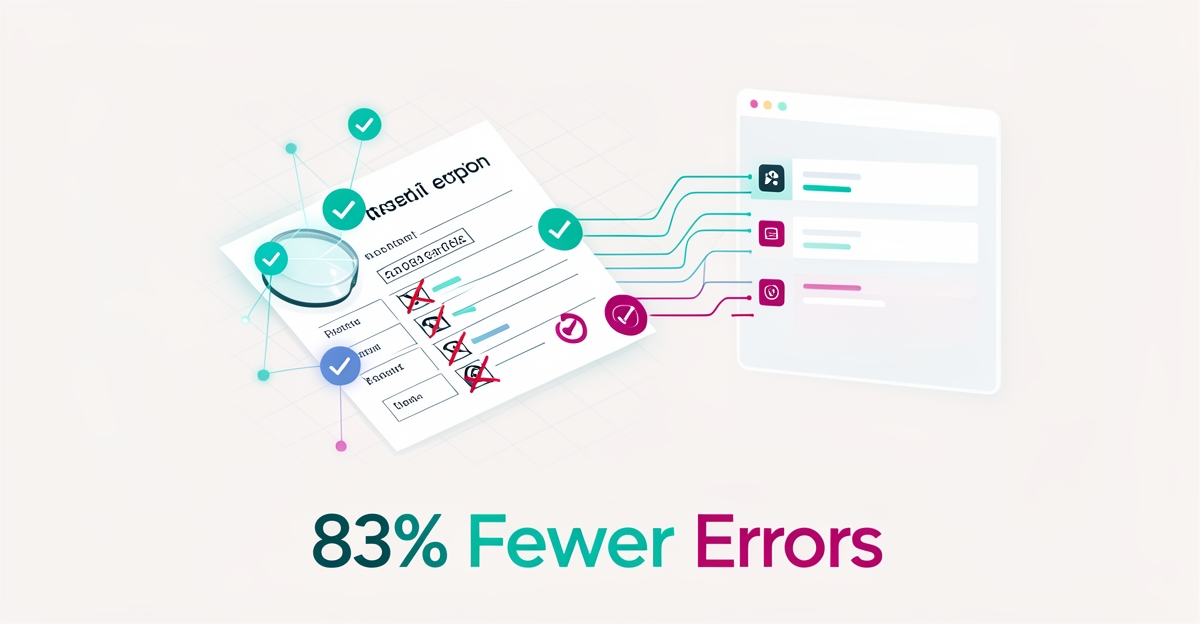
How AI Can Reduce Errors in Contact Lens Patient Intake Forms
Key Facts
- Physician burnout remains widespread as of late 2026, with paperwork such as EMR data entry consistently cited as a leading driver.
- AI-assisted data entry and validation typically reduce manual intake errors significantly compared with unaided keyboard entry.
- Real-time validation catches prescription inconsistencies, transposed powers, invalid base curves, mismatched modalities, before they reach the EHR.
- Human-in-the-loop escalation keeps uncertain entries with staff, so automation never guesses on clinical data.
- A phased rollout, one form first, then integration, then decision support, delivers measurable wins without disrupting the practice.
Hire a team member that works 24/7 — for less than a part-time wage.
AI receptionists, SDRs, dispatchers and 99+ roles. Trained on your business, fully managed.
Not sure where to start? Ask our AI planner
The Hidden Cost of Manual Intake Errors in Eye Care Practices
Manual data entry in contact lens patient intake forms creates significant hidden costs for eye care practices. These errors not only compromise data integrity but also strain clinical workflows and staff well-being. As of late 2026, physician burnout remains a persistent industry problem, and paperwork, especially EMR data entry, is consistently cited as one of its leading drivers. That burden lands directly on the accuracy and efficiency of patient intake in optometry and ophthalmology clinics.
The consequences of manual intake errors extend beyond clinician fatigue to include compliance risks and operational inefficiencies. Inaccurate patient data can lead to incorrect contact lens prescriptions, billing discrepancies, and potential regulatory violations. Practices often spend valuable clinical time identifying and correcting these mistakes, diverting focus from direct patient care. AI-powered intake solutions address these challenges by automatically parsing forms, validating data against known parameters, and flagging inconsistencies in real time, preventing errors from propagating into clinical records or EHR systems.
- AI-assisted data entry and validation typically catch a large share of manual entry errors before they reach clinical records
- Automated intake frees front-desk staff from re-keying patient information, reducing repetitive work
- Real-time flagging shortens review time and keeps clinicians focused on patients rather than paperwork
For eye care practices, integrating AI into contact lens intake workflows means fewer prescription errors, reduced administrative burden on staff, and faster, more reliable patient onboarding. AIQ Labs builds managed AI Employees, including intake and front-desk roles, that connect directly with intake forms and electronic health records, ensuring data accuracy and compliance from the moment a patient submits their information. By automating validation and flagging discrepancies before they reach clinicians, these systems help mitigate the hidden costs of manual intake while supporting sustainable practice operations.
How AI Parses, Validates, and Flags Intake Data in Real Time
AI-powered intake systems use natural language processing to read and interpret patient data from contact lens forms, extracting critical details like prescription strength, wear schedule, and ocular history with high precision. When grounded in your practice's own documents and clinical guidelines, modern language models are far less prone to misinterpretation than free-form manual entry. This level of precision allows AI to distinguish between similar but clinically distinct entries, such as differentiating between daily disposable and extended wear lenses, before data ever reaches the EHR.
These systems apply real-time validation rules that cross-check extracted information against known clinical parameters, such as valid base curve ranges or acceptable power values for specific lens types. Inconsistencies, like a patient reporting a -15.00 D prescription with a base curve of 8.0 mm, which may fall outside safe fitting parameters, are flagged immediately for review. The same automation principles that reduce documentation burden elsewhere in healthcare apply directly to intake forms: by automating validation, AI reduces manual review time while increasing data reliability.
- Flags mismatches between self-reported symptoms and lens compatibility (e.g., dry eye complaints with high-water-content lenses)
- Detects illogical combinations, such as bifocal lenses prescribed for patients under 18 without clinical justification
- Identifies missing required fields like insertion/removal technique or solution compatibility
- Highlights temporal inconsistencies, such as a reported replacement schedule that contradicts the lens modality
- Alerts to potential data entry errors, like transposed digits in prescription values (e.g., -2.50 recorded as -5.20)
By combining natural language understanding, rule-based validation, and real-time inconsistency detection, AI creates a proactive safety net that prevents erroneous data from propagating into clinical records. This approach not only improves data integrity but also reduces the cognitive load on staff who would otherwise spend time verifying entries manually. AIQ Labs builds these capabilities into custom intake systems through focused Workflow Builds, rebuilding the one workflow that costs your practice the most, at a fixed price, in phases, so every patient record entering the EHR has been parsed, validated, and verified for accuracy.
From Pilot to Practice: Implementing AI Intake with Minimal Disruption
The biggest mistake practices make with AI intake is trying to automate everything at once. A phased approach, starting small, proving value, then expanding, turns a risky overhaul into a series of manageable wins.
Start with a single, high-friction workflow, such as new-patient intake or contact lens history forms. This mirrors the milestone-based approach AIQ Labs uses, where each phase ships, gets approved, and delivers measurable value before the next begins. Even one automated form typically delivers immediate returns in reduced re-entry and fewer correction cycles.
Integration is where most implementations stall, so prioritize compatibility early. Your AI system should connect directly with existing intake forms and your EHR, syncing validated data without forcing staff to learn a parallel system. Deep, two-way API integration ensures information flows bidirectionally, patient entries update records automatically, and existing records pre-fill forms to reduce redundant typing.
Staff training matters more than most practices expect. With paperwork a leading driver of physician burnout, frame AI as relief rather than replacement. Train front-desk teams to review flagged entries, not re-enter data, and show clinicians how validated intake frees them for patient care.
Human-in-the-loop safeguards keep the system trustworthy as it scales. Configure the AI to escalate uncertain entries, an unusual medication, a conflicting allergy, to staff for review rather than guessing. Grounded systems perform well on routine validation, but human oversight remains essential for edge cases.
A practical rollout looks like this:
- Phase 1: Automate one form type, validate against existing records, measure error reduction
- Phase 2: Expand to EHR integration and real-time consistency checks
- Phase 3: Add clinical decision support and refine escalation rules based on audit trails
Data privacy cannot be an afterthought. Choose systems with audit trails, role-based access, and compliance baked in from day one, especially when handling sensitive ocular health histories. AIQ Labs builds these governance controls into every deployment, ensuring patient confidentiality stays protected as automation expands.
Start monthly with a single AI employee handling intake coordination, build in milestones to prove ROI at each step, or own the system outright, either way, you retain full ownership of the system and the data, avoiding vendor lock-in while your practice scales intelligently. For practices ready to connect intake, scheduling, and records into one layer, an AI Operating System approach ties it together in phases you approve.
Still paying for 10+ subscriptions that don’t talk to each other?
We build custom AI systems you own outright. No vendor lock-in. Full control.
Not sure where to start? Ask our AI planner
Frequently Asked Questions
How much can AI reduce errors in contact lens patient intake forms?
Can AI really help reduce clinician burnout in eye care practices?
What specific errors does AI catch in contact lens intake forms?
How accurate is AI at understanding and validating clinical data from intake forms?
Will implementing AI intake disrupt our current workflow or require staff to learn a new system?
Is it safe to rely on AI for patient data validation, or do we still need human oversight?
Turning Intake Accuracy Into Practice Advantage
AI-powered intake systems do more than prevent data errors, they reclaim clinical time, reduce staff burnout, and safeguard patient safety by catching inconsistencies before they reach the EHR. For eye care practices, this means fewer prescription mistakes, smoother onboarding, and a stronger foundation for compliance and trust. The path forward doesn't require a full overhaul, starting with a single high-friction form, validating results, and scaling thoughtfully delivers measurable wins without disruption. To see whether this fits your practice, complete the 2-minute Fit Check at aiqlabs.ai/apply and book a free 30-minute strategy call where we map your biggest bottlenecks and identify high-ROI opportunities, no sales pitch, just a real working conversation. Questions first? Reach us at [email protected].
Make AI your competitive advantage — not just another tool.
Strategy, implementation and ongoing optimization. One partner, end to end.
Not sure where to start? Ask our AI planner