# How AI Can Reduce Errors in E-Waste Inventory and Recycling Logs
**Quick Answer:** Manual e-waste data entry causes costly compliance errors. AI scans, verifies, and optimizes inventory logs in real time, reducing misclassification and keeping your audit trail clean.
## Key Facts
- E-waste facilities relying on manual data entry face cascading compliance failures; automated verification typically catches errors before they reach audit trails
- Real-time AI validation flags mislabeled lithium-ion batteries and incorrect hazardous waste codes before they trigger EPA violations
- AI document processing dramatically reduces invoice and manifest processing time while improving data extraction accuracy from shipping manifests and disposal certificates
- AI Employees typically cost around 80% less than a comparable human hire while working 24/7 to monitor e-waste streams and generate audit-ready regulatory reports
- Data center electricity demand keeps climbing through 2026, making efficient AI-driven e-waste tracking increasingly critical as hardware turnover accelerates
## Table of Contents
1. [The Hidden Cost of Manual E-Waste Data Entry](#the-hidden-cost-of-manual-e-waste-data-entry)
2. [How AI Scans, Verifies, and Optimizes E-Waste Logs in Real Time](#how-ai-scans-verifies-and-optimizes-e-waste-logs-in-real-time)
3. [From Pilot to Production: Implementing AI with AIQ Labs' Proven Approach](#from-pilot-to-production-implementing-ai-with-aiq-labs-proven-approach)
## The Hidden Cost of Manual E-Waste Data Entry
Manual data entry in e-waste inventory creates a high-risk environment where small mistakes cascade into serious regulatory and operational failures. When staff manually transcribe waste types, weights, and disposal codes from paper logs or spreadsheets, errors in classification and tracking become inevitable. These inaccuracies directly impact compliance with hazardous waste regulations, leading to misrouted materials, incorrect reporting, and avoidable fines. Across the waste management industry, manual processes consistently produce higher error rates that undermine both environmental accountability and operational trust.
The consequences extend beyond compliance failures to tangible financial and reputational damage. Misclassified e-waste, such as treating lithium-ion batteries as general electronics, can trigger hazardous material violations under EPA or international waste treaties. Weight tracking errors distort recycling metrics, affecting landfill diversion reports and extended producer responsibility obligations. These discrepancies often go unnoticed until audits reveal systemic issues, resulting in penalties, corrective action plans, or even suspension of operating licenses. AIQ Labs observes that businesses relying on manual data entry frequently face repeated audit findings, not due to negligence, but because human-driven processes lack the consistency needed for accurate, auditable waste logs.
Operational inefficiencies compound these risks as teams spend excessive time reconciling discrepancies, rerouting mislabeled shipments, and correcting logs after the fact. Manual entry slows down inventory cycles, delays disposal scheduling, and creates blind spots in real-time waste tracking. This reactive approach increases labor costs while reducing throughput, preventing facilities from scaling operations safely or responding quickly to regulatory changes. By contrast, manual processes lock companies into a cycle of error correction that consumes resources better spent on proactive waste management and recycling innovation.
## How AI Scans, Verifies, and Optimizes E-Waste Logs in Real Time
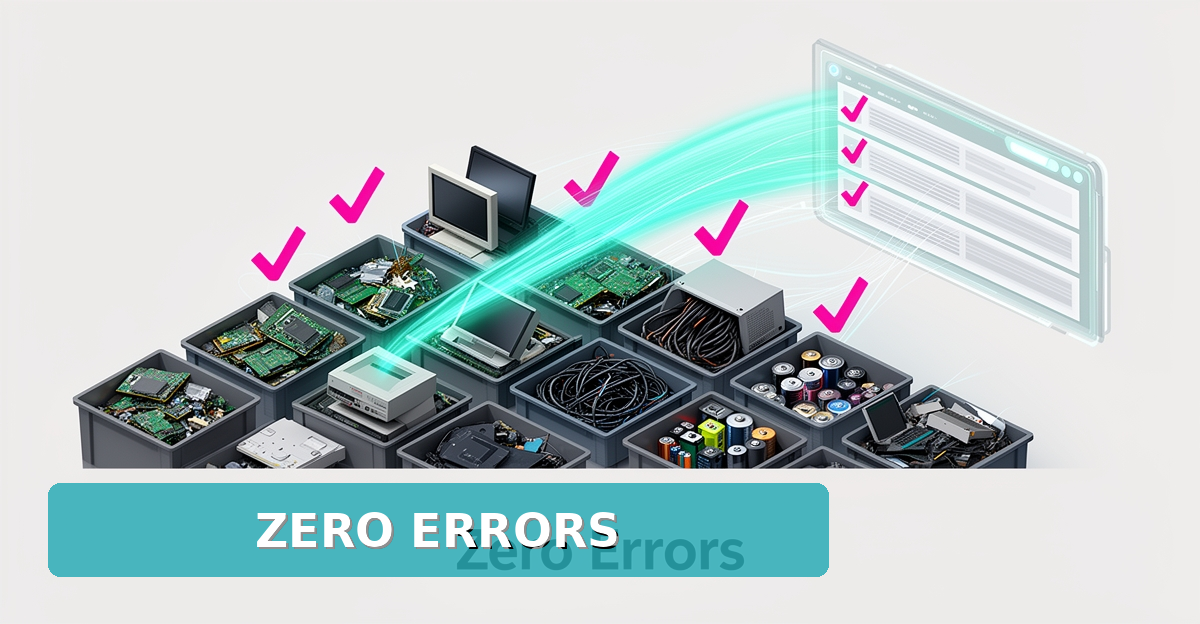
Manual data entry in e-waste management is a ticking time bomb for compliance errors. AI-powered document processing systems now scan, categorize, and validate inventory logs in real time, transforming how recycling facilities track everything from circuit boards to hazardous components.
These systems leverage computer vision and natural language processing to read shipping manifests, weight tickets, and disposal certificates instantly. Instead of relying on manual keystrokes, the AI extracts data points, waste types, weights, and destination codes, and cross-references them against regulatory databases. The operational lift is
AI Employees
Hire a team member that works 24/7 — for less than a part-time wage.
AI receptionists, SDRs, dispatchers and 99+ roles. Trained on your business, fully managed.
See If You’re a Fit — AI Employees from $700/mo
Not sure where to start? Ask our AI planner
substantial: when AI handles complex logistics data, facilities typically see faster intake processing and fewer downstream corrections.
The verification layer is where AI truly shines. **Real-time validation** flags discrepancies the moment data enters the system, catching a mislabeled lithium-ion battery or an incorrect hazardous waste code before it contaminates your audit trail. This proactive error detection represents a shift from reactive cleanup to preventive accuracy, ensuring that every log entry meets regulatory standards without constant human spot-checking.
Key capabilities that drive this accuracy include:
- Automated classification of e-waste categories using visual recognition and text analysis
- Instant cross-referencing of disposal routes against certified recycler databases
- Anomaly detection that flags unusual weight patterns or duplicate entries
- Audit-ready documentation generated automatically with timestamped verification trails
**AIQ Labs** builds custom document processing systems trained specifically on industry data, ensuring the AI recognizes the nuances of e-waste terminology and regional compliance codes. Unlike generic OCR tools, these systems learn from your historical logs to understand your specific inventory workflows, reducing the misclassification risks that trigger regulatory fines. For facilities where one broken workflow causes the most damage, a targeted [AI Workflow Build](/workflow-builds) rebuilds that single process at a fixed price.
Beyond error reduction, the technology delivers predictive insights. By analyzing patterns across thousands of records, the system identifies which suppliers consistently submit incomplete documentation or which waste streams frequently trigger classification errors, letting you fix root causes instead of symptoms.
The result is a **self-correcting inventory ecosystem** that maintains compliance without slowing operations. Every scanned document feeds a continuously improving model, ensuring your recycling logs remain accurate, audit-ready, and defensible under regulatory scrutiny.
## From Pilot to Production: Implementing AI with AIQ Labs' Proven Approach
Starting with a focused pilot allows e-waste businesses to validate AI's impact before scaling, reducing risk and building confidence in the technology. AIQ Labs recommends beginning with a single, high-impact workflow, such as scanning and verifying waste type classifications in incoming shipments, where manual entry errors commonly trigger compliance issues. This narrow use case enables rapid testing, model training on industry-specific data, and measurable results within weeks, not months. By anchoring the pilot to a clear success criterion, like a meaningful reduction in misclassification rates, teams can objectively assess performance before expanding scope.
Integrating AI with existing systems ensures seamless adoption without disrupting current operations. Rather than replacing legacy inventory software or scale house systems, AIQ Labs builds custom connectors that pull data from weigh scales, RFID scanners, and ERP platforms, then push validated outputs back into the same workflows. This approach maintains a single source of truth while eliminating manual re-entry points where errors typically occur. For example, AI can automatically cross-check declared waste types against visual identifiers from intake photos, flagging discrepancies for human review only when confidence falls below a set threshold. This hybrid model preserves operator oversight while offloading repetitive validation, directly addressing the skilled personnel gap often cited as a barrier to AI adoption in waste management.
Scaling from pilot to production involves choosing the right operating model for your business. An [AI Employee](/ai-employees) trained as an Inventory Validation Agent can continuously monitor incoming e-waste streams, update logs in real time, and generate audit-ready reports for regulatory submissions, working 24/7 at a fraction of the cost of a comparable hire. Alternatively, an [AI Operating System](/ai-operating-systems) connects your entire operation, intake, scale house, compliance reporting, into one owned layer built in phases. AIQ Labs has deployed 200+ multi-agent systems and runs four live Saa
AI Development
Still paying for 10+ subscriptions that don’t talk to each other?
We build custom AI systems you own outright. No vendor lock-in. Full control.
See If You’re a Fit — AI Employees from $700/mo
Not sure where to start? Ask our AI planner
S products daily, so these approaches are proven in production, not theory. Payment is flexible: start monthly, build in milestones, or own it outright.
Throughout scaling, continuous monitoring tracks KPIs like log accuracy rates and exception handling speed, ensuring ROI remains transparent and tied to operational improvements rather than speculative gains. This structured progression, from pilot proof to enterprise-scale reliability, turns AI from a cost center into a compliant, auditable advantage in e-waste logistics.
## Frequently Asked Questions
**Why do manual e-waste inventory logs cause so many compliance problems?**
Manual transcription of waste types, weights, and disposal codes inevitably leads to classification and tracking errors, like treating lithium-ion batteries as general electronics, which can trigger hazardous material violations under EPA or international waste treaties. These discrepancies often go unnoticed until audits reveal systemic issues, resulting in penalties or corrective action plans.
**How does AI actually catch errors in recycling logs?**
AI-powered document processing scans shipping manifests, weight tickets, and disposal certificates in real time, extracting waste types, weights, and destination codes, then cross-references them against regulatory databases. Real-time validation flags discrepancies the moment data enters the system, catching a mislabeled battery or incorrect hazardous waste code before it contaminates your audit trail.
**What measurable improvements can AI deliver in waste management operations?**
Facilities using automated verification typically see faster intake processing, fewer downstream corrections, and materially lower rework costs. The biggest gains come from eliminating bottlenecks caused by data errors and repeated manual log fixes.
**Will AI replace our existing inventory software and scale house systems?**
No, AIQ Labs builds custom connectors that pull data from weigh scales, RFID scanners, and ERP platforms, then push validated outputs back into the same workflows. This maintains a single source of truth while eliminating manual re-entry points where errors typically occur, with human review reserved only for cases where AI confidence falls below a set threshold.
**How should we start implementing AI without a huge upfront risk?**
Begin with a focused pilot on a single high-impact workflow, like verifying waste type classifications in incoming shipments, anchored to a clear success criterion. This enables measurable results within weeks, not months, so you can objectively assess performance before scaling. AIQ Labs offers fixed-price workflow builds and monthly-start options to keep initial risk low.
**Can AI help us prepare for audits and regulatory reporting?**
Yes, AI systems generate audit-ready documentation automatically with timestamped verification trails, and an AI Inventory Validation Agent can continuously monitor incoming e-waste streams and produce audit-ready reports for regulatory submissions 24/7. This addresses the consistency gap that causes businesses relying on manual entry to face repeated audit findings.
## Turning E-Waste Accuracy into Competitive Advantage
Manual data entry in e-waste inventory isn't just tedious, it's a liability that risks compliance failures, financial penalties, and reputational damage. AI-powered document processing eliminates these errors by scanning, verifying, and optimizing logs in real time, ensuring every entry meets regulatory standards while boosting operational efficiency. The result is fewer audit surprises, lower labor costs from rework, and the confidence to scale recycling operations sustainably.
For e-waste businesses ready to move beyond reactive fixes, AIQ Labs offers a clear path forward: start with a focused pilot to validate impact, then scale with managed AI Employees or a fully owned AI Operating System that integrates seamlessly into existing workflows. Take the first step by completing the [2-minute Fit Check](/apply), then book a free 30-minute strategy call to see where AI can deliver measurable ROI in your waste management processes, no obligation, just clarity on your opportunity to turn inventory accuracy into a defensible, auditable advantage. Questions? Reach us at [email protected].
AI Transformation Partner
Make AI your competitive advantage — not just another tool.
Strategy, implementation and ongoing optimization. One partner, end to end.
See If You’re a Fit — AI Employees from $700/mo
Not sure where to start? Ask our AI planner