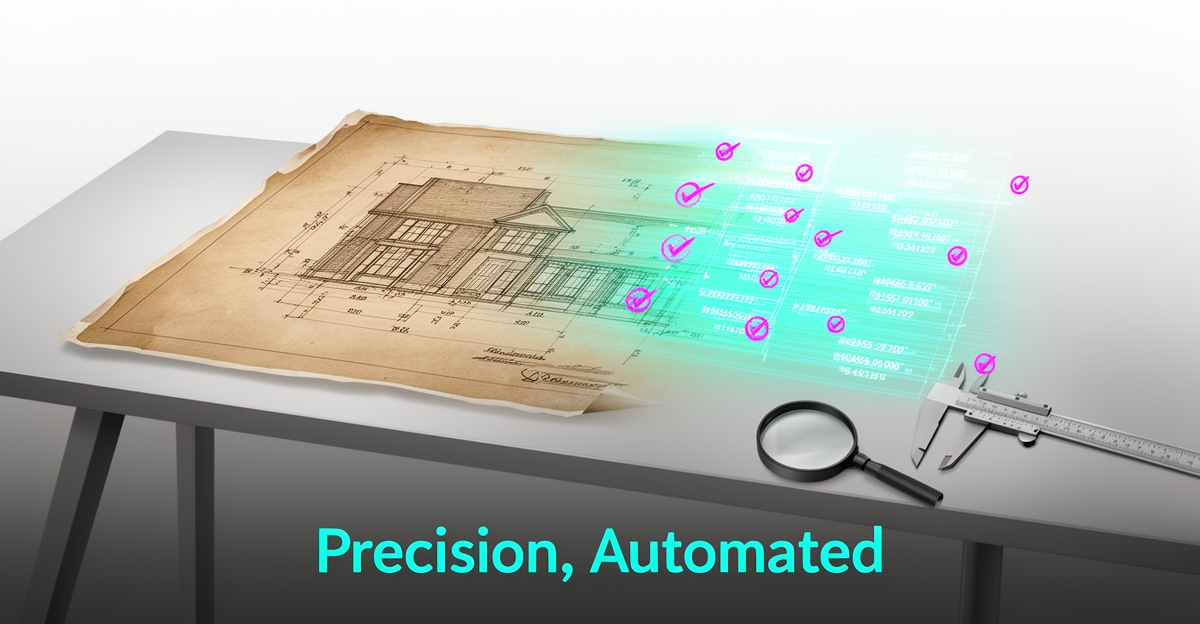
How AI Can Reduce Errors in Historical Blueprint and Measurement Data Entry
Key Facts
- A large share of historical research work still involves manual data entry, according to industry analysis.
- AI document processing can cut per-document processing time roughly in half in document automation case studies, as reported benchmarks show.
- AI can process large volumes of pages quickly while traditional methods remain limited by human reading speed, recent analysis suggests.
- AI can read damaged manuscripts, recover text from carbonized scrolls, and decipher handwriting, research on historical applications indicates.
- Modern AI systems extract text, tables, and bounding boxes with semantic labels from complex multi-column documents, document recognition specialists note.
- AI introduces risks including biased outputs and hallucinated facts that require human oversight, historical research analysis warns.
- Document noise, distortion, and quality variability directly impact AI extraction accuracy and reliability, document processing studies indicate.
Hire a team member that works 24/7 — for less than a part-time wage.
AI receptionists, SDRs, dispatchers and 99+ roles. Trained on your business, fully managed.
Not sure where to start? Ask our AI planner
The Hidden Cost of Manual Blueprint Data Entry in Restoration
A single misread dimension on a century-old blueprint can cascade into structural failure, budget overruns, and months of rework. In historical restoration, that risk is built into the workflow itself.
Historic restoration relies heavily on accurate measurements and blueprints, yet the data pipeline remains stubbornly manual. Industry research suggests that a large share of historical research work still involves manual data entry, a pattern that maps directly to how teams transcribe measurements from scanned drawings and documents. Human reading speed and accuracy limits create bottlenecks where fatigue, faded ink, and nonstandard notation increase transcription errors.
Traditional methods offer human oversight and review, but they are limited by human reading speed and accuracy. Recent analysis notes AI can process large volumes of pages quickly, while traditional methods are limited by human reading speed. That gap matters when a restoration project must reconcile dozens of partial sets, field sketches, and archival revisions under tight deadlines.
The cost shows up in rework and risk. Errors in measurement transcription from scanned blueprints lead to incorrect material orders, misaligned fabrication, and on-site conflicts that are expensive to correct once construction begins. Document quality issues compound the problem. Document processing studies highlight that AI can be affected by issues such as noise, distortion, and variability in document quality, which can impact its accuracy and reliability, a challenge that is especially acute with aged, hand-annotated plans.
Manual entry also slows discovery. Document automation benchmarks report per-document processing time dropping by roughly half once a document recognizer is introduced. Applied to blueprint sets, that kind of acceleration means faster validation cycles and earlier error detection.
Common failure points in manual blueprint data entry include:
- Misreading handwritten dimensions and archaic units on faded sheets
- Inconsistent transcription of revision marks across multiple scanned versions
- Delayed cross-referencing between blueprints, specifications, and field notes
- Propagation of a single typo into material takeoffs and cost estimates
AI document processing changes the risk profile by extracting, validating, and cross-referencing data from scanned documents to prevent costly mistakes. AIQ Labs builds these systems through AI Workflow Builds—rebuilding the one workflow that costs you the most, at a fixed price and in phases—so extraction respects the variability of historical formats while enforcing human review where it matters most.
The shift is from reactive correction to proactive validation. With structured extraction and semantic labeling, measurement data can be linked to its source region on the original scan, creating an auditable trail for every dimension entered into the restoration model.
How AI Extracts and Validates Measurements from Scanned Historical Documents
Historical restoration projects stall when measurements from fragile, faded blueprints are entered by hand. Scanned drawings carry noise, distortion and variability in document quality that slow traditional teams and invite costly errors.
AI document image recognition uses machine learning models to extract, interpret and organize information from scanned documents and images. According to industry research on document image recognition, these systems can extract text, tables and bounding boxes with semantic class labels from documents, and handle complex multirow/multicolumn tables.
Restoration archives are especially difficult. AI can be used to read damaged or unreadable manuscripts, recover text from carbonized scrolls and decipher handwriting. A future-of-research overview notes AI can also be used to read damaged or unreadable manuscripts, recover text from carbonized scrolls, and decipher handwriting.
For blueprint work this means dimensions, annotations and material callouts are located even on low-quality scans. AI can also detect and extract specific information from documents, such as names, dates and addresses. A document processing case study reports per-document processing time cut roughly in half after introducing a document recognizer.
Speed compounds at scale. Analysis of AI in historical research highlights that AI can process large volumes of pages quickly, while traditional methods are limited by human reading speed. That shift matters because industry insights indicate that much of the manual effort in historical research still goes into data entry.
Validation is built into the workflow. Systems trained on real restoration datasets can cross-reference measurements across sheets, flag inconsistencies and assign semantic labels to bounding boxes around dimensions, grid lines and symbols. This reduces transcription errors and prevents mismatched details from reaching fabrication or permitting.
AIQ Labs builds these extraction systems as part of its Workflow Builds service, trained on real restoration datasets to ensure precision. The approach supports faster digitization without sacrificing accuracy.
Typical extraction capabilities include:
- Text and handwritten annotation recognition from faded or damaged scans
- Table and multi-column schedule parsing with semantic class labels
- Bounding box detection for dimensions, symbols and callouts
- Cross-document consistency checks for measurements and revisions
When extraction outputs are monitored and refined, error logs improve model performance and reduce manual correction over time. Human review remains essential for quality and variety of training data, as AI is affected by noise, distortion and variability in document quality.
From Extraction to Accuracy: Validation, Cross-Referencing and Human Oversight
Extracting data from a faded blueprint is only half the battle — the real risk lies in trusting that extraction blindly. AI introduces powerful capabilities to historical research, but it also introduces new failure modes that demand structured safeguards.
The most significant risks are well documented. According to research on AI's role in historical analysis, these systems can produce biased outputs and even hallucinate facts that were never present in the original document. When the source material is a century-old blueprint with faded ink, water damage, or hand-drawn annotations, the potential for misinterpretation multiplies. Document noise, distortion, and inconsistent quality all impact extraction accuracy in ways that generic models are not equipped to handle.
This is precisely why training data matters more than model size. AI systems trained on real restoration datasets — actual historical blueprints, field measurement logs, and degraded scans — learn to recognize the specific patterns, symbols, and imperfections common to these documents. Rather than guessing at an ambiguous dimension line, a purpose-built system can flag the uncertainty and route it for review. AIQ Labs takes this approach when building document processing systems, training extraction models on domain-specific data so the AI understands context rather than simply pattern-matching characters.
Effective validation goes beyond flagging unclear readings. A well-architected system applies multiple layers of automated and human checks:
- Cross-referencing extracted values against related documents, such as comparing a floor plan's stated dimensions against elevation drawings or material schedules
- Anomaly detection that flags measurements falling outside expected ranges for the structure type or era
- Confidence scoring that routes low-certainty extractions to human reviewers before they enter the project record
- Audit trails that log every extraction, validation result, and manual override for full traceability
The human oversight component is not optional — it is structural. As industry analysis of AI in historical research emphasizes, the quality and variety of training data and the need for human review are critical considerations. The goal is not to remove people from the process but to redirect their attention. Instead of manually transcribing every measurement — a task that consumes the bulk of the effort in many historical research workflows — professionals focus only on the entries the system flags as uncertain.
This division of labor preserves speed without sacrificing precision. AI handles the volume; humans handle the judgment calls. The result is a workflow where errors get caught at the point of entry rather than discovered months later during construction, when a misread dimension becomes a structural problem and a budget overrun.
Implementing AI-Powered Blueprint Processing for Restoration Teams
Moving from pilot to production requires a deliberate strategy that addresses document variability head-on. While recent analysis indicates that much historical research work still relies on manual data entry, restoration teams can break this bottleneck by following a structured implementation approach tailored to archival materials.
Match your extraction method to the document type and layout. Blueprints and measurement logs present unique challenges—faded ink, non-standard notation, and complex spatial relationships—that generic OCR tools often miss. According to document AI specialists, modern extraction systems can identify text, tables, and bounding boxes with semantic labels, handling even complex multirow and multicolumn layouts common in architectural drawings.
Before processing begins, standardize your scanned files. Consistent formatting, tagging, and file structure significantly improve extraction accuracy, as document recognition research emphasizes. This preprocessing step reduces noise, distortion, and variability—issues that document automation case studies identify as primary causes of extraction errors in historical documents.
Monitor and refine your outputs continuously. Establish a review protocol where team members validate AI extractions against original blueprints, logging discrepancies to retrain the model. Research on AI in historical applications stresses that human oversight remains essential to catch hallucinations or misinterpretations, particularly with damaged or degraded source materials.
When implementing these systems, restoration firms should prioritize:
- Document type classification (blueprints, handwritten field notes, typed specifications)
- Image preprocessing standards for aged or damaged scans
- Validation workflows that flag low-confidence extractions for human review
- Iterative training using correction logs to improve accuracy over time
The performance gains justify this disciplined approach. Document processing benchmarks show that AI extraction can cut per-document processing time roughly in half, while simultaneously improving accuracy through consistent application of extraction rules.
For restoration teams without in-house AI expertise, partnering with a specialized developer ensures these best practices become embedded in your workflow. AIQ Labs builds custom extraction systems trained specifically on historical construction documents, and you own what gets built outright. Whether you deploy a managed AI employee to handle ongoing data entry at a fraction of the cost of a human hire, or rebuild the document workflow itself through a Workflow Build, the goal remains the same: transforming fragile paper archives into reliable digital assets without sacrificing the precision that historic preservation demands.
Still paying for 10+ subscriptions that don’t talk to each other?
We build custom AI systems you own outright. No vendor lock-in. Full control.
Not sure where to start? Ask our AI planner
Frequently Asked Questions
Can AI actually read faded, handwritten dimensions on old blueprints?
Will using AI mean we can get rid of human reviewers?
How much faster is AI compared to manual blueprint data entry?
Is my team’s manual work really that big a bottleneck?
What are the biggest risks if we trust AI extraction blindly?
Do we need special training data for historical restoration blueprints?
From Fragile Paper to Reliable Models
Manual transcription of historical blueprints carries a cost that shows up late — in rework, misordered materials, and on-site conflicts. AI changes the risk profile by extracting, validating, and cross-referencing measurements from faded, hand-annotated scans, linking each dimension back to its source region for an auditable trail. With systems trained on real restoration datasets, extraction can flag ambiguous readings, detect inconsistencies across sheets, and route low-confidence entries to human review instead of letting errors propagate into takeoffs and fabrication. The shift is from reactive correction to proactive validation, preserving expert judgment for the decisions that matter. If your team is still spending most of its time transcribing, start by standardizing scan quality, defining validation rules for your document types, and piloting extraction on a representative set with built-in human review. AIQ Labs builds custom document processing systems trained on historical construction documents — through a fixed-price Workflow Build you own outright — so restoration teams can turn fragile archives into reliable digital assets. Start the two-minute Fit Check at aiqlabs.ai/apply, then book a free 30-minute strategy call to map your biggest bottleneck. With so much historical research work still tied up in manual data entry, the teams that validate first will finish first.
Make AI your competitive advantage — not just another tool.
Strategy, implementation and ongoing optimization. One partner, end to end.
Not sure where to start? Ask our AI planner