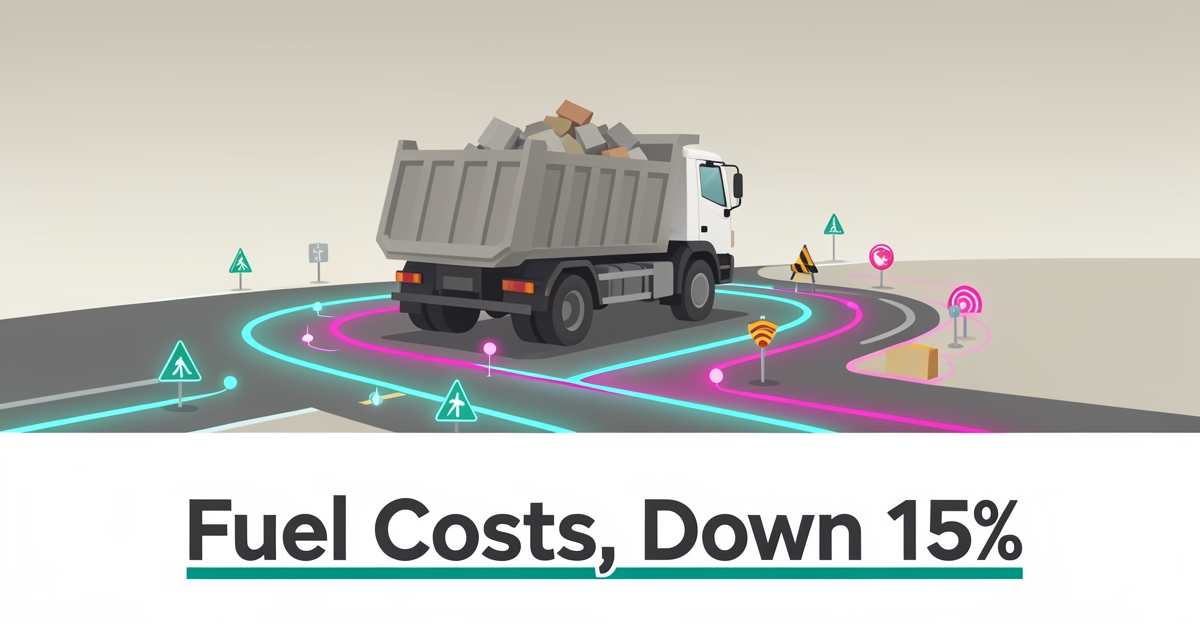
How AI Can Reduce Fuel Costs by 15% in Debris Hauling Operations
Key Facts
- AI-powered route optimization typically achieves 15-20% average fuel reduction in debris hauling operations according to industry research
- AI-driven route optimization has delivered 15-25% total fuel cost reductions within roughly 90 days for some fleet operators as reported by fleet management studies
- Optimized routes have cut fuel consumption by up to 62% compared to regular routes in documented case studies based on AI route optimization analysis
- AI implementation has reduced delays and idle times by up to 50% in debris hauling fleets per fleet operator reports
- Dynamic load balancing through AI assigns tasks based on range, load, terrain and temperature to eliminate inefficient trips as demonstrated in route optimization comparisons
- Real-time traffic analysis enables continuous route optimization that adapts to congestion, accidents and disruptions mid-shift according to industry analysis
- Pilot AI implementations have shown 10-15% shorter delivery times alongside fuel savings in debris hauling operations as reported by fleet management research
Hire a team member that works 24/7 — for less than a part-time wage.
AI receptionists, SDRs, dispatchers and 99+ roles. Trained on your business, fully managed.
Not sure where to start? Ask our AI planner
The Hidden Fuel Waste in Debris Hauling: Why Traditional Routing Fails
Every debris hauling operation burns fuel it doesn't need to, silently, daily, and entirely by design. The problem isn't careless drivers or aging trucks. It's the way routes get planned in the first place.
Traditional route planning is fundamentally static. Dispatchers map routes once, often manually, using a handful of variables like distance and job location. Once a truck rolls out, that route rarely changes, even when an accident snarls traffic, a job runs long, or a landfill queue backs up. A comparison of routing approaches highlights the core gap: manual planning considers limited variables and produces fixed routes, while AI systems evaluate hundreds of variables and adjust dynamically as conditions change.
That rigidity shows up directly on the fuel ledger. Idle time in traffic, detours around congestion, and trucks running half-empty on predictable routes all compound into significant waste. Research on AI fleet fuel optimization reports that companies implementing AI-driven fuel management have achieved 15-25% total fuel cost reductions within roughly 90 days, savings that traditional planning leaves on the table. The same research notes that fleets using AI report up to 50% fewer delays and idle times, which is precisely where much of that waste originates.
Empty miles are the other hidden drain. When routes are built without considering load capacity and job density, trucks haul air. A truck that finishes a debris pickup and drives across town empty, only to pick up another load near where it started, represents pure fuel loss. AI-powered systems address this by designing routes that minimize empty mileage and sequence pickups and deliveries in the most fuel-efficient order.
Consider what traditional planning simply cannot account for:
- Live traffic conditions that shift the fuel cost of a route hour by hour
- Vehicle capacity, terrain, and load weight when assigning jobs to trucks
- Job density patterns that allow backhauls instead of empty returns
- Weather and road disruptions that change the optimal route mid-shift
The contrast becomes stark when these factors stack up. One documented case of an AI-driven route optimization platform achieved a 28% reduction in fuel costs within six months, and in another comparison, an optimized route cut fuel consumption by 62% versus the regular route. These aren't marginal gains from driving a little slower, they're structural corrections to how work gets assigned and sequenced.
As one industry analysis puts it, "AI doesn't just plan the route, it continuously optimizes it whenever congestion, accidents, or other disruptions occur." That continuous adaptation is exactly what static planning lacks, and it's the mechanism behind the fuel savings this article explores. It's also why operators like AIQ Labs build automation that adapts to traffic, job density, and vehicle capacity in real time rather than treating routing as a one-time decision.
How AI Cuts Fuel Use Through Smart Route Optimization and Real-Time Adaptation
Fuel is the single biggest variable cost in debris hauling, and every empty mile eats directly into margin. AI-powered route optimization changes that equation by making routes smarter, lighter, and continuously adaptive.
AI designs routes to minimize empty mileage and determine the most fuel-efficient order of deliveries. Industry research shows companies that have implemented AI in fleet management typically report an average fuel reduction of 15-20%. That saving comes from interconnected mechanisms working together to make every route more efficient.
Real-time traffic analysis is the engine behind those gains. AI-powered systems can analyze live traffic, weather, delivery windows, vehicle capacities, and hundreds of other variables simultaneously, then continuously adjust as conditions change. As one analysis notes, AI doesn't just plan the route, it continuously optimizes it whenever congestion, accidents, or other disruptions occur.
Dynamic load balancing extends the benefit beyond the road. AI systems can assign tasks based on range, load, terrain, and temperature, ensuring vehicles are deployed where they make the most sense. This real-time adaptation reduces idle time and avoids fuel-wasting detours.
Results scale quickly when the system is in place. AI-powered fuel management has delivered 15-25% total fuel cost reductions within roughly 90 days for some operators. One route optimization platform documented a 28% reduction in fuel costs within six months through AI-driven route optimization.
In debris hauling, where job density and vehicle capacity fluctuate daily, this approach is especially valuable. Route optimization, real-time traffic analysis, and dynamic load balancing work together to significantly reduce fuel consumption. AIQ Labs builds this kind of automation through AI Workflow Builds, rebuilding the one workflow that costs you the most, at a fixed price and in phases, so the system adapts to traffic, job density, and vehicle capacity to improve efficiency and lower operating costs.
The optimization process typically focuses on:
- Minimizing empty return miles between pickups and disposal sites
- Re-sequencing stops based on live congestion and weather
- Matching load weight and truck capacity to avoid overruns
- Continuously re-optimizing routes mid-shift as new jobs appear
Traditional route planning is manual and static. AI route optimization is automated and dynamic, considering hundreds of variables instead of a handful. That shift typically drives shorter delivery times by 10-15% and up to 50% fewer delays and idle times.
Continuous improvement is built in. Monitoring fuel use, driving behavior, and delivery performance lets algorithms refine themselves over time, compounding savings as the fleet learns.
Dynamic Load Balancing and Predictive Scheduling: The AI Edge in Fleet Efficiency
Dynamic load balancing and predictive scheduling are transforming how debris hauling fleets operate, turning static assignments into intelligent, real-time decisions. By analyzing vehicle capacity, terrain, range, and current job density, AI systems ensure each truck carries an optimal load without overburdening engines or wasting fuel on underutilized trips. This precision reduces mechanical strain and eliminates inefficient routing that burns excess diesel. Early implementations have shown fuel use dropping by up to 25% when AI continuously rebalances loads based on live operational data.
AI-driven scheduling goes beyond static route planning by incorporating real-time traffic, weather, and job urgency into every dispatch decision. Instead of relying on fixed daily manifests, fleets adapt mid-shift to avoid congestion, prioritize nearby jobs, and minimize deadhead miles. This dynamic responsiveness keeps vehicles in their most efficient operating zones, reducing idle time and unnecessary acceleration. As a result, companies report not only lower fuel consumption but also improved on-time performance and reduced driver fatigue.
The cumulative effect of intelligent load distribution and adaptive scheduling is a fleet that runs leaner, cleaner, and more responsively. AI doesn't just assign jobs, it optimizes the entire workflow around physical constraints and environmental variables, turning inefficiencies into savings. For debris haulers operating in unpredictable urban and construction environments, this level of automation delivers measurable cost reductions while maintaining service reliability. AIQ Labs integrates these capabilities into systems built around your fleet-specific workflows, so every adjustment serves both operational and financial goals.
From Pilot to Profit: Implementing AI in Your Debris Hauling Fleet with AIQ Labs
Moving from a promising pilot to fleet-wide fuel savings requires structure, not guesswork. Debris hauling lives and dies by route efficiency, and AI turns telematics into a continuous profit lever.
A phased implementation builds confidence and protects operations while capturing the 15-20% average fuel reduction through AI implementation reported by fleet operators. AIQ Labs supports this journey with AI Workflow Builds for rebuilding your dispatch and routing workflow at a fixed price, and AI Employees, managed AI dispatchers and logistics staff that cost roughly 80% less than a human hire.
Start with an honest current state audit. Collect routes, fuel consumption, driving behavior and delivery delays to identify weak points and inefficiencies. Poor or incomplete telematics, mapping or road data can significantly reduce optimization accuracy, so data quality is the foundation.
Next, integrate the data that makes AI actionable. Connect GPS/telematics systems, weather data, road maps and historical records into a comprehensive source for analysis. This integration enables route optimization, real-time traffic analysis and dynamic load balancing that adapt to traffic, job density and vehicle capacity.
Pilot before you scale. Run AI-based route optimization for a few vehicles or test routes, observe savings, detect issues and fine-tune parameters. Companies that have implemented AI in fleet management typically report an average fuel reduction of 15-20%, shorter delivery times by 10-15%, and up to 50% fewer delays and idle times. Pilots also surface the human factor; drivers may initially be skeptical of AI-generated suggestions, and effective coaching ensures smooth adoption.
The practical rollout follows a clear sequence:
- Audit current operations and benchmark fuel, idle time and on-time performance
- Integrate telematics and GPS data with job management and weather feeds
- Run a pilot group with AI-powered dispatch and continuous monitoring
- Scale across the fleet with AI Employees supporting dispatch and logistics
- Establish continuous monitoring, refinement and driver feedback loops
Scaling unlocks compounding gains. AI-powered fuel management has delivered 15-25% total fuel cost reductions within roughly 90 days for some operators, while AI-driven route optimization platforms have documented a 28% reduction in fuel costs within six months. Dynamic load balancing assigns tasks based on range, load, terrain and temperature, ensuring the right truck does the right job.
Ongoing adaptation sustains results. Analyze results, refine algorithms and coach drivers for continuous improvement. AI doesn't just plan the route, it continuously optimizes it whenever congestion, accidents or other disruptions occur.
Ready to map your biggest bottleneck? Start the 2-minute Fit Check at https://aiqlabs.ai/apply, then book a free 30-minute strategy call to assess current systems and identify high-ROI automation opportunities.
Still paying for 10+ subscriptions that don’t talk to each other?
We build custom AI systems you own outright. No vendor lock-in. Full control.
Not sure where to start? Ask our AI planner
Frequently Asked Questions
How much can AI really reduce fuel costs in debris hauling operations?
What specific factors does AI consider that traditional route planning misses?
Is AI route optimization just about driving slower or taking shorter roads?
How quickly can a debris hauling company see results after implementing AI?
What happens if our telematics or GPS data is incomplete or poor quality?
Will drivers resist AI-generated routes, and how do we handle that?
Turn Fuel Waste Into Fleet Margin
Debris hauling burns fuel it doesn't need to because static routes can't keep up with live traffic, job density, and vehicle capacity. AI changes that by continuously optimizing routes, minimizing empty miles, and balancing loads in real time, which is how fleets typically see an average fuel reduction of 15-20% through AI implementation alongside fewer delays and idle time. The savings aren't theoretical; they come from replacing one-time planning with dynamic adaptation that re-sequences stops mid-shift as conditions change. For operators ready to capture that margin, start with an honest audit of routes, fuel use, and idle time, integrate telematics and job data, then pilot AI optimization on a small group before scaling fleet-wide. AIQ Labs builds this kind of automation, whether as a fixed-price AI Workflow Build for your routing workflow or as part of a fuller AI Operating System you own outright. Start the 2-minute Fit Check at https://aiqlabs.ai/apply, then book a free 30-minute strategy call to map your biggest bottleneck and identify high-ROI automation opportunities.
Make AI your competitive advantage — not just another tool.
Strategy, implementation and ongoing optimization. One partner, end to end.
Not sure where to start? Ask our AI planner