# How AI Can Reduce Missed Orders in Thai Restaurants Using Smart Confirmation Systems
**Quick Answer:** With chronic understaffing and high turnover across the restaurant industry, missed orders cost Thai restaurants dearly. Smart AI confirmation via SMS, email, and apps validates orders, triggers follow-ups, and protects revenue.
## Key Facts
- Understaffing and high turnover remain persistent across the restaurant industry as of late 2026, straining manual order confirmation processes
- Automated order confirmation via SMS, email, and app reduces missed or canceled orders by ensuring every order is validated
- AI-driven forecasting typically improves operational accuracy, extending naturally to order validation and timing
- AI chatbots and self-service tools reduce wait times and improve satisfaction in Thailand's competitive food landscape
- AIQ Labs has deployed 200+ multi-agent systems and runs four live SaaS products daily
## Table of Contents
1. [The Hidden Cost of Missed and Canceled Orders](#the-hidden-cost-of-missed-and-canceled-orders)
2. [Why Smart Confirmation Cuts Missed Orders](#why-smart-confirmation-cuts-missed-orders)
3. [AI Confirmation Workflows for Thai Restaurant Operations](#ai-confirmation-workflows-for-thai-restaurant-operations)
4. [Implementation Roadmap from Pilot to Scale](#implementation-roadmap-from-pilot-to-scale)
## The Hidden Cost of Missed and Canceled Orders
Missed orders don't start with a bad phone signal. They start with kitchens stretched too thin to confirm, follow up, or even hear the request in the first place.
Thai restaurants are operating under intense staffing pressure. Industry research has consistently reported elevated turnover rates and widespread understaffing across food service as of late 2026. That combination forces manual order handling to carry more weight than it can bear.
When teams are short, confirmation calls get skipped, SMS replies pile up, and online orders sit unacknowledged. Customers assume the order is lost and cancel, or they call back repeatedly, adding more strain. The revenue hit is immediate, but the trust erosion lasts longer.
High turnover also breaks institutional memory. New staff learn different confirmation habits, and without a consistent process, errors multiply. Workforce instability drives both cost and service risk, and AI-powered scheduling tools are increasingly used to reduce that strain.
Manual handling creates three compounding failure points:
- Delayed confirmations as staff juggle front-of-house and phone duties
- Lost follow-ups when shifts change and handoffs are informal
- Inconsistent messaging across phone, SMS, email and in-app channels
Each missed touchpoint increases the chance a customer walks away. In a market where speed and reliability define choice, that friction directly impacts repeat business.
The cost shows up in more than refunds. It shows up in negative reviews, lower average order value, and staff burnout from constant firefighting, a problem food service employers continue to grapple with.
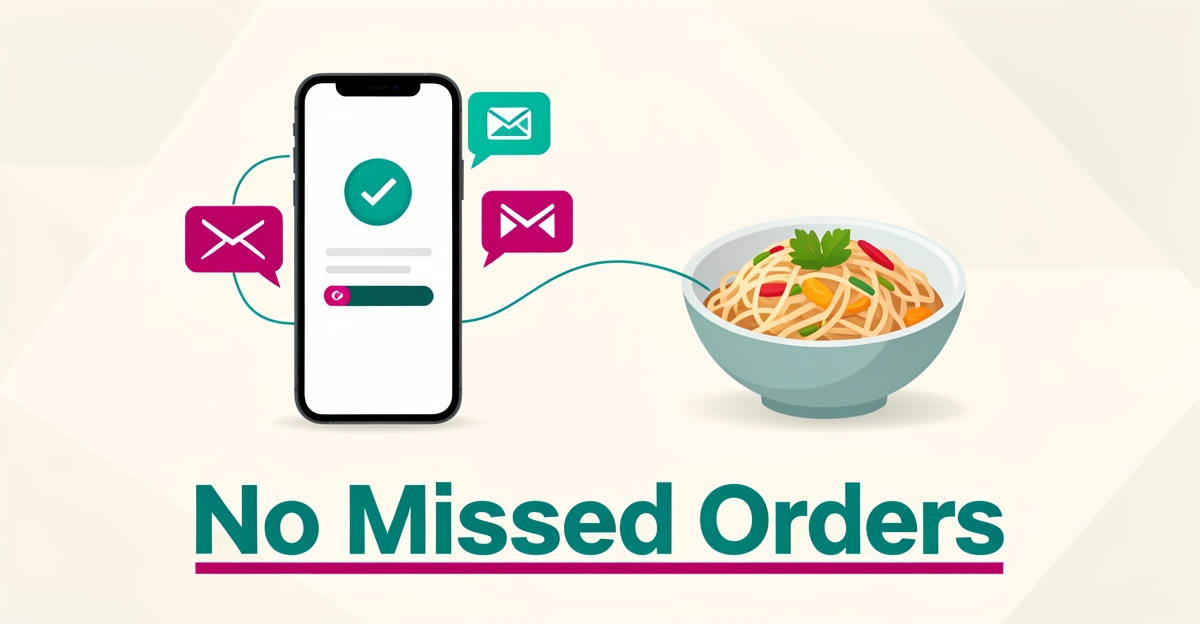
Restaurants that stabilize confirmation workflows protect both revenue and reputation. Automated order confirmation via SMS, email, and in-app notifications can reduce missed or canceled orders by ensuring every order is validated and followed up without relying on an overstretched team.
AIQ Labs builds these systems as AI Workflow Builds, rebuilding the one workflow that costs you the most, at a fixed price, in phases. Within that context, the confirmation layer acts as reliable AI staff that works 24/7, even when your team is thin.
With consistent, automated confirmations, kitchens gain clarity, customers gain confidence, and the hidden cost of missed orders begins to shrink.
## Why Smart Confirmation Cuts Missed Orders
A missed order at a busy Thai restaurant isn't just a lost sale; it's a ripple effect that frustrates customers, wastes ingredients, and strains already thin staff. With understaffing widespread across the industry, manual order-taking during peak hours becomes a recipe for errors. Smart confirmation systems solve this by adding an automated verification layer that catches mistakes before they reach the kitchen.
These systems work by instantly validating order details across SMS, email, and in-app notifications, ensuring the kitchen receives exactly what the customer intended. When a customer places an order online or via phone, AI workflows immediately confirm receipt, clarify special requests, and flag discrepancies, eliminating the "I never ordered that" disputes that erode trust. AI-driven forecasting typically improves operational accuracy, a precision that extends naturally to order validation and preparation timing.
The technology also tackles the costly no-show and cancellation problem head-on. Automated reminders sent via SMS or email prompt customers to confirm or modify their orders before pre
AI Employees
Hire a team member that works 24/7 — for less than a part-time wage.
AI receptionists, SDRs, dispatchers and 99+ roles. Trained on your business, fully managed.
See If You’re a Fit — AI Employees from $700/mo
Not sure where to start? Ask our AI planner
paration begins, reducing food waste from abandoned pickups. This proactive communication is especially critical when turnover leaves fewer experienced staff available to manually chase down unconfirmed orders or resolve miscommunications.
Beyond accuracy, these systems enhance the customer experience through speed and convenience. AI chatbots and self-service tools provide instant responses to order status inquiries, while automated confirmations keep diners informed without requiring staff intervention. That speed and responsiveness are key differentiators in Thailand's competitive food landscape.
AIQ Labs builds these intelligent confirmation workflows as part of a targeted AI Workflow Build, integrating validation checks directly into existing ordering systems. The result is a seamless safety net that protects revenue:
- Instant order validation across SMS, email, and app channels
- Automated follow-ups that reduce no-shows and cancellations
- Real-time error detection before kitchen preparation begins
- Multilingual support for diverse customer bases
By removing human error from the confirmation process, Thai restaurants can focus on hospitality rather than damage control. The technology doesn't replace the personal touch, it ensures every order starts with clarity, so every dish ends with satisfaction.
## AI Confirmation Workflows for Thai Restaurant Operations
Thai restaurants face significant pressure from high employee turnover and understaffing. These challenges directly impact order accuracy and customer satisfaction, often leading to missed or canceled orders due to miscommunication or delayed confirmations. AIQ Labs addresses this gap by deploying AI workflows that validate incoming orders through automated confirmation channels like SMS, email, and in-app notifications, triggering immediate follow-ups when responses are delayed or unclear.
The AI confirmation workflow begins the moment an order is placed via phone, website, or delivery platform. Using natural language processing and contextual validation, the system checks for completeness, verifying items, quantities, special instructions, and timing, against menu data and real-time kitchen capacity. If any field is ambiguous or missing, the AI initiates a polite, multi-channel follow-up to clarify details before the order enters the preparation queue. This proactive validation reduces errors caused by voice mishears, incomplete online forms, or last-minute changes that staff might overlook during peak hours.
Once validated, the order is synchronized with the restaurant's POS and booking systems in real time, ensuring kitchen staff, floor managers, and delivery coordinators all see the same accurate information. This integration eliminates silos between front-of-house and back-of-house operations, a common source of missed orders in busy Thai restaurants. By linking confirmation data to AI-driven forecasting, restaurants can also align staffing and inventory levels with actual demand patterns.
Beyond order validation, the workflow supports continuous improvement by logging confirmation success rates, common points of failure, and customer response patterns. These insights feed into broader AI analytics, enabling data-driven decisions about menu design, peak staffing, and inventory reorder points. Over time, this creates a feedback loop where the system learns from past interactions to reduce follow-up needs and increase first-time confirmation rates, directly cutting down on wasted food, labor, and lost revenue from missed or incorrect orders.
For restaurants ready to connect confirmation with phone intake, reservations, and delivery coordination in one layer, an AI Operating System approach ties these workflows together, built in phases and owned outright.
## Implementation Roadmap from Pilot to Scale
Thai restaurants face significant operational strain from missed orders, a problem amplified by high staff turnover and understaffing. Manual order confirmation processes often fail under pressure, leading to customer dissatisfaction and lost revenue. Implementing smart confirmation automation addresses this gap by ensuring every order is validated and followed up consistently.
The implementation begins with a targeted workflow audit to pinpoint where order slips occur, whether during phone intake, online ordering, or kitchen dispatch. AIQ Labs' Build in Milestones model supports this phased approach, allowing restaurants to validate the solution on a single high-volume channel before expanding. Pilot deployment focuses on integrating AI-driven confirmation triggers via SMS, email, or in-app alerts that activate upon order receipt, reducing reliance on overburdened staf
AI Development
Still paying for 10+ subscriptions that don’t talk to each other?
We build custom AI systems you own outright. No vendor lock-in. Full control.
See If You’re a Fit — AI Employees from $700/mo
Not sure where to start? Ask our AI planner
f.
Staff training is critical during this phase. Rather than replacing employees, the system augments their role by handling routine confirmations, freeing them to manage complex customer interactions or kitchen coordination. Clear communication about the AI's supportive function helps mitigate resistance, especially in environments where job security concerns may arise. Performance is monitored through key metrics like confirmation response rates and order completion accuracy, with adjustments made based on real-time data.
As confidence grows, the system scales to additional touchpoints, such as third-party delivery platforms or dine-in reservations, using the same validation logic. Restaurants choosing the Own It Outright model gain full control to customize and expand the system over time, ensuring long-term alignment with evolving operational needs. Continuous optimization ensures the AI adapts to seasonal demand shifts, menu changes, or new communication preferences, maintaining high accuracy without constant reconfiguration. This structured progression from pilot to full-scale deployment turns a reactive fix into a resilient, self-improving operational asset.
## Frequently Asked Questions
**Why do Thai restaurants keep missing orders even when customers place them correctly?**
Missed orders usually happen because kitchens are stretched too thin to confirm, follow up, or hear the request in the first place, not because of bad phone signals. With high turnover and widespread understaffing across the industry, confirmation calls get skipped and online orders sit unacknowledged until customers cancel.
**How does an AI confirmation system actually work?**
The moment an order comes in via phone, website, or delivery platform, the AI validates items, quantities, special instructions, and timing against menu data and kitchen capacity. If anything is ambiguous, it sends an automated follow-up via SMS, email, or in-app notification to clarify details before the order enters the preparation queue.
**Will AI confirmation reduce canceled orders and no-shows?**
Yes, automated reminders prompt customers to confirm or modify orders before preparation begins, which cuts down on abandoned pickups and food waste. AI-driven forecasting also improves operational accuracy, helping ensure orders are prepared and timed correctly the first time.
**Will the AI replace my staff?**
No, the system handles routine confirmations so your team can focus on complex customer interactions and kitchen coordination instead of firefighting missed orders. This matters especially given how widespread burnout has become in food service.
**How do we roll this out without disrupting the restaurant?**
Implementation starts with a workflow audit to find where orders slip, then pilots on a single high-volume channel before scaling to delivery platforms and reservations. AIQ Labs' Build in Milestones model lets you approve and pay per phase as each piece ships, so you can validate results before expanding.
**Does it integrate with our existing POS and ordering systems?**
Yes, validated orders sync with your POS and booking systems in real time, so kitchen staff, floor managers, and delivery coordinators all see the same accurate information. The system also logs confirmation success rates over time, creating a feedback loop that increases first-time confirmation rates. To see how this would map to your setup, start the Fit Check and book a free strategy call.
## Turning Confirmation Into Competitive Advantage
Missed orders in Thai restaurants rarely start with a bad signal, they start with stretched teams, informal handoffs, and confirmation steps that get skipped under pressure. With understaffing and turnover still straining the industry as of late 2026, manual validation breaks down, eroding revenue and trust. Smart confirmation systems add a reliable, always-on layer that validates orders instantly across SMS, email and in-app, clarifies special requests, and triggers follow-ups before the kitchen starts. The result is fewer cancellations, less food waste, and clearer operations for staff who can focus on hospitality instead of damage control.
For operators ready to stabilize this workflow, the practical path is to audit where orders slip, phone, online or delivery, and pilot automated validation on one high-volume channel first. AIQ Labs has deployed 200+ multi-agent systems and runs four live SaaS products daily, building confirmation workflows that work 24/7 even when staffing is thin. Start the Fit Check for a free 30-minute strategy call to map your biggest bottleneck and see if a targeted confirmation workflow is a clear win for your operation. Questions? Reach us at [email protected].
AI Transformation Partner
Make AI your competitive advantage — not just another tool.
Strategy, implementation and ongoing optimization. One partner, end to end.
See If You’re a Fit — AI Employees from $700/mo
Not sure where to start? Ask our AI planner