How AI Can Reduce Project Delays in Soil Testing by Automating Scheduling
Key Facts
- AI-powered predictive scheduling can achieve substantial downtime reduction in industrial settings, typically reported in the 30-50% range in manufacturing implementations
- Manufacturers using AI-powered predictive maintenance commonly report maintenance cost reductions around 25%
- AI models can often predict failures and schedule conflicts roughly a week in advance when trained on quality operational data
- Emergency repairs and last-minute rescheduling typically cost several times more than planned work
- Unplanned downtime is one of the largest hidden costs in industrial operations, with hundreds of lost hours per site per year
- A large majority of predictive maintenance adopters report positive ROI, per widely cited industry research
- Proactive, condition-based operations can deliver order-of-magnitude cost savings versus reactive approaches
Hire a team member that works 24/7 — for less than a part-time wage.
AI receptionists, SDRs, dispatchers and 99+ roles. Trained on your business, fully managed.
Not sure where to start? Ask our AI planner
The Hidden Cost of Reactive Scheduling in Geotech Projects
A single weather delay or lab backlog can push a soil testing project days, or even weeks, off schedule. Across industrial operations, unplanned downtime is consistently one of the largest hidden costs, with hundreds of lost production hours per site per year in the worst cases.
In geotechnical work, those delays often stem from three recurring bottlenecks:
- Weather windows that force last-minute cancellations and rescheduling
- Lab capacity constraints that create testing backlogs
- Field access conflicts that prevent crews from collecting samples on time
The deeper issue is that many organizations still operate in a reactive mode. Industry surveys consistently find that a majority of industrial facilities still run reactive maintenance strategies, with a substantial share relying on run-to-failure approaches. In soil testing, the same mindset translates to scrambling to reschedule crews, labs, and equipment only after a delay has already occurred.
This reactive scheduling model carries hidden costs. Emergency repairs and last-minute adjustments typically cost several times more than planned work, while project timelines stretch and client expectations slip. For geotech firms managing multiple sites, even small disruptions can cascade into major delays.
The good news is that these delays are increasingly avoidable. AI-driven scheduling systems can analyze weather patterns, lab availability, and field access constraints to predict conflicts before they happen. Instead of reacting to disruptions, teams can proactively adjust schedules and keep projects moving.
This is where AIQ Labs comes in, by deploying AI-driven scheduling agents that monitor project variables in real time, firms can shift from reactive firefighting to proactive planning, reducing delays and protecting margins.
Predictive Scheduling: How AI Sees Delays Coming
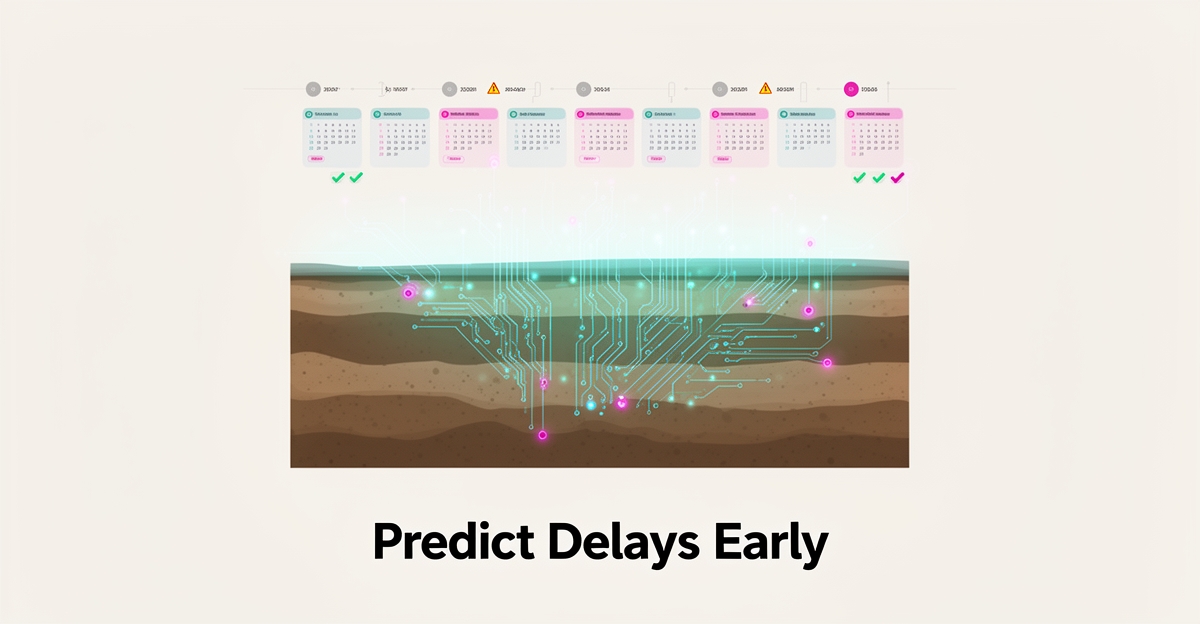
Advanced AI models can forecast potential delays in soil testing projects days to a week in advance. By continuously analyzing weather forecasts, laboratory throughput data, and real-time site access conditions, these systems identify scheduling conflicts before they disrupt workflows. This foresight transforms reactive scrambling into proactive planning, giving teams the lead time needed to reschedule tests, reallocate resources, or adjust field operations without costly interruptions. Industry implementations show AI models reach strong predictive accuracy within weeks of deployment when trained on live operational data.
The predictive capability stems from multi-agent systems that process diverse data streams simultaneously. Weather agents monitor precipitation forecasts and temperature extremes that could halt field sampling or compromise sample integrity. Lab capacity agents track instrument availability, technician schedules, and reagent stock levels to anticipate bottlenecks in analysis. Site access agents integrate with project management tools to flag permitting delays, equipment availability, or crew scheduling conflicts. When these agents detect converging risks, such as heavy rain forecasted for a sampling day when the lab is already near capacity, the system triggers alerts days early, enabling condition-based rescheduling that avoids emergency premiums. Because emergency repairs and rescheduling often cost several times more than planned interventions, early prediction is a critical cost-saving lever.
AIQ Labs implements this predictive scheduling through custom AI agents designed specifically for geotech workflows. These agents integrate with existing tools like field data collectors, LIMS platforms, and scheduling software via API connections, creating a unified operational view. Rather than replacing human schedulers, the AI acts as an always-on analyst that surfaces hidden risks and recommends optimal adjustment windows. Teams receive clear, actionable insights, such as "Delay sampling Site B by 48 hours due to high rain probability; Lab A has capacity Wednesday-Thursday", allowing informed decisions without guesswork. This approach aligns with broader trends where AI-driven soil testing enhances both efficiency and reliability by turning predictive insights into tangible schedule adjustments. By preventing delays before they occur, firms maintain project momentum, reduce overtime costs, and avoid cascading timeline disruptions that impact downstream construction phases.
From Prediction to Action: Automated Scheduling Agents in the Field
Predictive insights mean little if they sit idle in a dashboard while field crews wait on stalled sites. The real shift happens when AI-driven scheduling agents translate those forecasts into immediate operational moves, reassigning drill rigs before weather closes a window, rerouting samples to labs with capacity, and alerting project managers before a two-day delay becomes a two-week cascade.
Manufacturing implementations of AI-powered predictive maintenance commonly report 30-50% downtime reduction and roughly 25% maintenance cost savings. Those same principles apply directly to geotechnical workflows, where unplanned downtime can consume hundreds of hours per site per year.
AIQ Labs deploys scheduling agents that operate as autonomous field coordinators. They ingest live weather feeds, lab throughput data, site access permits, and crew availability, then execute decisions without waiting for human triage:
- Auto-reassign field crews to alternate borehole locations when access permits lapse
- Redirect sample shipments to partner labs the moment primary capacity hits threshold
- Push proactive alerts to project managers with revised timelines and cost impacts
- Adjust equipment maintenance windows to avoid conflict with critical sampling days
The agents don't just react, they negotiate. When a lab reports a spectrometer failure, the system instantly checks backup facility certifications, recalculates turnaround times, and updates the project schedule before the field team even packs up core boxes. This mirrors how predictive maintenance systems forecast failures days ahead, enabling condition-based repairs instead of emergency fixes at several times the planned cost.
For geotech firms, the payoff isn't theoretical. Eliminating the domino effect of a single missed drilling day, crew standby fees, rig mobilization costs, contract penalties, compounds across every project in the pipeline. The scheduling agent becomes the operational nervous system that keeps momentum intact from site mobilization through final report delivery.
Implementing AI Scheduling Without Disrupting Your Workflow
The biggest mistake geotech firms make with AI scheduling is trying to automate everything at once. A phased approach that starts narrow and proves value before scaling delivers far better results than a company-wide rollout.
Begin by identifying your single most delay-prone workflow. For most soil testing operations, this is the coordination between field sampling crews and laboratory capacity, where a single missed handoff can cascade into days of lost time. Target this bottleneck first with a focused solution rather than rebuilding your entire operation simultaneously.
Before trusting AI recommendations, validate the model against your actual project history. Feed it past scheduling data and compare its predictions against what really happened. AI models typically reach strong predictive accuracy within weeks of processing real operational data, but only when trained on quality inputs.
Data quality determines everything. If your current systems contain incomplete records, inconsistent formats, or missing variables, the AI will learn those flaws and replicate them at scale. Clean your data before deployment, not after.
Maintain human oversight during the transition. Configure the system to flag uncertain predictions for manual review rather than auto-scheduling around them. This human-in-the-loop validation catches edge cases while building team confidence in the technology.
Integration with existing project management tools prevents the "another dashboard" problem that kills adoption. The AI should push alerts and schedule adjustments directly into the platforms your team already uses daily, whether that is Procore, Monday.com, or industry-specific ERP systems.
- Start with one workflow: Pick your highest-pain scheduling bottleneck and automate only that
- Validate with real data: Test predictions against historical outcomes before going live
- Clean your inputs: Standardize data formats and fill gaps before training
- Keep humans in the loop: Require approval for high-stakes or low-confidence decisions
- Integrate, don't isolate: Embed AI outputs into existing tools rather than creating new silos
AIQ Labs structures engagements around this phased reality. Our AI Workflow Builds target exactly one critical process, the workflow that costs you the most, at a fixed price, delivered in phases you approve as they ship. For broader transformations, our AI Operating Systems build one connected operating layer across your firm, in milestones, owned outright. This mirrors how predictive maintenance succeeds in manufacturing, where plants implementing AI see the biggest gains by starting with targeted pilots rather than plant-wide overhauls.
The goal is not to replace your project managers but to give them predictive visibility they currently lack. When the AI handles routine schedule optimization and flags risks early, your team focuses on solving problems rather than discovering them too late.
The ROI Case: Why Early Adopters Win in Geotechnical Services
Project delays in soil testing rarely come from a single failure, they compound when weather windows close, lab capacity tightens, and field access is lost. The financial impact is immediate and measurable.
A large majority of predictive maintenance adopters report positive ROI, per widely cited industry research. That level of confidence is rare in construction technology, and it reflects how quickly proactive scheduling pays back.
The cost gap between reactive and predictive operations is stark. The same analyses find AI-powered predictive approaches can deliver order-of-magnitude cost savings versus reactive operations. For geotechnical firms, that translates to fewer standby crews, less rush lab fees, and preserved margin on fixed-price contracts.
Emergency fixes drive the penalty. Implementation data from industrial settings consistently shows emergency repairs carry a multiple-times premium over planned work. When a soil test is delayed, the ripple hits mobilization, concrete pours, and client penalties.
Early adopters convert that risk into competitive advantage. Firms that automate scheduling with AI can:
- Predict schedule conflicts days before they happen and shift lab slots proactively
- Substantially reduce downtime by embedding predictive signals into field and lab workflows
- Cut maintenance and rescheduling costs while protecting project momentum
AIQ Labs deploys AI-driven scheduling agents that proactively alert teams of potential delays, helping geotech firms maintain project momentum by analyzing weather, lab capacity, and field access and automatically adjusting scheduling. The result is a predictable delivery cadence that clients notice and refer.
The business case is not theoretical. With most industrial operations still running reactive strategies, the market rewards firms that move first. Early adoption creates pricing power, preferred contractor status, and a reputation for reliability that is hard to replicate later.
A low-risk starting point is to map the highest-delay workflow and test automation in place. Start with the two-minute Fit Check, then book a free 30-minute strategy call to assess current systems and identify high-ROI automation opportunities. If there isn't a clear win, the team will say so.
Still paying for 10+ subscriptions that don’t talk to each other?
We build custom AI systems you own outright. No vendor lock-in. Full control.
Not sure where to start? Ask our AI planner
Frequently Asked Questions
How far in advance can AI actually predict soil testing delays?
What's the real cost of reactive scheduling in geotech projects?
Can AI scheduling reduce downtime and maintenance costs for soil testing?
Will AI replace my project managers or just add another dashboard?
How do I start with AI scheduling without disrupting current workflows?
What ROI can geotech firms expect from automated scheduling?
Key Takeaways
From Reactive Scrambling to Predictable Delivery. Soil testing delays rarely stem from a single failure, they compound when weather windows close, lab capacity tightens, and field access vanishes. AI-driven scheduling agents break that cycle by forecasting conflicts days ahead, then acting on them automatically: reassigning crews, rerouting samples, and alerting project managers before a small slip becomes a cascade. Start with one high-pain workflow, validate predictions against your own history, and keep humans in the loop. The firms that move first turn reliability into a competitive advantage, and AIQ Labs can help you map that first workflow in a single strategy call.
Make AI your competitive advantage — not just another tool.
Strategy, implementation and ongoing optimization. One partner, end to end.
Not sure where to start? Ask our AI planner