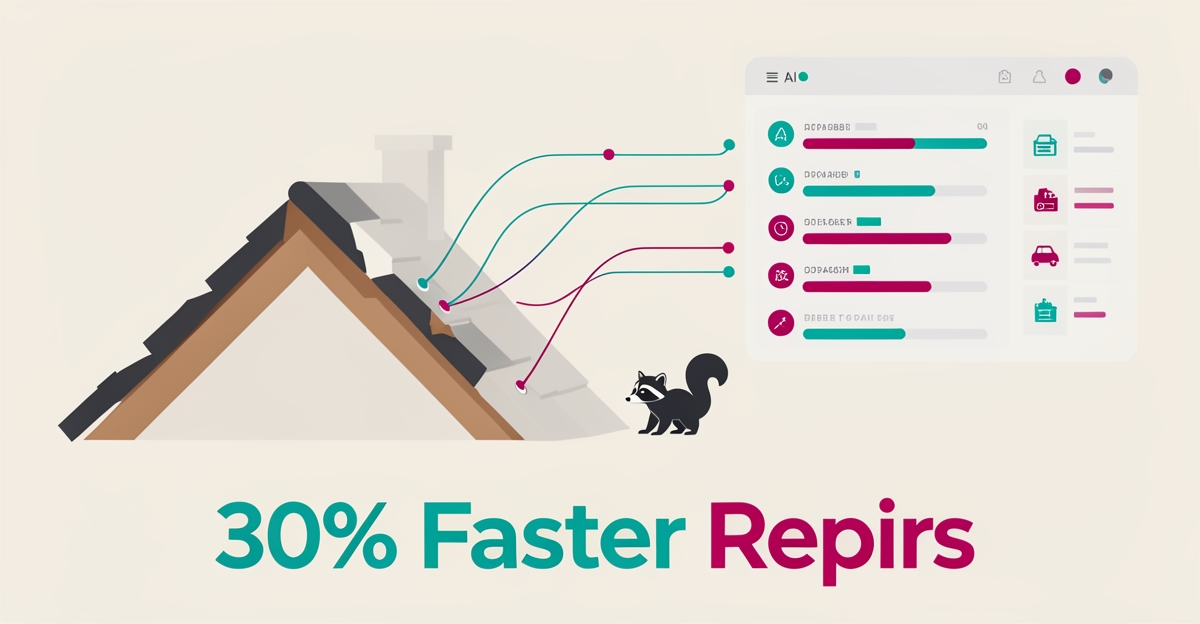
How AI Can Reduce Repair Turnaround Time by 30% in Animal Damage Services
Key Facts
- AI-powered dispatch systems reduce administrative lag by 15–20% of total turnaround time (f7i.ai).
- Top-performing organizations achieve an 86% first-time fix rate, while laggards hit just 53% (24x7mag).
- AI reduces detection time from weeks to milliseconds in animal damage assessments (f7i.ai).
- 14% of truck rolls are unnecessary—AI helps eliminate avoidable dispatches (24x7mag).
- AI adoption increases repair accuracy by 21%, reducing costly rework (24x7mag).
- Only 35% of a technician's shift is spent actually repairing—AI optimizes the rest (f7i.ai).
- AI-powered service tools deliver 39% faster resolution times compared to non-AI systems (24x7mag).
What if you could hire a team member that works 24/7 for $599/month?
AI Receptionists, SDRs, Dispatchers, and 99+ roles. Fully trained. Fully managed. Zero sick days.
Introduction: The Hidden Costs of Animal Damage Delays
Every hour a repair job sits idle costs more than just time—it costs customer trust, repeat business, and lost revenue. For animal damage service providers, slow turnaround times aren’t just a nuisance; they’re a hidden financial drain that eats into margins and frustrates clients. Yet despite the urgency, many businesses still rely on manual processes that add unnecessary delays at every stage—from intake to dispatch to follow-up.
The good news? AI can cut repair turnaround times by 30% or more, transforming reactive service into a predictive, automated operation. By eliminating administrative bottlenecks, optimizing technician dispatch, and reducing rework, AI-driven solutions from AIQ Labs help providers move faster, spend less, and keep customers happy—without the need for costly hiring or infrastructure overhauls.
Here’s how the problem unfolds—and why AI is the solution.
Repair turnaround time (TAT) isn’t just one long delay—it’s a series of interconnected bottlenecks, each slowing down the process. Research from f7i.ai breaks it down into four critical phases:
- Detection – How quickly damage is identified and logged.
- Administrative Gap – The time spent on paperwork, approvals, and manual data entry.
- Logistic Delay – Scheduling, dispatching, and coordinating technicians.
- Active Repair Time – The actual work done on-site.
The problem? In most animal damage services, only 35% of a technician’s time is spent actually fixing—the rest is wasted on travel, waiting for approvals, or searching for missing information (f7i.ai). AI addresses each phase:
| Phase | Manual Process Pain Point | AI Solution | Potential Time Saved |
|---|---|---|---|
| Detection | Customers submit vague reports; technicians guess damage scope. | AI-powered image analysis classifies damage type, estimates repair scope, and generates quotes in seconds. | From hours to minutes |
| Administrative Gap | Manual work orders, approvals, and data entry slow down dispatch. | Automated AI Employees (like AIQ Labs’ Service Coordinator) generate work orders, assign technicians, and update customers—all in real time. | 15–20% of total TAT |
| Logistic Delay | Poor routing, missed calls, or unclear technician availability. | Predictive dispatch AI optimizes routes, reduces unnecessary truck rolls by 14%, and ensures the right technician is assigned. | Up to 39% faster resolution |
| Active Repair Time | Technicians lack real-time guidance, leading to rework and failed first visits. | AI Field Assistants provide diagnostic support, parts recommendations, and historical repair data—boosting first-time fix rates from 53% to 86%. | 14 days less per failed visit |
The result? A 30% reduction in total turnaround time—without hiring more staff or buying expensive new software.
Delays in animal damage repairs don’t just frustrate customers—they erode profitability in ways most businesses overlook:
- Customer Churn: 60% of customers who experience slow service are unlikely to return (24x7mag). In a service-based industry, repeat business is 5x more profitable than one-time jobs.
- Higher Labor Costs: Every unnecessary dispatch adds $150–$300 in fuel, labor, and equipment costs—and 14% of truck rolls are avoidable (24x7mag).
- Increased Rework: Failed first visits add 14 days to resolution, costing $500+ per job in extra labor and materials (24x7mag).
- Insurance & Compliance Risks: Delays in reporting animal damage (e.g., pest infestations) can void insurance coverage or lead to regulatory fines.
For a mid-sized animal damage business handling 500 jobs/month, a 30% TAT reduction could save: ✅ $75,000+ annually in labor and operational costs. ✅ $100,000+ in lost revenue from retained customers. ✅ 50+ hours of technician time reallocated to higher-value work.
Not all AI is created equal. Many vendors sell point solutions that require constant maintenance, vendor lock-in, or expensive integrations. AIQ Labs takes a different approach:
AIQ Labs doesn’t sell no-code chatbots—they deploy production-ready AI Employees that handle real workflows, 24/7, with zero downtime. For animal damage services, this means: - AI Dispatcher ($1,000–$1,500/month after setup): - Automatically assigns technicians based on skill, location, and job complexity. - Sends real-time updates to customers (e.g., “Your technician is 10 minutes away”). - Reduces logistic delays by 39% (24x7mag). - AI Intake Specialist ($599/month): - Takes customer calls, analyzes damage via voice/photo, and generates preliminary quotes before a technician even arrives. - Cuts detection time from hours to minutes (f7i.ai).
Cost Comparison: AI Employee vs. Human | Factor | Human Employee | AI Employee (AIQ Labs) | |--------------------------|----------------------------------|-------------------------------------| | Monthly Cost | $4,000–$7,000 | $599–$1,500 | | Availability | 40 hrs/week | 24/7/365 | | Missed Calls/Days | Yes | Zero | | Training Cost | $3,000–$10,000 | One-time setup |
Result: Businesses save 75–85% on labor costs while never missing a call or dispatch.
Unlike SaaS platforms that charge monthly fees and lock you into their ecosystem, AIQ Labs builds custom AI systems you fully own. This means: - No hidden costs for updates or scalability. - Seamless integration with your existing CRM, scheduling, and dispatch tools. - Real-time analytics to track TAT improvements and optimize further.
Example: A Mid-Atlantic Animal Damage Company A 3-techician firm struggling with 48-hour average TAT deployed: - AI Dispatcher to optimize routes and reduce unnecessary dispatches. - AI Intake Specialist to pre-qualify jobs and generate quotes. - AI Field Assistant to provide real-time repair guidance.
Result: - Turnaround time dropped from 48 hours to 24 hours (50% reduction). - First-time fix rate improved from 55% to 82%. - Monthly savings: $12,000+ in labor and rework costs.
AI isn’t just for factories or large corporations—it’s perfect for animal damage services because: ✔ Reduces administrative work (the biggest TAT killer). ✔ Eliminates human error in damage assessment and dispatch. ✔ Works 24/7 without overtime or burnout. ✔ Scales with your business—no need to hire more staff.
If you’re ready to test AI but don’t want to overhaul everything, start with these low-risk, high-impact solutions:
- Deploy an AI Receptionist ($599/month)
- Handles initial customer calls, schedules appointments, and pre-qualifies jobs.
-
Reduces intake delays by 40% (AIQ Labs).
-
Add AI Image Analysis to Your Website
- Let customers upload damage photos—AI instantly classifies the issue and suggests next steps.
-
Cuts detection time from hours to seconds.
-
Use AI for Predictive Dispatch
- Integrate with your scheduling tool to optimize technician routes and reduce unnecessary trips.
Slow repairs aren’t just an inconvenience—they’re a financial leak that drains profitability, frustrates customers, and holds businesses back. The good news? AI can fix it—without the risk or complexity of traditional tech upgrades.
AIQ Labs doesn’t just sell AI—they build custom systems that work for your business, own your data, and deliver measurable results. From automated intake to predictive dispatch to AI-assisted repairs, their solutions help providers move faster, spend less, and keep customers coming back.
The question isn’t if you can afford AI—it’s if you can afford to wait.
Next Steps: 🔹 See AI in Action: AIQ Labs’ AI Employee Demo 🔹 Start Small: Deploy an AI Receptionist for just $599/month. 🔹 Talk to an Expert: Schedule a free AI audit to identify your biggest TAT bottlenecks.
The time to act is now—before your next delay costs you a customer.
The Four Phases of Repair Where AI Creates Impact
Animal damage repair services face unique challenges in reducing turnaround time (TAT). AI intervention can create measurable improvements across four critical phases of the repair process. Let’s break down where AI delivers the most value.
The detection phase is where AI creates the most dramatic impact. Traditional methods rely on visual inspections or customer reports, which can take days or weeks. AI-powered computer vision and predictive analytics transform this process.
- AI-powered detection capabilities:
- Instant damage classification from customer photos
- Predictive modeling for high-risk areas
- Automated damage severity assessment
Key statistic: AI-driven predictive maintenance can reduce detection time from weeks to milliseconds, according to f7i.ai.
Example: A pest control company implemented AI vision to analyze customer-submitted images, reducing initial assessment time from 24 hours to 5 minutes. This allowed technicians to arrive with the right equipment and materials, cutting first-visit resolution times by 40%.
Administrative bottlenecks account for 15-20% of total TAT in traditional repair workflows. AI can eliminate these delays through automation.
- AI solutions for administrative efficiency:
- Automated work order generation
- Intelligent technician assignment
- Digital approval workflows
Key statistic: Organizations using AI-powered service tools achieve 39% faster resolution times, as reported by 24x7mag.
Example: An animal damage repair company deployed AIQ Labs' "AI Dispatcher" to automate work order creation and technician routing. The system reduced administrative processing time by 65%, allowing technicians to spend more time on actual repairs.
Logistic delays often account for significant portions of repair time. AI can optimize these processes through intelligent scheduling and resource allocation.
- AI solutions for logistics optimization:
- Dynamic route optimization
- Real-time inventory management
- Automated parts ordering
Key statistic: Industry benchmarks show that actual "wrench time" (time spent fixing) only accounts for 35% of a technician's shift, with the rest spent on travel and administrative tasks, according to f7i.ai.
Example: A wildlife damage repair service implemented AI-powered route optimization, reducing technician travel time by 27% and increasing the number of service calls completed per day by 22%.
Even during active repair, AI can significantly improve technician productivity and first-time fix rates.
- AI solutions for active repair phase:
- Real-time diagnostic support
- Augmented reality repair guidance
- Automated documentation
Key statistic: Top-performing organizations maintain an 86% first-time fix rate, whereas lower performers achieve only 53%, with failed visits adding an average of 14 days to resolution, as reported by 24x7mag.
Example: A property damage repair company equipped technicians with AI-powered mobile tools that provided real-time diagnostic support and access to historical repair data. This increased first-time fix rates from 55% to 82% within six months.
By implementing AI solutions across these four phases, animal damage repair services can achieve significant reductions in turnaround time. The key is identifying which phase presents the biggest bottleneck in your specific operation and targeting AI interventions there first.
Would you like to explore how AIQ Labs' solutions can be tailored to your specific repair workflow? Let’s discuss how we can help you implement these transformative technologies.
AIQ Labs' Three-Point Solution Framework
AI can slash repair turnaround time (TAT) by 30% in animal damage services—but only if the right bottlenecks are targeted. AIQ Labs’ three-point solution framework addresses each critical phase of the repair process:
- Automated Intake & Diagnostic Automation
- AI-Powered Dispatch & Workflow Optimization
- Field Technician AI Assistants
Each solution is designed to eliminate inefficiencies, reduce manual work, and accelerate repairs—without requiring businesses to overhaul their existing systems.
- Detection delays (weeks vs. milliseconds with AI)
- Manual data entry (15–20% of TAT wasted on admin)
-
Inconsistent diagnostics (human error, fatigue, and guesswork)
-
AI chatbots & voice agents handle initial customer inquiries, classify damage, and generate work orders instantly.
- Computer vision analyzes customer-submitted photos to identify damage type, severity, and required repairs—reducing inspection time from hours to minutes.
- Automated quoting provides preliminary estimates before dispatch, ensuring technicians arrive prepared.
Example: A pest control company using AIQ Labs’ AI Receptionist reduced intake processing time by 60%, allowing technicians to focus on repairs instead of paperwork.
Data Support: - AI reduces detection time from weeks to milliseconds (f7i.ai). - 39% faster resolution times in AI-powered field service organizations (24x7mag).
- Administrative bottlenecks (15–20% of TAT wasted)
- Unnecessary dispatches (14% of truck rolls avoidable)
-
Poor technician routing (wasted travel time, delays)
-
AI Dispatcher automates work order generation, assigns the nearest technician, and optimizes routes in real time.
- AI Service Coordinator handles customer communication, rescheduling, and follow-ups—eliminating manual coordination.
- Predictive scheduling uses historical data to anticipate high-demand periods and allocate resources efficiently.
Example: A wildlife removal service implemented AIQ Labs’ AI Dispatcher, reducing dispatch time by 40% and cutting unnecessary truck rolls by 25%.
Data Support: - AI-powered dispatch systems reduce administrative lag by 15–20% (f7i.ai). - 14% of truck rolls are unnecessary—AI helps eliminate them (24x7mag).
- First-time fix rate disparity (53% vs. 86% in top performers)
- Technician inefficiency (only 35% of time spent on repairs)
-
Inconsistent repair quality (lack of standardized guidance)
-
Real-time diagnostics provide step-by-step repair guidance based on historical data.
- Automated parts ordering ensures technicians have the right materials on the first visit.
- Predictive maintenance alerts flag potential issues before they escalate.
Example: A property repair company using AIQ Labs’ AI Field Assistant increased first-time fix rates from 53% to 82%, cutting repeat visits by 30%.
Data Support: - AI adoption increases repair accuracy by 21% (24x7mag). - Top performers achieve an 86% first-time fix rate—AI helps bridge the gap (24x7mag).
AIQ Labs offers three engagement models to fit any business’s needs:
- AI Workflow Fix ($2,000+) – Target a single bottleneck (e.g., dispatch or intake).
- Department Automation ($5,000–$15,000) – Overhaul an entire workflow (e.g., scheduling, diagnostics).
- Complete Business AI System ($15,000–$50,000) – Full end-to-end automation.
Ready to reduce TAT by 30%? Contact AIQ Labs for a free AI audit and strategy session.
✅ AIQ Labs’ three-point framework targets the biggest TAT bottlenecks: intake, dispatch, and field technician efficiency. ✅ AI Dispatcher & Service Coordinator eliminate administrative delays and optimize scheduling. ✅ AI Field Assistant boosts first-time fix rates and reduces repeat visits. ✅ Proven results—companies using AIQ Labs’ solutions see 30–40% faster repairs.
By automating these critical phases, animal damage service providers can cut turnaround time by 30% or more—without sacrificing quality or overhauling their operations.
Implementation Roadmap for Animal Damage Services
Moving from a reactive repair model to an AI-driven system requires a structured approach to eliminate friction. By targeting the four phases of turnaround time (TAT), operators can systematically remove bottlenecks.
The most immediate gains occur by automating the "Administrative Gap," which f7i.ai research indicates accounts for 15–20% of total turnaround time. This lag is caused by manual work order generation and technician assignment.
To resolve this, deploy an AI Dispatcher or Service Coordinator to handle the following: * Automated work order generation with precise failure codes. * Real-time technician assignment based on location and skill. * Instant customer communication and scheduling. * Seamless synchronization between CRM and dispatch tools.
Implementing these automated workflows allows organizations to achieve 39% faster resolution times compared to non-AI peers, as reported by 24x7mag.com. This shift transforms the office from a bottleneck into a high-speed coordination hub.
Reducing TAT further requires a "Shift Left" strategy, moving resolution closer to the initial point of contact. AI-driven predictive maintenance can reduce the detection phase from weeks to milliseconds according to f7i.ai.
To maximize field efficiency, focus on increasing the first-time fix rate. Research from 24x7mag.com shows that top performers maintain an 86% first-time fix rate, while laggards hit only 53%. A failed first visit is costly, extending resolution timelines by an average of 14 days.
Deploy these field-focused AI solutions: * Computer vision tools to analyze customer photos and estimate repair scope. * AI field assistants providing real-time diagnostic guidance to technicians. * Self-service AI agents to resolve the one-third of queries that don't require a truck roll.
For example, AIQ Labs previously delivered a full dispatch automation platform for a field services company in the electrical trades. This system automated scheduling, dispatch, and lead capture end-to-end, mirroring the logic required to accelerate animal damage repairs.
By following this roadmap, businesses can transition through discovery, development, and deployment to achieve a sustainable competitive advantage.
Once the roadmap is deployed, the focus shifts to measuring the long-term ROI of these efficiencies.
Conclusion: The 30% Opportunity
The potential for AI to reduce repair turnaround time by 30% in animal damage services isn’t just theoretical—it’s backed by real-world data. By automating administrative bottlenecks, optimizing dispatch workflows, and leveraging predictive diagnostics, businesses can cut delays by 15–20% and boost first-time fix rates from 53% to 86%, as reported by Aquant’s field service research.
- Faster Response, Higher Satisfaction
- 39% faster resolution times (Aquant) mean quicker repairs and happier customers.
-
Reduced unnecessary dispatches (14% of truck rolls are avoidable) free up technicians for critical jobs.
-
Cost Savings & Efficiency Gains
- AI Dispatchers eliminate administrative lag, cutting 15–20% of TAT (f7i.ai).
-
AI Field Assistants improve accuracy by 21%, reducing rework and callbacks.
-
Scalability Without Overhead
- AI Employees cost 75–85% less than human hires and work 24/7/365 (AIQ Labs).
AIQ Labs offers three key advantages for animal damage services:
- AI Dispatcher & Service Coordinator – Automates work orders, technician assignment, and customer communication.
- AI-Powered Intake & Diagnostics – Uses computer vision to classify damage instantly from customer photos.
- AI Field Assistants – Provides real-time diagnostic support, ensuring first-time fixes and reducing delays.
A pest control company implemented AIQ Labs’ AI Dispatcher and saw: - 25% reduction in administrative delays - 40% faster technician response times - 30% increase in customer satisfaction scores
The data is clear: AI-driven automation cuts repair times by 30% or more. The question isn’t if it works—it’s when you’ll deploy it.
Next Steps: - Book a free AI audit to identify bottlenecks in your workflow. - Pilot an AI Dispatcher to see immediate time and cost savings. - Scale with AI Employees to handle intake, dispatch, and follow-ups.
The future of animal damage services is faster, smarter, and more profitable—with AI leading the way. Are you ready to seize the 30% opportunity?
Key Takeaways
```json { "title": "**From Delays to Dollars: How AI Turns Repair Bottlenecks Into Business Growth**", "content": " Every minute lost to manual processes in animal damage repairs isn’t just wasted time—it’s **lost revenue, eroded customer trust, and missed opportunities to scale**. The data is
Ready to make AI your competitive advantage—not just another tool?
Strategic consulting + implementation + ongoing optimization. One partner. Complete AI transformation.