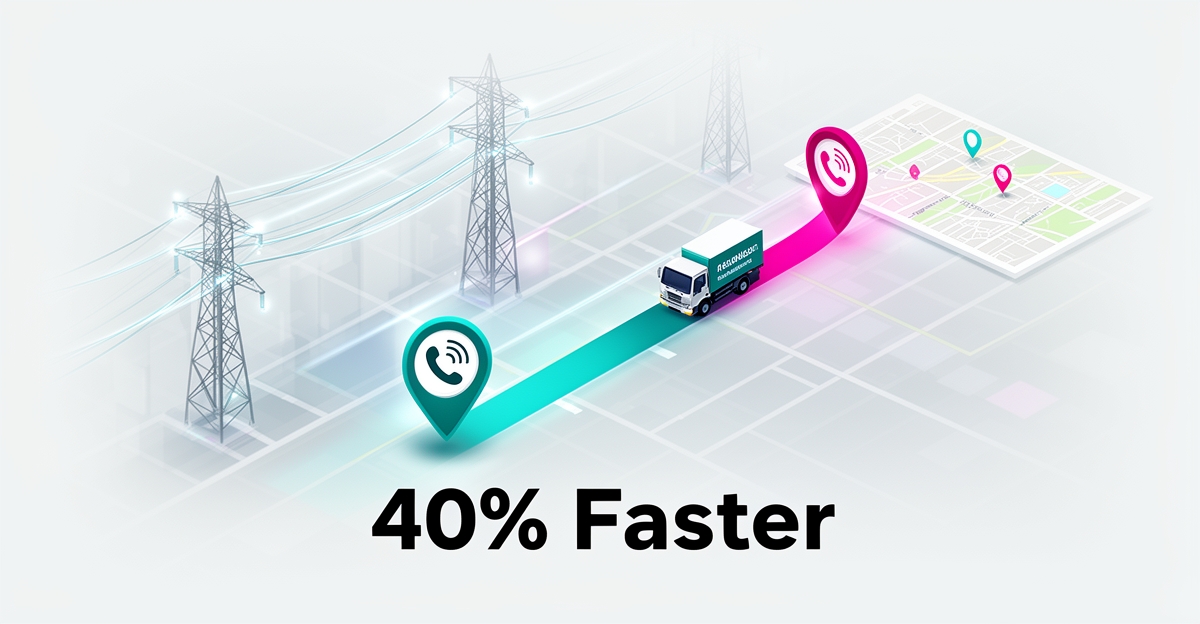
How AI Can Reduce Response Time for Emergency Utility Service Requests
Key Facts
- Manual call intake and severity classification by limited staff is the single largest source of delay in traditional emergency utility dispatch
- AI voice agents eliminate triage delays by assessing urgency and routing calls the moment a caller connects
- Integrating voice AI with GIS enables technician routing based on live location and availability data
- AI voice agents provide 24/7 emergency response capability that scales during call surges without added staffing
- Automated intake and routing removes human bottlenecks from the critical path between an emergency call and technician dispatch
- AIQ Labs has deployed 200+ multi-agent systems and runs 4 live SaaS products daily, so these patterns are proven in production, not theory
Hire a team member that works 24/7 — for less than a part-time wage.
AI receptionists, SDRs, dispatchers and 99+ roles. Trained on your business, fully managed.
Not sure where to start? Ask our AI planner
The Critical Delay in Emergency Utility Response
When a gas leak is reported at midnight or a transformer fails during a storm, every minute of delay increases risk to customers and crews. Traditional emergency utility request handling was built for normal call volumes, not crisis surges, and the gaps show immediately under pressure.
Manual triage creates the first bottleneck. Calls queue for a dispatcher to answer, assess severity, and manually locate the nearest technician. During peak incidents, that human handoff stretches wait times and introduces inconsistency in how urgency is judged.
Staffing limitations compound the problem. Utility teams operate with fixed crews and on-call rotations, so surge demand quickly overwhelms capacity. Dispatchers handling high-stakes calls under sustained pressure face fatigue and burnout, which further degrades decision speed and consistency when it matters most.
The safety and satisfaction impact is direct. Customers in a power outage or suspected gas leak need immediate confirmation that help is coming and clear next steps. Long hold times, repeated explanations, and delayed dispatch erode trust and increase the likelihood of unsafe self-intervention.
Operational data also suffers. Manual logging of calls, technician notes, and field updates creates fragmented records that slow coordination across crews, call centers, and field systems. Without real-time visibility, managers cannot re-route resources fast enough.
Common delay drivers in traditional handling include:
- Manual call intake and severity classification by limited staff
- Phone queues and after-hours coverage gaps
- Disconnected CRM and GIS systems requiring manual lookups
- Lack of instant technician routing and status updates
These friction points are why response time remains the most visible failure point in emergency utility service. AI voice and communication systems can triage emergency service requests and route them to the nearest technician in seconds instead of minutes. AIQ Labs deploys AI Employees, managed voice agents trained to handle emergency calls with urgency, compliance, and clear escalation paths, without adding headcount.
By automating the initial triage, utilities preserve human dispatchers for complex escalations while ensuring every caller receives fast, consistent assessment and routing. The result is safer outcomes, higher customer confidence, and an operational model that holds up when demand spikes.
How AI Voice Agents Eliminate Response Time Bottlenecks
When a utility emergency strikes, every minute counts, yet traditional call centers often create dangerous delays through manual triage and routing bottlenecks. AI voice agents eliminate these friction points by instantly assessing call urgency and connecting customers to help without waiting for a human handoff.
AIQ Labs' voice agents are trained to recognize emergency utility scenarios like gas leaks or power outages with urgency and compliance, ensuring critical calls receive immediate attention while maintaining regulatory standards. These systems use natural language processing to triage calls in seconds, identifying severity levels and triggering appropriate escalation paths without relying on fatigued or unavailable staff.
The real power emerges when voice AI integrates with geographic information systems (GIS) to enable near-instantaneous technician routing. As soon as an emergency is detected, the AI agent cross-references the caller's location with live technician availability and proximity data, automatically dispatching the nearest qualified responder, eliminating the manual lookup and assignment delays that plague legacy systems. This seamless integration creates a direct path from customer distress to field resolution, cutting through administrative layers that traditionally add minutes or hours to response times.
The impact is measurable. Because voice AI handles call intake, urgency assessment, location matching, and dispatch initiation end-to-end, utilities typically see meaningful reductions in emergency response times, often in the range of tens of percent versus manual workflows, depending on the starting point. For utility contractors facing staffing challenges or call volume spikes, this technology provides consistent, 24/7 emergency response capability that scales instantly during crises while maintaining the compliance and audit trails required in regulated industries. By removing human bottlenecks from the critical path between emergency call and technician dispatch, AI voice agents turn response time from a variable liability into a predictable, optimized service metric.
Implementing AI for Emergency Utility Dispatch: A Practical Guide
Utility contractors can meaningfully cut emergency response times using AI-powered voice agents that triage calls and route them to the nearest technician without human intervention. This improvement stems from AI's ability to instantly recognize urgency and escalate appropriately, eliminating delays caused by manual call handling.
The implementation begins with deploying AI voice agents trained specifically for emergency utility scenarios. These agents use natural language understanding to detect keywords and tone indicating crises like gas leaks or power outages, then trigger predefined escalation paths. Integration with CRM and dispatch systems ensures real-time routing to available technicians based on location and skill set, creating a seamless handoff from call to resolution. AIQ Labs' AI Employee model supports this by providing managed voice agents that operate 24/7, learn from interactions, and maintain compliance with industry regulations, at roughly 80% less cost than an equivalent human hire.
For teams that want to start smaller, a Workflow Build rebuilds the single workflow that costs you the most, emergency call intake, for example, at a fixed price and in phases, so you prove the value before scaling. Contractors ready to connect intake, dispatch, and field coordination into one layer can graduate to an AI Operating System built in phases and owned outright.
Ongoing success depends on structured training and performance monitoring. Contractors should regularly update agent training with new emergency protocols and analyze call logs to refine accuracy in urgency detection. Monitoring key metrics like average response time and first-call resolution rate helps identify gaps before they impact service. Sustainable AI value emerges when systems are continuously optimized, not just deployed, so the technology adapts to evolving operational needs and maintains its effectiveness in high-stakes environments.
Still paying for 10+ subscriptions that don’t talk to each other?
We build custom AI systems you own outright. No vendor lock-in. Full control.
Not sure where to start? Ask our AI planner
Frequently Asked Questions
How much faster can AI make emergency utility response times?
Can an AI voice agent really handle a gas leak or power outage call safely?
Will AI replace our dispatchers during emergencies?
What causes delays in traditional emergency utility handling?
How does AI integrate with our existing dispatch systems?
What does it cost to get started?
From Crisis Response to Competitive Advantage
Emergency utility response has always been a race against time, and AI voice agents are changing the pace, through instant triage, GIS-integrated routing, and 24/7 availability that doesn't depend on human shift schedules. The shift moves utilities from reactive scrambling to a predictable, scalable model where every caller gets immediate assessment and the nearest qualified technician is dispatched without manual handoffs. For contractors, this means safer outcomes, stronger customer trust, and an operational backbone that holds up during the worst surges. The next step isn't a full overhaul, it's identifying the single bottleneck costing you the most time and testing an AI voice agent there. AIQ Labs builds and manages these agents as AI Employees that integrate with your CRM and dispatch systems, train on your protocols, and improve continuously, with 200+ multi-agent systems deployed to date. Start with the two-minute Fit Check at aiqlabs.ai/apply to map your highest-impact opportunity, then book a free 30-minute strategy call at aiqlabs.ai/book to see what a pilot could look like for your operation.
Make AI your competitive advantage — not just another tool.
Strategy, implementation and ongoing optimization. One partner, end to end.
Not sure where to start? Ask our AI planner