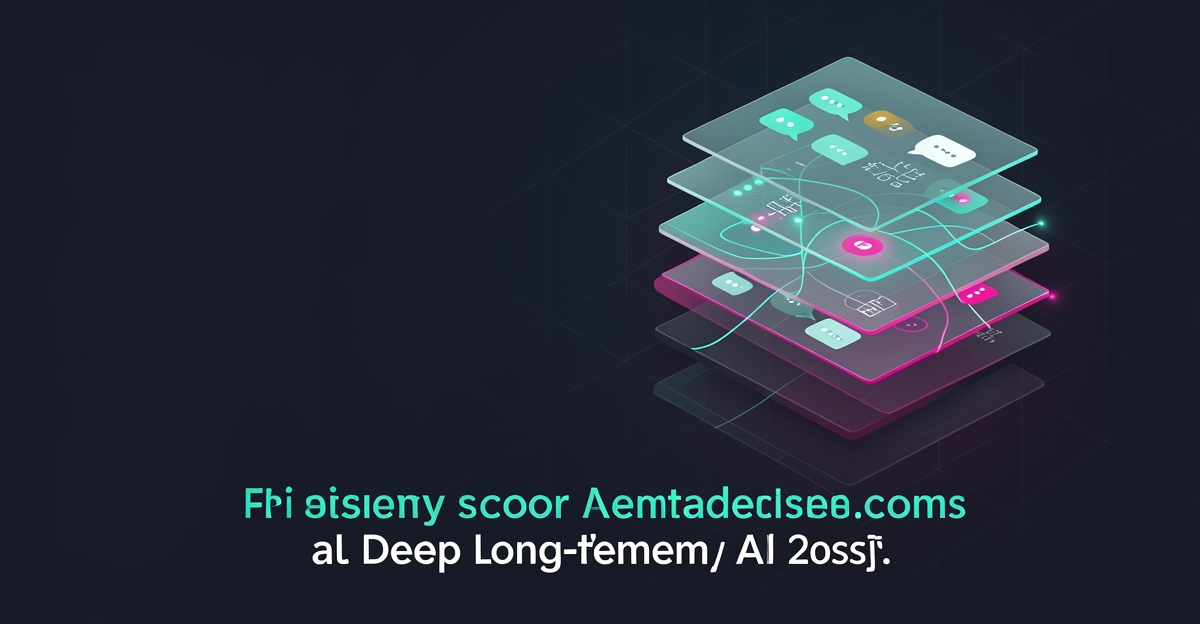
How AI Employees Remember Context Across Every Customer Conversation
Key Facts
- AI agents are set to automate $2.9 trillion in economic value by 2030 according to a recent survey.
- 67% of businesses use AI solutions as per industry research, with many lacking effective context management.
- Effective AI agents can boost customer satisfaction and retention, while reducing operational costs by up to 95% according to experts.
- AIQ Labs deploys over 200 multi-agent systems to streamline operations for businesses as showcased in live deployments.
- 2026 will see 62% of companies experimenting with AI agents, emphasizing the need for robust memory systems according to a recent study.
- AI employees like receptionists and SDRs can reduce operational costs by 75-85% compared to human hires.
- AIQ Labs' AI memory systems ensure that memory can't be governed, making it a liability waiting to surface in customer interactions.
Hire a team member that works 24/7 — for less than a part-time wage.
AI receptionists, SDRs, dispatchers and 99+ roles. Trained on your business, fully managed.
Not sure where to start? Ask our AI planner
The Context Problem: Why Stateless AI Frustrates Your Customers
The frustration of dealing with stateless AI is a common pain point for customers, who often find themselves repeating information or receiving contradictory answers from different agents. This issue is exacerbated by the fact that 67% of businesses are using AI, with 62% of companies experimenting with AI agents. The gap between stateless chatbots and true AI employees is significant, and it's an area where AIQ Labs is working to make a difference.
One of the key challenges is that stateless AI agents lack the ability to remember context, leading to a fragmented and frustrating experience for customers. This can result in lost trust and ultimately, lost business. To address this issue, businesses need to adopt AI solutions that prioritize memory architecture and governance, such as hybrid layered memory and deterministic governance layers.
Some of the key benefits of implementing effective AI agent memory management systems include:
- Improved customer satisfaction and retention rates
- Increased efficiency and productivity for human agents
- Enhanced ability to personalize and tailor interactions to individual customers
By leveraging these solutions, businesses can create a more seamless and intuitive experience for their customers, and stay ahead of the competition in an increasingly AI-driven market. With the right approach, AI agents can evolve from stateless tools into intelligent assistants that learn and adapt, providing a significant competitive advantage for businesses that adopt them.
Inside the Memory Stack: How Production AI Employees Actually Remember
AI employees aren’t just tools—they’re adaptive assistants that evolve with every interaction. According to industry research, 67% of businesses using AI agents prioritize memory systems that retain context across conversations. This capability transforms stateless tools into intelligent, learning systems capable of personalized, continuous engagement.
At the core of this innovation is hybrid layered memory, a framework combining session logs, personalization memory, and governed corporate knowledge. Session logs capture real-time interactions, while personalization memory stores user preferences and history. Governed corporate knowledge ensures adherence to organizational policies and brand guidelines. This layered approach allows AI employees to recall past conversations, adapt to user needs, and maintain consistency.
Expert insights emphasize the role of semantic graph extraction and user profiling in enhancing contextual understanding. Semantic graphs map relationships between entities, enabling AI to infer meaning beyond surface-level data. User profiling builds dynamic, evolving records of individual preferences, ensuring interactions feel human-centric.
- Session logs: Track real-time conversation history
- Personalization memory: Stores user preferences and behavior
- Governed corporate knowledge: Ensures compliance and brand alignment
A recent study found that 62% of companies experiment with AI agents, highlighting the urgency of robust memory systems. AIQ Labs integrates these principles into its managed AI employees, enabling seamless context retention across roles like AI Receptionists or SDRs. By combining deterministic governance with adaptive learning, AIQ Labs ensures its systems avoid hallucinations while delivering personalized, reliable service.
Hybrid layered memory and semantic graph extraction are not just technical features—they’re the foundation of AI that feels human. As one expert notes, “The right memory framework lets agents remember facts, recall past experiences, and learn user preferences.” This is how AI employees transition from transactional tools to strategic partners.
Governance Guardrails: Preventing Stale Facts and Hallucinated History
A customer tells your AI receptionist she moved to a new address, and three conversations later it quotes her old one. Worse, it confidently invents a service history that never happened. These failures rarely come from the language model itself—they come from what the system retrieves, and nothing stopping it from retrieving the wrong thing.
That's why production AI systems need a deterministic governance layer sitting on top of memory. As analysis of persistent memory in AI agents points out, governance and context management are critical components that prevent the retrieval of stale or conflicting facts—something probabilistic retrieval alone cannot guarantee.
There's a genuine industry debate here. Some practitioners favor probabilistic memory architectures, which flexibly surface relevant context based on similarity, as discussed in coverage of AI agent frameworks. Others argue that hallucinated history and outdated facts are exactly the risks probabilistic approaches introduce, and that deterministic rules must gate what enters and exits memory. The honest answer: production systems need both. Probabilistic retrieval provides the nuance and adaptability that make conversations feel intelligent, while deterministic guardrails provide the hard constraints that make them safe to trust.
Effective governance typically looks like:
- Validation checks that flag or block facts conflicting with the current customer record before they reach the model
- Layered memory separation—session logs, personalization data, and governed corporate knowledge kept distinct so one can't contaminate another
- Complete audit trails logging every retrieval and action for compliance review
- Human-in-the-loop escalation when a situation exceeds the agent's authority or confidence
Transparency matters as much as control. Oracle's developer guidance highlights approaches like checkpoints and version-controlled memory stores that make an agent's context inspectable, so teams can see exactly what the AI knew at any point in a conversation. This is the difference between an AI employee you can supervise and one you simply hope behaves.
The stakes are rising fast. A survey on enterprise AI agents found 62% of companies experimenting with them, and agent-driven automation is projected to unlock $2.9 trillion in US economic value by 2030. With 67% of businesses already using AI according to Dataiku research, the businesses that scale successfully will be the ones whose memory systems are governed, not just capable.
This is where engineering discipline separates real deployments from demos. At AIQ Labs, every agent action passes through validation layers with hard guardrails customized per role, configurable human escalation, and complete audit logging—the same reliability architecture we run across our own production platforms. Memory that can't be governed isn't a feature; it's a liability waiting to surface in front of a customer.
Deploying Memory-Driven AI Employees in Your Business
Deploying memory-driven AI employees begins with selecting a single, high-impact role—such as a receptionist, SDR, or dispatcher—to pilot the technology. This approach allows businesses to test context-aware automation in a controlled environment while minimizing risk. According to industry research, 67% of businesses use AI, but only a fraction have implemented governed memory systems to ensure consistent, accurate interactions. Starting with a defined role enables organizations to refine memory architecture and governance before scaling.
Integrating AI employees with existing tools is critical for seamless operations. A 2026 study found that AI agents automating $2.9 trillion in economic value by 2030 rely heavily on CRM, calendar, and payment system integrations. For example, an AI receptionist can sync with Google Calendar for scheduling, connect to a CRM for client history, and interface with payment gateways for invoicing. This interoperability ensures context is preserved across touchpoints, enhancing customer experiences.
Measuring success requires focusing on metrics like customer satisfaction (CSAT) and retention rates. Expert insights emphasize that memory management systems—combining session logs, personalization data, and corporate knowledge—directly influence these outcomes. AIQ Labs’ Start Monthly model simplifies adoption, offering a flat-rate plan that includes setup, training, and ongoing optimization. With 200+ multi-agent systems deployed, the platform demonstrates scalable, real-world effectiveness.
- Begin with a single role to minimize complexity
- Prioritize integrations with CRM, calendars, and payment systems
- Track CSAT and retention to evaluate context management
Businesses leveraging AI employees with robust memory frameworks report improved efficiency and customer engagement. By aligning with AIQ Labs’ structured deployment approach, organizations can transition from experimental AI use to sustainable, value-driven automation.
The Competitive Cost of Forgetting: What Happens If You Wait
Every day you wait, someone else's AI employee is remembering more. The numbers behind this shift aren't subtle: AI agents are estimated to automate $2.9 trillion in US economic value by 2030, and a recent survey found that 62% of companies are already experimenting with AI agents. Context-aware AI employees are no longer an edge case — they're becoming the default operating model for businesses that compete on responsiveness.
Meanwhile, industry research shows that 67% of businesses using AI already recognize memory as the difference between stateless tools and assistants that actually learn and adapt. As one expert put it, memory helps AI agents evolve from stateless tools into intelligent assistants that remember facts, recall past experiences, and retrieve relevant context when needed. Your competitors deploying these systems aren't experimenting — they're compounding advantages with every conversation their AI remembers.
Here's what forgetting actually costs a growing business:
- Repeat customers re-explaining their history because your systems have no shared memory of prior conversations
- Leads and bookings lost to competitors whose AI receptionists and dispatchers respond instantly, around the clock
- Stale or conflicting customer facts surfacing at the worst moments, because there's no deterministic governance layer preventing bad retrieval
- Operational staff buried in manual follow-up that a context-aware AI employee would handle for 80% less cost than a human hire
The gap widens faster than most owners expect. Businesses that adopt hybrid layered memory approaches give their AI a comprehensive understanding of customer context — session history, personalization data, and governed corporate knowledge working together. Businesses that don't are left with chatbots that forget, and customers notice the difference immediately.
This is why AIQ Labs builds AI employees with governed memory architecture from day one — trained on your business, integrated with your CRM and scheduling tools, and monitored continuously so context compounds instead of corrupting. With adoption accelerating across 62% of companies, the question isn't whether context-aware AI employees become standard. It's whether yours arrive before your competitors' do.
The cost of finding out later is real. The cost of checking now is two minutes.
Start the two-minute Fit Check at aiqlabs.ai/apply, and follow it with a free 30-minute strategy call at aiqlabs.ai/book — a real working session with an AI engineer to map your biggest bottleneck and identify high-ROI automation opportunities. If there isn't a clear win, we'll tell you that too. While you're reading this, a competitor is booking the job you missed.
Still paying for 10+ subscriptions that don’t talk to each other?
We build custom AI systems you own outright. No vendor lock-in. Full control.
Not sure where to start? Ask our AI planner
Frequently Asked Questions
How do AI employees remember context across every customer conversation?
What is the difference between stateless AI agents and AI employees with memory?
How can businesses implement effective AI agent memory management systems?
What are the benefits of using AI employees with memory?
How can AIQ Labs help businesses implement AI employees with memory?
What is the cost of not adopting AI employees with memory?
Unlocking the Power of Context-Aware AI
As businesses strive to deliver exceptional customer experiences, the importance of context-aware AI cannot be overstated. By leveraging hybrid layered memory and deterministic governance layers, organizations can create AI employees that remember context across every customer conversation. This leads to improved customer satisfaction, increased efficiency, and enhanced personalization. To get started, businesses can begin by identifying high-value opportunities for AI-driven automation and exploring solutions like AIQ Labs' managed AI employees. With the potential to automate $2.9 trillion in US economic value by 2030, as noted in a recent study published on arxiv.org, the time to adopt context-aware AI is now. Take the first step by starting the two-minute Fit Check and discover how AIQ Labs can help you unlock the power of context-aware AI.
Make AI your competitive advantage — not just another tool.
Strategy, implementation and ongoing optimization. One partner, end to end.
Not sure where to start? Ask our AI planner