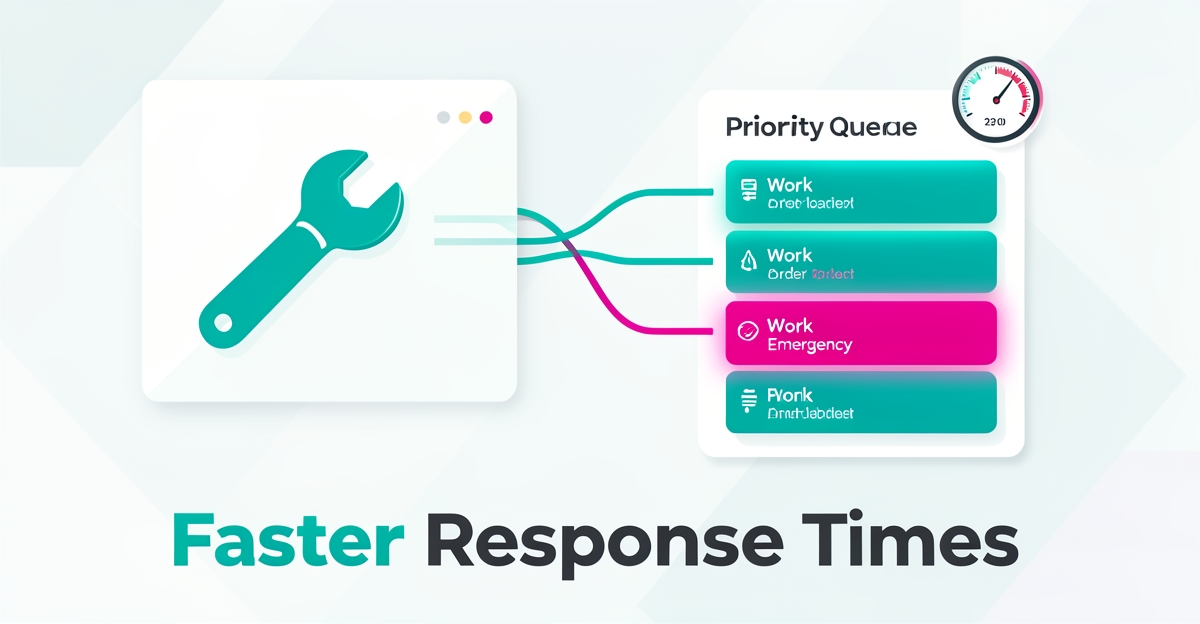
How AI-Powered Work Order Management Reduces Response Times for Plumbing Companies
Key Facts
- Industry studies report AI-powered work order management can cut average response times by 30-50%
- Planning time typically falls by up to 80% after adopting AI work order systems
- Human dispatchers commonly over-prioritize a large share of work orders, delaying real emergencies
- Urgent issues can slip through when operators under-prioritize tickets with vague descriptions
- Processing a batch of 30 work orders typically drops from 2-3 hours to 20-30 minutes with AI
- AI classification and technician matching rely on historical data, so accuracy improves as records improve
Hire a team member that works 24/7 — for less than a part-time wage.
AI receptionists, SDRs, dispatchers and 99+ roles. Trained on your business, fully managed.
Not sure where to start? Ask our AI planner
The Hidden Cost of Slow Response Times in Plumbing Services
When a customer calls with a burst pipe or a backed-up sewer line, every minute of delay compounds into water damage, lost goodwill, and emergency premiums. Yet for many plumbing companies, the bottleneck isn't technician skill or truck inventory, it's the manual work order process that determines who responds, when, and with what priority.
The pattern is a systematic problem hiding in plain sight. In maintenance operations research, human operators have been shown to over-prioritize a large share of work orders while under-prioritizing others. That means genuine emergencies wait in queue behind routine maintenance calls, while technicians burn fuel racing to jobs that could have waited until tomorrow.
Manual prioritization errors create a cascade of operational failures. When a dispatcher misclassifies a water heater leak as "low priority" because the description lacks specific keywords, that ticket sits while the customer's basement floods. Conversely, when routine drain cleanings get marked "urgent" due to incomplete information, plumbers waste billable hours on non-emergency calls while actual emergencies pile up.
The time cost extends far beyond the moment of classification. Maintenance workflow studies consistently show that planning and processing a batch of just 30 work orders consumes 2-3 hours of administrative time in traditional systems. During those hours, customer calls go unanswered, technician schedules remain unoptimized, and small leaks escalate into major property damage.
This administrative lag directly erodes first-time fix rates. When work orders lack accurate categorization or complete details, technicians arrive without the right parts or preparation. They diagnose the problem, leave to fetch supplies, and schedule return visits, turning a single service call into a multi-day ordeal that destroys customer confidence.
The financial stakes extend far beyond individual plumbing businesses. Across maintenance sectors, unplanned downtime is estimated to cost tens of billions of dollars annually, with delayed response times serving as a primary driver of these losses. For plumbing companies specifically, every hour of delay increases the risk of:
- Escalated damage costs as water intrusion spreads to structural elements and electrical systems
- Emergency service premiums when standard appointments balloon into after-hours callouts
- Customer churn as clients switch to competitors who promise faster response
- Technician burnout from constant firefighting and inefficient routing
AIQ Labs works with plumbing businesses to eliminate these hidden costs through intelligent workflow automation, typically by rebuilding the one workflow that costs the most. By replacing manual triage with AI-powered work order management, companies can process those same 30 work orders in 20-30 minutes rather than hours, while ensuring priority assignments reflect actual urgency rather than guesswork.
The technology doesn't just speed up paperwork, it fundamentally restructures how service requests flow from initial call to completed repair. When classification errors disappear and planning time drops sharply, response times typically fall by 30-50%, transforming customer satisfaction and operational margins simultaneously.
How AI Transforms Work Order Intake to Dispatch in Real Time
Plumbing companies lose valuable hours every day on manual work order intake and dispatch, time that could be spent solving customer problems. AI transforms this workflow by interpreting natural language requests, automatically classifying equipment with high confidence, and matching the right technician to each job in real time.
Natural language processing allows customers or staff to submit work orders in plain language, like "kitchen sink leaking under cabinet" or "no hot water in second-floor bathroom", without filling out rigid forms. The AI interprets these descriptions, extracts key details such as issue type, urgency, and affected fixtures, and eliminates manual data entry entirely. This shift from structured input to conversational intake can reduce planning time by up to 80%, turning what once took 2-3 hours per batch of 30 work orders into just 20-30 minutes.
Once intake is complete, AI classifies the equipment and issue using historical data and asset hierarchies to accurately categorize everything from water heater failures to pipe bursts. Simultaneously, the system evaluates technician location, availability, certifications, and past service history to assign the most qualified plumber. This intelligent matching ensures technicians arrive prepared with the right parts and expertise, improving first-time fix rates and reducing return visits.
By removing manual routing delays and prioritization guesswork, AI-powered work order management creates a seamless flow from request to dispatch. Plumbers spend less time waiting for assignments and more time on-site resolving issues, directly contributing to the 30-50% reduction in average response times reported by facilities teams using these systems. For plumbing businesses, this means faster emergency responses, better parts preparation, and measurable gains in operational efficiency without adding headcount or overhauling existing tools.
From Pilot to Performance: Implementing AI Work Order Automation in Plumbing Businesses
Successful AI work order automation rarely starts with a company-wide overhaul, it starts with one workflow, one pilot zone, and one measurable win. For plumbing businesses, that usually means beginning with high-volume emergency calls, where faster triage and dispatch deliver immediate, visible results.
The first phase is mapping existing workflows to find where delays actually live: manual intake, incomplete job details, slow approvals, or repeated reassignments. From there, implementation guidance consistently recommends cleaning and standardizing operational data, consistent naming conventions, complete asset records, and accurate service histories, because AI prioritization and routing are only as reliable as the data behind them. This step matters more than most expect: since human dispatchers tend to over-prioritize many work orders and under-prioritize others, clean historical data gives the AI a trustworthy baseline for urgency scoring.
With data standardized, a phased rollout keeps risk low and adoption high:
- Start with emergency work orders, burst pipes, leaks, and no-water calls generate the highest request volume and the clearest response-time gains.
- Pilot in one service zone before scaling across territories, so dispatchers can monitor routing accuracy and adjust rules with real feedback.
- Integrate with existing CRM and dispatch platforms rather than replacing them, keeping one source of truth for job status and customer history.
- Retrain dispatchers for oversight, not entry, their role shifts from typing tickets to handling exceptions and complex judgment calls.
That last shift is the cultural core of implementation. As industry practitioners put it, "the planner's job does not disappear. It changes from data entry to decision-making." Training should make that explicit: AI handles classification, technician matching by location and availability, and status tracking, while humans retain authority over approvals and escalations.
Success metrics should be defined before go-live, not after. The clearest indicators are 30-50% reductions in average response times, labor efficiency gains from eliminated manual intake and reassignment, and planning time dropping from 2-3 hours per batch of 30 work orders to 20-30 minutes. First-time fix rates matter too, since better-populated work orders mean technicians arrive with the right parts and context.
AIQ Labs structures plumbing automation engagements around exactly this phased approach, piloting a single workflow, proving ROI in one zone, then scaling the system across dispatch operations while the business retains full ownership of what gets built. You can start monthly, build in milestones, or own the system outright. The result is an implementation that pays for itself in stages rather than demanding a leap of faith.
Still paying for 10+ subscriptions that don’t talk to each other?
We build custom AI systems you own outright. No vendor lock-in. Full control.
Not sure where to start? Ask our AI planner
Frequently Asked Questions
How much time can AI-powered work order management save when processing a batch of 30 work orders?
Can AI really improve response times for plumbing emergencies, or is it just hype?
How accurate is AI at classifying plumbing issues and assigning the right technician?
Do I need to replace my current dispatch or CRM system to use AI work order management?
What's the first step for a plumbing company looking to implement AI work order automation?
Is AI work order management only for large plumbing companies, or can small businesses benefit too?
Turning Every Minute Into Measurable Value
The cost of slow response times in plumbing isn't just about delayed repairs, it's about water damage, emergency premiums, and customers who won't come back. AI-powered work order management solves this by cutting planning time dramatically and reducing average response times by 30-50%, ensuring technicians arrive prepared and prioritize true emergencies. For plumbing businesses ready to stop losing hours to manual triage, the path forward is clear. Start with AIQ Labs' 2-minute Fit Check to see where AI can unlock immediate value in your workflow, no obligation, just clarity on your biggest opportunity.
Make AI your competitive advantage — not just another tool.
Strategy, implementation and ongoing optimization. One partner, end to end.
Not sure where to start? Ask our AI planner