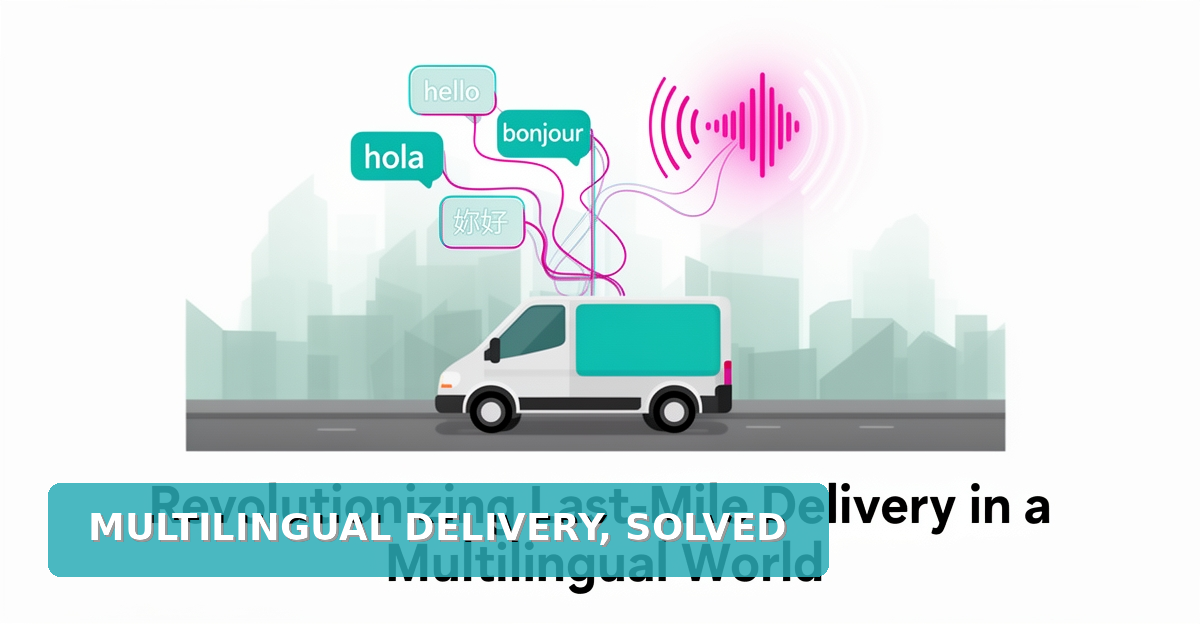
How AI Voice Receptionists Improve Delivery Communication with Customers in Multilingual Cities
Key Facts
- 77% of customers hate being put on hold during calls, a major pain point according to industry research.
- Custom-built AI voice systems achieve 25-35% faster call resolution than platform solutions.
- Custom voice AI implementations reduce manual handling by 20-30% versus off-the-shelf platforms.
- AI voice receptionists must keep latency under 300-500 ms per response turn to preserve natural conversation flow.
- Voice AI architecture relies on a streaming STT → LLM → TTS pipeline with Retrieval-Augmented Generation grounding responses in verified data.
- Multilingual AI receptionists answer delivery calls 24/7 in the customer's native language, eliminating hold queues and handoff gaps.
- Successful voice AI systems are designed around how conversations actually happen, not the most complex technology.
Hire a team member that works 24/7 — for less than a part-time wage.
AI receptionists, SDRs, dispatchers and 99+ roles. Trained on your business, fully managed.
Not sure where to start? Ask our AI planner
The Last-Mile Communication Gap in Multilingual Cities
Picture a delivery driver circling the same block for the third time while the customer, who called twice in a language the dispatch line doesn't support, waits with no update. In multilingual cities, this scenario plays out thousands of times a day, and it's rarely a logistics failure—it's a communication failure.
The last mile is where delivery operations are most fragile. Customers call to confirm windows, redirect packages, or clarify access instructions, and every one of those calls is a chance for the delivery to succeed or stall. When the person answering speaks a different language, the call takes longer, the information degrades, and the driver loses time.
Hold times make it worse. According to industry research on AI voice receptionists, 77% of customers hate being put on hold during calls. In a diverse urban market, a customer with limited English proficiency often faces a double penalty: first the hold, then the struggle to communicate once a human finally picks up.
Fragmented call handling compounds the problem. In many delivery operations, calls bounce between dispatchers, drivers, and customer service reps, and language support rarely follows the call. The result is a predictable pattern of friction:
- Misheard addresses and delivery instructions that send drivers to the wrong locations
- Repeated callbacks from customers who couldn't resolve their issue in one language attempt
- Escalations that sit in queues because no multilingual agent is available
- Missed delivery windows that trigger refunds, disputes, and churn
The cost of this miscommunication isn't just frustration—it's operational. Every repeat call and failed delivery consumes driver hours, support capacity, and margin. This is why custom-built voice systems consistently outperform generic ones, achieving 25-35% faster call resolution and 20-30% less manual handling when designed around real call workflows rather than generic scripts.
Language is the core of the challenge. Customers in multilingual cities speak with regional accents, mix languages mid-sentence, and expect to be understood without repeating themselves. Systems built with robust speech recognition, intent classification, and natural language understanding can keep latency low—ideally under 300-500 ms per response turn—so conversations feel human rather than robotic.
This is the gap that multilingual AI voice receptionists are built to close. Companies like AIQ Labs deploy voice AI that answers delivery-related calls in the customer's own language, 24/7, with no hold queue and no handoff gaps—ensuring clarity, accuracy, and inclusivity in last-mile operations. In diverse urban markets, that's not a nice-to-have; it's the difference between a delivery that lands and one that doesn't.
How Multilingual AI Voice Receptionists Improve Delivery CX
Multilingual cities create a last-mile communication gap that traditional call centers struggle to close. Customers call for delivery tracking, scheduling changes, or support, and language barriers turn simple requests into delays and frustration.
AI voice receptionists provide 24/7 multilingual coverage that removes those barriers at the point of contact. The systems handle high-frequency delivery intents in the caller’s native language, with clarity and accuracy that preserves operational flow. For businesses operating in diverse urban markets, this is how inclusivity becomes a measurable service advantage.
Custom-built solutions outperform platform tools in delivery environments. According to industry research, custom builds deliver 25-35% faster call resolution and 20-30% less manual handling. Those gains come from alignment with real call workflows rather than forcing teams to adapt to a tool.
Speed matters because waiting erodes trust. Research on voice receptionist development notes 77% of customers hate being put on hold during calls. An AI receptionist answers immediately, routes by intent, and resolves routine tracking and scheduling without human intervention.
The business value shows up across three core delivery interactions:
- Delivery tracking and ETA updates handled in multiple languages with real-time data retrieval
- Scheduling and rescheduling completed through natural conversation, reducing no-shows
- Support inquiries resolved 24/7, cutting after-hours workload for human teams
Performance depends on low-latency, grounded conversation. A technical guide to implementation targets latency under 300-500 ms per response turn to keep dialogue natural. Retrieval-Augmented Generation ensures responses are grounded in verified delivery data, not model assumptions.
AIQ Labs deploys multilingual AI voice receptionists as managed AI Employees for delivery and logistics teams. The approach focuses on cross-language delivery communication in diverse urban markets, ensuring clarity, accuracy, and inclusivity in last-mile operations. Systems integrate with CRM, scheduling, and billing so agents can act during the call, not just collect messages.
Custom development also gives control over language-specific nuances, accents, and regional variations. That control supports consistent service quality across languages rather than uneven performance. Human handoff remains available for low-confidence or complex cases, protecting service standards.
The result is faster resolution, less manual handling, and a more inclusive customer experience without adding headcount.
Build vs Buy and Core Architecture for Delivery Use Cases
Delivery communication breaks down fast when language barriers, hold times, and fragmented systems collide. In multilingual cities, customers expect immediate, accurate answers about tracking, ETAs, and changes — not voicemail.
Build vs buy shapes how quickly that expectation is met. Platform solutions launch faster because most components are preconfigured, but they limit customization, deep integration, and long-term scalability. Industry research shows custom-built systems deliver 25-35% faster call resolution and 20-30% less manual handling, with better fit to real workflows as needs evolve.
Custom development aligns the voice layer to existing dispatch, CRM, and routing tools rather than forcing process changes to match a tool. That alignment matters for last-mile operations where real-time data accuracy is non-negotiable. AIQ Labs approaches this through multilingual AI voice receptionists designed for cross-language delivery communication in diverse urban markets.
The core architecture for delivery use cases follows a streaming STT → LLM → TTS pipeline. Speech-to-Text converts live audio with noise handling and speaker detection, an LLM layer classifies intent, extracts entities, and generates responses, and Text-to-Speech returns natural low-latency voice output. Streaming inference lets responses begin before the full sentence is processed.
Grounding and memory keep answers reliable. Key components include:
- Retrieval-Augmented Generation to pull verified tracking, delivery windows, and customer data from internal systems before responding
- Session-level memory and structured context storage to maintain consistency across a call and across repeat interactions
- Real-time API integration with CRM, scheduling, and billing systems for live lookups and actions during the conversation
- Latency optimization targeting 300-500 ms per response turn to preserve natural flow
These layers address a critical customer pain point: survey data finds 77% of customers hate being put on hold during calls. Immediate, multilingual handling removes that friction and ensures inclusivity.
Platform options reduce initial effort but create dependency and limited control over data, escalation logic, and language-specific nuances. Custom builds require higher upfront investment yet provide stable long-term performance, deeper enterprise integration, and ownership of the system and data.
For delivery teams operating in multilingual cities, the combination of grounded RAG, persistent memory, and real-time integration is what turns a voice interface into an operational system that accurately communicates status, reschedules, and resolves issues without human handoff.
10-Step Implementation Roadmap for Delivery Teams
Delivery teams in multilingual cities lose customers when calls go unanswered or get stuck on hold. An AI voice receptionist removes that friction by handling high-frequency inquiries instantly in the caller’s language, keeping last-mile communication clear and continuous.
The rollout starts with real call work, not technology. Teams map high-frequency delivery intents such as tracking, rescheduling, and address changes, then define input → decision → action workflows with explicit fallback and escalation paths before any build begins. This use-case-first approach ensures the system mirrors how conversations actually happen.
Telephony and real-time audio come next. SIP or cloud telephony APIs route calls, while WebRTC/RTP pipelines enable bidirectional streaming for continuous conversation with low latency. The core stack follows a streaming pipeline of Speech-to-Text with noise handling and speaker detection, an LLM layer for intent classification and response generation, and Text-to-Speech synthesis for natural output.
Conversation logic is designed around realistic behavior. System prompts set tone and guardrails, intent-based routing triggers tool calls, and the model handles interruptions, silence, and ambiguity. Integration with enterprise systems transforms the receptionist into an operational tool, pulling live context from CRM, scheduling, and billing during the call.
Grounded responses are critical for delivery accuracy. Retrieval-Augmented Generation retrieves verified data from internal systems and injects it into prompts with validation layers and access controls. Memory and context management maintain session-level state, storing intent, entities, and history so interactions stay consistent across turns.
Performance targets are strict for voice. Latency must stay under 300-500 ms per response turn to preserve natural flow, and the system is tested against noisy environments, partial inputs, and low-confidence scenarios. Custom-built systems deliver measurable gains, achieving industry data showing 25-35% faster call resolution and 20-30% less manual handling versus platform solutions.
Deployment includes observability and safe handoffs. Teams set up logs, traces, and call analytics, implement confidence scoring with escalation triggers, and enable seamless transfer to human agents when needed. Continuous improvement closes the loop by analyzing transcripts for drop-offs and friction, refining prompts, workflows, and integrations over time.
For multilingual delivery operations, this sequence ensures inclusivity without sacrificing speed. AIQ Labs deploys multilingual AI voice receptionists that handle customer calls in multiple languages, aligning with its focus on cross-language delivery communication in diverse urban markets.
Key implementation checkpoints for delivery teams:
- Define high-frequency intents and escalation paths before building
- Build real-time telephony with streaming audio and low-latency inference
- Integrate RAG for grounded tracking and delivery data during calls
- Monitor latency, confidence scores, and human handoff rates post-launch
When calls are answered immediately, 77% of customers who hate being put on hold stay engaged, and delivery teams gain a 24/7 multilingual front door that reduces manual workload and protects service quality.
Still paying for 10+ subscriptions that don’t talk to each other?
We build custom AI systems you own outright. No vendor lock-in. Full control.
Not sure where to start? Ask our AI planner
Frequently Asked Questions
How do AI voice receptionists help delivery companies communicate with customers who don't speak English well?
What's the difference between a custom-built AI voice receptionist and an off-the-shelf platform for delivery operations?
How fast does an AI voice receptionist need to respond to feel natural on a phone call?
Can an AI voice receptionist actually take action during a call, like reschedule a delivery or look up a tracking number?
What happens when the AI can't understand a customer or the issue is too complex?
How does AIQ Labs deploy these systems for delivery companies in multilingual cities?
Turning Language Barriers into Delivery Advantages
In multilingual cities, the last mile isn't just about distance—it's about being understood. As we've seen, AI voice receptionists close the communication gap by answering calls immediately in the customer's language, reducing hold times, and resolving delivery inquiries faster without adding headcount. Custom-built systems deliver 25-35% faster call resolution and 20-30% less manual handling by aligning with real workflows, not forcing teams to adapt to generic tools. For delivery teams operating in diverse urban markets, this means fewer missed windows, lower operational costs, and a more inclusive experience that builds trust. The next step is to see how this fits your specific operations. Start with a free strategy call to map your biggest communication bottleneck and explore whether a multilingual AI voice receptionist is the right fit—no obligation, just clarity on where AI can make a measurable difference.
Make AI your competitive advantage — not just another tool.
Strategy, implementation and ongoing optimization. One partner, end to end.
Not sure where to start? Ask our AI planner