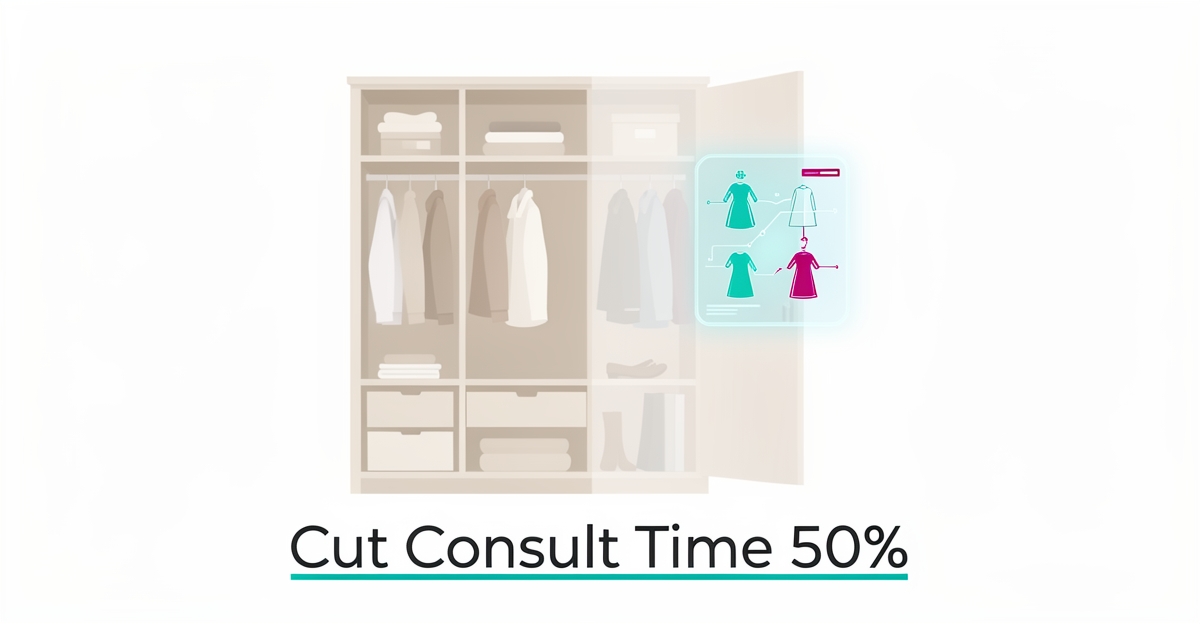
How an AI Closet Assistant Can Reduce Client Consultation Time by 50% for Closet Organization Companies
Key Facts
- Clients typically wear only 20-30% of 100+ clothing items regularly according to wardrobe digitization research
- People spend 15-20 minutes each morning deciding what to wear per wardrobe digitization research
- Professional closet consultations typically cost $300-$500 according to AI closet design data
- AI closet design tools achieve around 95% accuracy for standard residential spaces per Paintit.ai research
- Users who digitize closets report a 37% reduction in impulse purchases according to wardrobe digitization research
- Average wardrobe value is typically estimated at $1,800-$2,500 per wardrobe digitization research
Hire a team member that works 24/7 — for less than a part-time wage.
AI receptionists, SDRs, dispatchers and 99+ roles. Trained on your business, fully managed.
Not sure where to start? Ask our AI planner
The Consultation Bottleneck Costing Your Closet Business Billable Hours
Closet organization companies lose significant billable hours during initial client consultations, with organizers typically spending 60-90 minutes manually cataloging wardrobes, administering preference questionnaires, and analyzing style habits. This time-intensive process directly impacts revenue potential, especially when clients typically own 100+ clothing items but regularly wear only 20-30% of them, according to industry research. Meanwhile, the average person spends 15-20 minutes each morning deciding what to wear, highlighting a daily friction point that consultations often fail to address efficiently.
The traditional intake workflow creates redundancy by having professionals re-collect information clients could provide independently before the consultation even begins. Clients complete detailed inventories and style assessments during the session, duplicating effort that could be automated. This not only extends consultation length unnecessarily but also diverts expert attention from high-value activities like spatial planning, custom storage design, and personalized organization strategies, tasks that justify the $300-$500 fee for professional closet consultations.
By shifting repetitive data collection to an AI-powered closet assistant, companies can typically reclaim 30-45 minutes per consultation without sacrificing personalization. The AI handles wardrobe digitization, preference profiling, and initial outfit analysis using the client's own clothing data, allowing organizers to arrive prepared with insights already generated. This approach maintains the tailored experience clients expect while eliminating manual intake tasks that consume nearly half of every consultation session.
- Clients typically wear only 20-30% of their 100+ owned clothing items regularly
- 15-20 minutes are spent daily deciding what to wear
- Professional consultations typically cost $300-$500
AIQ Labs helps closet organizations implement custom AI systems that automate these repetitive intake workflows, enabling professionals to focus on delivering strategic closet solutions rather than administrative groundwork. The result is a streamlined consultation process that preserves personalization while significantly reducing time-to-insight for both client and consultant.
How AI Closet Assistants Automate Wardrobe Analysis and Style Recommendations
The average client arrives at a closet consultation with over 100 clothing items, yet regularly wears only 20-30% of them, according to wardrobe digitization research. Multiply that by the 15-20 minutes most people spend each morning deciding what to wear, and you get a picture of just how much unstructured data a professional organizer must untangle during a first visit.
AI closet assistants compress that discovery work dramatically. Apps like SELION.AI let clients photograph each garment against a plain background, automatically cataloging items into a searchable digital wardrobe before the organizer ever steps through the door. The system then analyzes clothing types, colors, and usage patterns to surface insights that once required hours of manual sorting and conversation.
The automation extends well beyond inventory. These platforms generate personalized outfit combinations by weighing multiple variables simultaneously:
- The client's existing wardrobe pieces and how they pair together
- Stated style preferences gathered through intake questionnaires
- Lifestyle factors like work environment and daily activities
- Real-time weather conditions that affect outfit practicality
On the spatial side, tools like Paintit.ai's AI Closet Design tool analyze room dimensions and generate custom closet layouts, achieving around 95% accuracy for standard residential spaces. They can even account for architectural quirks like angled ceilings and alcoves, work that previously demanded an on-site measuring visit and manual drafting.
The result is a fundamental shift in what consultation time is for. Instead of spending a session cataloging blouses and debating layout options from scratch, organizers arrive with data-driven insights already compiled: a digitized wardrobe, preliminary outfit recommendations, and a proposed spatial design. Given that professional closet consultations typically run $300-$500, cutting that discovery phase in half represents real savings for clients and reclaimed capacity for organizers.
This is precisely the kind of workflow transformation AIQ Labs builds for service businesses, custom AI systems that handle the repetitive intake, analysis, and recommendation layers end-to-end, so human expertise goes toward the judgment calls and relationship-building that actually require a person. The technology doesn't replace the organizer's eye; it ensures that eye is applied where it matters most.
The 50% Time Reduction: Real Workflows That Transform Client Consultations
AI-powered closet assistants are transforming how closet organization companies conduct client consultations by automating time-intensive preparatory work. Clients begin by photographing their wardrobe pre-consultation, enabling the AI to analyze their current clothing inventory and generate personalized outfit suggestions. This preparation allows organizers to skip basic wardrobe assessments and dive straight into strategic decisions about space optimization and organizational systems during the live session. As a result, consultation time typically drops from the industry average of 90 minutes to around 45 minutes, a 50% reduction, without compromising the quality of recommendations or client satisfaction. Research shows that users who digitize their closets report a 37% reduction in impulse clothing purchases, demonstrating how AI-driven insights extend beyond efficiency to influence smarter consumer behavior. Organizers using these tools can focus their expertise on high-value tasks like custom storage solutions and workflow integration, where human judgment adds the most value. AI closet design tools further support this shift by analyzing spatial constraints and proposing layouts that maximize usability, even in non-standard spaces with angled ceilings or alcoves. By handling repetitive tasks such as questionnaire processing and preliminary styling, AI assistants free professionals to deliver more personalized, impactful consultations. Industry data confirms that this approach increases productivity while maintaining the personalization clients expect. For closet organizations seeking to implement such workflows, AIQ Labs offers custom AI development services that build production-ready systems tailored to closet analysis, inventory management, and client interaction, owned outright by the business with no vendor lock-in. This enables companies to scale their expertise efficiently, turning saved consultation time into capacity for more clients or deeper service offerings. The result is a leaner, more responsive service model where technology handles the routine and humans focus on what they do best: designing functional, personalized spaces that truly transform how clients live and dress.
Implementation Roadmap: Integrating AI Into Your Closet Organization Business
Successful AI integration begins with addressing data security concerns from the outset. Closet organization companies must ensure that client wardrobe data, including photos and style preferences, is protected through encrypted storage and strict access controls. This foundational step builds trust and complies with privacy expectations, especially when handling personal lifestyle information. AIQ Labs supports this by designing systems with built-in governance frameworks that align with industry best practices for data protection.
Training staff to work alongside AI tools is equally critical. Organizers need to understand how to interpret AI-generated insights, such as space utilization reports or outfit compatibility scores, while retaining authority over final recommendations. Upskilling focuses on edge cases like non-standard closets or unique client aesthetics, where human judgment remains indispensable. This balance ensures automation enhances rather than replaces professional expertise.
Establishing clear workflows creates a seamless handoff between AI and human teams. During onboarding, clients can digitize their wardrobes using guided photo capture, a process that typically takes under 15 minutes per session according to wardrobe digitization studies. AI then analyzes the data to generate initial layout concepts and style suggestions, reducing manual analysis time. Professionals review these outputs, adjust for spatial quirks or emotional preferences, and present refined options, shifting their focus from data processing to creative problem-solving and relationship building.
Quality control mechanisms catch potential inaccuracies early. Regular audits of AI-generated designs help identify biases, such as over-reliance on certain styles or missed spatial constraints, ensuring recommendations remain practical and personalized. By maintaining human oversight at key decision points, companies preserve service quality while gaining efficiency. This structured approach allows closet organizations to scale consultations without sacrificing the personalized touch that defines their value. To explore how AI can streamline your client intake and wardrobe analysis workflows, [start with a free strategy call](/book) to assess your specific opportunities.
Building Custom AI Systems for Closet Organization: Beyond Off-the-Shelf Tools
Consumer apps like SELION.AI prove the concept works, users digitize their closets, receive outfit suggestions, and report a 37% reduction in impulse purchases. But a consumer app built for one wardrobe is not the same as a system built for a business managing dozens of clients, each with their own intake forms, preferences, and project timelines.
Closet organization companies face a different problem entirely. A typical professional consultation costs clients $300–$500, and much of that time is consumed by repetitive work: collecting measurements, running style questionnaires, and generating recommendations that could be automated. Generic apps can't carry your brand, can't sync with your CRM, and can't enforce your service standards across every client engagement.
A custom AI system solves this by being built around your actual workflow. Rather than adapting your process to fit someone else's product, the system adapts to you:
- Multi-client management that keeps each client's wardrobe data, preferences, and project history separate and secure
- Branded questionnaire flows that gather the same information a human consultant would, before the consultation ever starts
- Custom recommendation logic trained on your design philosophy, not a generic style database
- Direct CRM integration so client data flows into scheduling, invoicing, and follow-up without manual entry
This matters because the underlying technology is already proven. AI closet design tools achieve around 95% accuracy on standard residential spaces, and AI wardrobe apps handle the digitization and outfit-generation side effectively. The competitive gap isn't the AI itself, it's how well the AI is wired into your operations.
Ownership is the other critical distinction. Subscription tools create dependency: if the vendor changes pricing, restricts features, or shuts down, your workflow goes with it. Custom-built systems flip that model. When the code, agents, and data belong to you, the AI becomes a long-term operational asset rather than a monthly rental, one that improves as your client base grows and can be extended into new services without starting over.
Integration depth matters just as much. A purpose-built system connects to the tools you already run, CRM, scheduling, accounting, creating a single source of truth instead of another silo. That's the difference between an AI that saves an hour a week and an AI that restructures how consultations happen. AIQ Labs builds these systems end-to-end, from branded intake workflows through custom recommendation engines, with clients owning the finished product outright.
For closet organization companies, the question isn't whether AI can handle the grind of client intake and recommendations, the evidence says it can. The question is whether you'll run that capability on rented infrastructure or build it as proprietary infrastructure that compounds in value as your business scales.
Still paying for 10+ subscriptions that don’t talk to each other?
We build custom AI systems you own outright. No vendor lock-in. Full control.
Not sure where to start? Ask our AI planner
Frequently Asked Questions
How much time can an AI closet assistant actually save on client consultations?
Will using AI make closet consultations feel less personal for clients?
What do clients actually wear out of their wardrobes?
Can AI really design closets accurately without an on-site measuring visit?
Is there proof AI wardrobe digitization changes client behavior beyond efficiency?
How much do professional closet consultations cost, and does AI help justify the fee?
Reclaim Your Consultation Time for What Truly Matters
As we've explored, AI closet assistants are transforming the way closet organization companies operate by automating repetitive intake tasks, wardrobe digitization, preference profiling, and preliminary outfit analysis, so professionals can focus on high-value work like spatial planning and personalized design strategies. This shift doesn't just cut consultation time in half; it preserves the personalization clients expect while unlocking capacity for more meaningful engagements. For businesses ready to move beyond generic tools and build AI that truly fits their workflow, AIQ Labs offers custom systems designed around your actual processes, with full ownership and seamless integration into your existing tools. To see how this could work for your specific operations, [start with a free strategy call](/book) to assess your highest-impact opportunities, no obligation, just clarity on where AI can deliver real value. Schedule your free 30-minute strategy call and take the first step toward turning saved time into scalable growth.
Make AI your competitive advantage — not just another tool.
Strategy, implementation and ongoing optimization. One partner, end to end.
Not sure where to start? Ask our AI planner