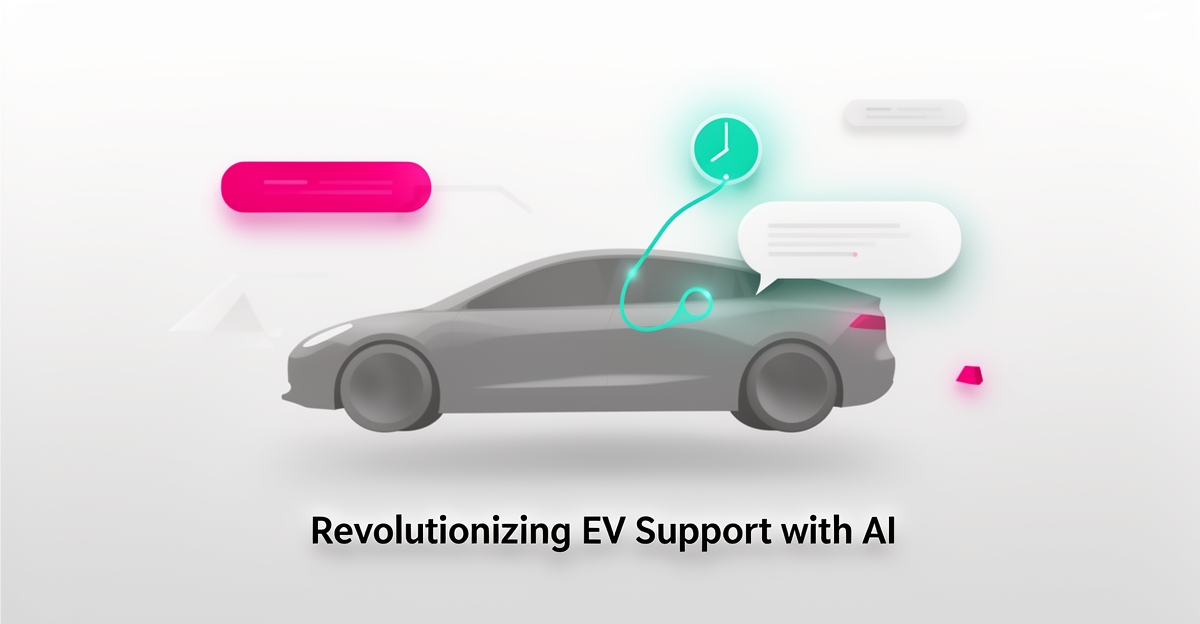
How an AI Customer Support Agent Can Handle EV Owner Inquiries 24/7
Key Facts
- Most EV support tickets are routine — charging questions, battery basics, warranty terms — and are highly automatable
- Consumers increasingly expect immediate responses to support inquiries, not next-business-day replies
- AI agents trained on service manuals and warranty documents can answer instantly, at any hour, with consistent accuracy
- Hybrid AI + human models keep complex diagnostics and warranty exceptions with certified technicians
- AIQ Labs has deployed 200+ multi-agent systems and runs 4 live SaaS products daily
Hire a team member that works 24/7 — for less than a part-time wage.
AI receptionists, SDRs, dispatchers and 99+ roles. Trained on your business, fully managed.
Not sure where to start? Ask our AI planner
The Rising Pressure on EV Support Teams
EV battery service centers are experiencing mounting strain as electric vehicle adoption accelerates, with owners flooding support channels with repetitive questions about charging protocols, battery degradation, and warranty terms. Consumers increasingly expect an immediate response to their support inquiries, creating intense pressure on teams that traditionally operate within limited business hours. This expectation collides with the reality that EV-related queries often require nuanced explanations—such as interpreting state-of-health metrics or clarifying conditional warranty coverage—that cannot be resolved through static FAQs alone.
The volume and predictability of these inquiries expose critical limitations in traditional support models. A large share of incoming tickets typically concern routine topics like optimal charging speeds for different climates or how to initiate a battery health check. When human agents are tied up answering these repetitive questions, response times for complex technical issues—such as diagnosing sudden range loss or coordinating warranty replacements—inevitably lengthen, frustrating owners who need urgent assistance. This bottleneck not only degrades the customer experience but also diverts skilled technicians from high-value diagnostic work that requires human expertise.
AIQ Labs addresses this challenge by deploying AI Employees specifically trained on EV battery service workflows, capable of handling tier-one inquiries 24/7 while seamlessly escalating intricate cases to human specialists. These managed AI agents integrate directly with service center systems to access real-time battery telemetry and warranty databases, ensuring responses are both instant and accurate. By automating the resolution of high-frequency questions—such as explaining Level 2 vs. DC fast charging impacts on longevity or walking owners through warranty claim documentation—service centers can reclaim significant operational capacity, allowing human technicians to focus on complex problem-solving and proactive outreach. This hybrid approach transforms support from a reactive cost center into a strategic asset that builds owner trust through consistent, knowledgeable engagement—without requiring proportional increases in staffing during peak inquiry periods.
How AI Agents Deliver Instant, Accurate EV Support
EV battery service centers know the drill: owners need answers about charging protocols, degradation curves, and warranty terms at all hours. Traditional support models buckle under that volume. AI agents built on retrieval-augmented generation, knowledge graphs, and multi-agent reasoning change the equation — they can resolve the majority of routine inquiries instantly, at any hour, with consistent accuracy.
- RAG retrieves exact passages from service manuals, TSBs, and warranty documents — no invented specs
- Knowledge graphs map relationships between battery chemistry, charging behavior, and failure modes for contextual answers
- Multi-agent reasoning breaks complex questions into steps: diagnose, verify coverage, schedule service
- Human technicians receive pre-triaged cases with full context, not raw tickets
AIQ Labs deploys this architecture as managed AI employees — support agents that integrate with your CRM, scheduling, and diagnostics tools. They handle the repetitive volume so your certified technicians focus on the cases that demand expertise. The result: owners get accurate answers at 2 AM, service bays stay booked with qualified appointments, and your team scales without adding headcount.
The Hybrid Model: AI + Human Technicians for Complex Issues
AIQ Labs designs AI customer support systems that create a seamless handoff between automated agents and human technicians, ensuring EV owners receive the right level of support at the right time. This hybrid approach allows AI to manage routine inquiries while escalating complex technical issues to qualified human experts.
AI agents can typically handle the bulk of routine customer inquiries—questions about charging times, battery maintenance basics, or warranty coverage details—freeing human technicians to focus on diagnostics and repairs that require specialized knowledge. When an inquiry involves nuanced diagnostics, safety concerns, or warranty exceptions, the AI agent seamlessly transfers the conversation to a human technician with full context preserved, reducing repetition and frustration for the customer.
- Technicians reclaim hours previously spent on repetitive calls, redirecting them to high-value diagnostics
- Routine issues are resolved in minutes rather than waiting for business hours
- Answers stay consistent across every touchpoint, because every response draws from the same verified documentation
By integrating AI into their support workflow, EV battery service centers can maintain 24/7 availability for common questions while ensuring that complex cases receive expert attention. This model not only improves first-contact resolution but also enhances technician productivity by eliminating repetitive inquiries from their workload. AIQ Labs implements this hybrid model through custom AI employees trained on EV-specific data, enabling natural, context-aware conversations that escalate appropriately when human expertise is required. The result is a support system that scales with demand while preserving the empathy and precision that EV owners expect when dealing with critical vehicle systems.
Implementing AI Employees for EV Support with AIQ Labs
EV owners don’t wait for business hours when a charger fails or warranty coverage is unclear. Support teams face high volumes of charging, battery life, and warranty questions that demand instant, accurate answers 24/7.
Deploying a managed AI Employee changes that dynamic for service centers. AIQ Labs builds fully trained, industry-specific AI Employees across 99+ roles that integrate with CRM and scheduling tools, work continuously, and are optimized from real interactions — typically at roughly 80% less cost than a comparable human hire.
For EV battery service, an AI Employee is trained on charging protocols, battery health diagnostics, warranty terms, and service center workflows. It answers FAQs instantly, triages issues, gathers vehicle and owner details, and routes complex technical problems to human technicians. This hybrid approach keeps routine inquiries automated while preserving human expertise for nuanced cases.
Implementation with AIQ Labs follows a done-for-you model. The business provides a role description, the team architects and trains the agent on specific processes and voice, integrates with existing CRM, calendar, and service tools, and manages performance ongoing. The agent operates via phone, email, chat, and SMS with natural communication.
Continuous optimization is built in. The system learns from performance data, updates knowledge as warranty policies or service procedures change, and maintains audit trails for compliance. Key capabilities include:
- Context-aware responses trained on your specific EV service data and documentation
- Seamless CRM and scheduling integration for appointment booking and case creation
- Intelligent escalation to human technicians for complex battery diagnostics or warranty disputes
- 24/7/365 coverage with zero missed calls and consistent quality
If your bottleneck is bigger than support — scheduling, intake, follow-up across the whole operation — a targeted Workflow Build rebuilds the one workflow that costs the most, or a full AI Operating System connects everything into one owned operating layer.
With the Start Monthly model, businesses get build, training, integrations, monitoring, and improvements in a flat monthly plan, with the ability to pause or adjust anytime. Prefer a fixed-scope project or full ownership? AIQ Labs also offers Build in Milestones and Own It Outright — see pricing for details. Managed AI Employees work alongside human teams, not as a widget, handling real workflows end-to-end.
Start the 2-minute Fit Check at aiqlabs.ai/apply for a free 30-minute strategy call to map your biggest support bottleneck and identify high-ROI automation opportunities. Questions? Email [email protected].
Still paying for 10+ subscriptions that don’t talk to each other?
We build custom AI systems you own outright. No vendor lock-in. Full control.
Not sure where to start? Ask our AI planner
Frequently Asked Questions
How can an AI support agent help EV owners with charging questions at any time of day?
What share of routine EV support inquiries can AI agents handle automatically?
Will using an AI support agent make our EV service feel less personal or robotic?
How much time can AI-powered support save our EV service team on routine calls?
Can AI agents integrate with our existing EV service tools like CRM and scheduling software?
What happens when an EV owner's question is too complex for an AI agent to handle?
Powering EV Support Around the Clock
As electric vehicle adoption accelerates, service centers face mounting pressure to deliver instant, accurate support for charging, battery health, and warranty inquiries—without burning out teams or inflating costs. AIQ Labs’ managed AI Employees resolve the bulk of routine questions 24/7, seamlessly escalating complex cases to human technicians while integrating with CRM, scheduling, and diagnostics tools. This hybrid model keeps response times short, keeps answers consistent, and frees skilled staff to focus on high-value diagnostics and proactive outreach. The result is a scalable, cost-effective support system that builds owner trust and turns service from a reactive cost center into a strategic advantage. To see how this works for your EV battery service operation, start with the free 2-minute Fit Check at aiqlabs.ai/apply — it leads to a no-obligation 30-minute strategy call where we’ll map your biggest bottleneck and identify high-ROI automation opportunities.
Make AI your competitive advantage — not just another tool.
Strategy, implementation and ongoing optimization. One partner, end to end.
Not sure where to start? Ask our AI planner