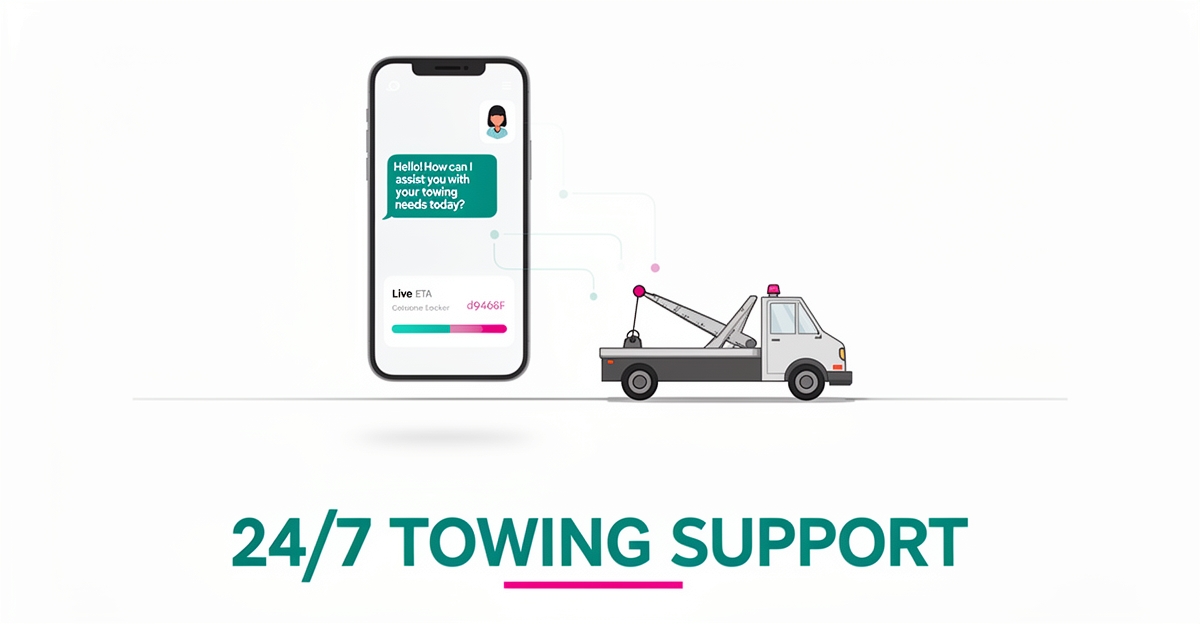
How an AI Customer Support Agent Can Handle Towing Complaints and Inquiries
Key Facts
- Proactive SMS updates typically reduce “Where is my tow truck?” calls substantially by answering the question before the customer asks it
- Accurate, consistent ETAs are one of the strongest drivers of customer trust in roadside assistance
- AI-optimized dispatching typically shortens average tow truck arrival times by matching jobs to the nearest available driver
- AI agents answer instantly at any hour, eliminating hold times and missed after-hours calls
- First-contact resolution typically improves when routine inquiries are handled without transfers
- Most routine towing inquiries—status checks, intake, billing questions—can be resolved without human intervention
- Digital booking and self-service portals typically lift online booking rates for field service businesses
Hire a team member that works 24/7 — for less than a part-time wage.
AI receptionists, SDRs, dispatchers and 99+ roles. Trained on your business, fully managed.
Not sure where to start? Ask our AI planner
Why Towing Customer Service Is Uniquely Difficult
A stranded motorist on the shoulder of a highway at 2 a.m. isn't calling to chat—they're calling scared, frustrated, and demanding to know when help will arrive. That single reality is what makes towing customer service unlike almost any other support environment.
Towing calls come in at all hours, often from customers in stressful or emergency situations, while dispatchers juggle incoming requests against driver availability and real-time location data. The business inherently involves danger, constant movement, machinery, and dealing with the public during moments of intense stress. Speed, accuracy, and empathy aren't nice-to-haves—they're the entire job.
The pressure compounds quickly. Traditional call handling is limited by the number of human agents on shift, so high call volume directly translates to missed calls and long hold times. Meanwhile, customer expectations keep climbing—people expect the same instant, transparent updates from a tow truck that they get from a rideshare or a food delivery app.
At the center of this storm sits the industry's most corrosive complaint loop: “Where is my truck?” A customer calls for an update, the dispatcher is busy with a new emergency, the customer calls again five minutes later, and trust erodes with every unanswered ring. This repetitive cycle burns out staff and clogs phone lines exactly when dispatchers need to focus on live incidents. And a poor service experience at a customer's worst moment is one of the fastest ways to lose their business for good.
The operational toll of this loop includes:
- Dispatchers pulled away from active emergencies to answer repetitive status calls
- Long hold times that turn anxious customers into angry ones
- Missed after-hours calls that send jobs straight to competitors
- Staff burnout driven by nonstop, high-stress phone traffic
What makes this especially difficult is that consistency matters as much as speed. Human responses vary by agent and can be affected by fatigue, mood, or information gaps—understandable in a 24/7 operation, but costly when a stranded customer hears three different ETAs from three different people. Accurate, consistent communication is precisely what anxious callers need most.
This is the gap AI support agents are built to close. By maintaining consistent communication across every touchpoint—answering calls instantly at any hour, collecting location and vehicle details accurately, and pushing proactive status updates—AI employees handle the repetitive inquiry volume so human dispatchers can focus on the emergencies that genuinely require judgment and empathy. It's the same model AIQ Labs applies across field service businesses with its AI Employees: AI manages routine communication and reduces call volume, while people handle the complex, high-stakes work. For an industry where every call is a customer's worst hour, that division of labor isn't a luxury—it's becoming the baseline for keeping customers and keeping staff.
How AI Agents Resolve the Core Complaints Instantly
Towing complaints often stem from uncertainty—customers left wondering when help will arrive or why their issue hasn’t been resolved. AI customer support agents eliminate this friction by delivering instant, consistent communication that keeps customers informed and calm. Automated SMS updates directly address the most frequent source of frustration in roadside assistance scenarios: the “Where is my tow truck?” call. This proactive communication ensures customers receive real-time status without needing to call and wait on hold.
Beyond updates, AI-driven ETAs significantly boost confidence in the service. When arrival predictions are accurate and consistent, anxiety turns into reassurance. When delays occur, the system communicates changes instantly, maintaining transparency. Sentiment analysis further enhances responsiveness by detecting frustration in a customer’s tone or language during chat or voice interactions. When negative sentiment is identified, the AI triggers an immediate escalation to a human agent, ensuring empathetic handling of complex or distressed situations without delay.
These capabilities drive measurable improvements in efficiency and resolution. Response times drop from minutes or hours to seconds, and first-contact resolution typically improves because routine inquiries are answered completely on the first interaction. By handling routine inquiries and providing timely updates, AI allows human dispatchers to focus on high-priority cases, improving overall service quality. AIQ Labs implements these capabilities through AI Employees that integrate with dispatch and CRM systems, ensuring seamless communication across all customer touchpoints.
The Hybrid Model: AI Handles Routine, Humans Handle Complex
The most effective towing operations don’t replace their dispatchers with AI—they build a partnership where each handles what they do best. This hybrid model allows companies to resolve the large majority of routine calls autonomously while ensuring complex situations receive human attention.
The division of labor is strategic. AI agents excel at managing high-volume, predictable interactions that typically overwhelm human staff during peak hours. By handling these routine inquiries, the system creates immediate capacity for your team to focus on high-stakes situations requiring empathy and nuanced judgment.
Here is how the workload typically splits:
- Routine billing and payment inquiries — AI processes payments, explains charges, and emails receipts without human involvement
- Real-time status updates — Automated SMS and voice updates eliminate most “Where is my tow truck?” calls by keeping customers informed proactively
- Structured dispatch intake — AI captures location, vehicle type, and service details accurately, logging everything directly into your dispatch system
- Complex complaint resolution — Human agents step in when customers dispute charges, report vehicle damage, or express significant frustration
- Sensitive negotiations — Staff handle pricing disputes, insurance complications, and situations requiring emotional intelligence
When a call requires escalation, the AI doesn’t simply transfer the customer to a queue. It performs a context-rich handoff, providing the human agent with the complete conversation history, customer intent, and relevant account data. This seamless transition means the customer never repeats information, and your team starts solving the problem immediately rather than gathering background details.
The financial impact of this collaboration is substantial. For towing companies, it means you can maintain 24/7 responsiveness without the expense of overnight staffing or the service gaps that drive customers to competitors—typically at a fraction of the cost of adding human coverage around the clock.
AIQ Labs designs these collaborative frameworks specifically for field service businesses, ensuring your AI employees integrate smoothly with existing dispatch workflows. The result is a support operation that scales efficiently—AI manages the predictable volume while your experienced team handles the exceptions that truly require human expertise.
Implementation Roadmap for Towing Operations
Towing customers are in distress, on the road, and expect instant answers. An AI customer support agent that is built for the towing workflow can absorb routine inquiries, deliver proactive updates, and keep human dispatchers focused on live jobs.
A practical rollout follows a six-step deployment path that aligns with how AI support agents manage complaints, provide service updates, and resolve simple issues without human escalation.
- Select an industry-specific provider that understands towing dispatch, service areas, and 24/7 call patterns
- Integrate with dispatch and CRM systems so the agent can read job status, driver location, and customer history in real time
- Train the AI on your service areas, pricing, and frequently asked questions for accurate, on-brand responses
- Enforce data security standards and privacy controls before any customer data flows to the agent
- Monitor performance via sentiment analysis and resolution metrics to improve handling of complaints
- Maintain clear human escalation paths for complex or sensitive situations
Provider selection matters because towing is high-pressure and time-critical. The agent must handle voice and chat, collect location and vehicle details accurately, and hand off seamlessly. Companies deploying AI support agents typically see response times collapse from minutes to seconds and first-contact resolution improve as routine inquiries stop bouncing between people and queues.
Integration is the foundation of trust. When the AI connects to dispatch and CRM, it can share accurate ETAs and automated SMS updates that dramatically reduce “Where is my tow truck?” calls. AI-optimized dispatching also typically shortens average arrival times by matching each job to the nearest suitable driver.
Training and security must happen in parallel. The model needs your specific service areas, pricing, and policies, plus guardrails for privacy and compliance. Data quality and availability are among the biggest obstacles to efficient AI implementation, and security concerns remain a top challenge for service leaders rolling out AI—so address both before go-live, not after.
Monitoring keeps the system honest. Sentiment analysis can flag frustrated customers for tailored responses or escalation, while resolution metrics show where routine issues are being handled. Most organizations find that the large majority of cases no longer require human intervention, freeing teams for complex complaints.
The hybrid model is essential. AI handles initial contact, data collection, and status updates, then passes full conversation context to a human when empathy or judgment is required. AIQ Labs deploys AI employees that maintain consistent communication, reduce call volume, and improve customer satisfaction across all touchpoints, with clear escalation built into the workflow.
Beyond Support: How AI Transforms the Whole Towing Business
Customer support is the visible tip of the towing operation, but AI support agents become the entry point to a fully optimized fleet.
When an AI employee answers a complaint, provides a service update, or resolves a simple issue without human escalation, it captures real-time data that feeds dispatch, maintenance, and revenue systems. The result is support automation that drives operational gains across the business.
Smart dispatching is one of the first operational wins. AI algorithms analyze real-time traffic, driver availability, and job nature to assign the closest and most suitable driver, typically cutting average arrival times meaningfully in the process.
Predictive maintenance follows the same data loop. Vehicle sensor data is analyzed to forecast service needs before a breakdown occurs, which typically reduces long-term repair costs and keeps trucks on the road instead of in the shop.
Fraud detection and customer retention also improve from support interactions. Photo verification and pattern analysis lower false claims, while automated follow-up keeps customers engaged.
Operational gains that connect directly to support automation include:
- Smart dispatching cuts arrival times by matching jobs to the nearest available driver
- Predictive maintenance reduces repair costs through sensor-based forecasting
- Fraud detection lowers false claims using AI photo verification
- Personalized follow-ups drive more repeat business via AI-generated emails
These improvements compound because the AI support agent maintains consistent communication across all touchpoints. AIQ Labs deploys AI employees that work 24/7, reduce call volume, and improve satisfaction while feeding structured data into back-office workflows. For operators who want to go further, a single Workflow Build can rebuild the one process that costs the most—often dispatch intake or after-hours call handling—and an AI Operating System connects support, dispatch, and billing into one layer you own outright.
The support layer also lifts trust and efficiency. Accurate AI-driven ETAs and automated SMS updates cut the volume of “Where is my tow truck?” calls substantially, freeing dispatchers to focus on exceptions rather than status checks.
Positioned as the front door to the operation, AI customer support becomes the control plane for the fleet. It resolves inquiries, captures intent, and triggers dispatch, maintenance, and follow-up actions in one continuous flow. For towing businesses, that means faster service, lower costs, and more repeat business from a single automation investment.
Still paying for 10+ subscriptions that don’t talk to each other?
We build custom AI systems you own outright. No vendor lock-in. Full control.
Not sure where to start? Ask our AI planner
Frequently Asked Questions
How can an AI customer support agent reduce the number of 'Where is my tow truck?' calls?
Can AI support agents handle complex complaints like billing disputes or vehicle damage claims?
What kind of improvement in customer trust can I expect from using AI-driven ETAs?
Will implementing an AI support agent require me to replace my human dispatchers?
How much can AI reduce average response times for towing inquiries?
Is it difficult to integrate an AI support agent with my existing dispatch and CRM systems?
Turning Towing Stress into Operational Strength
Towing customer service isn’t just about answering phones—it’s about delivering calm in chaos, and AI support agents are proving they can do exactly that. By handling routine inquiries, providing real-time updates, and cutting “Where is my tow truck?” calls dramatically, AI lets human dispatchers focus on emergencies that require judgment and empathy. The result is faster response times, higher customer trust, and a hybrid model that boosts satisfaction while cutting operational costs. For towing businesses ready to move beyond reactive support and build a resilient, 24/7 operation, the path forward starts with understanding where AI can make the biggest impact. Take the first step with a free, no-obligation strategy session to explore your specific opportunities—start your Fit Check today at https://aiqlabs.ai/apply.
Make AI your competitive advantage — not just another tool.
Strategy, implementation and ongoing optimization. One partner, end to end.
Not sure where to start? Ask our AI planner