How an AI Dispatch Agent Can Improve On-Time Delivery Rates for Your Bakery Wholesalers
Key Facts
- A 30-minute delay can render fresh bakery products unsellable, shrinking the margin for error to zero.
- Unlike reactive chatbots, AI dispatch agents detect delays and proactively notify partners before customers notice a problem.
- AI dispatch agents maintain short-term and long-term memory to recall historical traffic patterns and customer preferences.
- Safe AI deployment typically starts with a small share of delivery routes, monitored closely before scaling.
- Specialized AI agents for route optimization, customer notification, and inventory reconciliation work in parallel to protect perishable goods.
- AIQ Labs has deployed 200+ multi-agent systems and runs four live SaaS products daily, this is production-tested technology, not theory.
Hire a team member that works 24/7 — for less than a part-time wage.
AI receptionists, SDRs, dispatchers and 99+ roles. Trained on your business, fully managed.
Not sure where to start? Ask our AI planner
The Hidden Cost of Late Deliveries in Bakery Wholesale Logistics
Late deliveries in bakery wholesale don't just mean a missed slot. They mean unsellable product, broken trust with café and grocery partners, and revenue lost on perishable goods that cannot be recovered.
Traditional dispatch systems follow rigid, pre-programmed rules and static flows. They react only when prompted by a user and treat each interaction as new. When traffic jams, a vehicle breakdown, or a sudden order spike hits, the system cannot perceive, plan, or adapt.
Agentic AI dispatch systems reason, plan, and adapt dynamically based on real-world feedback. An agent can break down high-level goals such as "Deliver all morning orders by 8 AM" into executable steps and act without constant human input. Perception, planning, and autonomous action replace reactive monitoring.
Static automation fails because it lacks memory and tool usage. Traditional systems have limited or non-existent context and can invoke only specific, pre-defined functions. Agentic systems maintain short-term and long-term memory to recall past delivery issues, customer preferences, and historical traffic patterns to make informed decisions.
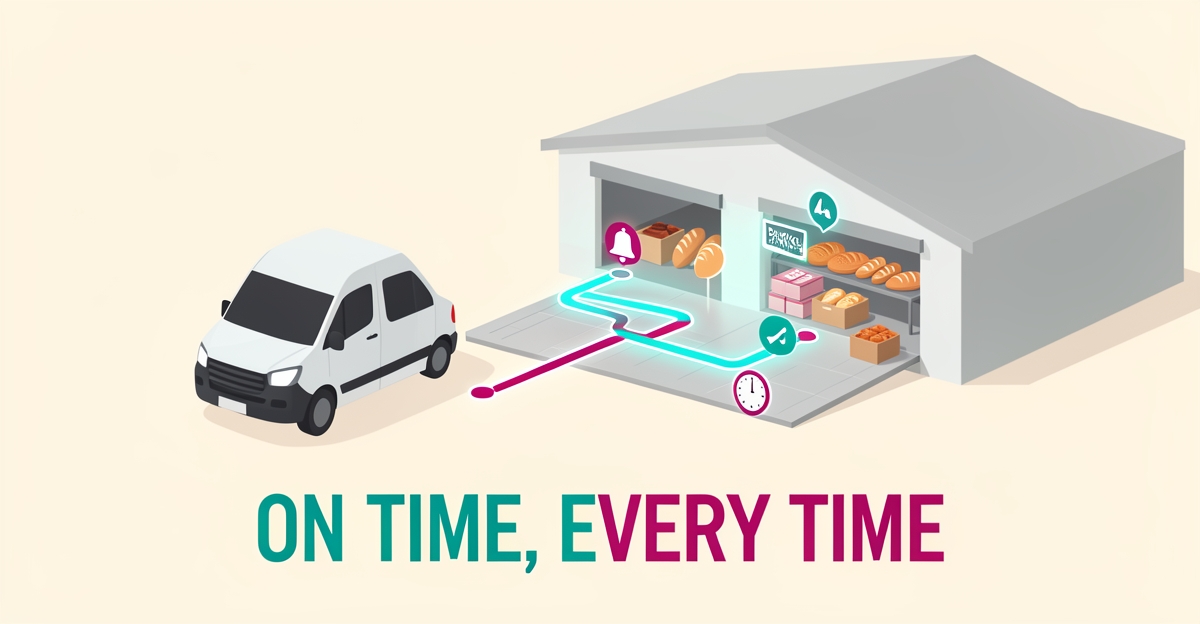
Proactive management changes the cost equation. Instead of waiting for a customer to call about a late delivery, an agent can detect a delay, calculate a new arrival time, and automatically notify the partner with an updated ETA. This shift from reactive responses to proactive management protects both margin and reputation.
Bakery wholesalers face compounding risks with current tools:
- Perishability windows shrink the margin for error; a 30-minute delay can render fresh items unsellable.
- Tight delivery windows require real-time rerouting, not next-morning reports.
- Reactive systems cannot coordinate route optimization, customer notification, and inventory reconciliation in parallel.
Without autonomous adaptation, teams stay in firefighting mode. Agents can analyze a broad range of variables such as weather, traffic, and order volume and adapt delivery plans instantly. Specialized agents for route optimization, customer notification, and inventory reconciliation can work in parallel to ensure efficiency.
As of late 2026, agentic AI has moved well past the experimentation phase for logistics teams that committed early. Wholesalers who wait for a "standard" playbook to emerge are handing a reliability advantage to competitors who already run dispatch agents in production.
AIQ Labs deploys managed AI employees to handle logistics workflows 24/7, enabling dispatch agents to proactively manage delivery schedules and notify partners of delays. The result is improved reliability and customer satisfaction without adding headcount, at a fraction of the cost of a human hire.
The hidden cost of late deliveries is not only spoiled product. It is the slow erosion of partner trust that static automation cannot prevent.
How AI Dispatch Agents Transform Logistics from Reactive to Proactive
For bakery wholesalers, the difference between a satisfied customer and a missed opportunity often hinges on minutes, not hours. Traditional dispatch systems react to problems after they occur, rerouting only when a driver calls in late or sending apologies after a delivery window closes. This reactive approach leaves bakeries vulnerable to spoilage, strained relationships, and lost revenue when timing is everything.
AI dispatch agents transform this dynamic by operating with true autonomy, memory, tool usage, and coordination, core capabilities that enable proactive logistics management. Unlike rule-based automation that follows static scripts, these agents perceive disruptions like traffic delays or equipment failures, reason through alternatives using real-time data, plan adjusted routes, and act by updating schedules and notifying stakeholders, all without human prompting. They maintain both short-term context for immediate decisions and long-term memory via vector databases to recall historical patterns such as recurring bottlenecks at specific intersections or customer-specific delivery preferences. By integrating with GPS APIs, inventory systems, and communication platforms through tool usage, they dynamically adjust plans based on live conditions. Furthermore, multi-agent coordination allows specialized roles, like a Route Optimizer agent working alongside a Customer Notifier agent, to execute complex workflows in parallel, ensuring efficiency even during peak demand.
This shift from reactive to proactive is critical for perishable goods where delays compound risk. Agentic AI systems initiate actions like delay notifications without direct user prompting, contrasting sharply with traditional chatbots that only respond when queried. For bakery wholesalers, this means an AI dispatch agent can detect a developing delay, calculate a new estimated time of arrival, and automatically alert wholesale partners via SMS or email before the customer even notices a problem, preserving trust and reducing inbound service calls. AIQ Labs builds such agentic systems as managed AI employees that operate 24/7, integrating directly with bakery logistics workflows to maintain freshness and reliability. By moving beyond rigid automation to adaptive, reasoning-driven agents, bakeries gain the agility needed to protect product quality and strengthen partner relationships in real time.
Implementing a Secure, Scalable AI Dispatch Agent: A Step-by-Step Guide
Implementing a secure, scalable AI dispatch agent requires a structured approach that balances automation with oversight. Start by defining clear, measurable goals such as maintaining 99% on-time delivery for perishable goods within strict 4-hour windows, which directly addresses bakery wholesalers' core logistics challenges. Agentic AI systems excel here by perceiving disruptions like traffic delays, reasoning through alternatives, and autonomously adjusting schedules, moving beyond rigid rule-based automation to dynamic problem-solving.
Next, integrate real-time data sources including GPS feeds, inventory systems, and order management platforms to give the agent situational awareness. This context gathering enables proactive adaptations, such as rerouting deliveries during unexpected road closures or notifying partners of delays before customers inquire. Design the agent's architecture to support multi-agent collaboration, for example, separating route planning from customer notification tasks, while implementing a vector database for long-term memory to recall historical patterns like recurring bakery-specific delivery bottlenecks.
Establish strict safety guardrails to prevent unauthorized actions, such as rerouting to closed facilities or sending incorrect ETAs, and validate these through rigorous simulation of edge cases like vehicle breakdowns during peak morning deployments. Deploy incrementally, starting with a small share of delivery routes, to monitor performance and compare outcomes before scaling, ensuring human supervisors retain override capability for high-stakes decisions. Continuous optimization then refines the agent's reasoning pipeline using post-execution feedback, turning logistics from a reactive cost center into a proactive, reliable advantage. AIQ Labs builds these systems in phases with fixed-price milestones, so you always know what you're paying for and can stop or course-correct at any point. Schedule a free strategy call to map your bakery wholesaler's specific dispatch workflow and identify where AI-driven autonomy can deliver measurable on-time delivery improvements.
Still paying for 10+ subscriptions that don’t talk to each other?
We build custom AI systems you own outright. No vendor lock-in. Full control.
Not sure where to start? Ask our AI planner
Frequently Asked Questions
How does an AI dispatch agent actually improve on-time delivery for perishable bakery goods?
Will the AI agent notify my wholesale partners if a delivery is running late?
What happens if the AI makes a mistake, like rerouting to the wrong location?
How is an AI dispatch agent different from the automation software we already use?
How do you roll out an AI dispatch agent without disrupting our existing delivery operations?
Is now the right time to invest in agentic AI for our logistics, or should we wait?
From Firefighting to First-Mile Advantage
Late deliveries in bakery wholesale cost more than spoiled product, they erode partner trust that static dispatch rules can't protect. Agentic AI changes the equation by perceiving disruptions, reasoning through alternatives, and acting without constant prompting to keep perishable goods moving within tight windows. With memory of past bottlenecks, real-time tool use across GPS, inventory and communications, and coordinated specialist agents, dispatch shifts from reactive apologies to proactive ETAs and reroutes that preserve margin and reputation. If you're mapping where autonomy can lift on-time delivery, start with a clear goal, secure data integrations, and guardrails for a phased rollout. AIQ Labs deploys managed AI employees to handle logistics workflows 24/7, helping teams move from firefighting to reliable, proactive delivery, with 200+ multi-agent systems already in production. Start the two-minute Fit Check at aiqlabs.ai/apply, then book a free 30-minute strategy call to map your dispatch workflow and identify high-ROI automation opportunities.
Make AI your competitive advantage — not just another tool.
Strategy, implementation and ongoing optimization. One partner, end to end.
Not sure where to start? Ask our AI planner