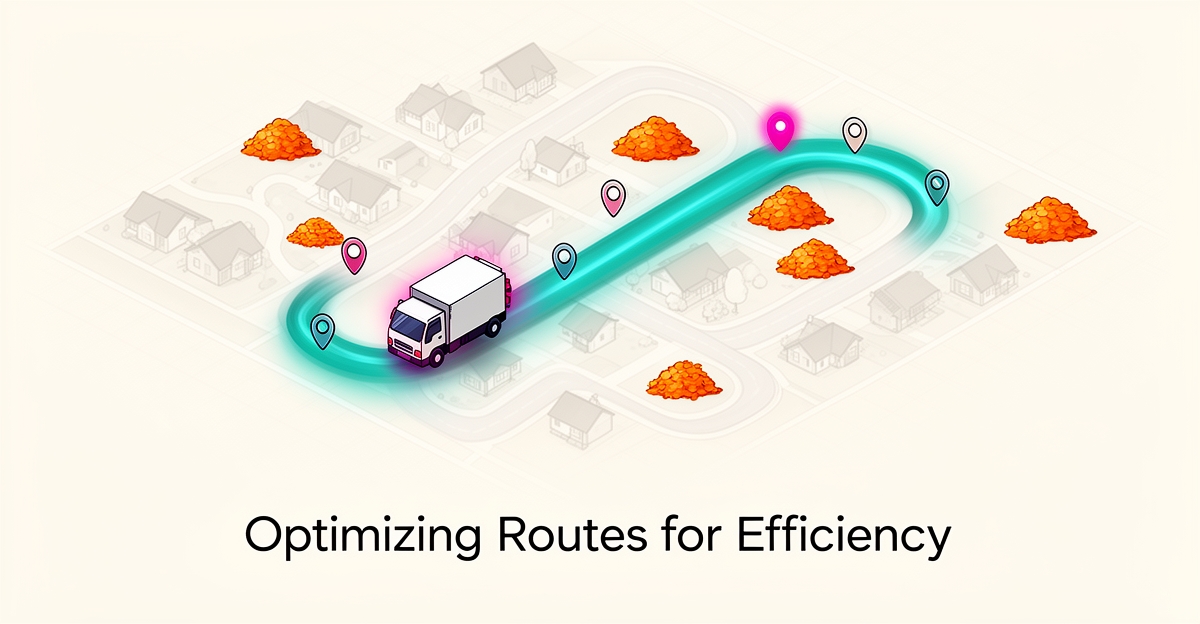
How an AI Dispatch Agent Can Improve Route Efficiency for Leaf Removal Businesses
Key Facts
- Skroutz improved on-time delivery reliability from 93% to 98.5% after implementing route optimization according to Google Maps Platform
- Driver throughput grew by 10% for Skroutz following route optimization deployment per Google Maps Platform case study
- Google Maps Route Optimization API handles dynamic road conditions and scales across geographic areas as detailed by Google Maps Platform
- AI dispatch agents re-optimize routes in real time for new orders, cancellations, and traffic delays per Google Maps Platform blog
- Logistics automation applies software and machinery to improve operational efficiency according to Wikipedia
- AIQ Labs AI Employees typically cost around 80% less than a human hire while working 24/7/365
- AIQ Labs has deployed 200+ multi-agent systems and runs 4 live SaaS products daily
Hire a team member that works 24/7 — for less than a part-time wage.
AI receptionists, SDRs, dispatchers and 99+ roles. Trained on your business, fully managed.
Not sure where to start? Ask our AI planner
The Hidden Cost of Inefficient Routes in Leaf Removal
Leaf removal businesses often face a hidden drain on profitability: inefficient routes. Manual dispatching relies on static plans that quickly unravel when faced with last-minute cancellations, traffic delays, or new job requests, forcing reactive changes that waste time and resources. This constant reshuffling leads to drivers backtracking, idling in traffic, or arriving late, directly increasing fuel consumption and operational costs. Without real-time adaptability, even well-intentioned schedules become sources of avoidable expense and frustration.
These inefficiencies cascade into missed jobs and dissatisfied customers. When routes aren't optimized for time windows or job density, crews may skip stops to catch up or arrive outside promised service windows, damaging trust and reducing repeat business. Businesses using static planning typically see meaningfully lower on-time performance, Skroutz, for example, improved its on-time delivery reliability from 93% to 98.5% only after implementing dynamic route optimization technology. For leaf removal, where timely service is expected seasonally, such gaps directly impact customer retention and brand reputation.
The root issue lies in the inability of manual systems to process multiple variables at once. AI dispatch agents overcome this by continuously analyzing traffic patterns, job locations, crew availability, and service constraints to generate optimal routes. They don't just plan once, they re-optimize in real time as conditions change, ensuring drivers take the most efficient path throughout the day. In Skroutz's deployment, this capability increased driver throughput by 10%, meaning more jobs completed per shift without adding vehicles or staff. For seasonal businesses, this translates to higher revenue potential during peak leaf-fall periods.
Ultimately, inefficient routing isn't just about wasted fuel, it's a systemic drag on service quality and scalability. By replacing guesswork with data-driven, adaptive planning, AI dispatch turns a costly liability into a streamlined, customer-focused operation. The result is fewer missed opportunities, lower costs per job, and a workforce that can focus on what they do best: removing leaves, not fighting traffic.
How AI Dispatch Agents Optimize Routes in Real Time
A static route plan built at 7 a.m. is often obsolete by 9. Traffic builds, customers call to reschedule, a job runs long, and suddenly your crew is burning fuel on backtracking instead of clearing yards. This is where an AI dispatch agent changes the math.
Unlike manual dispatch, which reacts slowly to disruption, AI-powered dispatch re-optimizes continuously. According to Google Maps Platform, modern route optimization can assign tasks and plan multi-stop routes for a fleet of one or more vehicles while handling dynamic road conditions and scaling across geographic areas. When a driver runs late, a new order comes in, or a customer cancels, the system re-optimizes the plan in real time rather than waiting for a dispatcher to redraw it by hand.
The intelligence behind this comes from operations research algorithms running on cloud infrastructure, designed to solve large, complex vehicle routing problems efficiently. For a leaf removal operation, that means the system weighs several competing objectives at once:
- Travel efficiency, measured in both time and distance, so crews spend hours raking, not idling in traffic
- On-time arrivals within defined service windows, protecting the customer promise
- Balanced workloads across drivers, preventing burnout and uneven days
- Minimal vehicle utilization, cutting fuel spend per job
The results from real deployments are compelling. Skroutz, a major e-commerce platform, improved its on-time delivery reliability from 93% to 98.5% and grew driver throughput by 10% after integrating route optimization, according to the company's case study. For a seasonal leaf removal business, a similar lift means more jobs completed per truck per day, the difference between a profitable season and a stretched one.
Accuracy of inputs matters as much as the algorithm itself. Google's solution is natively integrated with Google Maps routing and geolocation data, which serves as highly accurate inputs to optimization, a meaningful advantage when a wrong turn in a subdivision costs your crew twenty minutes. "We can account for pretty much all the constraints and optimize for our key metrics," said Agamemnon Papazoglou, Director of Strategy at Skroutz Last Mile, in an interview with Google.
This approach is part of the broader shift toward logistics automation, applying software and automated systems to operations to improve efficiency. The catch is that little generalized software exists for these workflows, which is why custom-built solutions tend to outperform off-the-shelf tools. That's precisely how AIQ Labs approaches dispatch: deploying intelligent, trained AI employees that handle dispatching with precision and speed, integrated with the scheduling and communication tools a field service business already runs. You can see the full range of roles, including dispatchers, on the AI Employees page.
When routes adjust themselves as conditions change, on-time performance stops being a daily scramble and becomes a system output.
Implementing an AI Dispatch Agent with AIQ Labs
Deploying an AI dispatch agent begins with defining clear operational constraints and objectives. For leaf removal businesses, this means specifying service windows, vehicle capacities, driver availability, and desired optimization goals, such as minimizing travel time or balancing workloads. AIQ Labs works with clients to translate these real-world requirements into technical parameters that the AI system can process, ensuring the solution aligns with daily field operations from the start.
Integration with existing tools is straightforward: the AI Employee connects to critical platforms like Google Calendar for scheduling, CRM systems for customer data, and routing engines for real-time path calculation. This allows the AI dispatcher to pull job details, update schedules, and re-optimize routes dynamically as conditions change, such as new orders, cancellations, or traffic delays, without manual intervention. The system handles dynamic road conditions and scales with organizational growth, turning complex routing problems into efficient, automated workflows.
AIQ Labs' Start Monthly model simplifies deployment by providing a fully managed AI Employee that works 24/7, with setup, training, tool integrations, monitoring, and continuous improvements included in a flat monthly fee, typically around 80% less than the cost of a human hire. As your operation grows, you can move to a Build in Milestones engagement to rebuild the workflow that costs you the most, or Own It Outright for a system you keep with no ongoing licensing. AIQ Labs has deployed 200+ multi-agent systems and runs 4 live SaaS products of its own daily, so the dispatch agent you get is built on patterns already proven in production. By combining deep technical expertise with a partnership mindset, AIQ Labs ensures the AI dispatch agent not only launches successfully but evolves alongside the business, delivering sustained gains in route efficiency, fuel savings, and service reliability.
Still paying for 10+ subscriptions that don’t talk to each other?
We build custom AI systems you own outright. No vendor lock-in. Full control.
Not sure where to start? Ask our AI planner
Frequently Asked Questions
How does an AI dispatch agent improve route efficiency for a leaf removal business?
What specific problems does inefficient routing cause for leaf removal companies?
Can an AI dispatch agent handle real-time changes like traffic delays or customer cancellations?
How does AIQ Labs implement an AI dispatch agent for a leaf removal business?
Is implementing an AI dispatch agent expensive for a small leaf removal business?
What results can a leaf removal business expect from using an AI dispatch agent?
Turn Every Route Into a Revenue Opportunity
Leaf removal businesses operate in a narrow seasonal window where every hour of efficiency translates directly into revenue. Static route plans crumble under the weight of last-minute cancellations, traffic delays, and new job requests, costing you fuel, missed appointments, and customer trust. An AI dispatch agent changes that equation by continuously optimizing routes in real time, balancing workloads across drivers, and ensuring on-time arrivals within promised service windows. Companies using dynamic route optimization have seen on-time reliability jump from 93% to 98.5% and driver throughput grow by 10%, according to Google Maps Platform case studies. For a seasonal business, that lift means more jobs completed per truck per day, without adding vehicles or staff. AIQ Labs deploys AI dispatch agents as fully managed AI Employees, integrating with your existing scheduling and communication tools so you can start seeing results without overhauling your operations. If you're ready to stop leaving revenue on the table, start the two-minute Fit Check and book a free strategy call to map your highest-ROI automation opportunity.
Make AI your competitive advantage — not just another tool.
Strategy, implementation and ongoing optimization. One partner, end to end.
Not sure where to start? Ask our AI planner