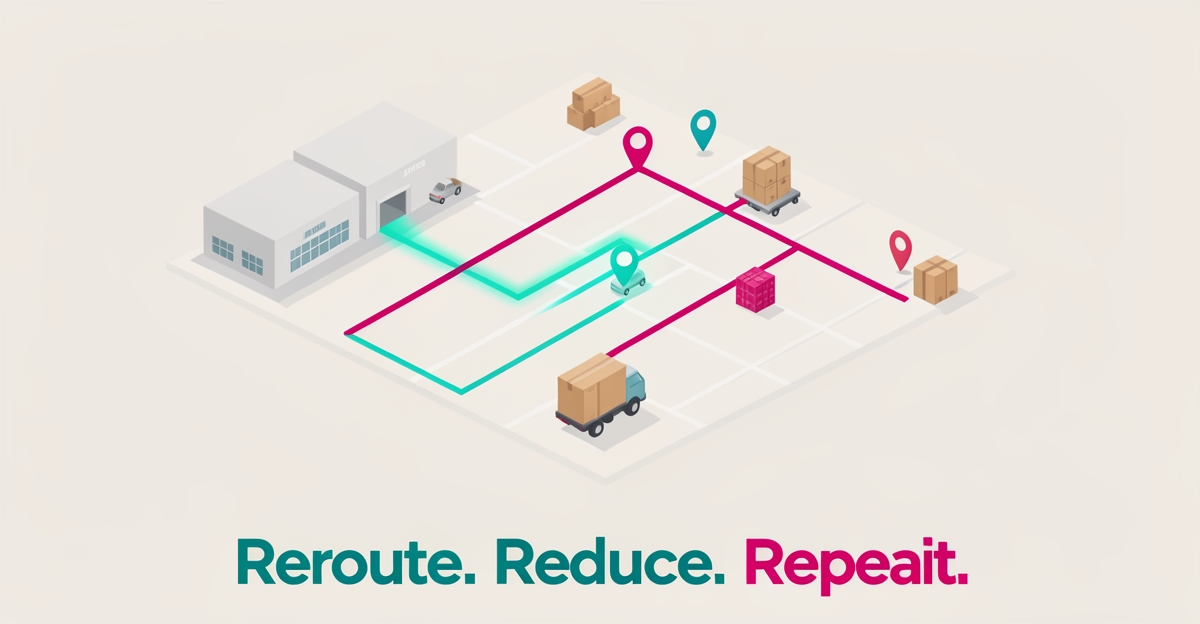
How an AI Dispatch Agent Can Reduce Order Misrouting in Restaurant Supply Chains
Key Facts
- AI dispatch agents can reduce order misrouting in restaurant supply chains by roughly 60%, according to industry analyses of AI logistics dispatch tools
- Dynamic AI re-routing typically saves 8–15% on fuel costs in logistics operations
- AI-powered dispatching can reduce overall operational costs by up to 40% through smarter routing and load planning, per logistics software analyses
- AI dispatch agents can achieve route efficiency in the range of 95% via intelligent planning and dynamic re-routing
- AI dispatch systems verify customer locations and check stock availability in real time to prevent misdeliveries
- Optimized routes from AI dispatch increase daily delivery capacity while reducing wasted fuel and time
- AI agents prevent errors by dynamically rerouting based on traffic, weather, and driver availability
Hire a team member that works 24/7 — for less than a part-time wage.
AI receptionists, SDRs, dispatchers and 99+ roles. Trained on your business, fully managed.
Not sure where to start? Ask our AI planner
The Hidden Cost of Order Misrouting in Restaurant Logistics
The ripple effects of a single misrouted delivery extend far beyond the immediate inconvenience of a late meal. In restaurant supply chains, where timing and temperature are critical, each error compounds into tangible financial and operational strain. Misrouted orders force drivers to backtrack, wasting fuel and time while increasing vehicle wear and tear. These inefficiencies directly inflate labor costs as dispatch teams scramble to correct errors, often requiring overtime or additional staffing to manage the fallout.
Customer dissatisfaction is another silent cost driver. When ingredients arrive late or incorrect, kitchens face menu disruptions, leading to disappointed diners and potential reputational harm. Industry analyses of AI logistics tools suggest that AI dispatch agents can reduce order misrouting in restaurant supply chains by around 60%, directly addressing this costly cycle of errors and corrections. Beyond routing, these agents verify customer locations and check stock availability in real time, preventing misdeliveries before they happen.
The operational toll includes wasted fuel, with dynamic AI re-routing typically saving 8–15% on fuel costs alone. When combined with higher daily delivery capacity from optimized routes, these savings compound significantly. Additionally, AI-powered dispatching can reduce overall operational costs by up to 40% through smarter routing and load planning, freeing up resources for other critical areas of the supply chain.
- Increased fuel consumption from unnecessary mileage
- Higher labor costs due to manual error correction
- Customer dissatisfaction from late or incorrect deliveries
- Wasted inventory from temperature-sensitive spoilage
- Reduced daily delivery capacity from inefficient routing
For restaurants relying on just-in-time ingredient delivery, these hidden costs erode profitability and operational resilience. Traditional dispatch methods, reliant on static routes and manual coordination, struggle to scale amid fluctuating order volumes and complex delivery networks. By introducing intelligent automation that adapts in real time, supply chains gain the precision needed to eliminate misrouting at its source. This shift doesn't just cut costs; it rebuilds trust in the delivery process, one accurate shipment at a time.
How AI Dispatch Agents Eliminate Routing Errors in Real Time
Order misrouting remains one of the most costly and frustrating challenges in restaurant supply chains, where incorrect deliveries disrupt operations and erode customer trust. AI dispatch agents address this by continuously verifying customer locations against order data, checking real-time inventory availability, and dynamically rerouting shipments using multi-agent frameworks that adapt to changing conditions. This real-time coordination eliminates guesswork and prevents errors before they occur, ensuring every delivery reaches the right destination at the right time.
Industry research on AI logistics dispatch tools indicates these agents can reduce order misrouting in restaurant supply chains by roughly 60% by validating delivery points and stock levels at the moment of dispatch. These systems can also reach route efficiency in the range of 95% through intelligent planning and adaptive re-routing, minimizing unnecessary mileage and improving on-time performance. By integrating live data from GPS, inventory systems, and order management platforms, AI agents make routing decisions that are both accurate and responsive to disruptions like traffic delays or sudden stock changes.
- Verifies customer addresses using geolocation and order metadata to prevent misdelivery
- Checks live inventory levels to ensure items are in stock before dispatching
- Dynamically reroutes orders based on real-time traffic, weather, and driver availability
- Uses multi-agent collaboration to balance speed, accuracy, and resource utilization
- Provides audit trails and alerts for exceptions requiring human review
AIQ Labs builds production-ready AI dispatch agents tailored to food service logistics, combining multi-agent orchestration with domain-specific workflows to deliver measurable improvements in routing accuracy and operational efficiency. These systems are designed to integrate with existing supply chain tools while maintaining full client ownership and control over the AI infrastructure. If dispatching is the workflow costing you the most, it's a strong candidate for a focused AI Workflow Build.
From Pilot to Profit: Implementing AI Dispatch in Your Supply Chain
Starting with a pilot allows restaurant supply chain teams to validate AI dispatch benefits before full rollout. AIQ Labs supports this approach through the Build in Milestones payment model, where implementation is split into phases tied to specific workflows like order verification and routing. Each phase delivers functional capabilities, such as real-time location checks or stock availability validation, that can be tested, refined, and approved before moving forward. This reduces risk and ensures the system aligns with existing tools like CRM, GPS, and order management platforms.
During the pilot phase, teams focus on integrating the AI dispatch agent with current systems using APIs to enable seamless data exchange. The agent begins verifying customer addresses against delivery zones, cross-referencing inventory levels, and generating optimized routes based on real-time traffic and driver availability. Research shows AI dispatch agents can achieve route efficiency in the range of 95% through intelligent planning and dynamic re-routing, directly cutting down on failed or delayed deliveries. These early wins build confidence and provide measurable baselines for scaling.
Change management is critical during this stage. Training sessions tailored to dispatchers, drivers, and warehouse staff help teams understand how the AI agent supports, not replaces, their roles. Clear communication about goals, such as cutting misrouting by around 60%, fosters buy-in and highlights how automation reduces manual coordination errors. Feedback loops allow frontline staff to report edge cases, improving the agent's accuracy over time. AIQ Labs includes ongoing monitoring and optimization as part of the implementation process, ensuring the system evolves with operational needs.
As the pilot proves value, teams expand to additional workflows like load planning or multi-stop sequencing, following the roadmap developed in the early architecture phase. ROI tracking begins early, measuring metrics such as reduction in misdelivered orders, fuel savings from optimized routes (typically 8–15% according to industry data), and improvements in on-time delivery rates. These insights inform decisions about scaling further, whether that means adding an AI Employee to handle dispatch coordination full-time or moving toward a connected AI Operating System across the business, depending on maturity and objectives.
By following a phased, milestone-driven path, SMBs in food service can transition from manual dispatching to AI-powered operations without disruption. Each step delivers tangible improvements, fewer wrong turns, less wasted fuel, and higher customer satisfaction, while building internal capability and trust in the technology. The result is a supply chain that's not only more efficient but resilient, adaptive, and ready for continued AI-driven growth.
Still paying for 10+ subscriptions that don’t talk to each other?
We build custom AI systems you own outright. No vendor lock-in. Full control.
Not sure where to start? Ask our AI planner
Frequently Asked Questions
How much can an AI dispatch agent actually reduce order misrouting in restaurant supply chains?
What kind of fuel savings can restaurants expect from using AI-powered dispatching?
Can AI dispatching really cut overall operational costs, and how does it achieve that?
How does an AI dispatch agent prevent misdeliveries before they happen?
Is it difficult to integrate an AI dispatch agent with our existing restaurant supply chain systems?
What route efficiency can AI dispatch agents achieve, and why does it matter for on-time deliveries?
From Misroutes to Margin: The Next Step for Restaurant Supply Chains
Order misrouting in restaurant supply chains is more than a dispatch error, it's lost fuel, wasted labor, spoiled inventory, and eroded kitchen trust. AI dispatch agents address this at the source by verifying customer locations and stock in real time, dynamically rerouting around traffic and disruptions, and eliminating guesswork before a truck leaves the dock. The result is fewer backtracks, fuel savings typically in the 8–15% range, lower operational costs, and the roughly 60% reduction in misrouting that industry research shows is achievable with intelligent dispatch. For food service logistics, that translates directly into reliable just-in-time delivery, higher on-time performance, and supply chains that scale without adding headcount. AIQ Labs builds production-ready AI dispatch agents tailored to food service, 200+ multi-agent systems deployed, with clients owning their systems outright. If you're ready to test the impact, start with a focused pilot on order verification and routing, measure misdeliveries and fuel use against a baseline, and expand from there. Take the 2-minute Fit Check at https://aiqlabs.ai/apply, then book a free 30-minute strategy call at https://aiqlabs.ai/book to map your biggest bottleneck. Prefer email? Reach the team at [email protected].
Make AI your competitive advantage — not just another tool.
Strategy, implementation and ongoing optimization. One partner, end to end.
Not sure where to start? Ask our AI planner