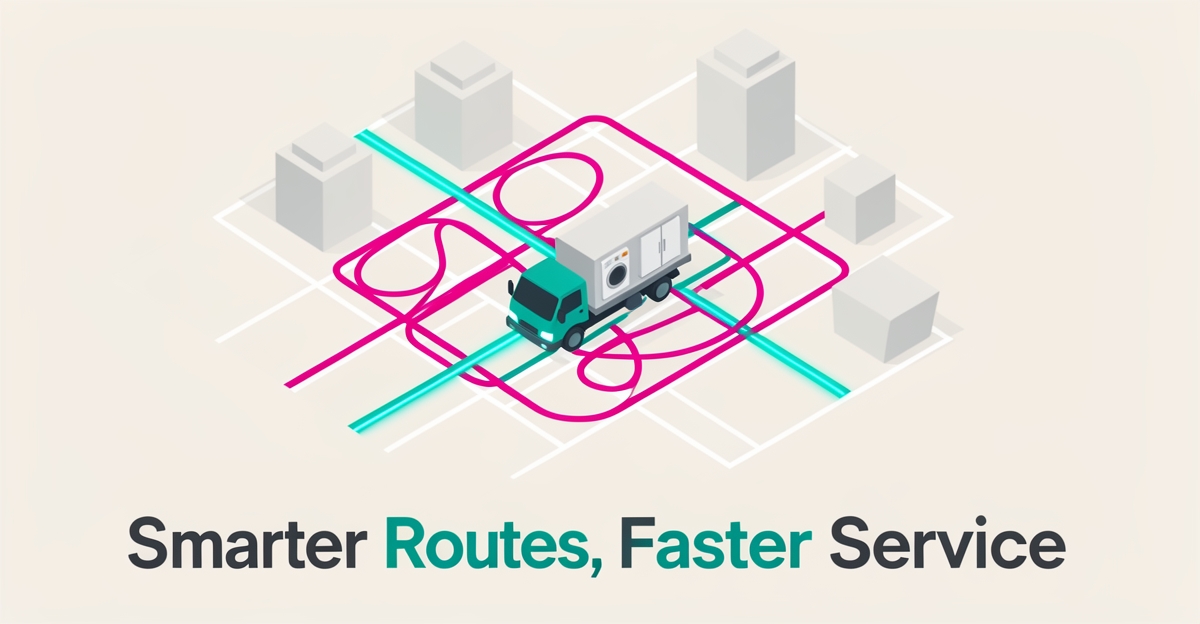
How an AI Dispatch System Can Optimize Routes for Appliance Removal Teams
Key Facts
- Poor routing and dispatching can inflate operating costs by up to 20%, according to ZenduIT research.
- AI-powered scheduling cuts miles driven per job by 8% to 20%, industry research shows.
- Intelligent dispatch automation reduces dispatcher call-handling time by 15% to 40%, per industry reports.
- DispatchTrack users report 40% fewer inbound customer calls thanks to automated ETAs and tracking links, the platform reports.
- Intelligent routing platforms help fleets cut fuel consumption by up to 45%, users report.
- The global AI-in-logistics market is projected to surge from $26.35 billion in 2025 to $707.75 billion by 2034, per industry projections.
- Leading dispatch platforms report 99% on-time service rates, according to Dispatch Science.
Hire a team member that works 24/7 — for less than a part-time wage.
AI receptionists, SDRs, dispatchers and 99+ roles. Trained on your business, fully managed.
Not sure where to start? Ask our AI planner
The Hidden Cost of Manual Dispatching in Appliance Removal
Every morning, appliance removal dispatchers make dozens of judgment calls under pressure: which truck takes which pickup, in what order, and when. The problem is that those decisions are locked in before the first truck leaves the yard. A single road closure or last-minute cancellation throws the whole day off, and there's no easy way to adapt mid-route.
That's because traditional dispatching is fundamentally reactive. According to industry research, manual dispatch models depend on human judgment and limited visibility, relying on static, pre-planned routes that fail to account for real-time variables like traffic congestion, road closures, or sudden job cancellations. Once a route is set, it stays set, no matter what changes on the road.
The financial toll is significant. Studies show that poor routing and dispatching can increase operating costs by up to 20%, driven by unnecessary fuel expenses, excessive labor hours, and vehicle wear and tear. For a fleet hauling heavy loads in trucks that already burn fuel quickly, that margin of waste compounds every single day.
For appliance removal teams specifically, the daily pain stacks up in predictable ways:
- Tight pickup windows that a static route can't accommodate when traffic shifts
- Heavy-load jobs assigned without balancing vehicle capacity or crew skill
- Customers calling repeatedly for ETA updates because there's no proactive communication
- Dispatchers spending hours on manual coordination instead of managing exceptions
- Uneven workloads, with some crews overloaded while others sit idle
The dispatcher experience is part of the hidden cost, too. Organizations still relying on manual coordination face constant phone tag, resequencing stops by hand, and apologizing for delays they couldn't see coming. AI Journal puts it plainly: instead of reacting to problems, modern systems can now anticipate and adjust before disruptions occur, something human judgment alone, however experienced, simply cannot do at scale.
This is why the shift toward intelligent dispatching is accelerating. The global AI-in-logistics market, valued at USD 26.35 billion in 2025, is projected to reach approximately USD 707.75 billion by 2034, a clear signal that businesses are moving past manual dispatch as a viable operating model.
The takeaway for appliance removal operators: the cost of manual dispatching isn't just the 20% operating cost premium. It's the compounding effect of wasted fuel, burned-out dispatchers, missed windows, and customers who lose patience. Companies like AIQ Labs build intelligent workflow systems that manage dispatching in real time, replacing that reactive scramble with routes that adapt to traffic, cancellations, and customer needs as they happen.
How AI Dispatch Thinks: Machine Learning Meets Real-Time Data
AI dispatch systems operate on two interconnected engines: machine learning models that learn from every job completed and real-time data streams that enable immediate adaptation. These models analyze historical route efficiency, driver performance, and service outcomes to uncover patterns invisible to static planning, such as which sequences minimize idle time or which technicians excel at handling bulky appliance pickups. By continuously ingesting GPS feeds, traffic APIs, and weather data, the system dynamically reroutes teams around congestion or sudden job changes, ensuring optimal stop sequencing without manual intervention. Unlike traditional dispatch that relies on fixed routes and reactive adjustments, this approach improves with each completed assignment, refining predictions for traffic patterns, service durations, and resource allocation. For appliance removal teams, this means routes evolve to reduce unnecessary mileage, field organizations report 8% to 20% fewer miles driven per job using AI-powered scheduling, while also cutting dispatcher call-handling time by 15% to 40% through automation. AIQ Labs builds these self-learning dispatch capabilities into custom workflow systems, integrating real-time telematics with predictive analytics to turn routing from a cost center into a strategic advantage. The result is a dispatch function that not only responds to conditions but anticipates them, learning from every mile driven to make the next route smarter than the last.
- Analyzes historical run-time data, service outcomes, and technician performance to uncover efficiency patterns
- Processes live GPS, traffic, and weather feeds for dynamic rerouting and stop sequencing
- Improves accuracy and efficiency with every completed job through continuous machine learning
The Payoff: Fuel Savings, Faster Service, and Happier Customers
The financial argument for AI dispatch isn’t theoretical, it’s already showing up on the balance sheets of field service organizations. Industry research shows that AI-powered scheduling reduces miles driven per job by 8% to 20%, a range that directly determines whether an appliance removal route runs at a profit or a loss.
Those saved miles translate immediately into fuel savings. Users of intelligent routing platforms report cutting fuel consumption by up to 45%, which matters enormously when your teams are hauling refrigerators and washing machines across town all day. Fewer miles also means less wear on vehicles and more capacity for additional pickups without adding trucks.
Speed improves alongside efficiency. Organizations deploying intelligent dispatch automation see dispatcher call-handling times drop by 15% to 40%, freeing your office staff from endless phone coordination to focus on customer service. This efficiency gain is why 78% of organizations now deploy AI in at least one business function, with dispatch and operations consistently ranking among the top three use cases.
Reliability becomes a competitive advantage. Leading platforms report 99% delivery success rates and 99% on-time service. For appliance removal, where customers often wait specifically to hand over an old unit before a new one arrives, that punctuality eliminates the friction that generates complaints and bad reviews.
Perhaps most valuable for daily operations is the silence in your inbox. DispatchTrack users report 40% fewer inbound customer calls because automated ETAs and tracking links keep customers informed without requiring staff to answer "where are you?" calls all day. Other platforms report similar reductions in inbound call volume alongside 28% total cost savings.
When you combine these metrics, the business case becomes clear:
- Fuel and labor costs drop immediately as routes tighten and dispatchers handle jobs faster
- Customer satisfaction rises because accurate ETAs replace vague arrival windows
- Capacity expands without adding vehicles, letting you book more removals per day
- Administrative overhead shrinks as manual coordination disappears
This is where the right implementation partner matters. AIQ Labs builds intelligent workflow systems that manage dispatching in real time, ensuring these optimizations integrate with your existing CRM and scheduling tools rather than creating new data silos. The result is a dispatch operation that learns from every completed pickup, turning route data into sustainable margin improvement while your competitors are still stuck in traffic.
From Order to Optimized Route: The AI Dispatch Workflow in Action
An appliance removal job starts the moment a customer books a pickup, and the difference between profit and waste is decided in the next few minutes. AI turns that window into a data-driven workflow that learns with every run.
Data integration creates the single source of truth. The system ingests new orders from CRM, driver availability from fleet management, and live feeds from GPS, traffic APIs and weather. Modern platforms unify data from enterprise systems such as ERP, CRM, fleet management software, and emergency call systems to provide a single source of operational truth. For smaller teams, integration considerations focus on API-ready tools and phased connections rather than wholesale replacement.
Automated job assignment removes manual bias. The AI evaluates location, availability, workload, skill set and vehicle capacity to match the right crew to the right appliance. AI automates job allocation based on location, availability, workload, and skill set, preventing uneven job distribution and ensuring the nearest available team is assigned. This eliminates manual coordination delays and reduces travel time, labor costs, and appointment cancellations.
Intelligent route planning builds the day before the truck moves. The algorithm sequences stops to minimize distance while respecting time windows, truck capacity and driver hours. Field-service organizations report 8% to 20% reductions in miles driven per job using AI-powered scheduling. Poor routing and dispatching can increase operating costs by up to 20%, driven by unnecessary fuel expenses, excessive labor hours, and vehicle wear and tear.
Live dynamic rerouting keeps the plan honest. As conditions change, the system continuously analyzes traffic patterns, delivery windows, and environmental factors and adjusts routes dynamically to maintain efficiency. Real-time dispatch optimisation integrates GPS feeds, IoT sensors, traffic APIs, weather data, and operational systems to enable instant response to road closures or new urgent requests.
Proactive customer notifications reduce inbound calls. Accurate ETAs and automated updates are pushed via SMS or email with tracking links. Organizations deploying intelligent dispatch automation report a 15%–40% reduction in dispatcher call-handling time, freeing staff for exception handling.
End-of-day performance analysis closes the learning loop. The system reviews on-time rates, fuel use, route efficiency and first-time completion, then feeds those outcomes back into the machine learning models. An AI-powered dispatch system is a self-learning dispatch algorithm, improving accuracy and efficiency with every assignment and outcome.
For smaller appliance removal teams, adoption works best when scoped to one workflow first. AIQ Labs builds workflow systems that manage dispatching in real time, ensuring teams operate efficiently and respond to customer needs faster. A practical rollout looks like:
- Connect CRM and fleet data first, then add traffic and weather feeds
- Start with automated assignment for proximity and capacity, then add skills matching
- Enable driver app rerouting and automated ETA texts before expanding to predictive analytics
The result is a dispatch process that is proactive, balanced and continuously improving.
Getting Started: Owning Your Dispatch Automation
For appliance removal teams, the daily challenge of balancing fuel costs, customer ETAs, and crew availability often hinges on a single decision point: dispatch. Manual routing, reliant on static maps and dispatcher intuition, frequently leads to inefficient paths, unnecessary mileage, and missed time windows, directly impacting the bottom line. Studies confirm that poor routing and dispatching can inflate operating costs by up to 20%, driven by excess fuel consumption, labor hours, and vehicle wear.
An AI-powered dispatch system transforms this reactive chore into a proactive, self-optimizing function. By continuously analyzing real-time traffic, weather, job priorities, and crew locations, it dynamically sequences stops and reroutes vehicles to avoid congestion. Field-service organizations using such technology report reductions in miles driven per job ranging from 8% to 20%, directly cutting fuel expenses and vehicle strain. Beyond routing, AI automates job assignment based on skill, availability, and proximity, ensuring the nearest qualified team handles each pickup, eliminating manual coordination delays and balancing workloads fairly.
The operational ripple effects extend further. Intelligent dispatch automation has been shown to reduce dispatcher call-handling time by 15% to 40%, freeing staff to focus on exceptions rather than rote scheduling. Simultaneously, proactive customer ETAs and live tracking links, enabled by AI-driven route accuracy, can slash inbound status calls by up to 40%, as seen with platforms like Dispatch Science. For appliance removal, where customers often schedule pickups around tight personal windows, this reliability boosts satisfaction and reduces costly reschedules.
- Start with a single workflow fix, like optimizing daily removal routes, to prove value quickly.
- Build in milestones, expanding to full department automation as ROI validates each phase.
- Own the system outright, gaining full control over code, data, and future enhancements without subscription lock-in.
This phased approach, from targeting one painful workflow to owning a complete AI dispatcher, aligns with how AIQ Labs partners with SMBs: through flexible models like Start Monthly, Build in Milestones, or Own It Outright. After a free strategy call to map your specific bottlenecks, we architect a custom solution that learns from your data, integrates with your tools, and scales as your team grows, turning dispatch from a cost center into a competitive advantage.
Still paying for 10+ subscriptions that don’t talk to each other?
We build custom AI systems you own outright. No vendor lock-in. Full control.
Not sure where to start? Ask our AI planner
Frequently Asked Questions
How much can poor dispatching actually cost an appliance removal business?
Will an AI dispatch system really reduce miles driven per job?
Does AI dispatch just find the shortest route, or does it handle real-world constraints?
How does AI dispatch help with customer calls about ETAs?
Can AI dispatch improve on-time service for pickups?
Is AI dispatch only for large fleets, or can smaller appliance removal teams use it?
Stop Leaving Money on the Road
Manual dispatching locks your appliance removal teams into static routes that crumble at the first traffic jam or cancellation, inflating operating costs by up to 20% through wasted fuel and idle crews. An AI dispatch system transforms this reactive scramble into a self-optimizing workflow that learns from every job, dynamically rerouting around delays and automating assignments based on proximity, capacity, and skill. The result is fewer miles driven, lower fuel bills, and happier customers who receive accurate ETAs instead of vague windows. AIQ Labs builds intelligent workflow systems that manage dispatching in real time, integrating with your existing CRM to turn routing from a daily headache into a competitive advantage. Whether you start with a single workflow fix or deploy a full AI dispatcher, the path forward begins with clarity. Take the two-minute Fit Check at aiqlabs.ai/apply to map your biggest bottleneck and identify your highest-ROI automation opportunity.
Make AI your competitive advantage — not just another tool.
Strategy, implementation and ongoing optimization. One partner, end to end.
Not sure where to start? Ask our AI planner