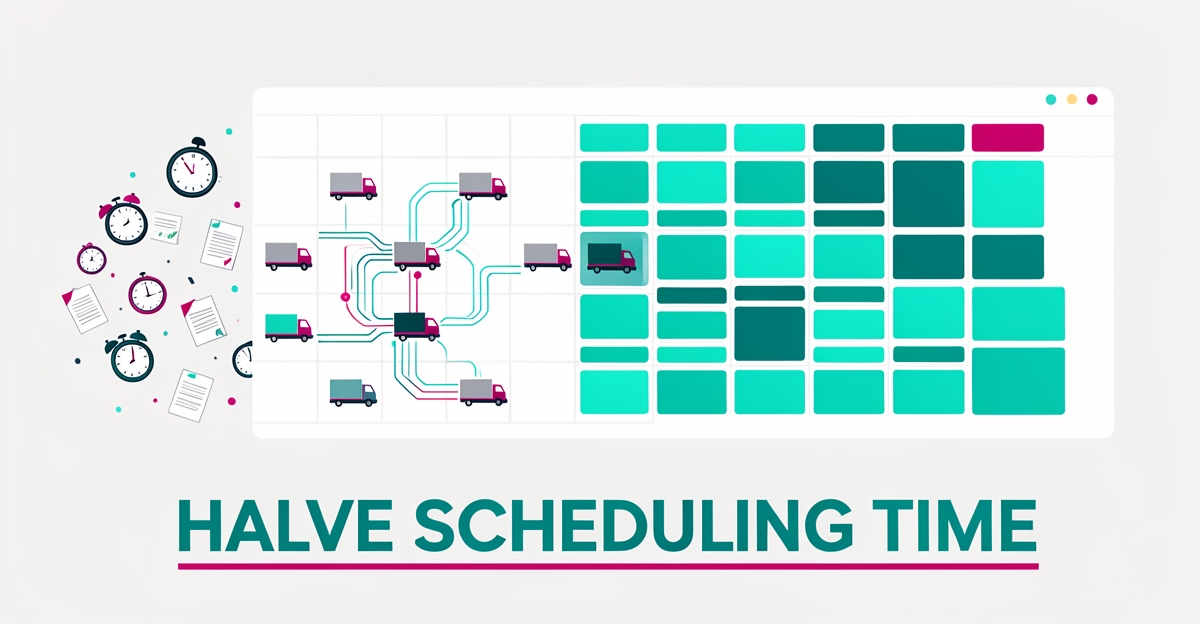
How an AI Dispatcher Can Cut Down Move Scheduling Time by 50%
Hire a team member that works 24/7 — for less than a part-time wage.
AI receptionists, SDRs, dispatchers and 99+ roles. Trained on your business, fully managed.
Not sure where to start? Ask our AI planner
The Hidden Costs of Manual Scheduling in Moving Operations
Every minute your team spends juggling spreadsheets, phone calls, and text messages to coordinate a single move is a minute your competitors are using to book their next job. Manual scheduling doesn't just slow down operations, it quietly drains revenue through a cascade of hidden inefficiencies that most moving companies accept as the cost of doing business.
The most visible cost is scheduling conflicts. When dispatchers rely on memory, whiteboards, or basic calendars to allocate crews, trucks, and equipment, double-bookings and overlapping assignments become inevitable. These conflicts trigger last-minute scrambles, overtime pay, and sometimes cancelled jobs that damage your reputation. Moving companies that stick with manual processes also miss out on the operational cost reductions that AI automation typically delivers within the first year.
Resource misallocation compounds the problem. Without real-time visibility into crew availability, equipment location, and job requirements, dispatchers often send the wrong-sized team or truck to a job. This leads to underutilized resources on some moves and overextended crews on others. For a mid-sized moving company running 15-20 crews, dispatch, routing, and customer service overhead can easily reach six figures annually, and a meaningful share of that is coordination work a well-built AI system can absorb.
Delayed customer responses represent another revenue leak. When potential clients request quotes or availability, manual scheduling forces them to wait while your team checks calendars, calculates travel times, and confirms crew availability. In an industry where speed wins business, these delays send customers to competitors. Larger operators have recognized this, and adoption of AI-assisted dispatch has been climbing steadily among big fleets as of late 2026.
The cumulative effect of these inefficiencies manifests in several ways:
- Increased labor costs from overtime and inefficient crew deployment
- Lost revenue from missed booking opportunities and cancelled jobs
- Higher fuel costs from poorly optimized routes and scheduling
- Reduced customer satisfaction leading to fewer referrals and repeat business
Labor efficiency is typically the single biggest contributor to total ROI when moving companies automate their dispatch operations, often around half of the measurable gains. These aren't just operational inconveniences; they're profit leaks that compound daily.
AIQ Labs works with relocation teams to eliminate these hidden costs through AI Employees in dispatcher roles that automate crew allocation, optimize service zones, and respond to customer inquiries in real time. By treating scheduling as a data problem rather than a coordination challenge, moving companies can redirect their teams toward higher-value activities while the AI handles the complexity of modern dispatch operations.
What Is an AI Dispatcher and How Does It Work?
Moving companies spend countless hours coordinating movers, timelines, and service zones through manual processes that are slow, error-prone, and resource-intensive. An AI dispatcher transforms this workflow by intelligently allocating resources in real time based on location data, time constraints, and client requirements.
These systems use location intelligence to match available crews with jobs in their service zones, reducing travel time and fuel consumption. They analyze time windows, crew availability, and equipment needs to prevent the scheduling conflicts that commonly derail manual planning. By continuously processing client preferences, such as fragile item handling or specific move dates, the AI ensures each allocation aligns with both operational efficiency and customer expectations.
Companies using AI automation in dispatch typically see operational cost reductions materialize within months, with labor efficiency gains accounting for the largest share of total ROI. For a mid-sized operation, the savings show up as eliminated manual bottlenecks and 24/7 scheduling responsiveness without added staff. These improvements stem from removing coordination delays, not from cutting crews.
- Real-time location tracking for optimal crew deployment
- Dynamic timeline adjustment based on traffic and job complexity
- Automated zone balancing to prevent overbooking or underutilization
- Client preference learning for personalized service matching
- Conflict detection and resolution before scheduling errors occur
AIQ Labs deploys AI dispatchers as managed AI employees that integrate directly with moving company workflows, handling end-to-end allocation decisions while learning from operational patterns to continuously improve accuracy and reduce scheduling friction.
Proven ROI: Where AI Dispatchers Deliver Cost Reductions
The financial case for AI dispatchers isn't theoretical, it's measurable and tends to show up within months rather than years. The exact numbers vary by operation, but the pattern is consistent: the biggest gains come from labor efficiency, routing, and faster lead response.
Labor efficiency gains typically account for the largest share of total ROI, often in the range of 40-50% of measurable savings. This aligns with what AIQ Labs observes when deploying AI dispatchers for logistics clients, the technology doesn't replace human judgment but eliminates the repetitive coordination tasks that consume dispatcher hours.
Key areas where AI dispatchers deliver measurable cost reductions:
- Automated crew scheduling that eliminates double-bookings and reduces dispatcher overtime
- Route optimization that cuts fuel costs and increases jobs per crew per day
- Instant customer quote generation that captures leads before competitors respond
- Predictive equipment maintenance that prevents costly breakdowns during peak season
- Automated customer communications that reduce inbound call volume by handling routine inquiries
Investment requirements vary widely based on existing technology infrastructure and integration complexity. Traditional enterprise deployments can run well into five figures or beyond, but AIQ Labs' payment models are built to avoid that barrier: Start Monthly for a managed AI dispatcher with no large upfront spend, Build in Milestones for a fixed-price rebuild of your dispatch workflow, or Own It Outright if you want to own the system with no ongoing fees. Most companies recover their investment within the first year through operational savings alone.
The competitive landscape adds urgency to this decision. Larger operators have been adopting AI-assisted dispatch faster than small fleets, and early adopters build compounding advantages in customer acquisition and operational efficiency. Every month of manual scheduling is a month competitors use to respond to leads faster and run tighter routes.
Implementing an AI Dispatcher: A Step-by-Step Guide
Moving companies looking to implement an AI dispatcher should start by establishing clear baseline metrics to measure current performance. This includes tracking average scheduling time per move, crew allocation efficiency, customer quote response times, and operational costs related to dispatching. Because labor efficiency typically drives the largest share of ROI, these metrics are critical for measuring success. By quantifying current pain points, such as manual scheduling conflicts or delayed quote generation, companies can identify where AI will deliver the greatest impact.
The next step involves selecting an approach that integrates with your existing tools, whether that's SmartMoving, MoveitPro, ServiceTitan, or a homegrown system. AIQ Labs' process begins with discovery and architecture, ensuring the solution aligns with your specific workflow before development starts. During this phase, prioritize capabilities like automated crew scheduling with conflict detection, AI-powered route optimization, and intelligent customer communication workflows. These directly address the core inefficiencies in move scheduling, inefficient route planning and manual coordination delays, that stretch out scheduling times.
Finally, monitor performance improvements against the established baseline to validate results. Key indicators to track include reductions in dispatch coordination time, improvements in customer quote response speed, and decreases in fuel costs from optimized routing. By continuously analyzing these metrics and refining the AI system based on real-world data, moving companies can sustain efficiency gains and scale the technology across additional workflows. This disciplined approach ensures the AI dispatcher delivers measurable value while minimizing disruption during adoption.
Overcoming Implementation Challenges and Getting Started
Moving companies often hesitate to adopt AI dispatchers due to concerns about upfront costs, integration complexity, and staff readiness. These concerns are valid, traditional enterprise AI deployments can require significant capital before any value is delivered. But the payment model doesn't have to work that way, and the long-term gains in labor efficiency typically justify the investment well within the first year.
AIQ Labs addresses these barriers through a structured, partnership-driven approach. Rather than treating AI deployment as a technical project, we frame it as a workforce transformation, starting with a single AI Employee in a dispatcher role to prove value before scaling. The Start Monthly model eliminates large upfront spends with a flat monthly fee that comes in around 80% less than a human hire, inclusive of build, training, tool integrations, monitoring, and continuous improvements. If your dispatch workflow is the single biggest cost center, a fixed-price Workflow Build rebuilds just that piece, in phases. And companies that want full ownership can have an AI dispatcher built into a broader AI Operating System they own outright.
For teams wary of change, we provide end-to-end support: from assessing current tools like SmartMoving or MoveitPro to configuring AI-powered conflict detection and predictive maintenance scheduling. Staff receive role-specific training, and human-in-the-loop controls ensure critical decisions remain supervised. By focusing on measurable outcomes, such as cutting dispatch coordination time and improving quote response speed, we turn implementation concerns into opportunities for sustainable efficiency gains. To explore how this applies to your operation, take the 2-minute Fit Check and then book a free 30-minute strategy call to map your biggest bottleneck and identify high-ROI automation opportunities.
Still paying for 10+ subscriptions that don’t talk to each other?
We build custom AI systems you own outright. No vendor lock-in. Full control.
Not sure where to start? Ask our AI planner
Frequently Asked Questions
How much time can an AI dispatcher actually save in move scheduling?
What kind of cost savings can a moving company expect from using an AI dispatcher?
Is an AI dispatcher going to replace my human dispatchers?
How long does it take to see a return on investment after implementing an AI dispatcher?
What features does an AI dispatcher actually include for moving companies?
How much does it cost to implement an AI dispatcher for a moving company?
Turn Scheduling Chaos into Competitive Advantage
Manual scheduling is costing moving companies more than just time, it's eroding profits through conflicts, misallocated resources, and delayed customer responses that send business to competitors. AI dispatchers eliminate these inefficiencies by automating crew allocation, optimizing routes, and enabling real-time customer engagement, with labor efficiency typically driving the largest share of the ROI. The path forward starts with clarity: measure your current scheduling bottlenecks, then explore how an AI Employee in a dispatcher role can transform your workflow without disruption. AIQ Labs makes this shift low-risk with a Start Monthly model that includes build, training, integrations, and ongoing support, at a fraction of the cost of a human hire. To see where AI can unlock the highest ROI in your operation, start with the 2-minute Fit Check and book a free 30-minute strategy call to map your biggest challenge and identify realistic automation opportunities.
Make AI your competitive advantage — not just another tool.
Strategy, implementation and ongoing optimization. One partner, end to end.
Not sure where to start? Ask our AI planner