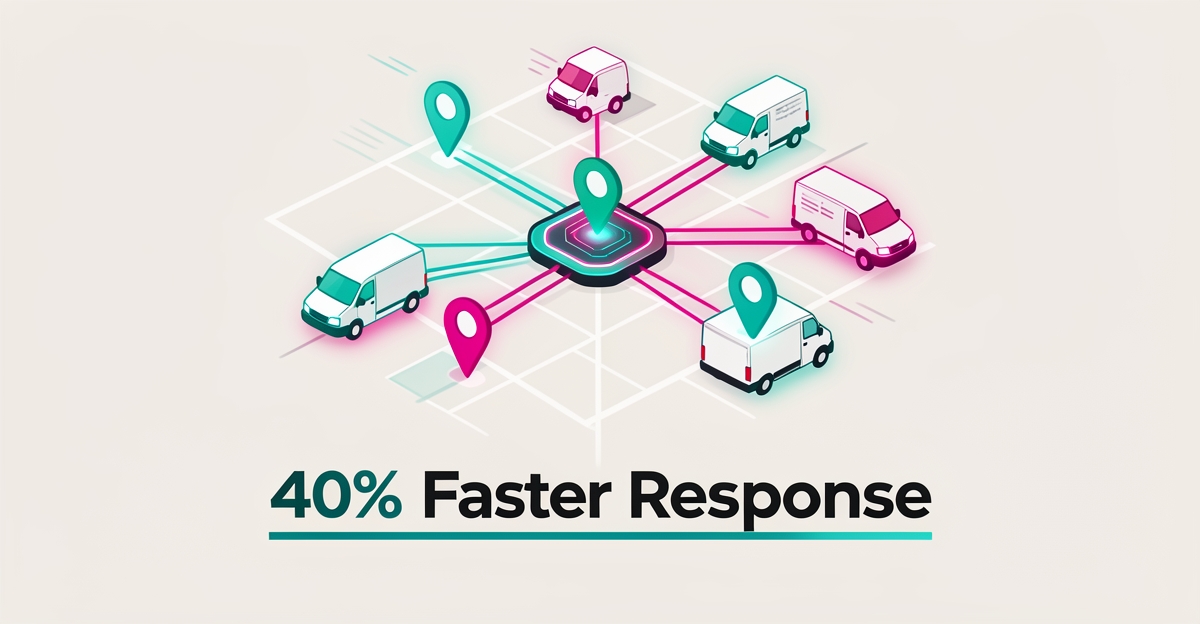
# How an AI Dispatcher Can Cut Down Service Response Times by 40%
**Quick Answer:** AI dispatchers cut service response times by up to 40% by matching jobs to qualified technicians in seconds, eliminating manual guesswork and failed stops. Automated skill-based assignment can reduce dispatcher workload by 40-60% while optimizing routes for faster, more reliable service. Start the two-minute Fit Check to see how AIQ Labs deploys 24/7 AI employees that deliver these results.
## Key Facts
- AI dispatch technology can reduce service response times by up to 40% through intelligent job assignment and real-time optimization
- Skill-based dispatch is reported to cut failed stops by 25-30% by preventing mismatches like sending unqualified technicians to jobs
- Automation can eliminate 40-60% of dispatcher time on assignment decisions, freeing an estimated 2-3 hours daily for a 20-driver operation
- Dynamic AI re-routing is typically credited with saving 8-15% on fuel costs while enabling roughly 20% more daily deliveries after deployment
- AI dispatch can handle last-minute order changes in under 90 seconds compared to an estimated 8-12 minutes for manual dispatch
- Each avoided failed stop can save $300-500 in direct costs like fuel, labor, and vehicle wear
- SMB logistics operators typically report recovering their AI dispatch investment within 6-14 months through combined operational savings
## Table of Contents
- [The Hidden Cost of Manual Dispatch: Why Technicians Show Up Unqualified](#the-hidden-cost-of-manual-dispatch-why-technicians-show-up-unqualified)
- [How AI Dispatchers Eliminate Guesswork with Skill-Based Assignment](#how-ai-dispatchers-eliminate-guesswork-with-skill-based-assignment)
- [From Dispatch Board to Bottom Line: Real-World ROI of AI Dispatch](#from-dispatch-board-to-bottom-line-real-world-roi-of-ai-dispatch)
- [Deploying Your AI Dispatcher: Integration, Adoption, and Scaling](#deploying-your-ai-dispatcher-integration-adoption-and-scaling)
## The Hidden Cost of Manual Dispatch: Why Technicians Show Up Unqualified
Every morning, dispatchers across the country sit down to a board full of jobs and a mental spreadsheet of who can handle what. That spreadsheet lives in their head, and it fails more often than anyone wants to admit. A driver without a liftgate shows up to a heavy-freight stop. A technician missing a required certification gets sent to a job he can't legally perform.
These aren't rare edge cases. Operations that adopt skill-based dispatch commonly report 25-30% fewer failed stops tied to qualification mismatches, which tells you how common those mismatches are under manual dispatch. Every failed stop isn't just an embarrassment. Each reattempt costs an estimated $15-20 in fuel, labor, and vehicle wear, before counting the customer who now trusts you a little less.
The labor cost is just as quiet and just as real. For a 20-driver operation, the manual matching process is estimated to consume 2-3 hours daily, time a dispatcher spends cross-referencing certifications, vehicle types, and equipment access instead of managing exceptions and supporting the field. On top of that, unplanned order changes can eat 18-27% of total dispatch labor time, most of it spent reacting and recalculating routes by hand.
The downstream effects compound quickly:
- Failed stops trigger paid reattempt costs and push other jobs behind schedule
- Unqualified arrivals damage first-time fix rates and customer confidence
- Dispatchers burn hours on routine matching instead of high-value decisions
- Fuel spend climbs as routes are built around availability rather than optimization
A failed dispatch can cost $300-500 once lost customer confidence is factored in, and confidence is the part that never shows up on an invoice. When the wrong technician arrives twice, customers start calling competitors, and a significant share of commercial contractors say outdated technology is limiting their growth.
This is the gap AI dispatch is built to close. A properly configured system holds a live skill profile for every technician, certifications, vehicle assignments, equipment access, and matches each incoming job only to qualified people, then optimizes routes within that pool. When a qualified driver becomes unavailable mid-shift, the system reassigns automatically instead of leaving the job stranded. AIQ Labs deploys [AI Employee dispatchers that operate 24/7](/ai-employees), ensuring no job sits unassigned because the dispatcher was buried in manual matching.
The financial case is straightforward. Automation can eliminate 40-60% of dispatcher time on assignment decisions, and dynamic AI re-routing is typically credited with saving 8-15% on fuel costs alone. For SMB operators, payback periods commonly run 6-14 months. The hidden cost of manual dispatch was never invisible, it was just spread across failed stops, wasted hours, and lost customers. AI makes it visible, then eliminates it.
## How AI Dispatchers Eliminate Guesswork with Skill-Based Assignment
AI dispatch technology transforms field service operations by eliminating guesswork through intelligent, skill-based assignment that matches jobs to the right technician every time. Rather than relying on proximity or availability alone, AI-pow
AI Employees
Hire a team member that works 24/7 — for less than a part-time wage.
AI receptionists, SDRs, dispatchers and 99+ roles. Trained on your business, fully managed.
See If You’re a Fit — AI Employees from $700/mo
Not sure where to start? Ask our AI planner
ered dispatch systems analyze detailed technician profiles, including certifications, vehicle capabilities, and equipment access, to ensure only qualified personnel receive specific work orders. This precision is reported to reduce failed stops by 25-30% by preventing mismatches like sending a technician without a liftgate to a heavy-freight job or an uncertified worker to a regulated delivery site.
**Agentic and predictive AI technologies work in tandem** to automate the entire assignment process: agentic AI autonomously detects service needs and initiates dispatch based on real-time technician availability and skill requirements, while predictive AI anticipates potential issues before they escalate into emergency calls. This dual approach enables systems to handle last-minute order changes in under 90 seconds, dramatically faster than the estimated 8-12 minutes required for manual recalculations, minimizing delays and keeping schedules intact.
- Automatically matches jobs to technicians based on certifications, vehicle type, and equipment access
- Reported to reduce failed stops by 25-30% through qualification-based filtering
- Can eliminate 40-60% of manual dispatcher overhead on assignment decisions
- Reassigns work instantly when technicians become unavailable mid-shift
- Integrates with ELD, TMS, and customer-facing APIs for executable, real-time decisions
By removing the cognitive burden of manual matching, where dispatchers traditionally spend an estimated 2-3 hours daily on qualification tracking for a 20-driver operation, AI dispatch frees human supervisors to focus on exceptions and complex problem-solving rather than routine scheduling. AIQ Labs applies this same principle in its [AI Employee Dispatcher role](/ai-employees), which operates 24/7 to ensure every job is instantly assigned to the most qualified technician, calculated with optimal routing, and communicated without delay, directly contributing to the up-to-40% reduction in service response times reported across industry implementations. This shift from reactive, error-prone dispatch to proactive, skill-aware automation delivers measurable gains in first-time fix rates, fuel efficiency, and customer satisfaction while scaling operational capacity without additional headcount.
## From Dispatch Board to Bottom Line: Real-World ROI of AI Dispatch
AI dispatch technology delivers measurable financial returns by transforming how service operations allocate resources and respond to demand. For small and medium businesses, the impact begins with eliminating costly inefficiencies in technician assignment and route planning. When an AI dispatcher instantly matches the right technician to each job based on skills, location, and availability, it prevents failed dispatches that waste time, fuel, and customer trust. Each avoided failed stop can save $300-500 in direct costs like fuel, labor, and vehicle wear, excluding the long-term value of retained customer confidence.
These savings compound quickly through operational gains. AI-powered dispatch can reduce average drive time per job by up to ten minutes, enabling fleets to complete one or two additional jobs per technician daily without adding headcount. Regional logistics operators have reported completing roughly 20% more daily deliveries after implementation, directly increasing revenue capacity. Simultaneously, dynamic route optimization is typically credited with cutting fuel consumption by 8-15% through smarter sequencing and real-time traffic adaptation, turning every mile driven into higher productivity.
The financial upside becomes clear when measuring payback. SMB logistics operators commonly report recovering their investment in AI dispatch within 6-14 months, driven by combined savings from reduced failed stops, lower fuel expenses, and increased daily output. For businesses already using AI Employees in roles like dispatcher or service coordinator, this technology integrates into existing workflows, automating assignment decisions while freeing human staff to handle exceptions and complex customer needs. The result is a tighter connection between dispatch efficiency and bottom-line performance, where every optimized route translates into tangible operational advantage.
## Deploying Your AI Dispatcher: Integration, Adoption, and Scaling
Manual dispatch breaks down the moment a fleet scales beyond what one person can track in memory. Skill-based AI dispatch replaces that mental load with constraint-driven matching that keeps the right technician on the right job.
Deploying it starts with the data that powers qualification. Driver skill profiles capture certifications, vehicle capabilities, equipment access, and service skills so the system stops relying on spreadsheets or dispatcher memory. Orders are then tagged with required skills such as hazmat handling, cold chain, liftgate, or signature requirements. The AI engine matches only to drivers who meet all mandatory requirements, then optimizes routes within that qualified pool.
Automation changes the dispatcher role. Operations using skill-based dispatch commonly report 25-30% fewer failed stops tied to qualification mismatches, and automation can eliminate 40-60% of dispatcher time on assignment decisions. For
AI Development
Still paying for 10+ subscriptions that don’t talk to each other?
We build custom AI systems you own outright. No vendor lock-in. Full control.
See If You’re a Fit — AI Employees from $700/mo
Not sure where to start? Ask our AI planner
a 20-driver operation, manual matching can consume an estimated 2-3 hours daily, time that shifts to exceptions rather than routine assignments.
Real-time adaptability is where response times compress. When a new order drops, a delivery confirms early, or traffic blocks a corridor, the system re-solves affected routes and pushes updates to driver apps. AI dispatch can handle last-minute changes in under 90 seconds compared with an estimated 8-12 minutes for manual dispatch. Dynamic re-routing is typically credited with saving 8-15% on fuel costs alone, with regional operators reporting roughly 20% more daily deliveries after deployment.
Integration makes decisions executable in the field. The three integration points that matter most are:
- Electronic Logging Device network for ground truth location and Hours of Service constraints
- Transportation Management System for order management and customer communication
- Customer-facing APIs for real-time window updates and notifications
Without these connections, recommendations cannot be executed. Most AI dispatch platforms are designed to connect with other software through APIs, and successful SMB deployments combine agentic AI for autonomous decision-making with predictive AI for proactive issue identification.
Change management determines adoption. The biggest non-technical failure mode in dispatch AI deployments is driver resistance, not software bugs. Starting with a dispatcher-in-the-loop model builds trust; approvals are required for changes above a defined impact threshold, then auto-accept can expand as confidence grows.
Continuous refinement closes the loop. Monitor first-time fix rates, average job duration, and failed stop costs, which run an estimated $15-20 per reattempt in fuel, labor, and wear. Unplanned order changes can account for 18-27% of total dispatch labor time, work that a properly configured system re-solves automatically.
AIQ Labs approaches this as a managed AI employee that works 24/7 alongside human teams, instantly assigning jobs, calculating optimal routes, and notifying technicians. Whether you start with a single dispatcher role or a broader [workflow rebuild](/workflow-builds), the framework gives field-executable decisions without replacing the judgment dispatchers bring to exceptions, which is how response times fall and customer satisfaction rises.
## Frequently Asked Questions
**How much can an AI dispatcher reduce service response times?**
AI dispatch technology can reduce service response times by up to 40% through intelligent job assignment, optimal route calculation, and real-time technician notifications.
**What percentage of failed stops are tied to qualification mismatches in manual dispatch systems?**
Operations using skill-based dispatch commonly report 25-30% fewer failed stops tied to qualification mismatches, indicating how common these mismatches are under manual dispatch.
**How much time does manual dispatch consume daily for a 20-driver operation?**
For a 20-driver operation, the manual matching process is estimated to consume 2-3 hours daily, time that could be redirected to managing exceptions and supporting the field.
**What is the typical payback period for SMBs implementing AI dispatch technology?**
SMB logistics operators commonly report recovering their investment in AI dispatch within 6-14 months, driven by savings from reduced failed stops, lower fuel expenses, and increased daily output.
**How quickly can AI dispatch handle last-minute order changes compared to manual methods?**
AI dispatch can handle last-minute order changes in under 90 seconds, compared to an estimated 8-12 minutes required for manual recalculations, minimizing delays and keeping schedules intact.
**What are the three key integration points needed for AI dispatch to make executable decisions in the field?**
The three integration points that matter most are Electronic Logging Device (ELD) network for location and Hours of Service data, Transportation Management System (TMS) for order management, and customer-facing APIs for real-time updates and notifications.
## The Dispatch Board Doesn't Have to Run on Memory
The math in this article adds up to one conclusion: manual dispatch isn't just slow, it's expensive in ways that compound daily. Skill-based AI dispatch is reported to cut failed stops by 25-30%, can free 40-60% of dispatcher time spent on routine matching, handles last-minute changes in under 90 seconds, and commonly pays for itself in 6-14 months. The up-to-40% reduction in service response times isn't a projection, it's what happens when the right technician is assigned automatically, routes are optimized in real time, and no job sits unassigned at 2 AM. If your dispatch board still runs on one person's memory, the first step is simple: map where your hours and reattempt costs actually go. Then start small, a single workflow or a dispatcher-in-the-loop pilot, and measure first-time fix rates before scaling. At AIQ Labs, we deploy AI Employee Dispatchers that work 24/7 alongside your team, and we'll tell you honestly if there isn't a clear win. Start the two-minute Fit Check at [aiqlabs.ai/apply](/apply) and book a free 30-minute strategy call to see where AI dispatch fits in your operation.
AI Transformation Partner
Make AI your competitive advantage — not just another tool.
Strategy, implementation and ongoing optimization. One partner, end to end.
See If You’re a Fit — AI Employees from $700/mo
Not sure where to start? Ask our AI planner