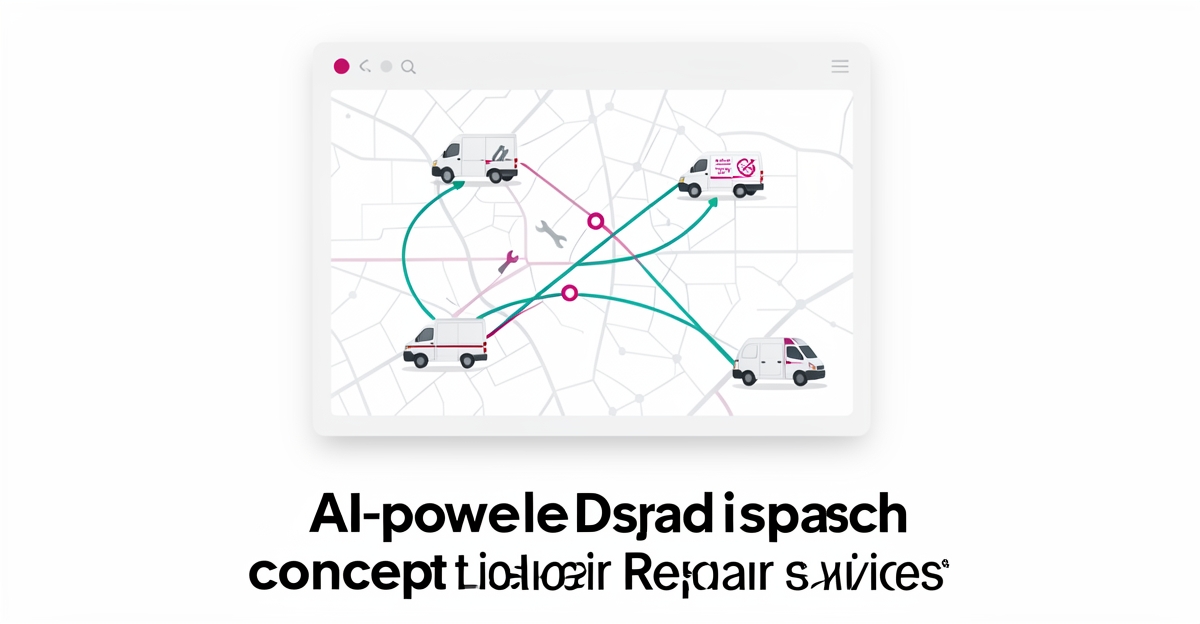
How an AI Dispatcher Can Improve Technician Scheduling in Repair Services
Key Facts
- AI dispatching can cut manual scheduling workload substantially, field service operators commonly report reductions of up to 80% on routine assignment and re-routing tasks
- Real-time analysis means the dispatch plan is never frozen and continuously adapts to changing conditions
- AI dispatchers work as an intelligence layer on top of existing CRM, ERP, and GPS tools without requiring new hardware
- A focused pilot can reach a first live workflow in roughly 30–60 days
- AI dispatching improves technician utilization by fitting more service calls into each workday without adding headcount
- Optimized routing enables tighter appointment windows and automatic customer notifications for arrival window changes
- AI dispatchers learn from historical data to improve performance over time, compounding benefits and ROI
Hire a team member that works 24/7 — for less than a part-time wage.
AI receptionists, SDRs, dispatchers and 99+ roles. Trained on your business, fully managed.
Not sure where to start? Ask our AI planner
Manual Dispatching Is Costing You More Than You Think
Manual dispatching feels fast in the moment, but it quietly erodes margins on every call. Phone calls stack up, technicians sit idle between jobs, and a single cancellation ripples through the day.
The cost shows up as slower response times and missed appointments. Practitioners describe manual dispatching as chaotic and inefficient, with limited ability to react to traffic, weather, or urgent requests. Human knowledge caps data utilization, so patterns in travel time and job density remain invisible.
Workload compounds quickly. Intelligent dispatching can deliver a substantial reduction in manual scheduling workload, field service operators commonly report figures as high as 80%, by automating assignment logic and real-time updates. That frees dispatchers from spreadsheet juggling to focus on exceptions and customer care.
Utilization suffers without dynamic optimization. AI dispatchers analyze job location, technician availability, and travel time to assign optimal repair visits, reducing idle time and improving on-time service delivery. A dynamic routing algorithm calculates the best routes based on real-time data and constraints, adjusting assignments as conditions change.
Adaptability is the real ceiling on growth. Manual boards cannot re-route instantly when a job runs long or a new emergency arrives. AI systems automatically update assignments and directions for technicians, learning from historical data to improve performance over time.
The pain points accumulate across the operation:
- Slow response times from reactive, phone-based scheduling
- Underutilized technicians due to poor proximity and skill matching
- Inability to adapt quickly to cancellations, traffic, or urgent jobs
- Growth ceiling when human capacity limits daily call volume
Visibility disappears with manual processes. Managers lack real-time information on technician performance and route efficiency, making it hard to meet SLAs and KPIs. AI dispatching provides enhanced visibility and control, with real-time feedback that supports planning and analysis.
AIQ Labs builds dispatch automation as part of its AI Workflow Builds, rebuilding the one workflow that costs you the most, at a fixed price and in phases. The AI works alongside human managers and field teams, analyzing location, availability, and travel time to reduce idle time. It serves as an acceleration layer for existing operations, not a replacement for them.
Without automation, repair services remain reactive. Service levels slip, fuel costs rise, and customers experience wider appointment windows. Shifting from manual to AI-powered dispatching removes the operational drag that limits scale.
How an AI Dispatcher Actually Works
An AI dispatcher turns scheduling from a reactive scramble into a continuously optimizing workflow. Instead of static assignments made hours in advance, the system evaluates live conditions and rebalances work as the day unfolds.
At its core, a dynamic routing algorithm is a mathematical model that calculates the best routes and schedules for technicians based on real-time data and constraints. These algorithms adjust to changing conditions such as traffic, weather, cancellations, or urgent requests, and automatically update assignments and directions for technicians. They also learn from historical data and patterns, improving performance over time.
The system ingests job location, technician skills and availability, travel time, and traffic conditions in real time. It assigns and reassigns tasks based on proximity, skills, and priorities, adjusting for changes like new jobs or delays. Field service practitioners describe this as using real-time data on technician locations, job details, and traffic conditions to continuously optimize routes.
Auto-adjustment happens without manual re-entry. When a job is added, a technician calls in late, or traffic shifts, the dispatcher recalculates and pushes updates to both technicians and customers. Integration with CRM and ERP systems keeps coordination efficient, with performance metrics tracked to refine the process over time. Real-time analysis means the plan is never frozen.
Learning compounds the benefit. Historical data on service times, repeat visits, and seasonal demand trains the model to anticipate bottlenecks and improve future assignments. This forward-looking approach supports proactive dispatching and reduces idle time. In practice, intelligent dispatching can enable a reduction in manual scheduling workload of up to 80% in well-configured deployments, helping get the right technician to the right job at the right time.
A production AI dispatcher typically surfaces updates through:
- Live re-routing to technicians with revised ETAs and directions
- Automatic customer notifications for arrival window changes
- Skill matching to ensure certifications and parts availability align with the job
- Dashboard visibility for managers to monitor utilization and SLAs
AIQ Labs can deliver this either as a custom workflow build or as a managed AI dispatcher employee, one of 99+ managed AI roles that cost roughly 80% less than a human hire. Either way, the system reduces idle time and improves on-time service delivery while keeping human oversight in the loop for exceptions and priorities.
The Measurable Payoff: Utilization, Costs, and Customer Satisfaction
The true test of any technology investment is whether it delivers measurable returns, and AI dispatchers pass that test. The most immediately striking figure comes from the scheduling desk itself: field service operators commonly report that intelligent dispatching reduces manual scheduling workload by up to 80%, freeing dispatchers from hours of daily coordination to focus on exceptions and customer relationships.
The financial benefits extend well beyond labor savings. By calculating optimal routes based on real-time job locations, technician positions, and traffic conditions, AI dispatchers meaningfully reduce fuel consumption and vehicle maintenance costs. These systems also maximize technician utilization, fitting more completed service calls into each workday without adding headcount or overtime.
Customer-facing metrics improve in parallel. Optimized routing enables tighter, more accurate appointment windows, and when delays do occur, the system communicates updated arrival times automatically. The result is better order fulfillment, higher on-time arrival rates, and the kind of reliability that builds long-term loyalty.
Perhaps most compelling is how broadly the value distributes across an organization. An intelligent dispatch algorithm supports all your stakeholders at once:
- Dispatchers, who gain checking logic, computing power, and automation in the planning process
- Field technicians, who receive optimized appointments and routes instead of chaotic daily schedules
- Customers, who benefit from improved order fulfillment and tighter appointment windows
- Management, who see stronger SLA and KPI achievement plus greater transparency and analysis options
There's even an environmental dividend: minimized resource consumption and reduced CO2 emissions through smarter routing, an increasingly relevant consideration for service businesses tracking their footprint.
Importantly, these gains don't require ripping out existing infrastructure. AI dispatching works as an intelligence layer on top of current systems, integrating with the CRM, ERP, and GPS tools a business already runs. This is precisely the approach AIQ Labs takes when building dispatch systems for field service clients, the AI works alongside human managers and technicians, handling the computational heavy lifting while people retain oversight and judgment. The technology functions as an acceleration tool that works alongside the systems you already use, not a wholesale replacement.
The compounding effect matters too. Because these algorithms learn from historical data and outcomes, performance improves over time, meaning the ROI a business sees in month three is typically better than month one. For repair service companies weighing the investment, the question increasingly isn't whether the payoff exists, but how quickly they can capture it.
Implementation Without the Headaches: Data, Integration, and Adoption
Many repair service owners worry that adopting AI dispatch means replacing their entire tech stack, CRM, ERP, scheduling tools, and all. The reality is far simpler: AI dispatchers work as an intelligence layer that enhances existing systems without requiring a full rip-and-replace. Modern AI implementations connect to current infrastructure using APIs and middleware, meaning zero new hardware is needed and service schedules keep running uninterrupted. This approach lets businesses keep their trusted tools while adding intelligent optimization on top.
Data quality remains the foundation of any effective AI dispatcher. The system's ability to assign the right technician to the right job at the right time depends entirely on accurate, up-to-date inputs, technician locations, skill sets, job details, traffic conditions, and customer preferences. Poor data quality leads to suboptimal routing decisions, so organizations must verify data sources and establish cleaning protocols before launch. Starting with a pilot project in a single service area allows teams to validate data accuracy and refine parameters without disrupting broader operations.
Successful adoption hinges on people, not just technology. Technicians may resist frequent schedule changes if they don't understand the benefits, so involving dispatchers and field staff from the outset builds trust and reduces friction. Providing hands-on training, clear communication about how AI reduces idle time and travel costs, and offering incentives for following algorithm recommendations all drive engagement. Meanwhile, keeping customers informed about updated arrival times and collecting their feedback ensures the transition improves, not harms, the service experience. AIQ Labs supports this human-centered rollout through phased builds and change management that aligns teams around shared goals, turning potential resistance into active participation.
Getting Started: From Pilot to Full Deployment
Starting with a focused pilot allows repair services to validate AI dispatcher benefits before scaling. Beginning with a single branch or team helps organizations test integration with existing systems and measure impact on scheduling efficiency. Involving dispatchers from day one addresses concerns and builds trust in the system's recommendations. This collaborative approach ensures the AI works alongside human expertise rather than replacing it.
Defining clear optimization goals and service level agreements (SLAs) is critical for measuring success. Teams should establish targets for reduced idle time, improved on-time arrivals, and technician utilization rates before deployment. When properly configured, AI dispatchers can reduce manual scheduling workload by up to 80%. Training technicians with incentives for following algorithm-generated assignments increases adoption and reinforces the system's value in daily operations.
Monitoring performance metrics enables continuous refinement of the AI dispatcher over time. Key indicators like travel time reduction, job completion rates, and customer satisfaction scores should be tracked weekly during the pilot phase. A focused pilot typically reaches its first live workflow in 30–60 days, with operational visibility from day one. AIQ Labs builds dispatcher systems that integrate with CRM, ERP, and GPS platforms, either as a fixed-price Workflow Build or as part of a broader AI Operating System you own outright, using pilot-phase data to optimize routing algorithms and expand deployment across additional teams. As performance improves, businesses can scale the solution confidently, knowing it has been validated in real-world conditions.
Still paying for 10+ subscriptions that don’t talk to each other?
We build custom AI systems you own outright. No vendor lock-in. Full control.
Not sure where to start? Ask our AI planner
Frequently Asked Questions
How much time can an AI dispatcher actually save my scheduling team?
Will I need to replace my current CRM or ERP to use an AI dispatcher?
What happens when a job runs long or a technician calls in sick, can the AI handle real-time changes?
How long does it take to get an AI dispatcher up and running?
My technicians might resist constant schedule changes, how do you handle adoption?
Does the AI dispatcher actually improve customer satisfaction, or just internal metrics?
Turn Dispatch Chaos into Your Competitive Advantage
AI-powered dispatching transforms repair services from reactive scrambles into precision operations, cutting manual scheduling workload by up to 80%, reducing idle time, and ensuring the right technician arrives at the right job on schedule. These gains extend beyond efficiency: tighter appointment windows boost customer satisfaction, optimized routes lower fuel costs, and real-time visibility empowers managers to hit SLAs consistently. The technology works as an intelligence layer atop your existing CRM, ERP, and GPS tools, learning from historical data to improve over time without disrupting current workflows. For repair businesses ready to move past spreadsheets and phone tags, the path forward starts with validation. Take the 2-minute Fit Check to see where AI dispatch can deliver measurable impact, then book a free 30-minute strategy call, no obligation, just clarity on your biggest scheduling bottleneck.
Make AI your competitive advantage — not just another tool.
Strategy, implementation and ongoing optimization. One partner, end to end.
Not sure where to start? Ask our AI planner