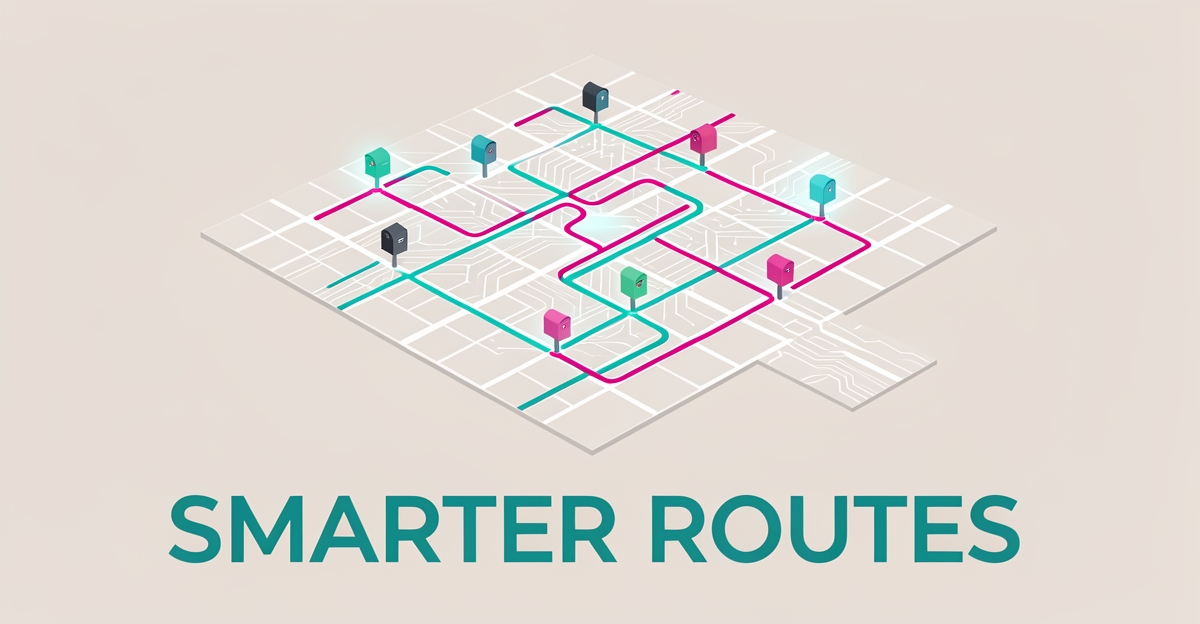
# How an AI Dispatcher Can Optimize Mailbox Repair Routes in Urban Areas
**Quick Answer:** Manual dispatch fails urban mailbox repair crews. AI dispatchers analyze requests, traffic, and availability to cut travel time and missed windows, with industry studies reporting meaningful gains in fuel spend and on-time performance.
## Key Facts
- Industry analyses of AI-powered dispatching report on-time delivery performance gains of roughly 38% in field operations.
- Route optimization studies suggest operational cost savings of up to 40% per service trip.
- Optimized routing has been reported to reduce travel time between jobs by around 20%.
- Proactive, AI-driven maintenance strategies are credited with reducing vehicle downtime by as much as 45%.
- Manual scheduling processes are slow and error-prone precisely when volume demands speed, according to technician scheduling research.
- These figures come from vendor-published field service research; your actual results will depend on your routes, volume, and baseline efficiency.
## Table of Contents
- [The Urban Mailbox Repair Crisis: Why Manual Dispatch Fails](#the-urban-mailbox-repair-crisis-why-manual-dispatch-fails)
- [How AI Dispatchers Analyze Requests, Traffic, and Availability in Real Time](#how-ai-dispatchers-analyze-requests-traffic-and-availability-in-real-time)
- [Measurable Impact: Fuel Savings, Faster Repairs, Happier Customers](#measurable-impact-fuel-savings-faster-repairs-happier-customers)
- [Implementation Roadmap: From Pilot to Full Deployment in 90 Days](#implementation-roadmap-from-pilot-to-full-deployment-in-90-days)
- [Why Custom-Built AI Dispatch Beats Off-the-Shelf Tools for Urban Ops](#why-custom-built-ai-dispatch-beats-off-the-shelf-tools-for-urban-ops)
## The Urban Mailbox Repair Crisis: Why Manual Dispatch Fails
A single morning rush can turn a full day of mailbox repair appointments into a schedule of missed windows and angry property managers. In dense urban areas, that chaos isn't occasional, it's structural. Manual dispatching simply wasn't built for the realities of city service work.
The core problem is that a human dispatcher makes decisions with incomplete information. Traffic patterns shift by the hour, service requests cluster unpredictably across neighborhoods, and technician availability changes in real time. A dispatcher juggling phone calls and spreadsheets can't re-sequence a route the moment a highway backs up or a new emergency repair lands.
The costs of that blindness compound quickly. Technicians burn fuel idling in congestion or backtracking across town to jobs that could have been sequenced together. Customers wait past their promised windows. Service-level agreements slip, and every missed appointment erodes trust, and margin.
Field service research suggests the financial toll is real: unoptimized routing can inflate operational costs substantially per service trip, with route optimization studies reporting savings of up to 40% and travel-time reductions of around 20%. Treat those numbers as directional benchmarks, not guarantees, but the direction is consistent across the research.
Manual dispatch fails urban mailbox repair operations in a few predictable ways:
- **Clustered requests get handled one at a time** instead of being grouped into efficient geographic runs.
- **Travel time between jobs balloons**, optimization studies suggest routing alone can cut it by roughly 20%.
- **Technician idle time goes unnoticed**, with crews sitting on standby while backlog grows elsewhere.
- **Traffic and weather disruptions force reactive scrambling** rather than automatic re-routing.
- **Fuel waste and vehicle wear accumulate silently** across hundreds of trips per month.
There's also a scaling problem. As request volume grows, a manual dispatcher's capacity doesn't. The result is longer response times, more callbacks, and dispatchers spending their day firefighting instead of managing. Research on technician scheduling systems notes that manual scheduling processes are slow and error-prone precisely at the moment volume demands speed.
This is where AI workflow automation changes the equation. An AI dispatcher can analyze incoming service requests, live traffic conditions, and technician availability simultaneously, then assign and sequence jobs in seconds, the kind of continuous optimization no human can sustain across a full urban route board. AIQ Labs builds these systems as part of its AI Workflow Builds, integrating with your local mapping tools so routes recalibrate automatically as conditions change rather than after a customer complains.
For urban mailbox repair operations, the question isn't whether manual dispatch creates waste, it's how much of it is still being absorbed into fuel bills, overtime, and lost customers.
## How AI Dispatchers Analyze Requests, Traffic, and Availability in Real Time
Urban mailbox repair teams face constant pressure to respond quickly while navigating dense traffic and shifting technician availability. AI dispatchers solve this by ingesting live service requests, fusing historical and real-time traffic data, and modeling technician skills and location to dynamically optimize routes. This real-time intelligence transforms reactive scheduling into proactive, data-driven decision making.
At the core of an AI dispatcher's function is the continuous intake of service requests from multiple channels, phone, email, or app, each tagged with urgency, location, and required skill set. These requests are instantly matched against a live feed of technician availability, factoring in current job status, proximity, and certification levels for mailbox-specific repairs. Historical traffic patterns are layered with real-time congestion data from GPS feeds to predict accurate travel times between jobs, avoiding delays caused by accidents,
AI Employees
Hire a team member that works 24/7 — for less than a part-time wage.
AI receptionists, SDRs, dispatchers and 99+ roles. Trained on your business, fully managed.
See If You’re a Fit — AI Employees from $700/mo
Not sure where to start? Ask our AI planner
construction, or rush-hour bottlenecks.
The system then runs continuous optimization cycles, recalculating the most efficient sequence of assignments every few minutes as new requests arrive or conditions change. This dynamic rebalancing ensures that high-priority repairs are never delayed by lower-urgency tasks stuck in traffic, while minimizing deadhead mileage between jobs. By aligning the right technician with the right job at the right time, AI dispatchers eliminate the guesswork that leads to missed appointments and customer frustration.
- Ingests live service requests with skill and urgency tags
- Fuses historical and real-time traffic data for accurate ETAs
- Models technician availability, location, and certification
- Dynamically re-optimizes routes every few minutes
- Reports from field service studies point to meaningful reductions in travel time and cost per trip
AIQ Labs builds custom AI dispatchers that integrate with local mapping tools and field service platforms to deliver these outcomes, turning fragmented workflows into a unified, intelligent system that adapts to urban complexity. The result is not just faster repairs, but a scalable foundation for sustainable service excellence in dense urban environments.
## Measurable Impact: Fuel Savings, Faster Repairs, Happier Customers
Urban mailbox repair crews lose hours to congestion, double-parking, and back-to-back calls clustered in the wrong order. An AI dispatcher changes that by analyzing service requests, live traffic patterns, and technician availability in real time to build routes that actually fit city streets.
Fuel burn drops when every mile is intentional. Route optimization research reports savings of up to 40% on operational costs per service trip, with travel time between jobs falling by around 20%. For mailbox teams navigating tight alleys and limited parking, that means fewer idle minutes and less fuel wasted circling blocks.
Faster repairs follow from smarter matching. AI dispatchers intelligently assign calls and optimize driver-task matching to eliminate bottlenecks that cause late arrivals. Field operations analyses link AI-powered dispatching to on-time performance gains of roughly 38%, while proactive maintenance strategies are credited with cutting vehicle downtime by as much as 45%. Technicians spend more time at the door and less time waiting for a slot.
The pattern is already visible at scale: automated dispatching systems have reportedly handled millions of deliveries and field tasks across a wide range of businesses, demonstrating how AI absorbs high request density without degrading service quality.
In urban mailbox repair, the wins compound across the day:
- Tighter clustering of jobs by neighborhood reduces deadhead miles between stops
- Live traffic and parking constraints are factored before the technician leaves the depot
- Dynamic re-routing absorbs new requests without breaking existing commitments
- Vehicle health signals trigger proactive maintenance, avoiding on-route breakdowns
Happier customers are the measurable outcome of those efficiencies. On-time arrivals build trust, and shorter cycle times mean fewer repeat visits for the same block. AIQ Labs builds these systems through AI Workflow Builds, a fixed-price engagement that rebuilds the one workflow costing you the most, in phases you approve.
Dispatch becomes a competitive advantage when it is owned, not rented. With an AI dispatcher analyzing requests, traffic, and technician availability continuously, mailbox repair operations gain predictable cost control and faster response times in the densest urban corridors.
## Implementation Roadmap: From Pilot to Full Deployment in 90 Days
Urban mailbox repair crews lose hours to stop-and-go traffic, overlapping service windows, and last-minute call-ins. An AI dispatcher that reads live service requests, traffic patterns, and technician availability can turn that chaos into a predictable, cost-efficient operation.
A phased rollout keeps risk low while proving value fast. Start with a single dispatch zone and a narrow set of repair types. This limits data complexity and lets the team validate routing logic against real-world conditions before wider expansion.
**Days 1–30: Pilot zone setup and integration.** Connect the existing CRM and GPS tools via API so service requests flow directly into the dispatcher. Map technician skills, vehicle capacity, and current service windows. Baseline KPIs are captured now for on-time arrival, miles driven, and jobs per day.
The pilot runs with human-in-the-loop oversight. The AI proposes assignments and routes, dispatchers approve or adjust, and feedback trains the model. The pilot is designed to measure on-time arrival, cost per trip, and miles driven against your own baseline, the only numbers that matter for your business.
**Days 31–60: Validation and refinement.** Compare pilot metrics to baseline. Adjust scoring for traffic, parts availability, and technician proximity. This is where you confirm whether the reported industry gains, up to 40% cost savings per trip, roughly 20% less travel time, show up in your routes.
Scale decisions are milestone-based. AIQ Labs builds in milestones: you approve and pay per phase, keep everything built so far, and can pause anytime. Ownership stays with the business, not the vendor.
**Days 61–90: Controlled expansion.** Add adjacent zones, expand repair categories, and enable automated call assignment. Integration deepens with mapping tools to reduce fuel costs and improve on-time performance. The system learns from each day's data and refines driver-task matching.
A practical 90-day roadmap includes:
- Pilot zone selection and KPI baseline with CRM and GPS API integration
- Human-in-the-loop dispatch with daily feedback loops and route validation
- Performance review a
AI Development
Still paying for 10+ subscriptions that don’t talk to each other?
We build custom AI systems you own outright. No vendor lock-in. Full control.
See If You’re a Fit — AI Employees from $700/mo
Not sure where to start? Ask our AI planner
gainst cost, travel time, and on-time metrics
- Phased zone expansion and automated assignment rollout
By day 90 the dispatcher is running live in production, owned by the team, and measurable against clear operational gains.
## Why Custom-Built AI Dispatch Beats Off-the-Shelf Tools for Urban Ops
Generic routing apps promise quick fixes but often fall short in the complex world of urban mailbox repair. Automated dispatching systems have reportedly handled millions of deliveries and field tasks across a wide range of businesses, evidence that intelligent automation delivers real results at scale.
Off-the-shelf tools treat every city the same. They cannot account for the unique traffic patterns of downtown Halifax during rush hour, the permit requirements for municipal mailbox access, or the union rules that govern technician schedules in different districts.
Custom-built AI dispatchers learn these local quirks over time. They adapt to your specific operational constraints rather than forcing your business to adapt to their limitations. Route optimization studies report cost savings of up to 40% and travel-time reductions of around 20%, but only when the system understands your actual routing environment.
Here is what tailored AI dispatch systems deliver that generic tools cannot:
- **Local traffic intelligence:** Learns rush hour patterns, construction zones, and seasonal road closures specific to your service territory
- **Municipal permit integration:** Automatically syncs with city permit systems to schedule repairs only when access is authorized
- **Union rule compliance:** Adapts scheduling to respect collective bargaining agreements, break requirements, and overtime restrictions
- **Continuous evolution:** Improves with every completed job, refining its understanding of your operational reality
True ownership separates custom builds from subscription software. With off-the-shelf tools, you rent access to someone else's system and depend on their update schedule. AIQ Labs builds AI dispatchers that you own outright, no vendor lock-in, no platform dependencies, complete control over future development. That's the "Own It Outright" payment model: one connected system, built in phases, and yours when it's done.
The difference shows up in performance metrics. Field operations analyses credit AI-powered dispatching with on-time performance gains of roughly 38% and vehicle downtime reductions of up to 45% through proactive maintenance. These gains compound when the system understands your specific urban environment.
Generic tools require you to bend your processes to fit their logic. Custom AI employees from AIQ Labs work the opposite way, they integrate with your existing CRM, scheduling software, and municipal databases, then learn your business rules and adapt as those rules change, at a fraction of the cost of a human hire.
When your dispatcher knows that the Elm Street mailbox cluster requires a two-person crew on Tuesdays, or that downtown permits expire at 3 PM sharp, you stop fighting your tools and start optimizing your routes. That level of specificity only comes from a system built for your operation, trained on your data, and managed by a partner invested in your long-term success.
## Frequently Asked Questions
**How much can an AI dispatcher reduce fuel and operational costs for mailbox repair teams?**
Industry studies report operational cost savings of up to 40% per service trip through route optimization, though your results will depend on your baseline and routes.
**Will an AI dispatcher actually improve on-time arrival rates for urgent mailbox repairs?**
Field operations research credits AI dispatching with on-time performance gains of roughly 38% by dynamically matching technicians to jobs based on real-time traffic, skill, and availability.
**How does an AI dispatcher handle sudden traffic jams or new emergency repairs during the workday?**
The system continuously re-optimizes routes every few minutes, absorbing new requests and adjusting for congestion without breaking existing commitments.
**Can a custom AI dispatcher learn our city's specific rules, like permit times or union schedules?**
Yes. Custom-built AI dispatchers adapt to local constraints such as municipal permit windows, union break rules, and neighborhood-specific traffic patterns over time.
**Is it better to build a custom AI dispatcher or use off-the-shelf routing software for mailbox repair?**
Custom AI dispatchers outperform generic tools by integrating with your CRM, learning your operational rules, and avoiding vendor lock-in.
**What's a realistic timeline to pilot an AI dispatcher for our mailbox repair team?**
AIQ Labs recommends a 90-day phased rollout: 30 days for pilot setup and integration, 30 days for validation, and 30 days for controlled expansion across zones.
## Turning Urban Chaos into Predictable Performance
Urban mailbox repair doesn't have to mean missed windows, wasted fuel, or frustrated customers. AI dispatchers transform reactive chaos into proactive efficiency by analyzing real-time requests, traffic, and technician availability, with industry studies reporting travel-time reductions around 20%, on-time performance gains near 38%, and cost savings of up to 40% per trip. The value isn't just in the numbers, it's in predictable operations, scalable growth, and a team that spends more time fixing mailboxes and less time fighting schedules. If you're ready to see how this works for your specific routes, start with the free two-minute Fit Check to identify your biggest bottleneck, then book a free 30-minute strategy call to map out a clear, no-obligation path forward.
AI Transformation Partner
Make AI your competitive advantage — not just another tool.
Strategy, implementation and ongoing optimization. One partner, end to end.
See If You’re a Fit — AI Employees from $700/mo
Not sure where to start? Ask our AI planner