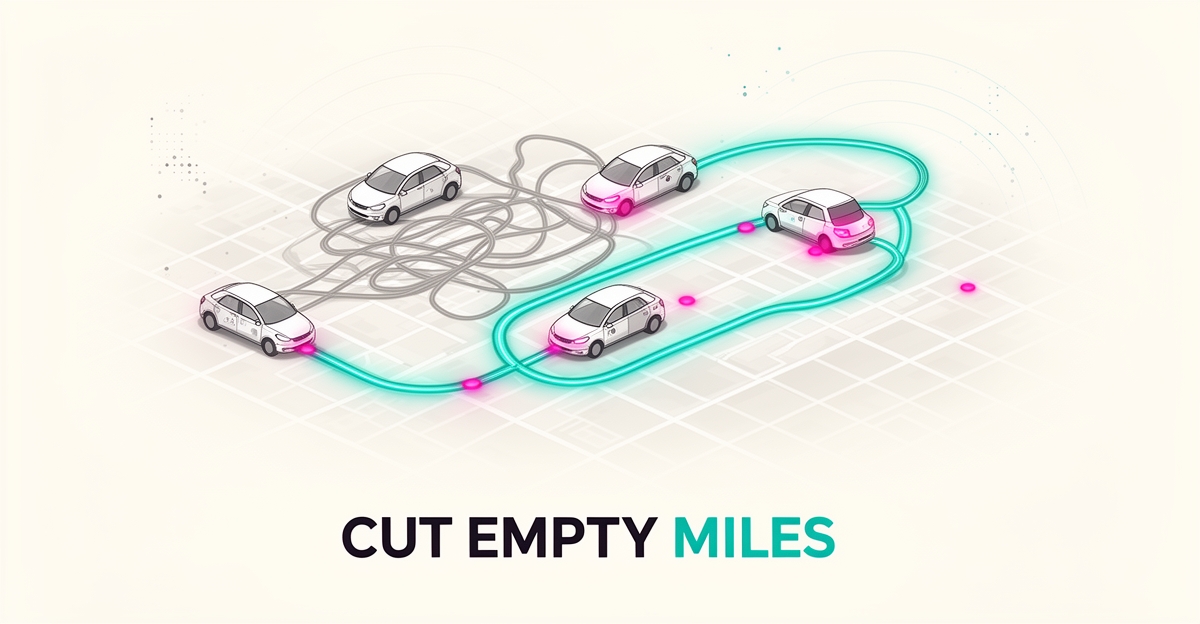
How an AI Dispatcher Can Reduce Empty Miles for Rideshare Fleet Operators
Key Facts
- AI drove 21,490 US job cuts in April 2026, representing 26% of all monthly cuts.
- 40% of workers now fear AI replacement, up sharply from 28% two years prior.
- Over 20 data center facilities were canceled in Q1 2026 due to community opposition.
- More than 100 local communities enacted construction moratoriums on new data centers.
- 67% of Americans express general concerns about AI’s broader societal impact.
- Organizations average 30 to 40 AI tools, with most unaware of their presence.
- Logistics firms are actively replacing entire human dispatch teams with AI routing systems.
What if you could hire a team member that works 24/7 for $599/month?
AI Receptionists, SDRs, Dispatchers, and 99+ roles. Fully trained. Fully managed. Zero sick days.
The Hidden Cost of Idle Time
Empty miles are the silent killer of rideshare fleet profitability, representing revenue lost to vehicles cruising without passengers. While manual dispatch systems attempt to mitigate this through trial and error, they lack the real-time computational power to optimize routes dynamically. This inefficiency creates a significant operational drag that manual processes simply cannot overcome.
Traditional dispatch relies on reactive decision-making, often leaving drivers idle while demand spikes elsewhere. An AI dispatcher changes this equation by analyzing location data and predicting demand before it happens. By automating the routing logic, fleets can shift from a reactive stance to a proactive strategy that minimizes downtime.
Key inefficiencies to address include:
- Reactive Routing: Waiting for a request before assigning a driver, leading to longer arrival times.
- Manual Overhead: Dispatchers spending hours on spreadsheets instead of optimizing live traffic.
- Static Allocation: Assigning drivers to zones regardless of real-time demand fluctuations.
Consider how IT service desks have evolved. According to CRN Australia, AI now acts as a "service desk dispatcher" that identifies problems and handles initial qualification automatically. This same logic applies directly to rideshare: AI identifies the rider’s need and routes the nearest available vehicle instantly.
The scale of this shift is already visible in broader logistics. In April 2026, a logistics worker reported their company replaced the entire dispatch team with an AI routing system, citing efficiency as the primary driver. This transition highlights a broader industry trend where human dispatch roles are being supplanted by automated systems.
Adoption barriers remain significant due to workforce sentiment. Memeburn reports that AI was cited as the primary reason for 21,490 US job cuts in a single month, representing roughly 26% of all cuts that period. Furthermore, 40% of surveyed workers now fear AI replacement, up from 28% just two years prior.
Fleet operators must navigate these social headwinds carefully. However, the operational benefits of reducing idle time are undeniable. AI systems do not take breaks, get distracted, or suffer from fatigue, ensuring consistent optimization around the clock.
For fleet operators, the path forward involves integrating these smart systems without disrupting core operations. AIQ Labs helps fleet operators build custom AI dispatch systems that integrate with existing GPS and booking platforms, delivering measurable reductions in operational waste.
By moving beyond manual dispatch, you transform idle vehicles into revenue-generating assets. The next step is understanding how these systems integrate with your current technology stack to maximize immediate ROI.
From Logistics Precedent to Rideshare Reality
The technology to automate dispatch is no longer theoretical; it is an active reality in logistics that rideshare operators can no longer ignore. While specific data on "empty miles" reduction in rideshare remains scarce, the operational precedent is undeniable.
In April 2026, a logistics worker confirmed their company replaced their entire dispatch team with an AI routing system. This wasn't a pilot program—it was a permanent structural shift that highlights how quickly adjacent industries are automating complex routing decisions.
This transition validates the core premise of AI dispatchers: machines can handle the high-volume, rules-based logic of matching supply with demand more efficiently than humans. For fleet operators, this suggests that the bottleneck is no longer technological capability, but rather the strategic implementation of these systems.
Key indicators of this shift include:
- Direct Job Replacement: AI routing systems are actively displacing human dispatch roles in logistics.
- Operational Efficiency: Automation is moving from experimentation to execution in high-volume sectors.
- Scalable Logic: The underlying algorithms for logistics routing are directly transferable to rideshare.
As these systems prove their worth in freight and delivery, the pressure mounts for rideshare fleets to adopt similar intelligence to maintain competitiveness.
To understand how AI will reduce empty miles, we must look at how it currently manages complex routing in other sectors. The logic is identical: identify a need, qualify the request, and assign the nearest appropriate resource.
In the IT and service sectors, AI already functions as a service desk dispatcher that automates the entire qualification process. By identifying problems and working through tickets before human intervention, AI eliminates the manual sorting that causes delays.
Jack Skinner, Co-founder and CTO of Oversee My IT, explains that AI can "act as your service desk dispatcher, take the call, identify the problem, work through the ticket and handle some of those initial qualification steps."
This capability translates directly to rideshare. An AI dispatcher doesn't just react to a ride request; it predicts demand, qualifies the trip, and pre-positions vehicles. This proactive approach is what drives down idle time and empty miles.
The benefits of this automated routing model are clear:
- Reduced Manual Triage: AI handles initial qualification, freeing humans for complex exceptions.
- Faster Response Times: Automated routing eliminates human processing delays.
- Data-Driven Decisions: Systems learn from historical data to optimize future placements.
By adopting these proven methodologies, fleet operators can move beyond reactive dispatching to predictive fleet management.
While the technology is ready, the environment for deployment is complex. Fleet operators must navigate significant political and social headwinds that accompany AI adoption.
The backlash is real and measurable. In April 2026, AI was cited as the primary reason for 21,490 US job cuts, representing roughly 26% of all cuts that month. This surge in displacement has fueled widespread anti-AI populism and worker resistance.
Furthermore, 40% of surveyed workers now fear AI replacement, a sharp increase from 28% just two years ago. This fear isn't abstract; it manifests in workplace sabotage and organized resistance, posing a tangible risk to operations.
Critical risks to monitor include:
- Labor Relations: High fear of replacement can lead to sabotage and reputational damage.
- Infrastructure Constraints: Data center moratoriums and energy costs impact AI reliability.
- Regulatory Scrutiny: Growing public concern may lead to stricter oversight of automated systems.
Successful implementation requires more than just code; it demands a robust change management strategy that addresses these human and infrastructural realities.
To capitalize on these precedents, fleet operators must approach AI dispatch as a strategic transformation rather than a simple software upgrade. This involves integrating AI with existing GPS and booking platforms while preparing for operational shifts.
AIQ Labs helps fleet operators build custom AI dispatch systems that integrate seamlessly with current infrastructure. By leveraging proven multi-agent architectures, we ensure that your dispatch system is not just a tool, but a competitive advantage.
However, operators must also prepare for the broader implications. With more than 20 data center facilities canceled in Q1 2026 due to local opposition, infrastructure stability is a key consideration.
Recommended steps for adoption:
- Pilot with Purpose: Measure empty mile reduction independently, as specific rideshare data is limited.
- Engage Your Workforce: Transparent communication can mitigate the fears driving the 40% replacement anxiety.
- Build Custom Solutions: Avoid generic tools; invest in systems that understand your specific fleet dynamics.
By combining technological precedent with strategic foresight, fleet operators can turn the threat of disruption into an opportunity for efficiency.
Navigating the Human and Infrastructure Friction
Deploying an AI dispatcher is not just a technical upgrade; it is a complex organizational change that triggers significant human and infrastructure resistance. Fleet operators must look beyond code to manage the political and social friction that often derails automation projects.
Labor backlash poses the single greatest risk to successful AI implementation in the transportation sector. As companies rush to cut costs, they are igniting a backlash that threatens operational stability and reputational integrity.
The transition to automated dispatch is happening faster than workforce adaptation. In April 2026, a logistics worker revealed their company replaced the entire dispatch team with an AI routing system without offering severance or clear communication (https://memeburn.com/why-anti-ai-populism-is-growing-and-whos-driving-it-in-2026/).
This abrupt shift is not an isolated incident but part of a broader trend fueling anti-AI populism. The speed of adoption has created an environment where worker fear is driving operational sabotage and public resistance.
- 21,490 US job cuts were attributed to AI in April 2026 alone, representing 26% of all monthly cuts (https://memeburn.com/why-anti-ai-populism-is-growing-and-whos-driving-it-in-2026/).
- 40% of workers now fear AI replacement, a sharp increase from 28% just two years prior (https://memeburn.com/why-anti-ai-populism-is-growing-and-whos-driving-it-in-2026/).
- 67% of Americans express general concern about AI’s impact, creating a hostile public relations environment for aggressive automation (https://memeburn.com/why-anti-ai-populism-is-growing-and-whos-driving-it-in-2026/).
Operators must anticipate this resistance by developing robust change management strategies. Proactive engagement with existing staff is critical to mitigating the risk of workplace sabotage and maintaining morale during the transition.
Beyond labor relations, physical infrastructure limits are becoming a tangible barrier to real-time AI deployment. AI workloads are energy-intensive, and the demand is straining local power grids in ways that directly impact operational continuity.
The expansion of AI requires massive computational power, which drives up energy costs and triggers local regulatory pushback. In the PJM grid region, data centers now account for nearly two-thirds of power supply cost increases (https://memeburn.com/why-anti-ai-populism-is-growing-and-whos-driving-it-in-2026/).
This energy demand has led to immediate regulatory consequences for technology adoption. Operators must assess the reliability of their local infrastructure before committing to cloud-based dispatch solutions.
- 20+ data center facilities were canceled in Q1 2026 due to community opposition (https://memeburn.com/why-anti-ai-populism-is-growing-and-whos-driving-it-in-2026/).
- 100+ local communities enacted construction moratoriums on new data centers (https://memeburn.com/why-anti-ai-populism-is-growing-and-whos-driving-it-in-2026/).
- High-profile political pressure is mounting, with leaders demanding AI operators pay for their own grid upgrades (https://memeburn.com/why-anti-ai-populism-is-growing-and-whos-driving-it-in-2026/).
To succeed, fleet operators must navigate these dual challenges of human resistance and infrastructure limits. The technology to automate routing is proven, as seen in IT service desks where AI handles initial qualification and ticket triage (https://www.crn.com.au/news/2026/ai/ai-use-cases-across-the-world-driving-real-msp-productivity-gains).
However, successful deployment requires a holistic approach that prioritizes transparency and infrastructure resilience. Operators should design pilot programs that measure efficiency gains while actively addressing labor concerns.
By acknowledging these friction points early, fleet operators can build AI dispatch systems that are not only technically superior but also socially and infrastructurally sustainable. This balanced strategy ensures that efficiency gains are not undermined by operational disruption or regulatory hurdles.
Building a Custom AI Dispatch System
Rideshare operators face a brutal financial reality: empty miles drain profitability faster than any other operational inefficiency. While generic software offers basic routing, it lacks the predictive intelligence needed to dynamically minimize idle time in real-time traffic conditions.
To truly optimize fleet utilization, you need a system that thinks like a human dispatcher but scales like a machine. AIQ Labs architects custom AI workflows that integrate directly with your existing GPS and booking platforms, creating a unified operational brain.
Unlike off-the-shelf solutions, our approach ensures you own the intellectual property, eliminating long-term vendor lock-in and subscription bloat.
- True Ownership: You retain full control and code ownership of your custom system
- Seamless Integration: We connect with your current GPS, CRM, and booking APIs
- Predictive Routing: AI analyzes real-time data to pre-position vehicles before demand spikes
As we move from strategy to execution, understanding the technical architecture is critical for success.
Building a dispatcher that reduces empty miles requires more than simple automation; it demands a multi-agent orchestration system. At AIQ Labs, we utilize advanced frameworks like LangGraph to create stateful workflows where specialized agents collaborate to solve complex dispatch challenges.
Our architecture separates concerns into distinct functional layers. One agent handles real-time location tracking, another predicts demand surges based on historical data, and a third executes the routing logic. This specialization ensures higher accuracy and faster decision-making than monolithic AI models.
- LangGraph Workflows: Complex, stateful logic where agents maintain context across multiple steps
- Specialized Agent Roles: Distinct AI entities handle routing, prediction, and communication separately
- Real-Time Processing: Low-latency decision-making essential for dynamic rideshare environments
This modular design allows us to deploy systems that are both robust and adaptable to your specific operational needs.
Implementing AI dispatchers requires navigating significant organizational hurdles. Recent industry analysis indicates that AI was cited as the primary reason for 21,490 US job cuts in April 2026, representing roughly 26% of all cuts that month. This data highlights the intense labor relations challenges operators must prepare for.
Furthermore, 40% of surveyed workers now fear AI replacement, a sharp increase from 28% two years ago. Successful deployment isn't just technical; it’s cultural. You must implement robust change management strategies to mitigate resistance and maintain team morale during the transition.
- Workforce Integration: Plan for transparent communication to address employee concerns about job security
- Infrastructure Readiness: Ensure your data centers and power grids can support 24/7 AI workloads
- Compliance First: Maintain strict audit trails to meet industry regulations and ethical standards
Addressing these human and infrastructural factors is as important as the code itself.
While specific rideshare metrics vary, the underlying technology for AI dispatch is proven in adjacent sectors. In logistics, companies have already begun replacing human dispatch teams with AI routing systems, demonstrating the viability of automated fleet management.
Similarly, in IT service management, AI functions effectively as a "service desk dispatcher," identifying problems and handling initial qualification steps. This analogy confirms that AI can successfully manage the logic of matching resources to requests, a core function of rideshare dispatching.
- Logistics Precedent: AI routing systems are actively replacing human dispatch teams in freight logistics
- Service Desk Analogies: AI successfully handles ticket triage and resource qualification in MSPs
- Production-Tested Expertise: AIQ Labs runs 70+ production agents daily across multiple live platforms
We apply these battle-tested methodologies to build dispatch systems that are reliable from day one.
The path to reduced empty miles lies in custom-built ownership, not rented software subscriptions. By partnering with AIQ Labs, you gain an end-to-end solution that evolves with your business.
We handle everything from initial discovery and architecture to ongoing optimization, ensuring your AI system delivers measurable ROI. Our team doesn’t just build tools; we build production-ready AI systems designed for long-term growth and scalability.
- End-to-End Partnership: From strategy through execution to continuous optimization
- No Vendor Lock-In: Complete control over your custom AI assets and future development
- Measurable Results: Focus on actionable insights that directly impact your bottom line
Ready to transform your fleet operations? Contact AIQ Labs today to schedule your Free AI Audit & Strategy Session and discover how we can help you eliminate operational waste.
Next Steps for Fleet Optimization
Transitioning from manual coordination to an AI-driven dispatch ecosystem requires a strategic approach that prioritizes operational readiness over rapid deployment. Fleet operators must recognize that while the technology is proven in adjacent logistics sectors, the implementation path involves navigating complex labor dynamics and infrastructure realities.
According to recent industry analysis, the automation of dispatch roles is no longer theoretical but an active operational shift. In April 2026, a logistics worker reported their company replacing their entire dispatch team with an AI routing system, citing significant operational changes as a primary driver of worker backlash as reported by Memeburn. This highlights the urgent need for fleet operators to prepare for significant labor relations challenges alongside technical integration.
To ensure a successful transformation, operators should focus on three critical preparation areas:
- Audit Current Data Infrastructure: Verify that GPS and booking platforms can support real-time API integration with custom AI systems.
- Develop Change Management Strategies: Address the 40% of workers who fear AI replacement to mitigate sabotage risks and maintain team morale according to Memeburn.
- Assess Local Infrastructure Risks: Monitor local energy and data center constraints, as rising power costs and construction moratoriums may impact cloud-based AI reliability as reported by Memeburn.
While specific metrics on "empty miles" reduction are not yet standardized in rideshare data, the functional precedent exists. AI systems are already functioning as effective "service desk dispatchers" in IT sectors, identifying problems and handling initial qualification steps to reduce manual routing efforts according to CRN Australia. This capability translates directly to matching riders with drivers, offering a viable model for rideshare optimization.
AIQ Labs offers a proven pathway to this transformation through our AI Employee service pillar. We provide fully trained, managed AI dispatchers that integrate seamlessly with existing GPS and booking platforms, delivering measurable reductions in operational waste without the complexity of building from scratch. Our standard AI Employee role includes a dispatcher function, available for a $2,000–$3,000 setup fee and $1,000–$1,500/month thereafter, ensuring you own the system and avoid vendor lock-in.
By partnering with AIQ Labs, fleet operators gain access to enterprise-grade AI development services that prioritize engineering excellence and true ownership. We help businesses move beyond experimental pilots to scalable, production-ready systems that deliver sustainable competitive advantages.
Start your journey toward optimized fleet efficiency by scheduling a Free AI Audit & Strategy Session with AIQ Labs today.
Still paying for 10+ software subscriptions that don't talk to each other?
We build custom AI systems you own. No vendor lock-in. Full control. Starting at $2,000.
Frequently Asked Questions
Can AI dispatchers actually reduce empty miles for my rideshare fleet?
How much does an AI dispatcher cost compared to hiring a human?
Will replacing dispatchers with AI cause labor backlash or sabotage?
Does AIQ Labs own the AI system, or do I own it?
Is the technology stable enough for real-time fleet management?
From Idle to Profitable: Owning Your Fleet’s Intelligence
Empty miles are not just wasted fuel; they are lost revenue that manual dispatch systems simply cannot stop. As demonstrated, shifting from reactive, spreadsheet-based routing to proactive, AI-driven prediction eliminates idle time and maximizes fleet utilization. For rideshare operators, the technology to capture this value exists, but implementation requires more than off-the-shelf software. AIQ Labs helps fleet operators build custom AI dispatch systems that integrate seamlessly with existing GPS and booking platforms, delivering measurable reductions in operational waste. Unlike vendors offering generic tools, we provide custom-built systems you own outright, ensuring true ownership without vendor lock-in. Don’t let inefficient routing erode your margins. Stop guessing and start optimizing. Contact AIQ Labs today for a Free AI Audit & Strategy Session to discover how we can architect your competitive advantage and turn your fleet into a profit-generating asset.
Ready to make AI your competitive advantage—not just another tool?
Strategic consulting + implementation + ongoing optimization. One partner. Complete AI transformation.