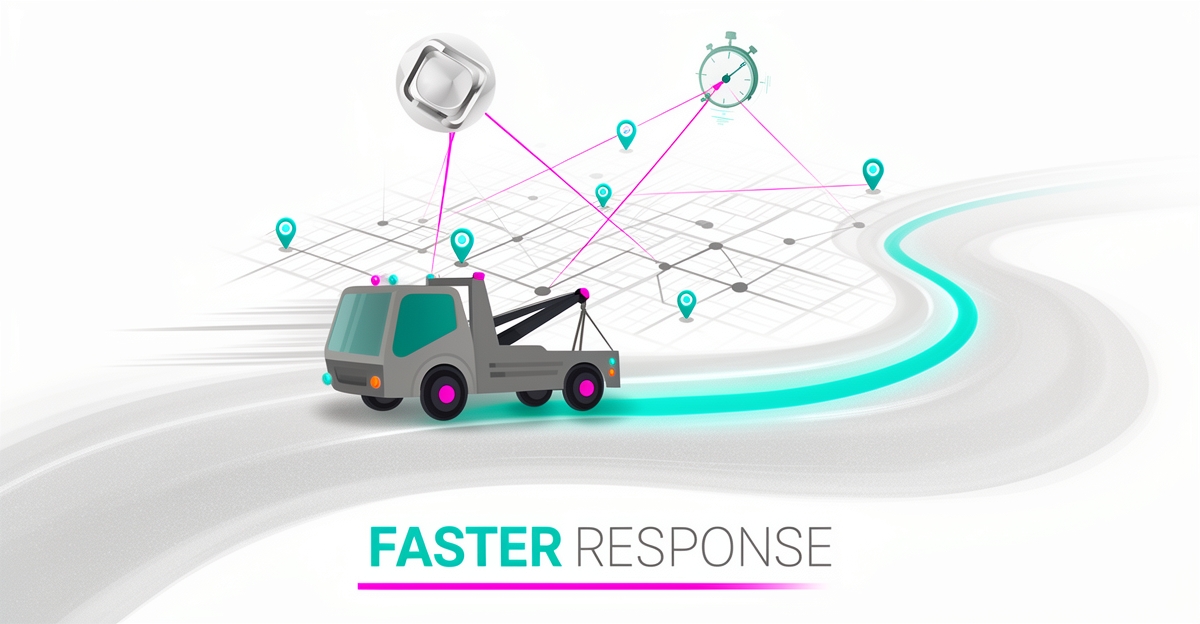
How an AI Dispatcher Can Reduce Response Times for Towing Companies
Key Facts
- Industry analyses as of late 2026 suggest AI dispatchers can reduce response times by roughly 30-50% compared to manual dispatching
- Manual dispatching typically takes 5-10 minutes per job cycle while AI completes it in seconds
- AI automation is commonly reported to cut dispatcher workload by 60% or more by eliminating manual tasks
- Towing industry data suggests a meaningful share of potential customers—often estimated at 15-25%—are lost during peak hours because calls go unanswered
- AI-assisted dispatching is typically associated with on-time rates in the high 90s, versus roughly 85-90% with manual methods
- One AI-enabled dispatcher can typically manage 35-50+ vehicles versus 10-15 manually
- Fleet management studies commonly report 15-20 hours saved weekly on administrative tasks like invoicing and claims
Hire a team member that works 24/7 — for less than a part-time wage.
AI receptionists, SDRs, dispatchers and 99+ roles. Trained on your business, fully managed.
Not sure where to start? Ask our AI planner
The Hidden Cost of Slow Towing Response Times
Towing companies lose more than just time when dispatching manually—they lose customers, fuel, and profit. Each job assignment delayed by 5-10 minutes due to manual dispatching cycles creates a ripple effect across operations. During peak hours, this inefficiency means a meaningful share of potential customers—industry estimates often put it at 15-25%—hang up before getting help, directly impacting revenue when every call counts. Manual dispatching is the bottleneck in most towing operations: recalling availability, estimating distances, and waiting for driver confirmation takes far longer than necessary, especially during high-volume events like snowstorms.
These delays aren't just frustrating for customers; they're expensive for businesses. Manual dispatching tends toward intuition-based routing that can increase fuel consumption by 15-30% due to poor stop sequencing and unnecessary mileage. Fleet management analyses as of late 2026 suggest fleets relying on manual methods often carry meaningfully higher total operating expenses than AI-optimized alternatives. For a mid-sized towing company, this inefficiency can translate to tens of thousands in avoidable annual costs—money that could otherwise fund growth or improve service quality.
- Lost customer opportunities from unanswered calls during peak hours
- Increased fuel costs from suboptimal, intuition-based routing
- Administrative overload from manual invoicing, claims, and lien processing
- Limited scalability, with one dispatcher managing only 10-15 drivers effectively
- Higher overtime and idle time due to inefficient job assignments
The hidden cost extends beyond immediate expenses. Dispatchers spending 15-20 hours weekly on administrative tasks like invoicing and claims processing are diverted from higher-value activities such as customer relationship management and exception handling. Industry research suggests AI automation can cut this workload by 60% or more, freeing skilled staff to focus on complex scenarios where human judgment is irreplaceable. Without addressing these inefficiencies, towing companies remain trapped in a cycle of reactive operations that hinder scalability and profitability. AIQ Labs builds AI dispatchers and other managed AI staff that integrate with existing towing operations to eliminate these delays and unlock operational efficiency.
How AI Dispatchers Eliminate Response Delays Through Real-Time Automation
Response delays in towing start the moment a phone rings and a dispatcher starts searching for a truck. That human latency compounds during peak hours and storms, when every minute of wait time costs customers and revenue.
AI dispatchers compress the entire dispatch cycle from minutes to seconds by removing manual handoffs. In a traditional setup, a dispatcher must recall driver locations, estimate distances, call drivers, wait for confirmation, and relay details back to the customer. This loop typically takes 5-10 minutes on a good day and often fails completely under high volume.
The system replaces that loop with real-time automation. Instant intake extracts location, vehicle type, and urgency from calls or digital portals immediately. Real-time fleet evaluation then analyzes GPS positions, current job status, estimated completion times, and truck capabilities such as flatbed versus wheel-lift simultaneously.
Optimal assignment follows, calculating who can arrive fastest by factoring traffic, workload, and equipment match, not just proximity. Automated notification pushes job details, navigation, and customer info to the driver via mobile app, eliminating phone tag. Together these steps are typically associated with a 30-50% reduction in response times compared with manual dispatching.
That speed shift changes the dispatcher role from route builder to operations manager. With routine assignments automated, teams focus on exceptions, customer relationships, and rate negotiations. Scalability improves as well, since one dispatcher can effectively oversee far more vehicles when AI handles volume.
The core mechanics that remove delay are:
- Instant intake that captures call details and urgency without manual entry
- Real-time fleet evaluation using live GPS, job status, and equipment capabilities
- Optimal assignment based on arrival time, traffic, and workload, not just distance
- Automated notifications that deliver job packets and navigation to drivers instantly
Beyond speed, automation reduces the administrative load that slows response. Fleet operations research as of 2026 commonly reports a 60-80% reduction in phone calls through automated status updates, and 60%+ reductions in dispatcher workload through AI automation.
For towing companies, faster answers directly protect revenue. Towing industry estimates suggest 15-25% of potential customers are lost because companies cannot answer the phone fast enough during peak hours.
AIQ Labs builds custom AI systems that integrate with existing towing operations to ensure real-time decision-making and seamless workflow execution. If dispatch is the single workflow costing you the most, a fixed-price Workflow Build rebuilds it in phases—no open-ended consulting engagement.
When the plan breaks, the system reshuffles in seconds and sends arrival updates automatically. That combination of instant intake, live evaluation, smart assignment, and automated notification is how response delays are eliminated at scale.
From Route Builder to Operations Manager: The Evolving Dispatcher Role
The role of the dispatcher is undergoing a fundamental shift as AI takes over repetitive, time-consuming tasks. Instead of spending minutes on each job recalling driver locations, making phone calls, and updating paperwork, dispatchers now oversee a system that handles these steps in seconds. This transition transforms them from route builders into operations managers who focus on exceptions, customer retention, and fleet optimization. Industry analyses suggest AI enables one dispatcher to manage significantly more vehicles—scaling from a manual limit of 10-15 drivers to overseeing 35-50 or more. Research as of late 2026 indicates this shift can reduce planning time from 60-120 minutes manually to under five minutes daily, and cut mid-day rerouting from 15-45 minutes to well under two minutes.
With routine dispatching automated, human dispatchers gain capacity to engage in higher-value activities that directly impact business performance. They can proactively manage customer relationships by addressing service issues before they escalate, negotiate better rates with repair shops or insurance partners, and analyze fleet performance data to identify optimization opportunities. AI handles the volume and speed of standard jobs—such as routine tows or lockouts—while flagging complex scenarios like accident recoveries or heavy-duty recoveries for human review. This hybrid approach ensures that AI's speed and consistency are leveraged for predictable workloads, while human judgment remains critical for nuanced, high-stakes situations. This evolution doesn't replace the dispatcher—it gives them the capacity to focus on what truly moves the needle for the business.
The scalability enabled by AI dispatching is particularly valuable for towing companies aiming to grow without linear increases in headcount. By automating intake, assignment, and communication, a single dispatcher can maintain oversight of a much larger fleet while improving response times and reducing operational waste. Data from AI dispatch implementations typically shows on-time rates in the high 90s—well above the 85-90% common with manual methods—and reductions in empty miles of 15-25% through smarter routing. These improvements not only lower fuel costs but also increase the number of jobs completed per shift, boosting revenue potential without adding drivers or trucks. For towing businesses, this means the dispatcher evolves into a strategic role—one that uses AI as a force multiplier to enhance service quality, control costs, and support sustainable growth. AIQ Labs builds AI dispatcher systems that integrate with existing towing operations to enable this transformation, ensuring real-time decision-making and seamless workflow execution.
Implementing AI Dispatch: A Practical Roadmap for Towing Companies
Implementing AI dispatch begins with a clear assessment of current operations and data readiness. Towing companies should evaluate call volume, average response times, and administrative bottlenecks while ensuring driver locations, vehicle capabilities, and customer data are accurate and up to date. Poor data quality directly undermines AI performance, so cleaning and standardizing this information is a critical first step. AI systems depend on reliable inputs to generate optimized routes and assignments.
Next, select an AI dispatch approach that integrates with existing tools like CRM, accounting software, and GPS tracking systems. The chosen solution should support real-time fleet evaluation, route optimization, and automated customer notifications. For fleets of 10 or more vehicles, this integration enables significant efficiency gains—studies commonly report 15-25% lower fuel costs and 15-20 hours saved weekly on administrative tasks like invoicing and claims processing. Hardware such as GPS trackers may need installation if not already in place.
Once integrated, configure business rules within the AI system, including driver skill sets (e.g., flatbed vs. wheel-lift), service boundaries, shift schedules, and job priority levels. Train dispatchers and drivers on the new workflow, emphasizing how the AI handles routine assignments while escalating complex cases for human review. This shift transforms the dispatcher from a "route builder" to an "operations manager," enabling one dispatcher to manage 35-50+ vehicles effectively. Pilot the system with a subset of the fleet or specific job types, monitoring key metrics like response time, fuel usage, and on-time delivery before full rollout. Continuous optimization based on performance data ensures long-term improvements in efficiency and customer satisfaction. Start with AIQ Labs' 2-minute Fit Check to assess your readiness and map a tailored implementation plan.
Turn Dispatch Delays into Competitive Advantage
As we've explored, the hidden costs of manual dispatching—lost customers, wasted fuel, and administrative overload—are not inevitable. AI dispatchers eliminate response delays by automating intake, real-time fleet evaluation, optimal assignment, and instant notifications, typically cutting response times by 30-50% and freeing dispatchers to focus on high-value activities like customer relationships and fleet optimization. For towing companies ready to scale without proportional headcount growth, this shift transforms dispatch from a bottleneck into a strategic advantage. The path forward starts with assessing your current operations and data readiness—ensuring driver locations, vehicle capabilities, and call volumes are accurate—then choosing an approach that integrates with your existing tools. AIQ Labs helps towing companies navigate this transition, whether you start with an AI dispatcher as a managed AI employee, a fixed-price Workflow Build for your dispatch workflow, or a full AI Operating System for your whole operation. To see how this applies to your business, take the 2-minute Fit Check and book a free 30-minute strategy call to map your biggest bottleneck—no obligation, just clarity on your AI opportunity.
Make AI your competitive advantage — not just another tool.
Strategy, implementation and ongoing optimization. One partner, end to end.
Not sure where to start? Ask our AI planner