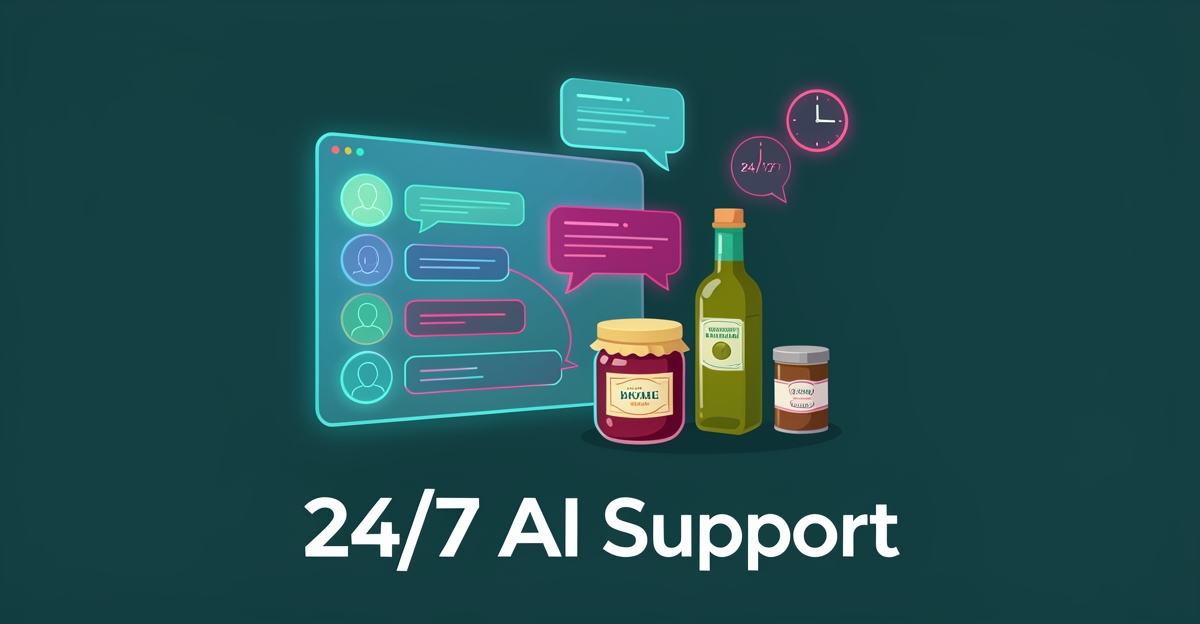
How an AI Employee Can Handle 24/7 Customer Inquiries for Your Specialty Food Brand
Key Facts
- Most customer support requests are repetitive tier-one questions that can be resolved through automation
- AI-powered support typically handles the majority of routine inquiries like stock checks and shipping ETAs instantly
- Customers increasingly prefer self-service options when they get instant, accurate responses
- AIQ Labs AI employees cost roughly 80% less than an equivalent human hire while working 24/7/365
- AIQ Labs has deployed 200+ multi-agent systems and runs 4 live SaaS products daily
Hire a team member that works 24/7 — for less than a part-time wage.
AI receptionists, SDRs, dispatchers and 99+ roles. Trained on your business, fully managed.
Not sure where to start? Ask our AI planner
The 24/7 Support Gap Specialty Food Brands Can't Afford
Specialty food brands face unique challenges when customers reach out after hours about product availability, expiration dates, or shipping timelines. These inquiries often come when human support teams are offline, creating a critical gap in service that directly impacts sales and customer trust. Without 24/7 coverage, brands risk losing sales to competitors who can answer questions in real time, especially when customers are making time-sensitive purchasing decisions.
The cost of maintaining round-the-clock human support is prohibitive for most specialty food businesses. Staffing overnight shifts requires premium pay, benefits, and management overhead that quickly erodes profit margins. Meanwhile, most customer support requests are repetitive tier-one questions that could be resolved instantly through automation, yet they continue to drain valuable human agent time that could be spent on complex issues requiring empathy and problem-solving.
This support gap leads to measurable business losses: abandoned carts when customers can't confirm if a product is in stock, negative reviews from frustrated shoppers who couldn't verify expiration dates before purchasing, and increased strain on human teams forced to handle backlogs during business hours. AI employees eliminate this gap by providing instant, accurate responses to routine inquiries 24/7 without overtime costs or staffing shortages, allowing human agents to focus on high-value interactions that build lasting customer relationships. The routine questions that dominate specialty food support include:
- Product availability questions
- Expiration date verification
- Shipping timeline inquiries
- Inventory status checks
- Order modification requests
By automating these routine interactions, specialty food brands ensure customers get the information they need when they need it, whether it's 2 PM or 2 AM, without compromising service quality or breaking the bank. This approach transforms a costly operational weakness into a competitive advantage that supports growth while maintaining the personal touch customers expect from premium food brands. AIQ Labs helps specialty food brands implement this solution through managed AI employees that integrate with existing support systems and scale with business needs.
Why AI Employees Beat Chatbots for Real-Time Food Questions
For specialty food brands, basic chatbots fall short when customers ask real-time questions about product freshness, shipping windows, or allergen details. AI employees outperform simple rule-based bots by understanding context, accessing integrated systems, and delivering accurate, brand-aligned responses 24/7. This capability drives measurable improvements in resolution speed and cost efficiency that basic automation cannot match.
For perishable goods inquiries, this speed prevents frustration from delayed answers about expiration dates or stock availability. Customers increasingly prefer self-service options when they get instant, accurate responses, critical for food brands where timing affects purchasing decisions. The difference comes down to what the system can actually do:
- Handles routine inquiries like stock checks and shipping ETAs instantly
- Preserves brand voice for sensitive topics like allergen info or product origins
- Escalates complex cases to humans while maintaining context
- Operates 24/7 without overtime, sick days, or coverage gaps
- Integrates with inventory and order systems for real-time accuracy
This hybrid AI-first, human-second model lets AI manage volume while humans focus on nuanced issues requiring empathy or judgment. For specialty food brands, this means customers get immediate answers about whether a product is in stock or how to store it properly, without waiting for business hours, while human agents step in only for complaints, custom orders, or detailed ingredient questions. The result is faster service, lower costs, and consistent brand trust around the clock.
How to Deploy a 24/7 AI Customer Service Agent for Specialty Food
Deploying a 24/7 AI customer service agent for a specialty food brand begins with ingesting your product catalogs, shipping policies, and expiration protocols into a custom knowledge base. This ensures the AI agent draws answers exclusively from verified business data rather than generic internet sources, critical for accuracy when customers ask about perishable goods or allergen information. AIQ Labs structures this knowledge ingestion as part of the AI Employee build process, grounding every response in your specific operational truth.
Next, persona calibration aligns the AI's tone with food safety standards, professional, clear, and reassuring, while reflecting your brand's voice. Guardrails are engineered to prevent the AI from guessing on expiration dates or shipping timelines, programming it to escalate uncertain queries to human agents immediately. Before full deployment, the agent operates in shadow mode, drafting responses for human review until accuracy meets an agreed benchmark. This phased approach mirrors AIQ Labs' implementation framework, ensuring reliability before live customer interaction.
Once deployed, the AI Employee handles routine inquiries, such as product availability, shelf life, and delivery estimates, around the clock without overtime, sick days, or shift coverage costs. Most support requests are repetitive and automatable, which means instant responses to high-volume questions about inventory or shipping, freeing human agents to focus on complex issues like complaint resolution or custom order consultations. With the Start Monthly model, your AI employee runs at roughly 80% less cost than a human hire, with build, training, tool integrations, monitoring, and continuous improvement included, delivering 24/7 coverage at a fraction of the cost of a part-time hire. You can see the full lineup of roles and payment options at AI Employees and pricing.
Measuring ROI and Scaling Beyond Support
You've deployed your AI employee, the after-hours inquiries are being handled, and customers are getting instant answers about stock and shipping. Now comes the question every owner eventually asks: is this actually paying for itself?
The answer comes from measuring the right things. Start with the core efficiency metrics: response time, resolution time, and the percentage of tickets your AI employee closes without human help. For a specialty food brand, that means your human team stops spending mornings answering "is the maple syrup back in stock?" and starts working on wholesale relationships and product development.
Cost metrics tell an even sharper story. Track contact cost per inquiry, hours returned to your team, and deflection rate, the percentage of routine questions resolved without human touch. Compare those against what an equivalent human hire would cost; with AIQ Labs AI employees running at roughly 80% less than a human hire, the math usually speaks for itself within the first billing cycle.
Once support ROI is proven, the same AI infrastructure can scale into operations that specialty food brands struggle with manually:
- Inventory forecasting, AI models analyzing sales patterns, seasonality, and multi-channel demand to reduce stockouts and cut excess inventory.
- Order processing, dedicated AI roles that handle order entry, fulfillment coordination, and invoice processing end-to-end.
- Internal knowledge management, automated knowledge bases that cut repetitive internal questions and speed up onboarding seasonal staff.
This is where the ownership question matters. Many support tools are rented widgets you can't extend, which is why AIQ Labs offers three ways to work together: Start Monthly with a managed AI employee, Build in Milestones on a Workflow Build for the one workflow that costs you the most, or Own It Outright with a full AI Operating System you keep with no vendor lock-in. That continuity is what turns a support win into a business-wide capability: the AI employee handling customer questions today can share the same data foundation as tomorrow's inventory and order-processing agents.
A practical measurement cadence: review deflection rate and response accuracy weekly during the first 90 days, then shift to monthly reviews of cost-per-contact and hours saved. One caution from the field, the most common failure mode is launching too many workflows at once and measuring nothing. Prove support first, expand deliberately, and let the ROI data dictate the pace of scaling.
Still paying for 10+ subscriptions that don’t talk to each other?
We build custom AI systems you own outright. No vendor lock-in. Full control.
Not sure where to start? Ask our AI planner
Frequently Asked Questions
How much can an AI employee reduce customer service costs for specialty food brands?
What types of customer inquiries can an AI employee handle 24/7 for a specialty food brand?
Will customers prefer talking to an AI employee over a human agent for food-related questions?
How does an AI employee avoid giving wrong information about product expiration or allergens?
What ROI can specialty food brands expect from deploying an AI employee for customer support?
Is using an AI employee really more affordable than hiring a part-time human for after-hours support?
Your Next Sale Shouldn't Wait Until Monday Morning
Every question your customers ask at midnight, about stock, shelf life, or shipping, is a sale you either win or lose right then. As we've covered, an AI employee closes that gap: answering routine inquiries instantly, around the clock, at roughly 80% less cost than a human hire, so your team can focus on the conversations that actually build loyalty. The path is proven, start with a grounded knowledge base, calibrate the tone to your brand, prove support ROI first, then scale deliberately into inventory, orders, and beyond. The brands moving fastest are the ones that start measuring now rather than waiting for a competitor to set the standard. If you want clarity on whether this fits your business, take the two-minute Fit Check at aiqlabs.ai/apply, then book a free 30-minute strategy call with an AI engineer, a real working session to map your biggest bottleneck and identify the highest-ROI opportunities. If there isn't a clear win, we'll tell you that too. Your customers are already asking questions after hours. The only decision left is who answers them.
Make AI your competitive advantage — not just another tool.
Strategy, implementation and ongoing optimization. One partner, end to end.
Not sure where to start? Ask our AI planner