How an AI Employee Can Handle Customer Complaints and Aftercare
Key Facts
- A large share of consumers won't make a repeat purchase after a poor customer service experience — complaint speed is a retention metric, not just a courtesy.
- AI employees typically cut significant handling time per interaction by automating capture, categorization, and first-response.
- Sentiment analysis lets AI flag at-risk customers early, so teams can escalate before churn risk grows.
- Most service leaders now consider AI and automation essential for business growth.
- A majority of customers expect to find answers through self-service options before contacting a human.
- AIQ Labs has deployed 200+ multi-agent systems and runs 4 live SaaS products daily — complaint handling is a proven use case, not a theory.
Hire a team member that works 24/7 — for less than a part-time wage.
AI receptionists, SDRs, dispatchers and 99+ roles. Trained on your business, fully managed.
Not sure where to start? Ask our AI planner
The Hidden Cost of Slow Complaint Resolution
A slow reply to a complaint rarely feels like a delay — it feels like dismissal. In customer service, minutes turn into churn, and a single unresolved issue can undo months of brand building.
When complaints linger, revenue follows. A large share of consumers say a poor customer service experience will stop them from making a repeat purchase, and negative experiences get shared faster than positive ones. The financial hit compounds with reputation damage.
Speed is now a retention metric. AI employees typically cut meaningful handling time per interaction by automating intake, routing, and first response. That acceleration directly shortens the window where frustration turns into defection.
AI-powered complaint management changes the cost equation by automating the first moments that matter most:
- Automated capture via chat, voice, and email parsing logs issues immediately and acknowledges customers without wait
- Intelligent categorization using NLP and sentiment analysis routes complaints to the right team by type, severity and urgency
- AI-assisted resolution surfaces knowledge bases, workflows and personalized recommendations for faster closure
Faster handling also reduces downstream workload. Resolution speed protects both service capacity and sales — teams that resolve on first contact field fewer repeat tickets and recover more at-risk revenue.
In practice, this means complaints move from manual triage to continuous flow. AI can identify patterns of dissatisfaction before they escalate, enabling proactive outreach rather than reactive firefighting. The result is fewer repeat contacts, lower agent fatigue, and higher first-contact resolution.
For teams managing aftercare and post-service follow-up, slow responses create a specific vulnerability: the customer is already in a service moment. An AI customer service agent can respond to complaints, confirm appointments, and manage follow-ups in real time, improving satisfaction without adding human overload.
AIQ Labs deploys AI employees — managed AI staff covering receptionists, SDRs, dispatchers, and 99+ other roles — that absorb peak complaint volume while maintaining consistent tone and process, at roughly 80% less cost than a human hire.
Organizations that treat complaint speed as operational risk, not just service etiquette, tend to retain more customers and spend less to recover them.
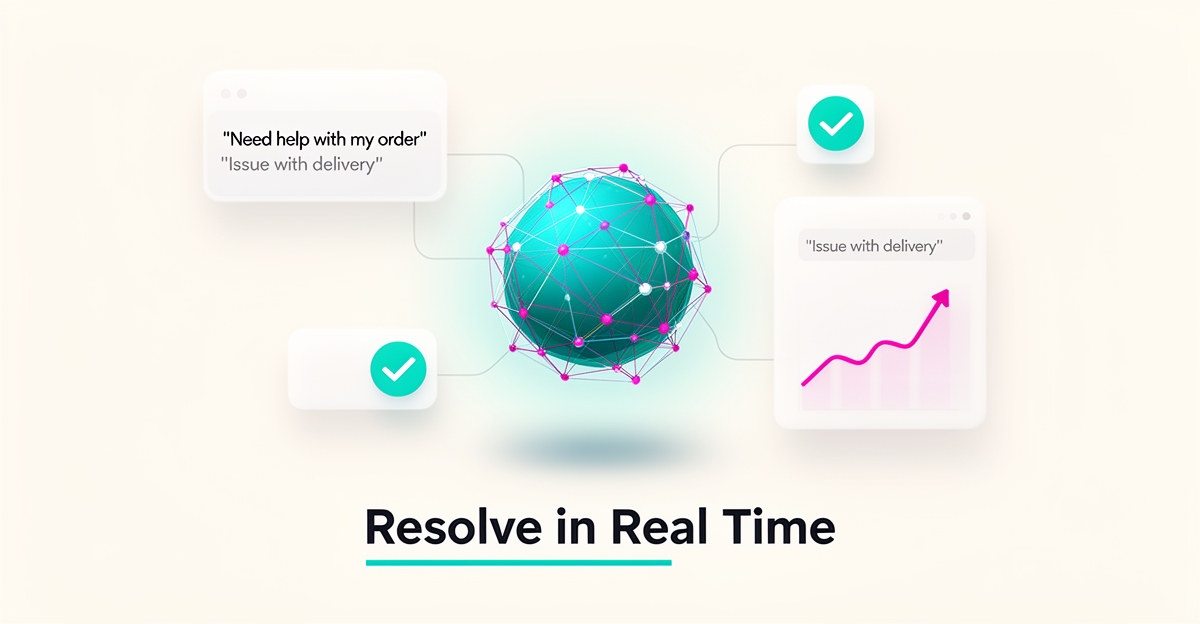
How AI Employees Capture, Categorize, and Resolve Complaints in Real Time
Customer complaints arrive across chat, email, phone and social, and speed of capture sets the tone for resolution. AI employees remove the manual logging bottleneck by listening and reading in real time, acknowledging issues instantly and creating a structured record for action.
Capture starts with automated intake. Chat, voice recognition and email parsing collect complaints from multiple channels and log them accurately without human retyping. This typically saves teams significant handling time per interaction, freeing staff for higher-value work.
Once captured, intelligent categorization routes each case to the right owner. Natural Language Processing and sentiment analysis read content and tone to assign type, severity, urgency and responsibility. This AI-powered routing ensures complaints reach the most relevant team or agent faster, reducing resolution times and improving efficiency.
Sentiment analysis also drives prioritization. AI can score satisfaction risk from sentiment signals, allowing teams to escalate high-risk cases before churn risk grows. Most service leaders now consider AI and automation essential for business growth.
Resolution accelerates when agents have instant access to context. AI co-pilots surface knowledge base articles, automated workflows and pre-written scripts matched to the complaint profile and customer history, supporting faster, more consistent outcomes and meaningfully reducing agent workload.
In practice, an AI customer service agent can respond to complaints, confirm appointments and manage post-service follow-ups without human overload. AIQ Labs deploys AI employees trained on your specific processes to handle inquiries end-to-end, improving satisfaction and reducing response times.
The real-time workflow typically includes:
- Capture: multi-channel intake via chat, voice and email parsing with immediate acknowledgment
- Categorize: NLP and sentiment analysis for type, severity and urgency tagging
- Prioritize: satisfaction risk scoring to surface critical cases first
- Resolve: knowledge access, automated recommendations and seamless human handoff
This approach shifts complaint management from reactive logging to proactive, data-driven service. By combining capture, categorization and assisted resolution, businesses deliver personalized responses faster while building a continuous improvement loop from complaint data.
Turning Complaint Data Into Proactive Service Improvements
Complaint logs stop being a backlog when AI turns them into a live service signal. Instead of waiting for customers to escalate, teams can read patterns across channels and act before dissatisfaction hardens.
AI captures and structures complaints at scale through chat, voice, and email parsing, so nothing slips through manual logging. Natural Language Processing and sentiment analysis then automatically categorize by type, severity, urgency and ownership, enabling intelligent routing to the right team. Sentiment-based risk scoring gives managers an early warning system for at-risk relationships.
That predictive insight fuels a shift from reactive firefighting to proactive service. AI identifies patterns of dissatisfaction from prior interactions and flags customers likely to complain, allowing outreach before a formal issue is filed.
Proactive service improvements emerge when complaint data is continuously analyzed for trends. Teams can surface recurring product defects, process bottlenecks, and training gaps without manual review of logs. This data-driven loop supports continuous improvement and stronger retention, since customers who have a poor experience often don't come back.
In practice, an AI employee trained on your service processes can respond to complaints, confirm follow-ups, and manage aftercare while feeding structured insights back to operations. The result is faster resolution and less human overload.
Typical proactive actions enabled by complaint analytics include:
- Flagging repeat failure points and triggering process changes before volume spikes
- Automating personalized recovery outreach to customers showing early dissatisfaction signals
- Prioritizing agent training topics based on sentiment and resolution patterns
- Updating knowledge bases and self-service answers to prevent future tickets
Service leaders are already aligning around this priority, with most considering AI and automation essential for growth — reflecting demand for systems that reduce manual effort while improving experience.
AIQ Labs deploys AI employees trained in customer service to handle inquiries without human overload, and the same architecture can turn complaint data into service improvements. With 200+ multi-agent systems deployed, teams gain capacity to focus on prevention, not just resolution.
Deploying Your AI Employee for Complaint Handling: A Practical Roadmap
Starting with a clear job definition ensures your AI employee aligns with your complaint handling goals. AIQ Labs begins by architecting an AI Complaint Handler role trained on your specific processes, voice, and escalation protocols — turning a job description into a production-ready agent that manages inquiries end-to-end. This role integrates directly with your CRM and ticketing systems using secure API connections, enabling real-time logging, categorization, and routing of complaints without manual intervention. Under the Start Monthly model, setup, training on your business data, tool integrations, and initial deployment are included, with ongoing monitoring and improvements — at roughly 80% less cost than a human hire.
Phased deployment reduces risk while accelerating value. Phase 1 focuses on capturing complaints across channels — chat, email, and voice — using AI-powered tools that automate logging and immediate acknowledgment, improving customer perception from the first touchpoint. Phase 2 introduces intelligent categorization via NLP and sentiment analysis, routing issues to the right workflow or human agent based on type, severity, and urgency — cutting resolution times and boosting efficiency. Phase 3 enhances resolution with access to dynamic knowledge bases, automated workflows, and personalized response suggestions, leading to faster closures and higher satisfaction. Throughout each phase, AIQ Labs manages performance, retrains the agent as needed, and optimizes for accuracy and tone — ensuring the AI employee learns and improves continuously.
Ongoing oversight turns complaint handling into a source of strategic insight. By analyzing complaint trends, sentiment patterns, and recurring issues, your AI employee helps identify areas for product or service improvement, process optimization, and targeted agent training — driving proactive engagement before small frustrations become formal complaints. Depending on your goals, you can start monthly, build in milestones with a fixed-price workflow rebuild, or move toward an AI operating system you own outright — no vendor lock-in, no hidden fees, and the flexibility to pause or adjust anytime. Businesses using AI for complaint management typically see faster response times, lower ticket volume, and 24/7 coverage — and with AIQ Labs' 200+ deployed multi-agent systems and 4 live SaaS products run daily, the approach is proven in production, not just in theory.
Still paying for 10+ subscriptions that don’t talk to each other?
We build custom AI systems you own outright. No vendor lock-in. Full control.
Not sure where to start? Ask our AI planner
Frequently Asked Questions
How much time can AI actually save when handling customer complaints?
Can AI really predict customer satisfaction from complaint data?
Will using AI for complaints make our service feel less human or impersonal?
What kind of results have businesses seen from using AI in complaint management?
Is AI complaint handling only for big companies, or can small businesses use it too?
How does AI help prevent complaints before they happen?
Turn Complaints Into Your Competitive Advantage
Slow complaint resolution isn't just a service hiccup — it's a direct threat to retention and revenue. AI-powered complaint handling transforms this vulnerability into a strength by automating capture, intelligently categorizing issues, accelerating resolution, and turning complaint data into proactive service improvements. The result is faster responses, lower support volume, and higher first-contact resolution. For businesses ready to stop reacting and start preventing dissatisfaction, the path forward is clear. Take the 2-minute Fit Check or book a free 30-minute strategy call to see how an AI employee trained in your specific workflows can handle complaints end-to-end — without human overload — and begin building a service operation that turns every complaint into an opportunity to strengthen trust and drive growth.
Make AI your competitive advantage — not just another tool.
Strategy, implementation and ongoing optimization. One partner, end to end.
Not sure where to start? Ask our AI planner