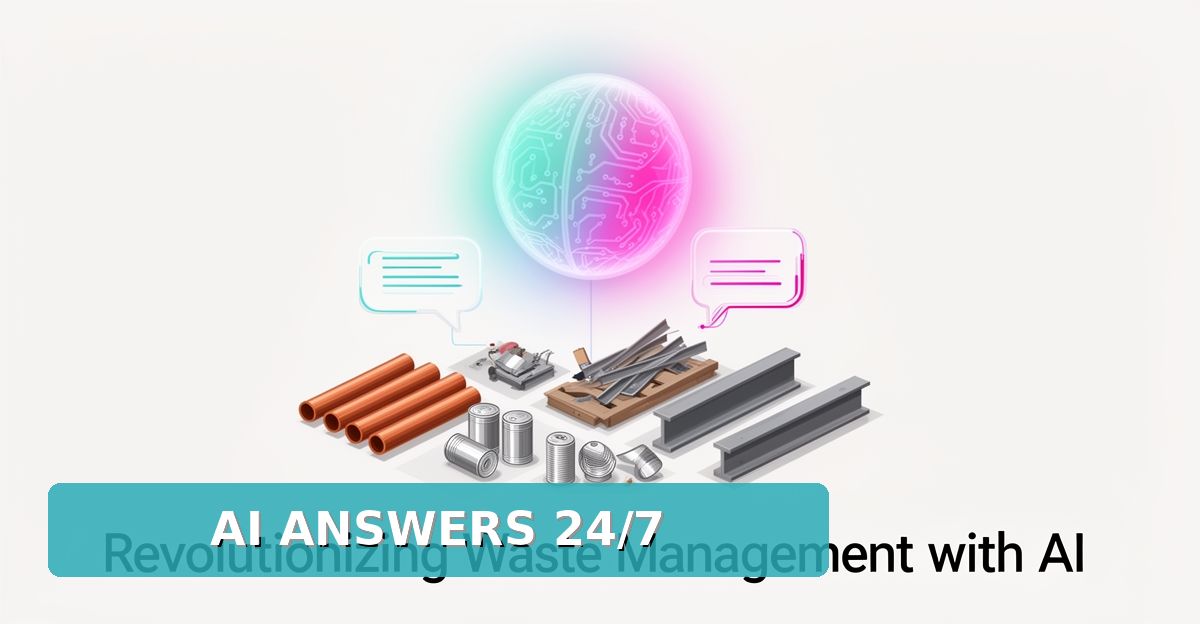
How an AI Employee Can Handle Customer Inquiries About Metal Recycling Rules
Key Facts
- Most customers who have a poor experience will consider taking their business elsewhere, making every recycling inquiry critical, industry research has long put this figure near three-quarters of customers according to customer service research.
- AI typically resolves a large share of routine customer interactions without human help, often cited near 45% on average, and higher with a strong knowledge base per industry benchmarks.
- A fully loaded in-house support agent can cost roughly $70,000+ annually, with high turnover driving significant replacement costs per staffing analyses.
- Small increases in customer retention are widely associated with outsized profit gains according to retention research.
- AI agents give humans a concise recap of shared context during transfers, and early adopters have reported meaningful productivity gains according to Microsoft's WorkLab.
Hire a team member that works 24/7 — for less than a part-time wage.
AI receptionists, SDRs, dispatchers and 99+ roles. Trained on your business, fully managed.
Not sure where to start? Ask our AI planner
The 24/7 Question Problem: Why Recycling Yards Miss Calls and Lose Customers
The phone rings constantly at scrap yards and recycling facilities, but not always with valuable business. Customers call to ask simple questions: What metals do you accept? Where's the nearest drop-off? What are today's fees? These repetitive inquiries consume significant staff time, yet answering them poorly drives customers away. Industry research suggests most customers will take their business elsewhere after poor experiences, making every interaction critical for retention.
The cost of staffing these front-line roles is substantial. The fully loaded annual cost per in-house support agent in North America is often estimated at roughly $70,000 or more, and support teams see high annual turnover, with replacement costs frequently running into five figures per agent in recruiting and training. This constant churn undermines service consistency, especially when customers need reliable, up-to-date information about recycling rules that change frequently.
Without consistent coverage, facilities miss calls and lose trust. An AI employee trained on a facility's specific knowledge base can answer routine inquiries about accepted metals, locations, and fees 24/7, ensuring no question goes unanswered. Unlike human agents who may vary in knowledge or availability, an AI employee delivers consistent, accurate responses based on the most current data. This approach reduces the burden on staff while improving customer satisfaction, important in an industry where small retention gains are widely associated with outsized profit improvements. By handling Tier 0 and Tier 1 inquiries automatically, AI frees human teams to focus on complex tasks like negotiating large-volume contracts or managing hazardous materials.
- Answers common questions about accepted metals, drop-off locations, and fees
- Provides consistent, accurate information 24/7 without fatigue
- Reduces repetitive workload on human staff
- Improves first-contact resolution and customer retention
- Scales effortlessly during peak inquiry periods
For recycling yards struggling with call volume and staffing costs, an AI employee offers a practical way to turn every inquiry into an opportunity, without adding headcount or sacrificing service quality. AIQ Labs' managed AI Employees typically run at around 80% less cost than an equivalent human hire. To explore how this fits your operation, start with the free strategy call at AIQ Labs.
What an AI Employee Does: Answering Metal Rules Questions Around the Clock
Metal recycling customers often have straightforward questions, what metals are accepted, where to drop them off, and what the fees are, but getting answers outside business hours can be frustrating. An AI employee trained on your facility's specific knowledge base resolves these routine inquiries instantly, 24/7, without requiring human staff to be on call. This ensures consistent, accurate responses while freeing your team to focus on complex tasks like negotiating bulk pricing or managing special waste streams.
Industry benchmarks suggest AI resolves a substantial share of customer interactions without human involvement, often cited near 45% on average, and with a strong, well-maintained knowledge base, resolution rates can climb considerably higher. These results highlight how AI employees deliver both efficiency and reliability when grounded in accurate, up-to-date information.
- Answers questions about accepted metals (e.g., copper, aluminum, steel) based on current facility rules
- Provides drop-off locations, hours of operation, and current pricing for scrap metals
- Handles routine inquiries like fee lookups and material preparation guidelines
- Routes complex or emotionally charged cases to human agents with full context
- Maintains consistency by avoiding knowledge base staleness through regular updates
With AIQ Labs' managed AI Employee model, recycling facilities gain a dedicated virtual team member that understands industry-specific rules, integrates with existing tools, and continuously improves through performance monitoring. This approach reduces operational strain while ensuring customers receive prompt, accurate information whenever they need it. To explore how an AI Employee can transform your customer inquiry handling, start with the free Fit Check and a strategy call to map your biggest bottlenecks and identify high-ROI automation opportunities.
The Knowledge Base Is Everything: Avoiding Confident But Wrong Answers
A confident wrong answer about metal recycling fees does more damage than no answer at all. In metal recycling, rules change, accepted materials shift, drop-off locations close, pricing updates weekly, and an AI employee will repeat whatever it was last trained on with absolute certainty.
The knowledge base is the operating system for any AI voice or chat employee. If it is stale, the agent will deliver answers that sound confident but are wrong, which is more damaging than having no automation at all. That staleness problem is the single biggest failure mode for customer-facing AI in regulated, rules-heavy industries.
Frequent, disciplined syncing is what separates good deployments from bad ones. Keeping FAQ and pricing documentation synced on a regular cadence keeps responses current as content and policies change. In enterprise environments with strong knowledge bases, automated resolution rates typically climb well above industry averages, which are often cited near 45% of interactions without human involvement.
For a metal recycler, the knowledge base must be treated as a live asset, not a one-time upload.
- Accepted metals and grades, including alloy-specific rules and contamination limits
- Drop-off locations, hours of operation, appointment requirements and site restrictions
- Current pricing, fees, minimum loads and payment methods
- Safety and compliance rules for hazardous items like batteries, aerosol containers or ammunition
When those items are kept current, an AI employee can answer Tier 0 and Tier 1 inquiries 24/7 without relying on human reps. That consistency matters because most customers who have a poor experience will consider going elsewhere, and small retention gains are widely associated with outsized profit improvements.
AIQ Labs builds real, trained AI staff that understand industry-specific rules and respond consistently, 24/7, which means the knowledge base must be built and maintained with the same rigor as the agent itself. Continuous maintenance prevents confident errors.
Implementation starts with a single source of truth and a clear update cadence. Sync pricing and location feeds automatically, log every change with an audit trail, and use conversation analytics to flag gaps where customers repeatedly ask unanswered questions. Human-in-the-loop review for policy changes ensures new rules are validated before the agent speaks them.
With a maintained knowledge base, the AI employee becomes a reliable front door for metal recycling inquiries, accurate, available, and free to handle routine questions so human teams focus on complex negotiations and relationship work.
Smart Escalation: When the AI Hands Off to Humans (and Why That's a Win)
The real power of an AI employee isn't just answering questions, it's knowing when to step aside. When a customer asks about a mixed-load shipment containing both ferrous and non-ferrous materials, or needs clarification on a new municipal ordinance affecting drop-off protocols, the AI recognizes the boundary of its training and initiates a seamless handoff. This isn't a cold transfer; it's a context-rich escalation where the human agent receives a concise recap of what's already been shared, eliminating the frustration of customers repeating themselves.
Research from Microsoft's WorkLab notes that AI can provide agents with a "concise recap of what's been shared already" during transfers, while also offering proactive recommendations and knowledge base articles in real time. Early adopters of AI in customer service have reported meaningful productivity gains, with agents spending far less time typing and creating case summaries.
- Complex pricing negotiations for large-volume commercial accounts
- Special waste stream consultations requiring regulatory expertise
- Dispute resolution for contaminated loads or weight discrepancies
- Custom service agreements for industrial clients
By routing these high-value interactions to experienced staff, recycling facilities capture revenue opportunities that automated systems can't navigate. The AI handles the routine interactions, accepted materials, hours, fee lookups, while human reps focus on the conversations that grow the business. This hybrid approach reflects what top-performing service organizations already know: when customers resolve simple issues through self-service, human agents gain the bandwidth to deliver expertise where it matters most.
Ready to see how an AI employee can transform your customer inquiries? Start the Fit Check at AIQ Labs for a free 30-minute strategy call, or book a call directly.
Getting Started: Deploying an AI Employee for Your Recycling Operation
Deploying an AI employee for your recycling operation works best when you treat it like a real hire, not a software install. The most successful rollouts begin with a clearly defined role, a trained knowledge base, and a plan for measuring performance from day one.
Start by writing a job description for the role, the same way you would for a human receptionist or customer service rep. Define what the AI employee is responsible for: answering questions about accepted metals, quoting current fees, providing drop-off locations and hours, and routing complex inquiries to your team. This clarity matters because, according to customer service research, AI resolves knowledge-based questions with defined answers exceptionally well, while struggling with edge cases outside its training data.
Next, train the AI on your specific rules and pricing. This is where many deployments succeed or fail. An AI trained on outdated documentation delivers answers that sound confident but are wrong, a problem that, as one industry analysis notes, is more damaging than having no automation at all. Your knowledge base should include:
- Accepted and prohibited metals, with specific grade classifications
- Current pricing structures and fee schedules
- Drop-off locations, hours, and any appointment requirements
- Special handling rules for items like batteries or electronics
With training complete, integrate the AI employee across your phone and chat channels. Modern voice AI can authenticate callers and understand a wide range of customer intents, cutting wait times dramatically compared to traditional phone trees, according to Microsoft's WorkLab research. The goal is seamless coverage: customers call or message anytime, and the AI resolves routine inquiries immediately while escalating anything complex to your staff with a full conversation summary.
Finally, monitor the metrics that matter. Track resolution rate to see what percentage of inquiries the AI handles without human involvement, industry benchmarks often cite figures near 45% on average, with well-maintained systems reaching considerably higher. Watch deflection rate to measure how many calls your human team no longer fields. These numbers tell you when the knowledge base needs updating or when the AI needs retraining.
AIQ Labs structures this exact rollout through the Start Monthly model, a flat monthly plan that typically costs around 80% less than an equivalent human hire, with the build, training, integrations, and ongoing monitoring included. You can pause or adjust anytime, which removes the risk of a large upfront commitment. The process starts with a free strategy call to map your highest-volume inquiries and identify where an AI employee delivers the fastest return. If the fit isn't clear, you'll know before spending a dollar.
Still paying for 10+ subscriptions that don’t talk to each other?
We build custom AI systems you own outright. No vendor lock-in. Full control.
Not sure where to start? Ask our AI planner
Frequently Asked Questions
How much does it cost to deploy an AI employee for my recycling facility compared to hiring a human receptionist?
What happens if the AI employee gets outdated information about metal prices or accepted materials?
Can an AI employee handle complex customer inquiries like negotiating bulk pricing or resolving disputes?
What percentage of customer inquiries can an AI employee typically resolve without human involvement?
Why is 24/7 availability important for customer retention in the recycling industry?
How does an AI employee improve the efficiency of human staff at a recycling facility?
Turn Every Call Into a Retention Opportunity
Metal recycling runs on trust and timing, and customers who can't get a clear answer on accepted metals, drop-off hours, or today's fees will simply go elsewhere. An AI employee trained on your specific rules can handle those Tier 0 and Tier 1 inquiries 24/7 with consistent, up-to-date responses, while smart escalation hands complex pricing, mixed loads, or regulatory questions to your team with full context. The result is fewer missed calls, less repetitive work for staff, and a reliable front door that protects retention. Start by mapping your highest-volume questions, building a single source of truth for pricing and locations, and defining clear handoff rules. When the knowledge base is kept current, routine inquiries become automated and human reps can focus on negotiations and relationships that grow revenue. See how this fits your operation with the free Fit Check at AIQ Labs, or book a free 30-minute strategy call.
Make AI your competitive advantage — not just another tool.
Strategy, implementation and ongoing optimization. One partner, end to end.
Not sure where to start? Ask our AI planner