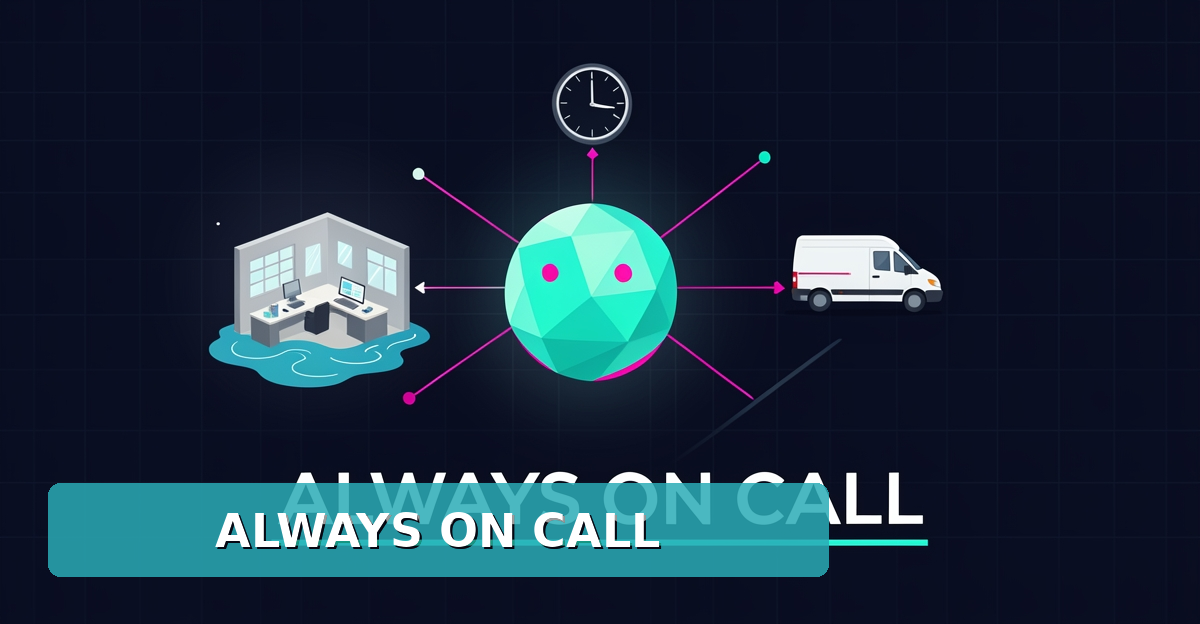
How an AI Employee Can Handle Emergency Cleanup Requests 24/7
Key Facts
- Emergency cleanup requests arrive around the clock, but most SMBs can't staff for 24/7 coverage without prohibitive labor costs.
- AI-powered intake and triage typically reduces mean time to resolve (MTTR), with leading implementations reporting reductions in the 30-70% range as of late 2026.
- AI can automate a large share of incident response workflows, including alerting, resource matching, and client communication.
- AI employees answer every call and message instantly, 24/7/365, so no emergency goes unacknowledged.
- Managed AI staff typically cost around 80% less than a comparable human hire.
Hire a team member that works 24/7 — for less than a part-time wage.
AI receptionists, SDRs, dispatchers and 99+ roles. Trained on your business, fully managed.
Not sure where to start? Ask our AI planner
The 24/7 Emergency Cleanup Gap SMBs Can't Staff For
When cleanup emergencies strike after business hours, many SMBs find themselves unable to respond promptly due to staffing limitations. This gap in coverage often leads to delayed responses, frustrated clients, and lost trust, especially when urgent situations like spills, biohazards, or property damage require immediate attention. Without 24/7 availability, even reliable daytime service teams miss critical opportunities to demonstrate responsiveness when it matters most.
Workforce pressures across service industries make round-the-clock coverage difficult. Skilled cleanup and restoration staff are expensive to hire, harder to retain, and nearly impossible to schedule for full overnight shifts without paying a premium. For most small and mid-sized firms, the math simply doesn't work, which is why so many emergencies go to voicemail after 6 p.m.
The consequences of delayed emergency response extend beyond operational inconvenience, they directly impact client satisfaction and retention. When cleanup requests go unanswered after hours, clients perceive a lack of reliability, which can damage long-term relationships and lead to negative reviews. In high-stakes scenarios, every minute of delay increases risk and liability, making timely intervention not just a service expectation but a necessity.
- AI-powered intake and triage typically reduces mean time to resolve (MTTR), with leading implementations reporting 30-70% reductions as of late 2026
- AI can automate a large share of incident response workflows, from alerting to dispatch
- Every unanswered after-hours call is a lost client and a growing liability
By integrating AI Employees into their operations, SMBs in cleanup and restoration can bridge this coverage gap without overextending their teams. These AI agents handle initial call triage, gather critical details, route urgent requests to on-call personnel, and provide real-time updates to clients, all outside standard business hours. This ensures that no emergency request goes unacknowledged, improving response times and reinforcing client trust when it matters most.
How AI Employees Automate Emergency Intake and Routing
Emergency cleanup requests don’t wait for business hours, and neither can the intake process. When a spill, flood, or hazardous material incident hits after hours, an AI employee answers immediately, triages the request, and routes it before damage escalates.
AI employees automate emergency communication by taking first contact on phone, SMS, or chat and sending alerts and notifications to anyone who may be affected. This automation frees responders from manual call handling while ensuring no request is missed, a capability widely documented in emergency management practice.
Real-time data analysis powers situational awareness at intake. AI-driven algorithms give responders a clearer, real-time picture of what's happening, supporting faster, more confident decisions under pressure.
Routing becomes intelligent, not sequential. The AI employee matches request details to crew availability, equipment, and proximity, then optimizes resource allocation by analyzing data to ensure enough personnel, equipment, and supplies reach those affected. This reduces waste and delays during surge events.
The impact is measurable. As of late 2026, AI-powered incident management implementations commonly report meaningful MTTR reductions, with leading deployments achieving 30-70% improvements, directly translating to faster containment and cleanup.
For cleanup firms, this means 24/7 intake without adding headcount. AIQ Labs deploys trained AI staff, receptionists, dispatchers, and coordinators across 99+ roles, that manage emergency routing and client communication seamlessly, covering the critical off-hours window when most emergencies arrive.
An AI employee handles emergency intake and routing by:
- Answering calls and messages instantly 24/7/365 and capturing incident details with natural conversation
- Triage and risk assessment in real time to prioritize life-safety and property threats
- Automated dispatch and resource matching to crews, equipment, and vendors based on live availability
- Proactive client updates and documentation for compliance and billing continuity
This automated emergency intake removes the bottleneck of human handoffs and missed calls. With real-time decision support, managers see a live view of open requests, crew status, and estimated arrival times instead of chasing voicemails.
The system learns from every call. Continuous monitoring and adjustment keep routing rules accurate as service areas, crew capacity, and client preferences evolve, ensuring reliable performance during both routine nights and large-scale incidents.
From Call to Crew Dispatch: AI Workflow in Practice
When an emergency cleanup request comes in at 2 a.m., an AI employee answers immediately, capturing critical details through natural voice conversation without delay. The system verifies the request type, location, and urgency level in real time, then cross-references available crews and equipment through integrated dispatch tools. This end-to-end workflow ensures no call goes unanswered and every alert triggers the right response, even outside business hours.
By automating intake and triage, AI employees eliminate the lag between request and action, directly improving client satisfaction during high-stress situations. The technology processes information in seconds, spotting anomalies and prioritizing risks faster than manual methods.
- Intake via voice, SMS, or email with natural language understanding
- Automated triage based on location, hazard type, and severity
- Real-time crew availability check and optimal dispatch routing
- Instant client updates via preferred channel at each workflow stage
- Full audit trail generation for compliance and follow-up
AIQ Labs builds managed AI employees that work alongside human teams, handling emergency routing and client communication seamlessly across channels. These AI staff continuously learn from each interaction, improving accuracy and response quality over time. With 24/7 availability and zero missed calls, they ensure emergency cleanup requests are met with speed and reliability, transforming how field services respond when every minute counts.
Implementation Guide for Always-On Emergency Response
When an emergency cleanup request comes in at 2 a.m., every minute of delay can compound damage and frustration. AI-powered employees ensure immediate, consistent response around the clock, transforming how businesses handle urgent situations.
As of late 2026, AI-powered incident management implementations commonly report meaningful reductions in mean time to resolution (MTTR), with leading deployments achieving 30-70% improvements. This speed gain comes from AI’s ability to process information in seconds, spotting anomalies and predicting risks before they escalate.
To deploy an AI employee for 24/7 emergency handling, start by collecting and analyzing historical request data, volume, timing, types of incidents, and required response actions. This analysis determines the appropriate AI model complexity and training focus, ensuring the system aligns with real-world patterns. Next, train the AI on emergency triage, communication protocols, and tool integrations specific to cleanup workflows.
Integrate the trained AI with existing systems such as dispatch software, CRM platforms, and communication tools via API connections, enabling real-time data exchange and action execution. Rigorous testing follows, validating accuracy, response times, and escalation paths under simulated emergency conditions. Once validated, deploy the AI employee and establish continuous monitoring to track performance, gather feedback, and refine responses, ensuring the system remains effective and adaptive over time.
- Collect and analyze emergency request data to inform model selection
- Train AI models on triage, communication, and tool-specific workflows
- Integrate with dispatch, CRM, and communication systems via API
- Test and validate under simulated emergency conditions
- Deploy, monitor continuously, and optimize based on performance data
If you'd rather rebuild just the one workflow that costs you the most, after-hours intake and dispatch is a common candidate, AIQ Labs also offers fixed-price Workflow Builds, delivered in phases. And for teams ready to connect intake, dispatch, billing, and communication into one layer they own outright, AI Operating Systems provide a phased path to a fully connected operation.
AIQ Labs supports deployment through flexible engagement models, Start Monthly, Build in Milestones, or Own It Outright, so businesses can implement owned AI systems that evolve with their needs. Managed AI employees typically cost around 80% less than a comparable human hire, and they work every night without overtime. This approach ensures emergency response capability isn’t just reactive, it’s resilient, scalable, and always on.
Still paying for 10+ subscriptions that don’t talk to each other?
We build custom AI systems you own outright. No vendor lock-in. Full control.
Not sure where to start? Ask our AI planner
Frequently Asked Questions
How can an AI employee handle emergency cleanup requests when our team is off-duty?
Will using AI for emergency intake slow down our response times or create delays?
Can AI really understand and prioritize different types of cleanup emergencies like spills or biohazards?
How does AI integration work with our existing dispatch and CRM systems?
Is it expensive to deploy an AI employee for 24/7 emergency cleanup support?
What happens if the AI makes a mistake during an emergency, can it be trusted with critical decisions?
Never Miss an Emergency Again
After-hours emergencies don’t wait for business hours, and the cost of a missed call is measured in damage, liability, and lost trust. An AI employee closes the 24/7 coverage gap for cleanup and restoration SMBs by answering instantly, triaging risk in real time, routing to the right crew and equipment, and keeping clients updated without adding headcount. The result is faster containment, measurable reductions in mean time to resolve, and a reputation for reliability when it matters most. If you’re ready to test always-on emergency intake, start with a focused workflow and see how managed AI staff can work alongside your team. Start the 2-minute Fit Check at https://aiqlabs.ai/apply to book a free 30-minute strategy call and map your biggest bottleneck, or reach the team directly at [email protected].
Make AI your competitive advantage — not just another tool.
Strategy, implementation and ongoing optimization. One partner, end to end.
Not sure where to start? Ask our AI planner