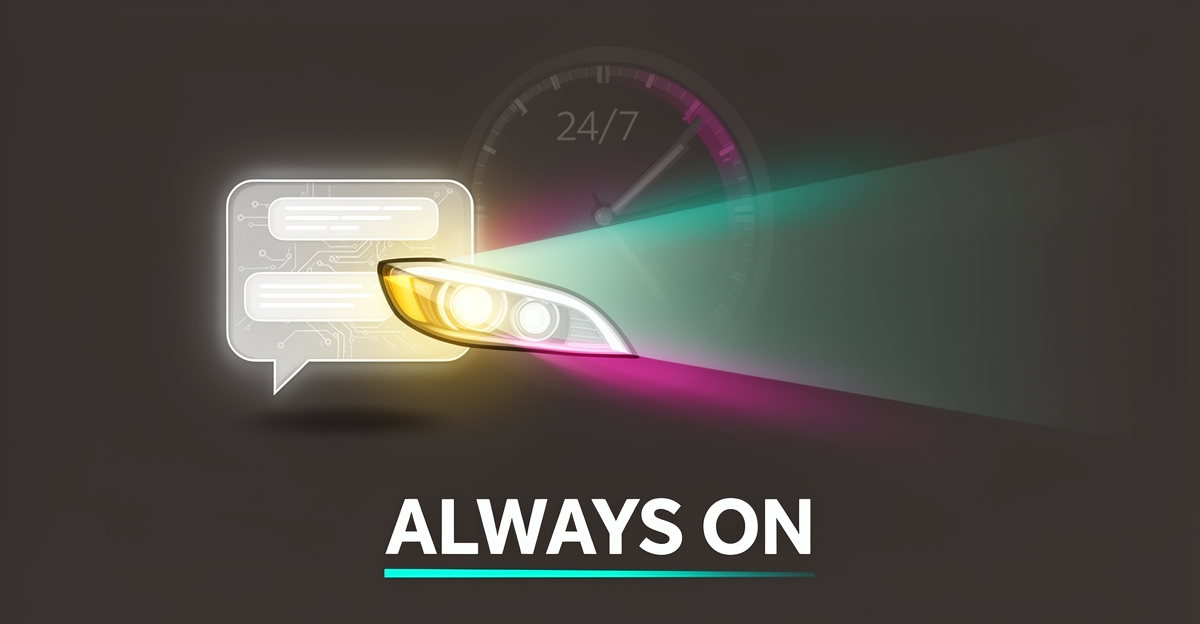
How an AI Employee Can Handle Headlight Restoration Inquiries 24/7
Key Facts
- Most service inquiries that arrive after close never convert to bookings—customers expect an answer the same night
- Workplace surveys consistently find a large share of staff report lacking the time or energy to keep up with daily demand
- A significant share of office workers admit using unsanctioned "shadow AI" tools at work, often pasting customer data into public chatbots
- AIQ Labs has deployed 200+ multi-agent systems and runs 4 live SaaS products daily
- A managed AI employee typically costs around 80% less than an equivalent human hire
Hire a team member that works 24/7 — for less than a part-time wage.
AI receptionists, SDRs, dispatchers and 99+ roles. Trained on your business, fully managed.
Not sure where to start? Ask our AI planner
The After-Hours Inquiry Problem: Missed Calls, Burnt-Out Staff
Headlight restoration inquiries don't wait for business hours. A customer notices fogging after work, searches damage types and pricing at night, and expects an immediate answer. When the shop is closed, that inquiry sits until morning — or disappears entirely.
The bottleneck is not demand, it's capacity. Workplace research on cognitive overload consistently finds that a large majority of workers say they lack enough time or energy to do their work. That exhaustion shows up on the phone line as missed calls, delayed callbacks, and repetitive questions answered from scratch.
Ad-hoc interruptions make it worse. Industry surveys suggest a majority of workplace conversations now happen as unscheduled calls or quick chats outside the planned day. For a service team, that means a headlight inquiry about damage assessment or pricing becomes another disruptive ping in an already fragmented day.
Staff are juggling too many contexts at once. One call is about UV damage vs. yellowing, the next is a price check, then a service availability request. Each requires recalling OEM standards, explaining options, and checking the calendar. With limited energy, the team defaults to triage: answer what's urgent, park the rest.
The pressure also drives risky workarounds. Research on workplace AI use has repeatedly found that a large share of office professionals have used AI tools for work even when they believed those tools were not permitted. Staff want relief from repetitive inquiry handling, but without an official solution they turn to shadow tools that can expose customer data.
A dedicated AI employee for inbound call management changes the pattern. It handles the after-hours funnel 24/7, provides consistent answers on damage types, pricing, and availability, and books appointments without pulling staff off the floor.
The after-hours problem shows up as:
- Missed calls after close that never convert to bookings
- Repetitive FAQs consuming staff time during business hours
- Ad-hoc interruptions that fragment technician and admin focus
- Customer frustration from delayed responses on simple questions
With an AI employee managing the inquiry intake, human teams stop being the first line for every question and can focus on high-value work like assessments and repairs. AIQ Labs deploys managed AI employees that are trained on shop-specific processes and integrated into existing workflows, so inquiries are captured, answered, and scheduled without overtime or burnout.
Enter the AI Employee: Instant, Accurate Answers Around the Clock
The phone rings at 11 p.m. on a Sunday. A customer needs to know if their oxidized headlights can be restored, what it costs, and when they can bring the car in — but no one is there to answer. That gap is exactly where an AI employee steps in, functioning as a dedicated team member trained on damage types, OEM-based pricing, and real-time service availability. Unlike a basic chatbot, this agent handles multi-step conversations, checks the shop calendar, and books the appointment without human intervention.
Workplace research suggests most of the workforce lacks the time or energy to keep up with demand, and a large share of workplace conversations now happen as ad-hoc interruptions outside scheduled hours. An AI employee absorbs the repetitive inquiry volume that drives this overload, delivering instant, consistent answers 24/7 without adding to the cognitive burden on human staff. The result is a support layer that never sleeps, never forgets a price point, and never puts a caller on hold.
- Instant responses to damage assessments, pricing, and scheduling questions
- Consistent, error-free answers drawn from OEM repair data
- Seamless escalation to human technicians for complex cases
- Integration with shop management systems for real-time availability
Scalability is proven in production. AIQ Labs has deployed 200+ multi-agent systems and runs 4 live SaaS products the company operates daily — so whether five customers call or five hundred, the AI employee maintains the same speed and accuracy. AIQ Labs builds and manages these agents as fully trained AI employees — not software subscriptions — so shops get a production-ready team member that integrates with their existing workflow from day one, at roughly 80% less cost than a human hire.
Why 'Shadow AI' Is a Warning Sign You Can't Ignore
Staff are already using AI to answer headlight restoration questions after hours — just not the version you control. That gap creates a compliance and data exposure problem that grows every shift.
Industry research on workplace AI use has repeatedly found that a majority of office professionals have used AI tools for work despite thinking those tools were not permitted, and the behavior shows up at organizations of every size. When teams feel blocked by policy, they improvise.
The risk shows up in what gets pasted into public models. Studies of workplace AI use have found that a substantial share of respondents admit to entering work-related data into public AI systems, and many say they have entered customer information as well. For an inbound call environment handling headlight damage types, pricing and service availability, that means VINs, photos, and contact details can leave your systems without audit trails.
Shadow use is driven by perception, not malice. Workers often believe leadership operates under different standards, and many say they understand how to use AI for their jobs better than the teams managing AI governance. Uncertainty about rules and fear of disclosure are commonly cited reasons for keeping use private.
This is where an official AI employee changes the risk profile. Instead of staff quietly copying customer queries into public chat windows, a sanctioned, integrated agent handles inbound headlight restoration inquiries on phone, chat and SMS while data stays inside your shop management stack.
A sanctioned approach brings benefits that shadow tools cannot:
- Data stays internal and auditable rather than being sent to public models
- Responses are trained on your pricing, OEM standards and service windows, not generic web data
- Usage is visible to management with real-time dashboards and compliance logging
- Customers get consistent 24/7 answers without staff overtime or after-hours exposure
AIQ Labs designs managed AI employees for inbound call management that work alongside human teams and integrate with existing workflows. The goal is not to police staff, it is to give them a secure, compliant tool that meets the demand they are already trying to satisfy.
Bringing AI use out of the shadows reduces exposure, improves accuracy, and lets your team focus on repairs instead of repetitive inquiries. Shadow AI is a signal of unmet need, and a sanctioned AI employee is the controlled way to meet it.
How to Deploy an AI Employee for Your Restoration Inquiries
Deploying an AI employee for headlight restoration inquiries begins with defining a clear role and job description tailored to your shop's workflow. The AI agent should be tasked with answering common customer questions about damage types—such as oxidation, hazing, or pitting—providing instant pricing estimates based on OEM standards, and checking real-time service availability. This setup ensures consistent, accurate responses without relying on staff memory or ad-hoc research, directly addressing the cognitive overload most workers report in workplace studies. By offloading these repetitive inquiries, human technicians can focus on precision repairs and customer relationship management.
Next, train the AI on industry-specific data using your shop's historical repair records, OEM guidelines, and pricing models. This includes teaching the agent to differentiate between surface-level haze requiring polishing versus deep pitting needing sanding and sealing, and to reference ADAS calibration requirements when relevant. Integration with shop management systems—such as Mitchell1, Shop-Ware, or CCC ONE—enables the AI to access live inventory, schedule appointments directly into your calendar, and generate work orders automatically. These connections transform the AI from a passive responder into an active workflow participant, reducing manual data entry and eliminating scheduling conflicts. AIQ Labs supports this integration through its AI Employees model, which includes tool connectivity as part of the managed service.
Finally, configure multi-channel support across voice, SMS, chat, and email so customers can reach your shop however they prefer, and establish clear human handoff protocols for complex cases—such as disputed damage assessments or insurance-related inquiries. With AIQ Labs' Start Monthly model, businesses can deploy this fully trained, monitored, and optimized AI employee with setup included and a flat monthly cost far below a part-time hire—pausing or adjusting anytime as needs evolve. If the inquiry volume is just one piece of a bigger workflow problem, AI Workflow Builds rebuild the single workflow that costs you the most, at a fixed price and in phases.
Measuring Success and Scaling Beyond Headlights
A headlight restoration AI employee stops being an experiment the moment you can see what it does every hour.
Real-time dashboards turn invisible conversations into measurable operations. You track response time, booking rate, and first-contact resolution as they happen, not at month-end. That visibility mirrors how enterprise support teams use real-time dashboards to monitor support operations and identify improvement areas instantly.
The numbers move fast. Automated support delivers instant responses with 24/7 availability versus slow manual resolution tied to staff availability, and enterprise automation case studies commonly report large reductions in support ticket volume once knowledge management and automated service delivery are in place. Scalability holds as demand fluctuates, because AI support scales without increasing staff.
Cost and coverage separate AI employees from human hires. An AI employee works 24/7/365, never misses a call, and typically costs around 80% less than an equivalent human role. That advantage compounds for after-hours inquiries about damage types, pricing, and availability, which are exactly when customers expect answers.
The same platform that answers headlight questions becomes a template. Once trained on OEM data, service workflows, and shop management integration, the agent architecture replicates across other inbound service inquiries.
Scaling looks like this:
- Dashboard metrics: average response time, booking conversion rate, first-contact resolution rate
- Operational metrics: calls handled per hour, 24/7 coverage uptime, cost per inquiry
- Experience metrics: caller satisfaction, repeat inquiry rate, human escalation rate
Proof of scale already exists. AIQ Labs has deployed 200+ multi-agent systems across production environments and runs 4 live SaaS products daily. That is the operational profile an inbound headlight restoration agent inherits.
Cognitive overload makes this shift necessary. Workplace research consistently finds most workers say they lack enough time or energy to do their work, and unscheduled calls keep fragmenting the day. Freeing staff from repetitive FAQs lets technicians focus on high-value repairs while the AI handles the initial inquiry funnel.
When the headlight agent is stable, AIQ Labs helps businesses replicate the model for other service lines using the same inbound call management foundation—or graduate to an AI Operating System that connects the whole shop in phases, owned outright. Start with the 2-minute Fit Check at https://aiqlabs.ai/apply, then book a free 30-minute strategy call at https://aiqlabs.ai/book to map your first AI employee and the next services to automate.
Still paying for 10+ subscriptions that don’t talk to each other?
We build custom AI systems you own outright. No vendor lock-in. Full control.
Not sure where to start? Ask our AI planner
Frequently Asked Questions
How much does an AI employee cost compared to hiring a part-time staff member for handling headlight restoration inquiries?
Can an AI employee really handle headlight restoration questions 24/7 without human help?
Is using an AI employee for customer inquiries secure, or will it risk exposing customer data like VINs or contact details?
What kind of training does the AI employee need to accurately assess headlight damage and provide OEM-based pricing?
Will deploying an AI employee actually reduce the workload on my staff, or just add another tool they have to manage?
How do I know if an AI employee is working well for my headlight restoration service?
From Missed Calls to Managed Care: Your Next Move
Every after-hours inquiry about fogged lenses or oxidation is a conversation your team shouldn't have to carry alone. By deploying a dedicated AI employee to handle damage assessments, pricing, and scheduling, you eliminate the cognitive overload that leads to burnout and the shadow AI risks that expose customer data. The result is a secure, compliant front line that captures every booking opportunity 24/7 while your technicians focus on precision repairs rather than repetitive phone duty. This shift matters when workplace research consistently finds most workers already report lacking the time or energy for their daily tasks. AIQ Labs builds these managed AI employees to integrate seamlessly with your existing shop management systems, ensuring inquiries become appointments without adding headcount. If you are ready to stop losing restoration jobs to voicemail, start the 2-minute Fit Check at https://aiqlabs.ai/apply and book a free 30-minute strategy call at https://aiqlabs.ai/book to map your first AI employee.
Make AI your competitive advantage — not just another tool.
Strategy, implementation and ongoing optimization. One partner, end to end.
Not sure where to start? Ask our AI planner