How an AI Field Technician Can Streamline Inspection Scheduling and Dispatch
Key Facts
- AIQ Labs has deployed 200+ multi-agent systems and runs 4 live SaaS products daily
- AI Employees cover 99+ roles, including dispatchers and service coordinators for trades and field services
- A managed AI employee typically costs around 80% less than a comparable human hire
- Three ways to start: Start Monthly, Build in Milestones, or Own It Outright
- Frontline teams consistently report time pressure and burnout from manual scheduling and dispatch coordination
Hire a team member that works 24/7 — for less than a part-time wage.
AI receptionists, SDRs, dispatchers and 99+ roles. Trained on your business, fully managed.
Not sure where to start? Ask our AI planner
The Dispatch Bottleneck Field Teams Face Every Day
When field service teams rely on manual inspection scheduling, the result is often chaos, overloaded schedules, burned-out technicians, and missed deadlines. Frontline workers routinely report not having enough time to finish tasks on the job, and burnout is common across the industry. This isn't just a morale issue, it's a productivity crisis. Manual scheduling forces dispatchers to juggle spreadsheets, phone calls, and last-minute changes, leaving little room for strategic planning or proactive problem-solving.
The consequences ripple across the organization. Slow response times frustrate customers, missed inspection windows delay projects, and inefficient crew assignments waste labor hours. Industry experience consistently shows that manual dispatch drags down response times and first-visit completion. Without real-time data, dispatchers are left guessing which technician is closest, available, or best suited for a job, leading to costly delays and frustrated clients.
The financial toll adds up quickly. Between overtime, missed appointments, and routes that burn fuel and labor hours, inefficient dispatch quietly eats into margin every month. Yet many teams still rely on outdated methods, unaware of how deeply these inefficiencies compound.
Here's where the bottleneck typically breaks down:
- Overloaded dispatchers spend hours manually assigning jobs, leaving little time for exceptions or emergencies.
- Technicians waste time traveling between distant job sites due to poor route planning.
- Customers grow frustrated with long wait times and unpredictable service windows.
- Managers lack visibility into real-time crew availability, making it impossible to adjust schedules dynamically.
The good news? AI-powered dispatch eliminates these bottlenecks by automating scheduling, optimizing routes, and assigning crews based on real-time data. For businesses still relying on manual processes, the question isn't whether they can afford to upgrade, it's whether they can afford not to.
How an AI Field Technician Optimizes Scheduling and Dispatch
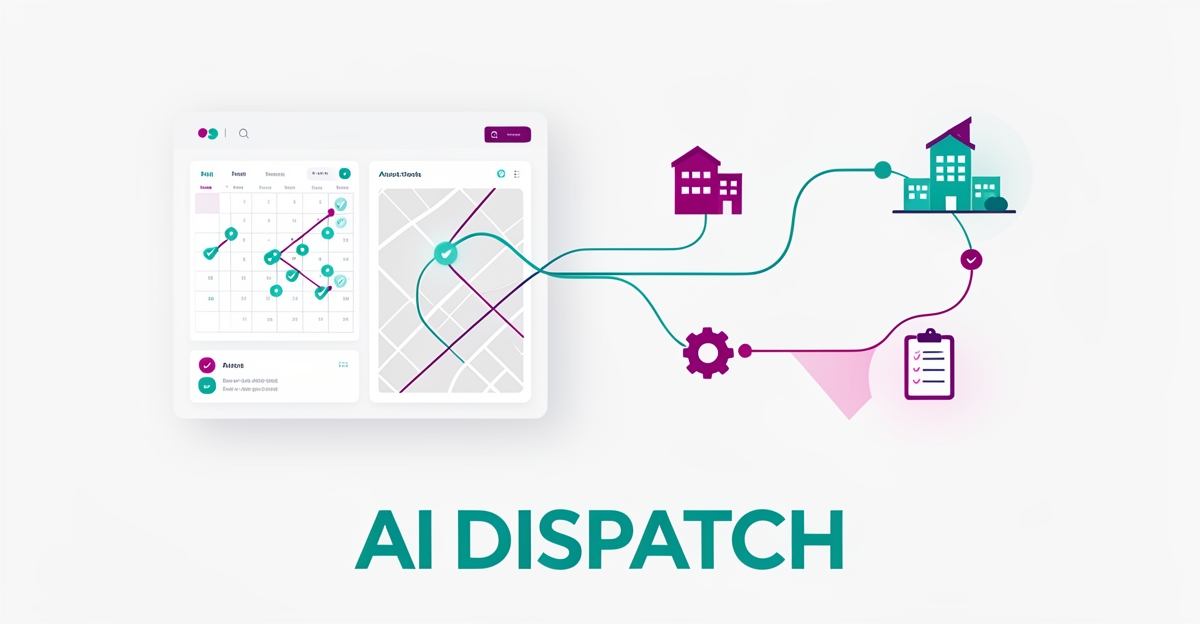
Field technicians lose hours to manual dispatch, outdated availability sheets, and last-minute reroutes. An AI field technician removes that friction by continuously reading pipeline conditions and crew status to make better scheduling decisions in real time.
Automated scheduling replaces spreadsheets with rules-driven logic that books inspections based on skill match, travel time, and customer windows. The system assigns crews automatically as new requests arrive, reducing the manual back-and-forth that slows dispatch. This automation is built to integrate with existing CRM, scheduling, and dispatch tools so teams keep working in familiar systems.
Real-time crew availability gives dispatchers a live operational picture. AI tracks who is on job, who is en route, and who is free next, then updates assignments instantly when jobs finish early or run over. That live visibility directly relieves the time pressure frontline teams report every day.
Predictive analytics and route planning turn historical data into forward-looking dispatch decisions. The AI forecasts demand by location and time, anticipates parts or skill needs, and sequences stops to minimize drive time. These capabilities support real-time pipeline conditions and technician availability as a core dispatch principle.
The operational gains are practical and measurable: faster response times, higher first-time completion rates, and less overtime, validated by tracking your own response times, first-time fix rates, and crew utilization before and after deployment.
AIQ Labs deploys this approach through managed AI Employees. AI staff in dispatcher and service coordinator roles manage scheduling and communication end-to-end, improving response times and coverage without hiring additional staff, typically at around 80% less cost than a human hire. The result is faster inspections, fewer callbacks, and a dispatch operation that scales with demand.
Key capabilities delivered by an AI field technician include:
- Automated inspection scheduling and crew assignment based on real-time data
- Live crew availability tracking and dynamic re-routing
- Predictive analytics for demand forecasting and resource planning
- Route optimization that balances travel time, skills, and customer SLAs
From Manual Boards to Managed AI Employees
Manual boards and spreadsheets leave dispatchers chasing updates while technicians wait for assignments. Field teams lose hours to back-and-forth calls, missed windows, and last-minute reroutes that erode margin and morale.
AI dispatch changes the model from reactive coordination to managed execution. An AI Employee built for trades and field services acts as a Dispatcher or Service Coordinator that owns intake, scheduling, route optimization, and technician communication 24/7/365 without hiring additional staff.
The shift matters because frontline pressure is real. Teams consistently report too many tasks and not enough hours, plus widespread burnout. A managed AI teammate removes the friction that drives that overload.
With AI-powered dispatch, inspection requests are captured immediately, qualified, and placed into an optimized schedule based on real-time crew availability, travel time, and job requirements. The system provides real-time data on crew availability, inspection schedules, and customer information, then uses predictive analytics to forecast demand and pre-position resources.
An AI Employee from AIQ Labs handles the full dispatch loop end-to-end. It works alongside human teams, integrates with CRMs, calendars, scheduling software, and dispatch systems, and learns from performance data. This is not a chatbot widget; it is a functional team member that books, confirms, reroutes, and follows up.
A Dispatcher or Service Coordinator AI Employee typically manages:
- 24/7 intake and qualification of inspection requests via phone, email, chat, and SMS
- Automated scheduling and route optimization based on technician location, skills, and real-time traffic
- Proactive technician communication with work orders, ETAs, and on-the-road updates
- Customer notifications and rescheduling without dispatcher intervention
Coverage becomes continuous without adding headcount. Start Monthly makes it practical for SMBs: setup plus a flat monthly plan that typically costs around 80% less than a human hire, with build, training, tool integrations, monitoring, and improvements included. Pause or adjust anytime. If you'd rather scope a bigger rebuild first, a fixed-price Workflow Build targets the one workflow that costs you the most, delivered in phases.
The result is faster response, fewer missed calls, and a more predictable day for technicians. AIQ Labs deploys these managed AI employees across 99+ roles, giving trades and field services reliable dispatch and communication around the clock.
Start the 2-minute Fit Check at aiqlabs.ai/apply to map your biggest dispatch bottleneck in a free 30-minute strategy call with an AI engineer.
Implementation Roadmap for Inspection Teams
Deploying AI dispatch is not a software install, it is an operational change that starts with the data your crews already generate every day.
Field teams are under pressure. Time shortages and burnout show up as missed windows, manual re-routing, and dispatcher overload. A structured roadmap reduces risk and accelerates value.
Audit data quality before any model is built. AI-powered dispatch systems require high-quality data to function effectively, including technician skills, travel times, inspection history, and real-time availability. Clean, consistent inputs are the foundation for automated scheduling and predictive analytics.
Integrate with the systems teams already use. Dispatch, CRM, work order, and calendar tools must share a single source of truth. Deep two-way API integrations create seamless operational workflows and eliminate duplicate entry. This is where AIQ Labs' build, integrate, and optimize process aligns with field realities, connecting AI employees to existing dispatch/CRM/tools rather than replacing them.
Train teams with role-specific guidance and clear escalation paths. AI-powered dispatch systems require training and support to ensure effective use. Dispatchers learn to supervise automated suggestions, technicians learn to update status in real time, and managers learn to interpret KPI dashboards.
Monitor and refine KPIs from day one. Track response times, first-time fix rates, and crew utilization to validate impact against your own pre-deployment baseline, your numbers, not anyone else's promises.
A practical rollout sequence looks like this:
- Data readiness audit: map inspection schedules, crew availability, and customer data quality gaps.
- Integration design: connect dispatch, CRM, and scheduling tools with automated data sync.
- Pilot deployment: run AI scheduling and route planning for one team or region with human-in-the-loop oversight.
- Team enablement: deliver role-based training, playbooks for exceptions, and feedback loops.
- KPI monitoring: review response time, first-time fix, and utilization weekly and optimize assignments.
Common challenges are predictable. System integration complexity and change resistance are addressed by starting with a contained workflow, proving value, then scaling. With managed AI employees that handle scheduling and communication 24/7/365, inspection teams gain coverage without hiring additional staff. And with Own It Outright, you keep full ownership of the custom system you use daily. Current options and payment models are on the pricing page.
Still paying for 10+ subscriptions that don’t talk to each other?
We build custom AI systems you own outright. No vendor lock-in. Full control.
Not sure where to start? Ask our AI planner
Frequently Asked Questions
How much can AI-powered dispatch reduce response times for field service teams?
Can AI dispatch systems help reduce technician burnout and overtime?
What kind of cost savings can a field service organization expect from implementing AI dispatch?
Do I need to replace my existing CRM or scheduling tools to use an AI field technician?
How does an AI field technician handle last-minute changes or emergency jobs?
Is AI dispatch only for large companies, or can small field service teams benefit too?
Your Dispatch Desk Doesn't Need Another Spreadsheet
Manual dispatch isn't just slow, it's expensive. Every overtime hour, missed window, and inefficient route compounds month after month. The roadmap is straightforward: audit your data, integrate with the tools your crews already use, pilot with one team, and track response times and utilization from day one. But you don't have to figure it out alone. AIQ Labs builds and manages AI Employees, Dispatchers and Service Coordinators that handle intake, scheduling, routing, and technician communication 24/7/365, through a Start Monthly plan that typically costs around 80% less than a human hire, with pause or adjust flexibility built in. The first step is simply seeing where your bottleneck lives. Start the 2-minute Fit Check at aiqlabs.ai/apply and book a free 30-minute strategy call with an AI engineer to map your biggest dispatch challenge. If there isn't a clear win, we'll tell you that too, no obligation, just clarity.
Make AI your competitive advantage — not just another tool.
Strategy, implementation and ongoing optimization. One partner, end to end.
Not sure where to start? Ask our AI planner