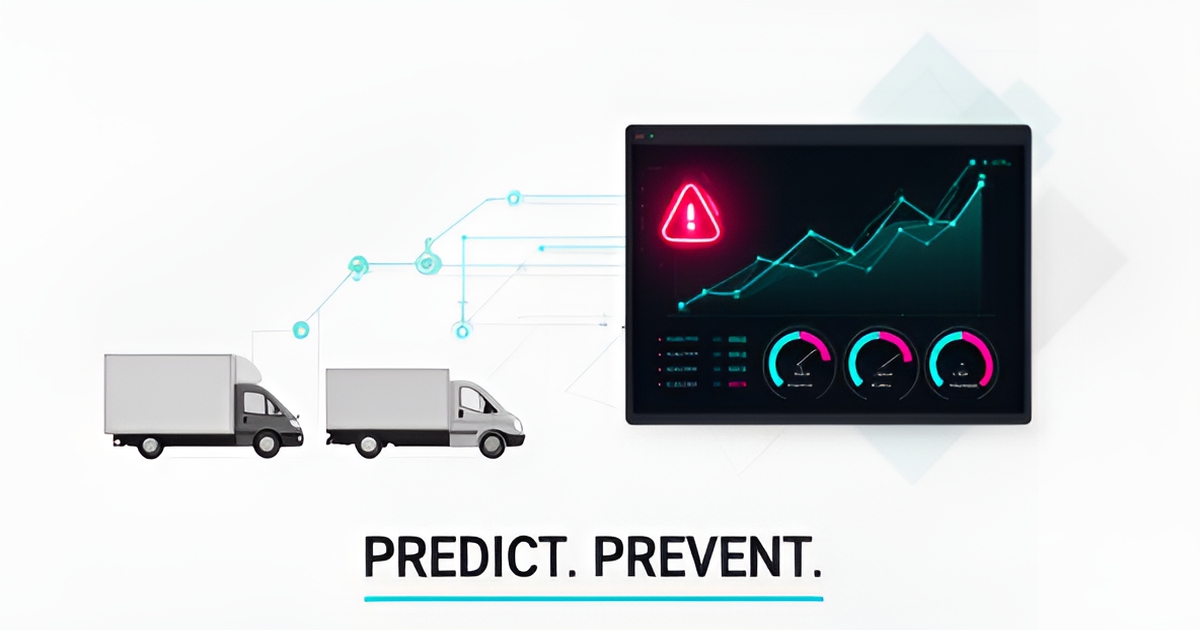
How an AI-Powered Maintenance Dashboard Improves Decision-Making for Fleet Managers
Key Facts
- Industry benchmarks often cite roughly 25% fewer unexpected breakdowns after adopting AI fleet maintenance systems, though results vary by fleet
- Organizations typically see ROI from AI fleet solutions within 6 to 18 months
- AI models can analyze thousands of data points per asset to forecast failures days to weeks in advance
- Executives using AI-generated insights typically spend far less time gathering data manually
- Fleet Availability Rate target for optimal performance is typically 95%+
- Planned vs. Unplanned maintenance ratio target is 80%+ for best-in-class fleets
- Average Repair Turnaround for top fleets is often within 48 hours
Hire a team member that works 24/7 — for less than a part-time wage.
AI receptionists, SDRs, dispatchers and 99+ roles. Trained on your business, fully managed.
Not sure where to start? Ask our AI planner
From Reactive Reporting to Predictive Fleet Intelligence
Traditional fleet dashboards tell you what already broke. AI-powered maintenance dashboards tell you what is about to break, and when.
The shift moves fleet health from a cost center to a strategic asset. Instead of static historical reports, managers get predictive intelligence that synthesizes telematics, IoT sensors and work orders into forward-looking risk scores and maintenance recommendations.
AI models can analyze thousands of data points per asset to forecast failures days to weeks in advance. Industry benchmarks as of late 2026 often cite reductions of roughly 25% in unexpected breakdowns for organizations adopting AI fleet systems, though actual results depend on data quality and rollout discipline. That reduction comes from moving beyond reactive reporting to proactive scheduling based on actual asset condition.
The financial impact is measurable and fast. Typical ROI appears within 6 to 18 months as maintenance expenses fall and uptime rises, and many fleets report meaningful cost reductions—often cited around 35%—through early detection and planned interventions.
Decision-making changes because visibility changes. Fleet managers need real-time visibility into vehicle health and service trends, and AI dashboards track key metrics like average repair time, component failure rates, and maintenance cost trends. The result is smarter capital decisions about repair versus replace.
The transition from reactive to predictive reframes three core outcomes:
- Failures are predicted, not discovered after downtime
- Maintenance is scheduled by condition, not by calendar
- Fleet health becomes a controllable strategic input
This is where predictive fleet intelligence replaces historical reporting. AI surfaces automated anomaly detection, natural language insights, and risk-scoring prioritization that executives can act on immediately.
For SMBs evaluating AI data analytics and business intelligence, the approach aligns with AI performance metrics and monitoring. AIQ Labs builds custom AI systems that businesses own outright, connecting telematics and work order data to dashboards that drive operational decisions without vendor lock-in—learn more at AI Operating Systems.
Executives spend less time gathering data and more time planning growth. With predictive signals in place, maintenance shifts from emergency response to planned optimization, and fleet availability moves toward the 95%+ target range that typically defines best-in-class operations.
The 12 KPIs That Drive Executive Decision-Making
Fleet managers face mounting pressure to balance operational efficiency with financial accountability, making data-driven decisions essential for sustainable performance. AI-powered maintenance dashboards transform raw telematics and sensor data into strategic insights that directly inform executive priorities.
The most critical metrics fall into four categories: financial, performance, maintenance, and risk. Financial indicators include Total Cost of Ownership and Cost Per Mile, which vary by vehicle class and fuel mix—check current benchmark reports for your segment as of 2026. Performance metrics focus on Fleet Availability Rate, with leading fleets typically maintaining 95%+ operational readiness, and Vehicle Utilization, where an optimal range of roughly 60-80% helps identify under or overused assets.
- Planned vs. Unplanned Maintenance Ratio (target 80%+)
- Average Repair Turnaround (leaders often fix within 48 hours)
- Predictive Failure Risk Scoring (enables repair vs. replace decisions)
- Mean Time Between Failures (MTBF)
- Compliance Risk Score
These KPIs allow executives to answer fundamental questions: Is the fleet enabling growth or creating drag? Which vehicles warrant repair versus replacement? By shifting from reactive reporting to predictive intelligence, AI dashboards can dramatically cut the time leaders spend gathering data, freeing capacity for strategic initiatives that drive long-term fleet optimization and cost control. AIQ Labs integrates these metrics into custom dashboards—built through AI Workflow Builds—that turn complex data into clear, actionable intelligence for fleet leadership.
The Data-Model-Human Framework for Reliable Predictions
Fleet managers face a constant challenge: turning raw sensor data into reliable maintenance decisions. Without a structured approach, even the most advanced AI can mislead. The Data-Model-Human (DMH) framework provides the necessary alignment to ensure predictions drive action, not noise.
Data quality forms the foundation of trustworthy insights. Noisy sensor inputs can trigger false positives at meaningful rates, potentially leading to unnecessary repairs and significant financial losses, according to research on predictive maintenance risks. Robust data pipelines that clean, validate, and contextualize telematics and IoT streams are essential to prevent "garbage in, garbage out" scenarios that erode confidence in the system.
Model robustness ensures the AI adapts to real-world variability. Outdated or undertrained models may miss critical failure signals, resulting in costly damages. Continuous retraining with labeled failure events and real-world validation helps models generalize beyond controlled environments, maintaining accuracy across diverse operating conditions.
Human judgment completes the loop, transforming predictions into prudent actions. AI acts as a built-in expert advisor, translating complex patterns into natural language insights—like flagging vehicles needing transmission service within a few weeks to avoid emergency costs. Yet final decisions rest with technicians and fleet managers, who apply contextual knowledge AI cannot replicate, such as vehicle history or upcoming route demands.
- Prioritize sensor data cleansing to minimize false positive triggers
- Validate models with real-world failure events before deployment
- Use generative AI for accessible insights, not autonomous directives
- Maintain human oversight for contextual interpretation and final approval
- Align data, model, and human inputs continuously, not just at setup
When these three pillars align, AI dashboards evolve from data displays into trusted decision partners. This integration allows fleet managers to shift from questioning alerts to acting on them—reducing unplanned breakdowns meaningfully while preserving the essential role of human expertise. AIQ Labs applies this framework in custom maintenance analytics systems, ensuring predictions are not only accurate but actionable.
Implementation Roadmap From Pilot to Fleet-Wide Impact
Moving from a spreadsheet-based view of fleet health to predictive, executive-ready intelligence follows a repeatable build path. The goal is real-time visibility into vehicle health and service trends that turns average repair time, component failure rates, and maintenance cost trends into decisions.
Start by defining the strategic questions the dashboard must answer about cost, risk, performance, and investment returns before any integration begins. Identify data sources such as telematics, maintenance records, fuel cards, and IoT sensors, then assess integration requirements with existing CMMS and ERP systems and establish baseline KPIs for ROI measurement.
Sensor deployment and data readiness come next. Install or connect smart sensors for temperature, vibration, pressure and acoustic signals, then stream, store and clean the data via cloud or edge platforms to remove noise and align time-series. Label historical failure events, repairs and anomalies so models learn what failure looks like, then train and validate ML/DL models with unseen data to ensure generalization.
Deployment connects the AI to operations. Connect the model to the CMMS or asset platform to automate alerts, maintenance tickets and recommendations. Visualize and monitor with executive dashboards that surface predicted failures days or weeks in advance; fleets using AI can analyze thousands of data points per asset to forecast issues before they occur.
A practical rollout typically includes:
- Define strategic questions and baseline KPIs tied to cost, risk and performance
- Map and integrate CMMS/ERP/telematics data sources for a single source of truth
- Deploy sensors, clean data and label failure events for model training
- Train, validate and deploy models with automated alerts into workflows
- Build executive visualizations and schedule monthly reviews of predictions vs outcomes
Pilot first in one critical zone with 2–3 KPIs tied to the biggest pain point, then scale fleet-wide. Organizations adopting AI fleet solutions typically see ROI within 6 to 18 months, with industry benchmarks often citing roughly 25% fewer unexpected breakdowns. Executives also typically reclaim significant time from manual data gathering for strategic planning.
AIQ Labs delivers these custom owned dashboards through a production multi-agent architecture proven across 200+ deployed systems and four live SaaS products the company runs daily. Delivery can be structured as Start Monthly, Build in Milestones with phase approvals and the ability to stop anytime, or Own It Outright for full ownership of code, agents and data—see pricing for details. The result is a dashboard your business owns, not rents, that shifts maintenance from reactive reporting to proactive strategic asset management.
Still paying for 10+ subscriptions that don’t talk to each other?
We build custom AI systems you own outright. No vendor lock-in. Full control.
Not sure where to start? Ask our AI planner
Frequently Asked Questions
How is an AI-powered maintenance dashboard different from the fleet dashboard we already use?
What kind of cost savings can we realistically expect from predictive fleet maintenance?
Which KPIs should executives actually track in an AI maintenance dashboard?
Can AI predictions be trusted, or will noisy sensor data cause false alarms?
How long does it take to implement an AI maintenance dashboard for a fleet?
Do we have to replace our current CMMS or ERP to use predictive maintenance?
From Dashboard to Decision Advantage
The shift from reactive reporting to predictive fleet intelligence turns maintenance from a cost center into a controllable strategic input. AI-powered dashboards synthesize telematics, IoT sensors and work orders into forward-looking risk scores, enabling failures to be predicted not discovered, maintenance to be scheduled by condition not calendar, and fleet health to drive capital decisions about repair versus replace. With the right KPIs in place, managers reduce unplanned breakdowns, cut maintenance expenses, and reclaim time previously spent gathering data for strategic planning. Reliable predictions depend on the Data-Model-Human framework: clean sensor data, robust continuously retrained models, and human oversight for contextual action. Start with a focused pilot on one critical zone and 2-3 KPIs tied to your biggest pain point, define the strategic questions first, and build from a single source of truth. AIQ Labs builds custom owned AI systems that connect your telematics and work order data to dashboards that drive operational decisions without vendor lock-in. Start the 2-minute Fit Check at https://aiqlabs.ai/apply, then book a free 30-minute strategy call at https://aiqlabs.ai/book to map your bottleneck and identify high-ROI automation opportunities. You can also reach the team at [email protected].
Make AI your competitive advantage — not just another tool.
Strategy, implementation and ongoing optimization. One partner, end to end.
Not sure where to start? Ask our AI planner