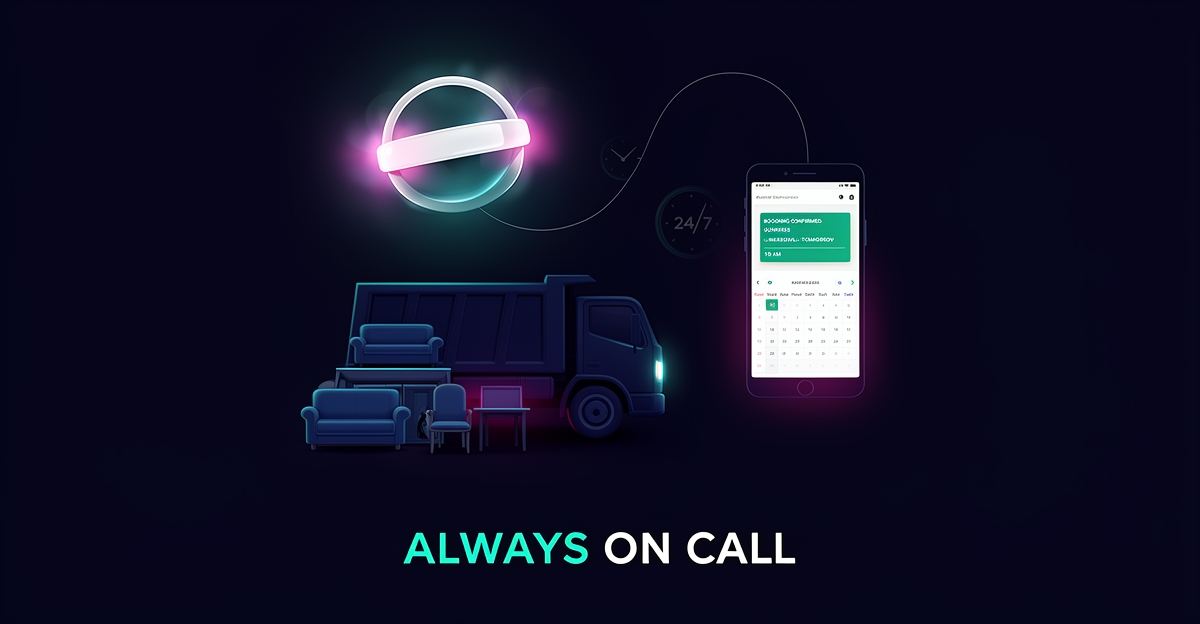
# How an AI Receptionist Can Handle Junk Removal Inquiries 24/7
**Quick Answer:** AI receptionists handle junk removal inquiries 24/7, answering calls in seconds and booking pickups instantly. They resolve most routine calls without human help, and at roughly 80% less cost than a full-time human hire, they pay for themselves fast.
## Key Facts
- AI receptionists answer every call in seconds, with no hold queues or voicemail
- Most routine inquiries, junk type, location, pricing, scheduling, are resolved without human intervention
- An AI receptionist from AIQ Labs typically costs around 80% less than a full-time human hire
- AI receptionists support dozens of languages, so diverse customers get clear answers on the first call
- A full-time human receptionist typically costs tens of thousands of dollars per year once salary and benefits are included
- Traditional answering services typically charge per call, with overage fees during busy seasons
- AI receptionists eliminate missed calls by providing 24/7 availability for junk removal inquiries
## Table of Contents
- [The Missed Call Cost for Junk Removal Teams](#the-missed-call-cost-for-junk-removal-teams)
- [How an AI Receptionist Handles Junk Removal Calls 24/7](#how-an-ai-receptionist-handles-junk-removal-calls-247)
- [From Inquiry to Pickup: The Junk Removal Workflow](#from-inquiry-to-pickup-the-junk-removal-workflow)
- [Implementing an AI Receptionist Without Disrupting Operations](#implementing-an-ai-receptionist-without-disrupting-operations)
## The Missed Call Cost for Junk Removal Teams
A junk removal customer with a garage full of old furniture doesn't wait until Monday morning to call. They call when they finally decide to deal with it, often at 8 p.m. on a weeknight or during a Saturday afternoon when your crew is mid-job and nobody can reach the phone. Every one of those unanswered calls is a job handed to a competitor.
The math behind missed calls is unforgiving. Most junk removal operators run lean crews, which means the phone competes with dumpsters, driveways, and dispatch, and during busy seasons like spring cleanouts and post-holiday purges, calls spike exactly when your team is least available. Traditional answering services don't fully solve the problem either: they typically charge a monthly base for a limited call volume, with overage fees piling up precisely during those busy seasons when call volume surges.
Then there's the option of hiring a human receptionist. A full-time front-desk hire typically runs tens of thousands of dollars per year once salary and benefits are included. For a small junk removal operation, that's a significant payroll commitment for someone who still only covers 40 hours a week, takes vacations, and calls in sick.
The structural problem comes down to three compounding gaps:
- **Limited hours:** Customers call after 5 p.m. and on weekends, when no one is available to answer.
- **Variable efficiency:** A human answering between jobs may rush calls, miss details, or forget to log the lead.
- **Lost revenue:** Every unanswered inquiry is a potential pickup that goes to the next company on the search results page.
What makes this especially costly in junk removal is the urgency of the buyer. Someone clearing out an estate or a rental unit before a deadline rarely leaves a voicemail and waits, they simply call the next listing.
This is the gap that AI receptionists are built to close. A dedicated [AI employee](/ai-employees) can answer every inbound call around the clock, collect the type of junk, location, and preferred pickup date, qualify the lead, and book the job directly into the calendar, without adding payroll. At AIQ Labs, we build and deploy these AI employees for service-based businesses like junk removal, giving owners 24/7 coverage at roughly 80% less cost than a front-desk hire. Before evaluating solutions, though, it helps to understand exactly where your current phone process leaks revenue, and what a fully covered line actually looks like.
## How an AI Receptionist Handles Junk Removal Calls 24/7
An AI receptionist transforms how junk removal businesses handle customer inquiries by providing instant, intelligent responses around the clock. Unlike traditional voicemail or limited-hour answering services, an AI receptionist engages callers in natural conversation from the first ring. These systems answer every call in seconds, eliminating frustrating wait times that drive potential customers to competitors. This immediate responsiveness captures leads that might otherwise be lost during evenings, weekends, or peak busy periods when human staff are unavailable.
The AI receptionist resolves the vast majority of routine calls without human intervention, significantly reducin
AI Employees
Hire a team member that works 24/7 — for less than a part-time wage.
AI receptionists, SDRs, dispatchers and 99+ roles. Trained on your business, fully managed.
See If You’re a Fit — AI Employees from $700/mo
Not sure where to start? Ask our AI planner
g operational burden. Modern AI receptionists handle most inquiries autonomously by understanding caller intent, collecting essential job details, and providing accurate information. For junk removal services, this means the AI can qualify leads by asking about junk type, volume, location, and preferred pickup timing, all while maintaining a helpful, conversational tone. It seamlessly schedules pickups by integrating with the business calendar, answers frequent questions about pricing and service areas, and prioritizes urgent requests for immediate team notification.
Beyond basic call handling, the AI receptionist delivers multilingual support and measurable cost savings critical for service-based businesses. These systems support dozens of languages, ensuring effective communication with diverse customer bases without needing specialized staff. Most significantly, an AI receptionist typically costs around 80% less than a full-time human hire, with no per-call overage charges. This efficiency comes from eliminating per-call fees, minimizing missed opportunities, and freeing human staff to focus on complex jobs and customer relationships rather than routine call triage. For junk removal companies seeking to maximize every inquiry while controlling expenses, an AI receptionist provides a scalable, always-on front desk that never misses a beat.
## From Inquiry to Pickup: The Junk Removal Workflow
From the first inquiry to the final pickup, an AI receptionist streamlines every step of the junk removal workflow with precision and speed. When a customer calls or messages, the AI immediately engages in natural conversation to capture essential details, what type of junk needs removal, the exact location, and preferred pickup date, eliminating delays and manual note-taking. This automated intake ensures no inquiry is lost, even outside business hours, directly addressing the industry challenge of missed calls that can cost junk removal businesses valuable leads. By resolving most routine calls without human help, the system maintains high first-contact resolution while freeing human staff for more complex tasks.
The AI seamlessly integrates with the business's calendar to schedule pickups in real time, offering customers available slots based on crew availability and location. It can also connect with routing tools to optimize pickup sequences, reducing fuel costs and improving on-time performance, a critical efficiency gain for field service operations. For common questions about pricing, service areas, or accepted materials, the AI provides instant, accurate responses using a trained knowledge base, handling FAQs without human intervention. When an urgent request arises, such as a same-day cleanup after a storm or eviction, the AI identifies priority keywords and escalates the case immediately to a human dispatcher, ensuring time-sensitive jobs aren't buried in the queue.
Every interaction is automatically logged into the CRM, creating a complete record for follow-up, billing, and future marketing efforts. This end-to-end automation, from inquiry to dispatch, creates a scalable workflow that grows with the business without adding labor costs. AIQ Labs builds and manages AI employees specifically for reception and dispatch roles in service industries like junk removal, enabling 24/7 operation with zero missed calls. By handling routine tasks with conversational intelligence and tool integration, the AI receptionist transforms front-office efficiency while maintaining the personal touch customers expect. Junk removal businesses adopting this technology gain a competitive edge in responsiveness and operational clarity.
**Start the [Fit Check](/apply)**, a two-minute assessment, to see how an AI receptionist can solve your specific workflow bottlenecks. Then schedule a **free 30-minute strategy call** at [aiqlabs.ai/book](/book) to map out a tailored automation plan with zero obligation. If there isn't a clear win, we'll tell you that too.
## Implementing an AI Receptionist Without Disrupting Operations
Implementing an AI receptionist doesn't require overhauling your existing operations, it's about enhancing them with minimal disruption. Start by choosing a provider that aligns with your business goals and technical environment, ensuring they offer deep integration capabilities with tools you already use, like Google Calendar or your CRM. AIQ Labs follows a structured approach through the Start Monthly, Build in Milestones, or Own It Outright payment models, allowing junk removal businesses to begin small and scale confidently without upfront complexity. You can review the full breakdown on the [pricing page](/pricing).
Next, configure the system with your business details, branding, and service
AI Development
Still paying for 10+ subscriptions that don’t talk to each other?
We build custom AI systems you own outright. No vendor lock-in. Full control.
See If You’re a Fit — AI Employees from $700/mo
Not sure where to start? Ask our AI planner
specifics, such as pickup zones, accepted materials, and pricing tiers, so the AI sounds and acts like a natural extension of your team. Then, integrate it with your scheduling and dispatch platforms to enable real-time booking and automatic updates, reducing double-bookings and manual entry. Training the AI on your most common inquiries, like "What do you take?" or "How much does a couch pickup cost?", ensures accurate, consistent responses from day one.
Before going live, run test calls to validate call routing, message accuracy, and escalation paths for urgent requests. Once deployed, monitor performance metrics such as call resolution rate and booking completion, using insights to refine scripts and workflows over time. AI receptionists answer every call in seconds and resolve most routine inquiries without human help, significantly reducing missed opportunities while maintaining a professional front desk experience, all without adding to your payroll. Businesses using AI reception typically see faster response times and higher customer satisfaction, especially during peak seasons or after-hours inquiries, and the cost savings versus a human hire make it a sustainable upgrade for growing junk removal companies.
- Choose a provider with strong CRM and calendar integration
- Configure business info, services, and branding
- Train on FAQs and service-specific workflows
- Test thoroughly before deployment
- Monitor performance and optimize continuously
This phased, low-risk implementation ensures your team stays focused on core operations while the AI handles routine inquiries 24/7.
## Frequently Asked Questions
**How much does an AI receptionist cost compared to hiring a human receptionist for a junk removal business?**
An AI receptionist runs on a flat monthly plan through AIQ Labs' Start Monthly model, typically costing around 80% less than a full-time human hire while providing 24/7 coverage. A human receptionist typically costs tens of thousands of dollars per year once salary and benefits are included.
**Can an AI receptionist really handle junk removal calls outside of business hours, like nights and weekends?**
Yes, an AI receptionist operates 24/7/365, ensuring no calls are missed during evenings, weekends, or peak seasons when crews are busy, directly addressing the industry challenge of lost leads due to unanswered inquiries.
**What percentage of junk removal inquiries can an AI receptionist resolve without human help?**
AI receptionists resolve most routine inquiries autonomously by understanding caller intent, collecting job details like junk type and location, and scheduling pickups, reducing operational burden while maintaining high first-contact resolution. Anything unusual or urgent gets escalated to a human.
**How fast does an AI receptionist answer calls, and why does that matter for junk removal leads?**
AI receptionists answer every call in seconds, eliminating frustrating wait times that drive potential customers to competitors, especially critical in junk removal where urgency means callers won't leave voicemails and will simply call the next listing.
**Will an AI receptionist understand our specific junk removal services, pricing, and service areas?**
Yes, the AI is trained on your business specifics, including accepted materials, pricing tiers, pickup zones, and FAQs, so it provides accurate, consistent responses that sound like a natural extension of your team from day one.
**What happens if a customer has an urgent request, like a same-day cleanup after a storm?**
The AI identifies priority keywords in urgent requests and immediately escalates them to a human dispatcher, ensuring time-sensitive jobs aren't buried in the queue while still handling routine inquiries autonomously.
## Never Miss a Pickup Again
Junk removal is built on urgency, and every unanswered call after hours or on weekends is a job handed to a competitor. An AI receptionist closes that gap by answering every inquiry in seconds, collecting junk type, location and preferred pickup, qualifying the lead, and booking directly into your calendar, 24/7 without adding payroll. The result is fewer missed calls, faster first-contact resolution, and more pickups booked while your crew stays focused on the job site. For service businesses, that always-on coverage translates to real operational savings, an AI receptionist typically costs around 80% less than a human hire. AIQ Labs builds and deploys these [AI employees](/ai-employees) for junk removal teams, with 200+ multi-agent systems deployed behind the approach. Start the [Fit Check](/apply) for a two-minute assessment, then book a free 30-minute strategy call at [aiqlabs.ai/book](/book) to map a tailored automation plan with zero obligation.
AI Transformation Partner
Make AI your competitive advantage — not just another tool.
Strategy, implementation and ongoing optimization. One partner, end to end.
See If You’re a Fit — AI Employees from $700/mo
Not sure where to start? Ask our AI planner