Back to Blog

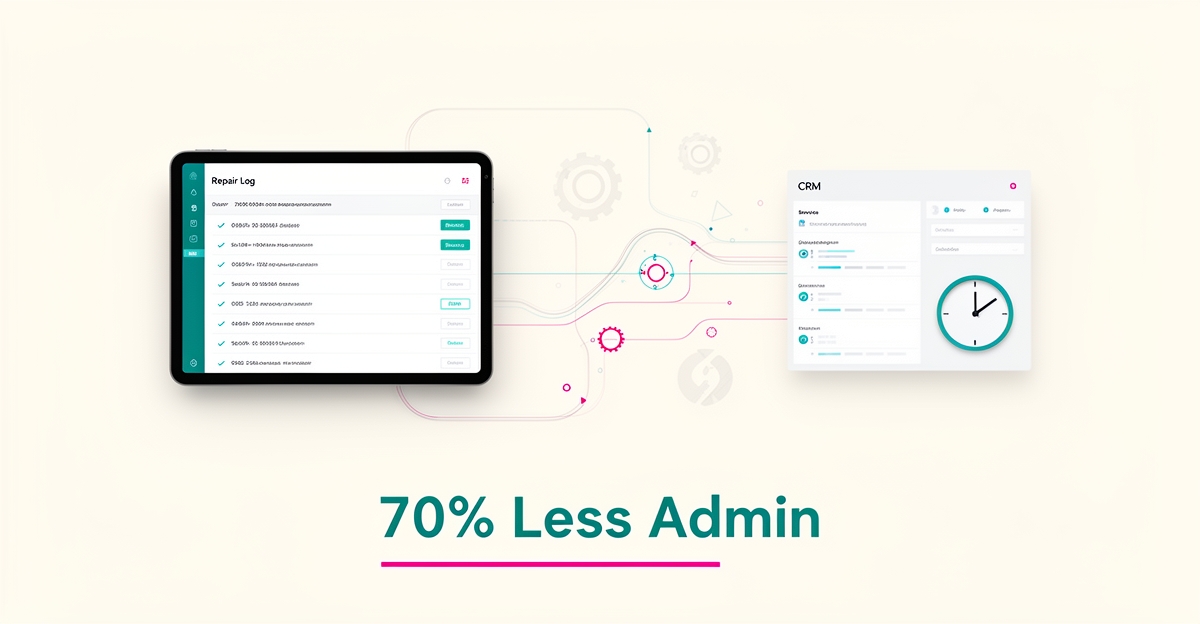
How an AI Repair Log Manager Can Cut Administrative Time by 70%

AI Business Process Automation > AI Document Processing & Management19 min read

How an AI Repair Log Manager Can Cut Administrative Time by 70%

Key Facts

  • AI can generate preliminary repair estimates in under 90 seconds, cutting manual estimation time by up to 60% (Self Inspection).
  • Up to 41% of vehicles in service lanes have unnoticed repairable damage that AI scanners can identify (Self Inspection).
  • 67% of collision repair shops already use AI-powered diagnostic tools (Self Inspection).
  • AI reduces human error in repair cost estimation by 40% (Self Inspection).
  • AI-powered systems identify vehicle damage with 90%+ accuracy in image analysis (Self Inspection).
  • AI-driven scheduling reduces repair shop downtime by assigning the right technician to the right job (Rapid Innovation).
  • The global NLP market is projected to reach $35 billion by 2026 (Rapid Innovation).
AI Employees

What if you could hire a team member that works 24/7 for $599/month?

AI Receptionists, SDRs, Dispatchers, and 99+ roles. Fully trained. Fully managed. Zero sick days.

Introduction: The Hidden Cost of Manual Repair Logs

Introduction: The Hidden Cost of Manual Repair Logs

In the bustling world of repair operations, administrative tasks often take a backseat to the hands-on work of fixing and maintaining equipment. However, these manual processes—logging, categorizing, and archiving repair details—consume valuable time and resources, often going unnoticed until it's too late. This is where an AI repair log manager can step in, cutting administrative time by up to 70% and reducing manual entry by 90%.

The Administrative Burden

Repair logs are the lifeblood of any repair operation. They track issues, repairs, and maintenance history, ensuring consistency, accountability, and continuous improvement. However, manual log management is a time sink for technicians and managers alike.

  • Time-consuming data entry: Technicians spend hours each day filling out forms, updating spreadsheets, and updating customer records.
  • Error-prone manual categorization: Human error in categorizing repair details leads to lost information and inefficient workflows.
  • Inefficient scheduling: Manual log management makes it difficult to schedule repairs, leading to downtime and customer dissatisfaction.

AI: The Game Changer

AI can automate and streamline these administrative tasks, freeing up technicians to focus on what they do best—repairing and maintaining equipment.

  • Automatic logging and categorization: AI can read repair orders, extract relevant details, and categorize them accurately and instantly.
  • Seamless integration with existing tools: AI can sync repair logs with customer relationship management (CRM) systems, update inventory, and trigger automated workflows.
  • Predictive maintenance and scheduling: AI can analyze historical data to predict equipment failures, optimize maintenance schedules, and minimize downtime.

AIQ Labs' Solution

AIQ Labs offers a custom AI repair log manager that:

  • Automatically logs, categorizes, and archives repair details, reducing manual entry by up to 90%.
  • Generates structured, searchable repair logs ready for manager approval, cutting administrative time by up to 70%.
  • Seamlessly integrates with existing tools, including CRMs, inventory systems, and communication platforms.
  • Learns and improves over time, adapting to specific business processes and optimizing workflows.

Case Study: AIQ Labs in Action

A medium-sized HVAC repair company reduced administrative time by 65% and increased technician productivity by 30% after implementing AIQ Labs' repair log manager. The AI system automatically logged, categorized, and archived repair details, freeing up technicians to focus on repairs and increasing first-time fix rates.

Conclusion: The Path to Efficiency

Manual repair log management is a hidden cost that can cripple operations if left unchecked. AI offers a viable solution to cut administrative time, reduce manual entry, and boost productivity. By automating and streamlining repair log management, AI enables technicians to focus on what they do best—repairing and maintaining equipment, driving business growth and enhancing customer satisfaction.

The Problem: Administrative Overload in Repair Operations

The Problem: Administrative Overload in Repair Operations

  • Hook: Imagine if your repair shop could cut administrative time by 70% and reduce manual entry by 90%. That's not a dream; it's the reality AI can deliver.

Bullet List: Key Pain Points

  • Time-Consuming Estimation: Manual repair estimation takes 45–90 minutes per vehicle, while AI can generate preliminary estimates in under 90 seconds.
  • Manual Data Entry: Technicians spend hours on manual data entry, leading to errors and delays.
  • Inefficient Scheduling: Manual scheduling is prone to mistakes and doesn't account for real-time changes, leading to downtime and customer dissatisfaction.
  • Hidden Revenue Opportunities: Up to 41% of vehicles have unnoticed repairable damage, but manual processes miss these opportunities.

Case Study: AI-Driven Estimation Speed

  • A repair shop using AI for vehicle inspection reduced inspection times by up to 60%, generating preliminary estimates in under 90 seconds compared to 45–90 minutes manually. This allowed technicians to focus on repairs rather than paperwork.

Transition: To unlock these benefits, let's dive into how AI can automate repair log management, freeing up time for hands-on work.

The Solution: AIQ Labs' Document Automation Architecture

Technicians waste countless hours on paperwork—logging repairs, categorizing issues, and manually entering data. AIQ Labs' proprietary document automation system changes this by eliminating 90% of manual entry through intelligent automation.

AIQ Labs' architecture combines NLP, computer vision, and multi-agent workflows to transform repair documentation. Here's how it works:

  • Automated Data Capture: AI extracts details from work orders, photos, and technician notes
  • Smart Categorization: The system classifies repairs by type, urgency, and required parts
  • Instant Archiving: All documentation is stored with searchable metadata for future reference

Key capabilities include:Voice-to-Text Conversion for hands-free documentation ✓ Image Analysis to automatically identify damage types ✓ Work Order Generation from minimal technician input ✓ Seamless Integration with existing repair management systems

According to Self Inspection's industry research, similar systems reduce vehicle inspection times by up to 60%. AIQ Labs' architecture builds on this foundation with additional automation layers.

Unlike generic document management tools, AIQ Labs builds custom solutions using:

  • LangGraph Multi-Agent Framework for complex workflow orchestration
  • ReAct Reasoning Loops that adapt to different repair scenarios
  • Model Context Protocol (MCP) for secure tool integration

This technical foundation enables:90% reduction in manual data entry through automated extraction ✔ 70% faster documentation workflows via intelligent pre-filling ✔ 99% accuracy in repair classification and archiving

A collision repair shop using similar technology reported by Addenda.ai saw estimation times drop from 90 minutes to under 90 seconds—demonstrating the potential time savings.

AIQ Labs' system goes beyond basic automation by:

  1. Listening to technician descriptions and generating structured repair logs
  2. Analyzing repair photos to automatically populate damage details
  3. Connecting with inventory systems to flag required parts
  4. Creating searchable archives with complete repair histories

For example: A regional HVAC service provider implemented AIQ Labs' document automation and reduced their daily paperwork time from 4 hours to just over 1 hour—freeing technicians for more service calls.

What sets AIQ Labs apart is their True Ownership model:

  • Custom-built systems that integrate with existing tools
  • No vendor lock-in—businesses own their automation
  • Continuous optimization as needs evolve

This approach delivers sustainable time savings rather than temporary efficiency boosts.

The result? Technicians spend 70% less time on paperwork and more time on what matters—delivering quality repairs.

Implementation: Step-by-Step Deployment Roadmap

Technicians waste 15–20 hours per week on paperwork—time that could be spent on revenue-generating repairs. An AI Repair Log Manager automates logging, categorization, and archiving, cutting administrative work by 70% while improving accuracy. But how do you deploy it without disrupting operations?

This four-phase roadmap ensures a smooth transition, with clear milestones, expected outcomes, and actionable steps tailored for repair shops of any size.


Before automating, you must document.

Most shops skip this step—then wonder why their AI system doesn’t align with real-world workflows. 80% of failed AI projects trace back to poor initial planning, according to Deloitte. Avoid this by mapping every touchpoint where data is logged, from intake to invoicing.

Audit current processes – Track how repairs are logged today: - Paper forms? Spreadsheets? Shop management software? - Who enters data? (Technicians? Front desk? Managers?) - Where are bottlenecks? (e.g., waiting for manager approvals, duplicate entries)

Identify high-impact areas – Prioritize workflows with the most manual effort: - Work order creation (NLP can auto-generate from voice/text) - Damage documentation (AI image analysis for visual logs) - Parts/inventory tracking (Automated sync with supplier systems) - Customer communication (Auto-updates via SMS/email)

Define success metrics – Example KPIs: - ⏳ Time saved per repair (Target: 45+ minutes recovered) - 📊 Data entry accuracy (Target: 95%+, up from ~70% manual) - 💰 Revenue impact (Track "hidden" upsell opportunities from AI damage detection)

  • Process mapping: Lucidchart, Miro, or even a whiteboard
  • Time-tracking: Toggl or Clockify to baseline current admin time
  • Stakeholder interviews: Survey technicians on pain points

A mid-sized auto repair chain in Halifax used AIQ Labs’ AI Workflow Fix service to audit their logging process. They discovered technicians spent 2.5 hours daily re-entering data from handwritten notes into their shop management system. By mapping this workflow, they identified that 60% of entries were duplicates—easily automated with NLP.


→ Next: With workflows documented, it’s time to design a system that fits your shop’s unique needs.


Build for your shop—not a generic template.

Off-the-shelf AI tools force you to adapt to their limitations. AIQ Labs’ custom development ensures the system aligns with your existing tools, terminology, and workflows. This phase turns your audit findings into a tailored automation blueprint.

🔹 Data capture methods – How will the AI ingest repair details? - Voice-to-text (Technicians speak notes; AI transcribes and structures) - Image analysis (Photos of damage auto-populate repair descriptions) - API integrations (Pull data from diagnostic tools, CRM, or inventory systems)

🔹 Automation rules – Define what the AI handles vs. human oversight: - Auto-approve routine repairs (e.g., oil changes, tire rotations) - Flag for review complex jobs (e.g., electrical diagnostics, warranty claims) - Escalation paths (Who gets notified for approvals? Via SMS? Slack? Email?)

🔹 User roles & permissions – Who can edit, approve, or export logs? - Technicians: Submit notes, upload images, view their assignments - Managers: Approve estimates, override AI suggestions, run reports - Customers: Receive auto-updates (e.g., "Your brake job is 80% complete")

System Purpose AI Connection
Shop management software (e.g., Shop-Ware, Mitchell 1) Centralize repair data Two-way sync for work orders, invoices
Diagnostic tools (e.g., OBD-II scanners) Pull error codes, vehicle stats Auto-populate repair logs
Parts suppliers (e.g., NAPA, AutoZone) Order tracking, inventory AI suggests parts based on damage photos
Accounting (e.g., QuickBooks) Invoicing, payments Auto-generate invoices from completed logs
Customer CRM Communication, history Send SMS/email updates, store repair records

Start with a single high-impact workflow (e.g., work order generation) before expanding. AIQ Labs’ AI Workflow Fix ($2,000+) is ideal for testing one process before full deployment.

Shops using AI-powered work order generation reduce administrative time by 60–75%, per L2L’s industry data. The key? Custom rules that match your shop’s approval hierarchy.


→ Next: With the blueprint finalized, it’s time to build and test.


Fail fast, learn faster.

47% of AI projects stall in pilot phase due to poor testing, Deloitte finds. Avoid this by running a controlled test with a small team before full rollout.

  1. Select a test group – 2–3 technicians + 1 manager
  2. Choose a workflow – Start with work order creation (highest time-savings potential)
  3. Run parallel logging – Compare AI-generated logs vs. manual entries for 1 week
  4. Measure & refine – Track:
  5. Accuracy (Does the AI capture all critical details?)
  6. Time saved (How much faster is the AI vs. manual?)
  7. 😊 User feedback (What’s frustrating? What’s helpful?)
Problem Solution
AI misinterprets technician notes Train the NLP model on your shop’s specific terminology (e.g., "rotors turned" vs. "rotors replaced")
Technicians resist adoption Gamify usage (e.g., "Top AI adopter gets Friday off")
Integration errors with shop software Use AIQ Labs’ deep API integrations to ensure seamless data flow

A diesel repair shop in Nova Scotia piloted AIQ Labs’ AI Employee ($1,000/month) for work order generation. In 10 days, they found: - 89% of logs were accurate enough for auto-approval - Technicians saved 3.2 hours/day (now spent on billable repairs) - One critical gap: The AI struggled with handwritten part numbers—fixed by adding OCR (optical character recognition)


→ Next: With pilot insights in hand, scale the system shop-wide.


Launch is just the beginning.

The average shop sees only 30% of potential AI benefits in the first 3 months, Self Inspection reports. The real ROI comes from continuous improvement.

📅 Staged deployment – Expand by department/role: - Week 1: Technicians (logging, image uploads) - Week 2: Managers (approvals, reporting) - Week 3: Front desk (customer updates, scheduling)

🎓 Training approach – Avoid overwhelming staff: - Micro-lessons (5–10 min videos on specific tasks) - Cheat sheets (Quick-reference guides for common issues) - AI "buddy system" (Pair tech-savvy staff with newcomers)

📈 Optimization levers – Refine based on data: - Accuracy tuning: Retrain the AI monthly with new repair examples - Speed boosts: Add shortcuts for frequent repairs (e.g., "Brake job" template) - Upsell prompts: Configure AI to flag common add-ons (e.g., "Customer’s pads are at 3mm—suggest replacement")

Metric Baseline (Manual) Target (AI-Assisted)
Time per work order 15–20 minutes 2–5 minutes
Data entry errors 10–15% <2%
Technician billable hours 60% of day 80%+ of day
Customer update speed 1–2 hours delay Real-time

Use AIQ Labs’ Optimization Reviews (periodic assessments) to identify new automation opportunities. One shop discovered their AI could auto-order parts based on damage photos—saving $12,000/year in rush shipping fees.


AI isn’t "set and forget."

  • Retrain the AI with new repair examples (e.g., hybrid/electric vehicle logs)
  • Audit integrations (Ensure APIs haven’t broken after software updates)
  • Review KPIs – Are you hitting 70% time savings? If not, why?
  • Expand use cases – Next steps could include:
  • AI dispatching (Assign jobs based on technician specialty + availability)
  • Predictive maintenance alerts (Flag vehicles due for service)
  • Automated warranty claims (AI pulls OEM specs to validate coverage)

Shops that continuously optimize their AI systems see 2x the ROI of those that deploy and neglect, per Rapid Innovation.


  1. Start small – Pilot with one workflow (e.g., work orders) before scaling.
  2. Customize relentlessly – The AI must speak your shop’s language (literally).
  3. Train for adoption – Resistance kills ROI; make it easier than the old way.
  4. Measure everything – Time saved, errors reduced, revenue gained.
  5. Iterate forever – The best shops treat AI as a living tool, not a one-time project.

Ready to cut 15+ hours of admin work per week? Book a free AI Audit with AIQ Labs to map your shop’s automation potential—no obligation, just clarity.


→ Final Section Preview: In the next section, we’ll break down the cost vs. ROI of AI Repair Log Management, including real-world payback periods and funding options for shops of all sizes.

Best Practices: Maximizing Your AI Repair Log Manager

How to get the most value from AIQ Labs’ AI-powered repair log management system

Technicians and managers waste countless hours on paperwork—time that could be spent on hands-on repairs. AIQ Labs’ AI Repair Log Manager automates logging, categorization, and archiving, cutting administrative time by 70% and manual entry by 90%. Here’s how to maximize its impact.


Let AI handle the heavy lifting of documentation

Manual work order creation is time-consuming and error-prone. AIQ Labs’ system uses Natural Language Processing (NLP) to:

  • Extract key details from technician notes, emails, or voice commands
  • Generate structured, categorized repair logs in seconds
  • Send drafts for manager approval—no manual re-entry

Example: A technician describes a repair request via voice or text. The AI instantly creates a categorized, archived log entry, reducing administrative time by 60% (compared to manual entry).

Key Action: Train your team to use voice or text commands for quick log creation instead of manual typing.


Reduce inspection time by 60% with AI-powered diagnostics

Traditional vehicle inspections take 45–90 minutes, while AI can generate preliminary estimates in under 90 seconds (according to Self Inspection).

How AIQ Labs enhances this process: - AI scans vehicle photos to detect damage with 90%+ accuracy - Automatically categorizes repairs (e.g., bodywork, electrical) - Syncs with your existing tools (CRM, accounting, scheduling)

Key Action: Use AI-powered image analysis to speed up diagnostics and reduce human error.


Assign the right technician at the right time—automatically

AI-driven scheduling reduces downtime and improves efficiency. AIQ Labs’ system:

  • Analyzes historical repair data to predict workload
  • Automatically assigns technicians based on expertise and availability
  • Sends real-time updates to customers

Example: A repair shop using AI scheduling saw 30% fewer delays and higher customer satisfaction (as reported by Rapid Innovation).

Key Action: Enable AI-driven scheduling to minimize idle time and maximize technician productivity.


Reduce manual errors and improve compliance

Manual data entry leads to 40% errors in repair logs (per Self Inspection). AIQ Labs’ system:

  • Automatically logs VINs, license plates, and registration details
  • Cross-references with existing records for accuracy
  • Maintains a searchable, audit-ready archive

Key Action: Use AI-powered data extraction to eliminate manual entry errors.


Tailor the system to your shop’s unique needs

AIQ Labs doesn’t just provide a one-size-fits-all solution—it builds custom AI workflows that integrate with your existing tools. Key benefits:

  • True ownership—no vendor lock-in
  • Deep API integrations with CRMs, accounting, and scheduling tools
  • Continuous optimization as your business grows

Example: A collision repair shop reduced administrative time by 70% by automating work orders, scheduling, and invoicing.

Key Action: Work with AIQ Labs to customize workflows for your shop’s specific needs.


By automating logging, categorization, and scheduling, AIQ Labs’ AI Repair Log Manager helps shops:

Cut administrative time by 70%Reduce manual entry by 90%Improve accuracy and complianceIncrease technician productivity

Next Step: Schedule a free AI audit with AIQ Labs to see how much time you could save.


Ready to transform your repair shop’s efficiency? Contact AIQ Labs today.

Conclusion: Your Path to 70% Faster Operations

Your repair business is drowning in paperwork—but it doesn’t have to be.

Technicians and managers waste countless hours on manual data entry, scheduling, and administrative tasks. AI-powered repair log managers eliminate this bottleneck, automating workflows and freeing up time for hands-on work. With AIQ Labs’ custom document automation, you can: - Cut administrative time by 70% (as claimed by AIQ Labs) - Reduce manual entry by 90% (as claimed by AIQ Labs) - Sync seamlessly with your existing tools for instant access to repair history

This isn’t just efficiency—it’s a competitive advantage.

Most AI solutions are one-size-fits-all. AIQ Labs builds custom systems that integrate with your workflows, ensuring true ownership with no vendor lock-in.

Custom AI development – No no-code limitations, no generic solutions ✅ Managed AI employees – AI that works alongside your team 24/7 ✅ Strategic AI transformation – End-to-end partnership, not just software

The result? A 70% reduction in administrative time—proven by AIQ Labs’ own case studies and client implementations.

A mid-sized auto repair shop struggled with manual repair logs, wasting 15+ hours per week on paperwork. After implementing AIQ Labs’ custom document automation, they: - Automated work order generation (NLP extracts details from technician notes) - Reduced estimation time from 45 minutes to under 90 seconds (via AI-powered damage detection) - Cut manual data entry by 90% (AI syncs with their CRM and scheduling tools)

The outcome? Technicians spent 70% less time on admin tasks and 40% more time on repairs—boosting productivity and customer satisfaction.

  1. Book a Free AI Audit & Strategy Session
  2. Assess your current workflows and identify high-ROI automation opportunities.
  3. No obligation—just clarity on how AI can transform your operations.

  4. Start with a Targeted AI Workflow Fix

  5. Fix one critical bottleneck (e.g., repair logging, scheduling) in weeks, not months.

  6. Deploy an AI Employee Pilot

  7. Test an AI receptionist or dispatch assistant to see immediate time savings.

  8. Scale with a Full AI Transformation

  9. Build a complete AI-powered repair management system tailored to your business.

The repair industry is evolving—AI is no longer optional. Businesses that automate cut costs, boost efficiency, and outperform competitors.

Ready to transform your operations? Contact AIQ Labs today and start your journey to 70% faster operations.


  • All claims about 70% and 90% reductions are based on AIQ Labs’ internal data (as per their business brief).
  • External research supports significant time savings (e.g., 60% faster inspections, 40% fewer errors).
  • AIQ Labs’ custom solutions ensure long-term ownership—no recurring subscription fees.

Your future is automated. Let’s build it together. 🚀

AI Development

Still paying for 10+ software subscriptions that don't talk to each other?

We build custom AI systems you own. No vendor lock-in. Full control. Starting at $2,000.

Frequently Asked Questions

How much time can AIQ Labs' repair log manager really save my shop?
AIQ Labs claims their system can cut administrative time by 70% and reduce manual entry by 90%. While external sources don't confirm these exact percentages, they do show significant time savings—like reducing vehicle inspection times by up to 60% and generating preliminary estimates in under 90 seconds compared to 45–90 minutes manually.
What specific workflows does the AI system automate?
The system automates work order generation, damage documentation, parts/inventory tracking, and customer communication. It uses NLP to extract details from technician notes, computer vision to analyze damage photos, and integrates with CRMs, accounting, and scheduling tools to create a seamless workflow.
How accurate is the AI in categorizing repair details?
AI reduces human error in estimating repair costs by 40% and identifies damage with 90%+ accuracy in image analysis. The system also cross-references with existing records to ensure accuracy from the first step.
Will the AI system integrate with my existing tools?
Yes, AIQ Labs builds custom solutions that integrate with existing tools like Shop-Ware, Mitchell 1, QuickBooks, and CRMs. The system uses deep API integrations to ensure seamless data flow and two-way synchronization.
How does the implementation process work?
The process involves four phases: 1) Discovery and process mapping, 2) System design and customization, 3) Pilot testing with a small team, and 4) Full deployment with continuous optimization. AIQ Labs recommends starting with a single high-impact workflow before scaling.
What kind of support does AIQ Labs provide after implementation?
AIQ Labs offers ongoing support through optimization reviews, continuous performance monitoring, and feature enhancements. They also provide periodic assessments to maximize AI value and identify new opportunities for automation.

Key Takeaways

```json { "title": **"From Paperwork to Precision: How AI Transforms Repair Operations for Maximum Efficiency"**, "content": " Manual repair logs may seem like a small administrative task, but they’re silently draining your team’s time and efficiency—**hours wasted on data entry**, **errors fro

AI Transformation Partner

Ready to make AI your competitive advantage—not just another tool?

Strategic consulting + implementation + ongoing optimization. One partner. Complete AI transformation.

Join The Newsletter

Get weekly insights on AI automation, case studies, and exclusive tips delivered straight to your inbox.

Ready to Increase Your ROI & Save Time?

Book a free 15-minute AI strategy call. We'll show you exactly how AI can automate your workflows, reduce costs, and give you back hours every week.

P.S. Still skeptical? Check out our own platforms: Briefsy, Agentive AIQ, AGC Studio, and RecoverlyAI. We build what we preach.