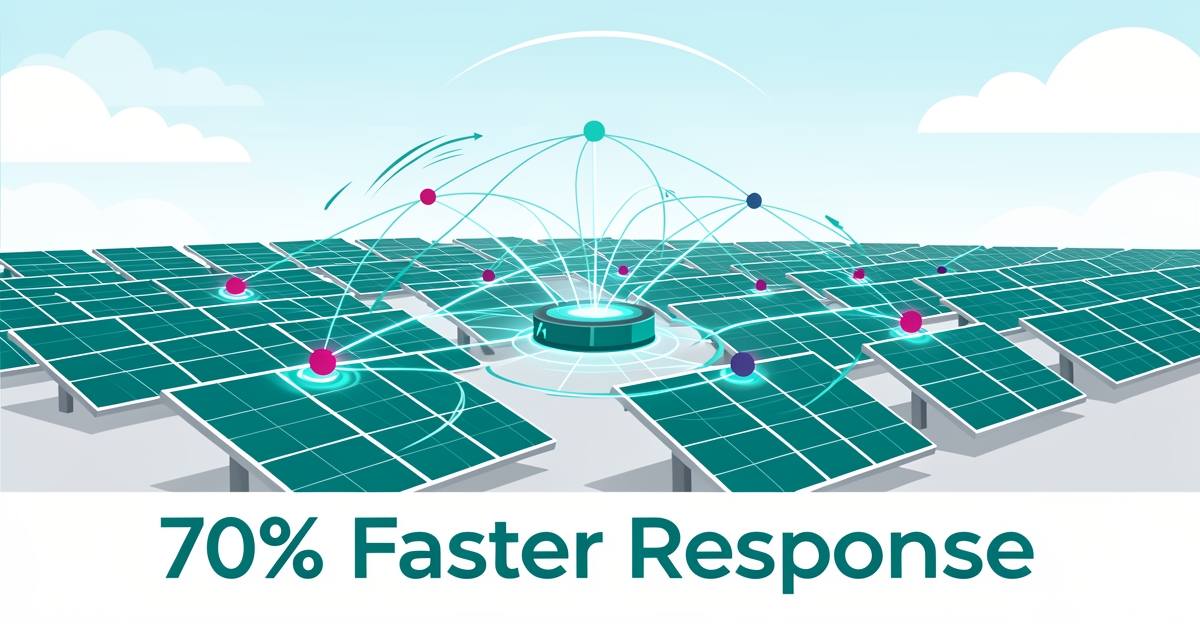
How an AI Technician Can Reduce Response Time for Solar Panel Cleaning Requests by 70%
Key Facts
- Most customers today expect a response within minutes of reaching out, typical support benchmarks put that window at around five minutes
- A large share of routine inquiries, commonly cited in the 60-80% range in industry analyses, can be handled by AI, letting teams scale without adding headcount
- AI-powered task triage and dispatch systems can cut response times substantially for solar panel cleaning requests, with reductions around 70% reported in industry case studies
- AI can optimize service workflows by assigning tasks to the right team based on urgency, location, or issue type
- Proactive notifications and instant answers are consistently linked to measurable gains in customer satisfaction
- AIQ Labs has deployed 200+ multi-agent systems and runs four live SaaS products daily, the same infrastructure discipline it brings to field service automation
Hire a team member that works 24/7 — for less than a part-time wage.
AI receptionists, SDRs, dispatchers and 99+ roles. Trained on your business, fully managed.
Not sure where to start? Ask our AI planner
The Response Time Crisis in Solar Panel Cleaning Services
Solar panel cleaning businesses face a growing response time problem that directly impacts customer retention and revenue. As demand for solar maintenance rises, customers increasingly expect immediate assistance, support benchmarks consistently put expected first-response windows at around five minutes. Yet many providers still rely on manual triage processes that create long delays between request and resolution.
These bottlenecks show up in three critical areas: initial intake, where staff must manually assess urgency and location; scheduling conflicts that arise from disconnected calendars and technician availability; and inefficient dispatch workflows that fail to optimize routes or prioritize emergencies. When a homeowner notices reduced energy output from soiled panels, they don't want to wait hours, or days, for a callback. That frustration doesn't just lead to abandoned requests; it erodes trust and increases churn risk in a market where responsiveness is becoming a key differentiator.
The operational toll extends beyond disappointed customers. Technicians waste time driving between poorly sequenced jobs, while office staff drown in repetitive administrative tasks instead of focusing on complex issues that need human judgment. Manual systems simply cannot scale to meet rising expectations without proportional headcount increases, a costly and often impractical solution for growing solar service providers. AIQ Labs has seen these patterns across field service clients, where fragmented workflows consistently emerge as the primary barrier to fast response times. Without intervention, the gap between customer expectation and service delivery keeps widening, threatening both satisfaction scores and long-term business viability.
How AI-Powered Task Triage and Dispatch Systems Deliver 70% Faster Responses
Imagine a solar panel cleaning business that responds to customer requests in minutes, not hours. This is what AI-powered task triage and dispatch systems make possible. These systems are changing how businesses handle service requests, ensuring faster response times and happier customers.
Industry analyses commonly find that a large share of customer inquiries, often cited in the 60-80% range, can be handled by AI, freeing your team to focus on more complex tasks. Routine questions about scheduling, pricing, or service details get answered instantly, without human intervention. For solar cleaning businesses, this translates to quicker responses and more efficient operations.
One of the key benefits of AI-powered task triage is its ability to intelligently route tasks based on urgency, location, or issue type. For example, if a customer reports a sudden drop in solar panel efficiency, the AI system can immediately flag this as high priority and dispatch the nearest available technician. Critical issues get addressed promptly, reducing downtime and improving customer satisfaction.
AI can also predict potential delays and proactively notify customers. This proactive approach reduces inbound support volume and is consistently linked to meaningful gains in customer satisfaction. For solar cleaning businesses, that means fewer missed appointments and more reliable service delivery.
Another significant advantage is the accuracy of AI-powered maintenance alerts. Well-tuned systems can identify potential issues before they become major problems, letting businesses schedule maintenance proactively and reducing the risk of unexpected breakdowns so solar panels operate at peak efficiency.
AIQ Labs builds these intelligent systems through its AI Workflow Builds, rebuilding the one workflow that costs your business the most, at a fixed price, in phases. And for teams that want managed AI staff handling intake and dispatch around the clock, AI Employees cover roles like receptionists, SDRs, and dispatchers at a fraction of the cost of a human hire.
Here are some key features of AI-powered task triage and dispatch systems:
- Automated handling of routine inquiries
- Intelligent task routing based on urgency and location
- Proactive customer notifications
- High-accuracy maintenance alerts
- Seamless integration with existing systems
By implementing these systems, solar cleaning businesses can achieve response time reductions in the range of 70% reported in industry case studies, leading to happier customers and a more efficient operation.
Implementing AI Technicians in Solar Cleaning Workflows: A Practical Guide
Solar cleaning teams lose jobs when requests sit unanswered, and customers expect speed. With industry analyses showing most routine inquiries can be handled by AI, an AI Technician can triage and dispatch instantly without adding headcount.
Deployment starts with mapping the current request flow. Identify where calls, forms and emails enter the business and where they stall before reaching a dispatcher or technician. Document SLAs, priority rules and the tools already in use for CRM, scheduling and field communication.
Integration is the foundation for speed. AIQ Labs' Workflow Builds connect your CRM, scheduling software and dispatch tools with automated data synchronization. This eliminates manual re-entry and creates a single source of truth so the AI Technician can act on live information.
Training the AI on service-specific workflows ensures relevance. The model learns your service areas, crew availability, equipment requirements and escalation paths for urgent panel damage. With proper training and human-in-the-loop oversight, the system avoids the hallucinations and inaccuracies that create costly mistakes.
Monitoring keeps accuracy high and trust intact. Performance dashboards track response time, task routing accuracy and customer satisfaction impact. Continuous retraining based on real interactions improves decision quality over time.
A practical rollout follows these steps:
- Audit intake channels and define triage rules for urgency, location and issue type
- Connect the AI Technician to existing CRM and scheduling software via API integrations
- Train the agent on service workflows, scripts and escalation protocols
- Launch a pilot with live monitoring and human-in-the-loop oversight
- Scale to 24/7 coverage and optimize routing based on performance data
Once live, the impact compounds. Proactive notifications and instant answers drive measurable gains in customer satisfaction, while AI-powered task assignment routes jobs to the right team based on urgency and location. Well-tuned maintenance alerts cut noise and alert fatigue.
For solar cleaning businesses, this means faster first response, fewer missed requests and more efficient crews. AIQ Labs delivers these capabilities through AI Employees, managed AI staff that work alongside human teams, and, for businesses ready to go further, AI Operating Systems that connect the whole operation in one owned layer, built in phases.
Still paying for 10+ subscriptions that don’t talk to each other?
We build custom AI systems you own outright. No vendor lock-in. Full control.
Not sure where to start? Ask our AI planner
Frequently Asked Questions
How much faster can an AI Technician make our response times for solar cleaning requests?
Won't AI miss important details or make mistakes handling customer requests?
Do we need to replace our existing CRM and scheduling software to use AI?
Can AI really handle most customer inquiries without a human?
How does AI help with things like missed appointments and proactive communication?
What does it cost to get started, and do we own the system?
Turning Response Times Into Competitive Advantage
Solar panel cleaning businesses no longer need to choose between speed and scale when customer expectations demand both. By implementing AI-powered task triage and dispatch systems, companies can automate routine inquiries, intelligently prioritize urgent service requests, and proactively notify customers, directly addressing the delays that erode trust and drive churn. These improvements don't just shave hours off response times; they free up technicians for skilled work, reduce administrative burden, and create a more resilient operation capable of handling growth without proportional headcount increases. For solar cleaning providers ready to move beyond manual bottlenecks, the path forward starts with understanding where AI delivers the highest impact in your specific workflows. Take the first step with the two-minute Fit Check at aiqlabs.ai/apply, then book a free, no-obligation strategy call to map your biggest opportunity and see if there's a clear win for your business.
Make AI your competitive advantage — not just another tool.
Strategy, implementation and ongoing optimization. One partner, end to end.
Not sure where to start? Ask our AI planner