How an AI Work Order System Can Reduce Missed Service Appointments
Key Facts
- 8 in 10 of the global workers say they lack enough time or energy to do their work according to industry research
- 60% of meetings happen as ad hoc calls outside the pre-scheduled day per recent analysis
- 25% or more of tasks are performed by AI in 36% of occupations based on workforce data
- 57% of AI use is augmentation, meaning workers use AI as a collaborator per workforce research
- 43% of AI use is automation, where AI completes tasks with little human involvement per workforce research
Hire a team member that works 24/7 — for less than a part-time wage.
AI receptionists, SDRs, dispatchers and 99+ roles. Trained on your business, fully managed.
Not sure where to start? Ask our AI planner
The Hidden Cost of Missed Service Appointments in Field Operations
Missed service appointments quietly drain revenue, morale, and trust in field operations. When a technician arrives to an empty driveway or a customer cancels late, the cost is more than a wasted hour — it is lost capacity that can't be recovered.
Field teams are already stretched thin. Industry research shows 8 in 10 workers say they lack enough time or energy to do their work. That fatigue shows up in scheduling errors, forgotten confirmations, and reactive rescheduling.
The scheduling environment itself is fragmented. Recent analysis finds 60% of meetings are happening as ad hoc calls or quick chats outside the pre-scheduled day-to-day. For fleets and field teams, ad hoc changes mean work orders shift constantly and appointment adherence slips.
AI is already changing how work gets done. Workforce data indicates 25% or more of tasks are performed by AI in 36% of occupations. Use is split between augmentation and automation, with 57% of AI use augmenting workers and 43% automating tasks with little human involvement.
That mix matters for service operations. Augmentation supports dispatchers and technicians with real-time visibility, while automation handles reminders, availability checks, and reassignments without manual chasing.
The hidden costs compound quickly:
- Unfilled truck rolls and lost billable hours from no-shows and late cancellations
- Customer dissatisfaction and churn after repeated rescheduling
- Dispatcher overtime spent manually re-routing and chasing confirmations
- Inventory and parts waste when jobs are prepared for appointments that never happen
These pressures are why AI-powered work order systems are moving from optional to essential in field operations. Systems can automatically send reminders, track live availability, and reassign tasks when needed, reducing missed appointments without adding headcount.
This is exactly the kind of high-friction workflow AIQ Labs targets with its AI Workflow Builds: rebuild the one workflow that costs the most — for most field service businesses, that's scheduling and dispatch — at a fixed price, in phases.
The result is fewer missed visits, higher utilization, and a calmer day for teams who are already operating at capacity.
How AI-Powered Work Order Systems Prevent No-Shows Through Automation
Missed service appointments drain revenue and burn out crews. AI-powered work order systems close that gap by handling the repetitive coordination that humans miss under pressure.
Work order automation is not wholesale replacement. Workforce research shows 57% of AI use is augmentation, meaning workers use AI as a collaborator, refining and improving their work. The remaining 43% of AI use is automation, where AI completes tasks with little human involvement. That split maps directly to field operations.
Augmentation supports dispatchers and technicians with real-time context while automation removes the manual follow-up that causes no-shows. With 8 in 10 of the global workforce saying they lack enough time or energy to do their work, cognitive overload is a real driver of missed appointments. Automated systems reduce that load.
An AI work order system prevents no-shows through three continuous loops:
- Automatic reminders sent by channel and timing preference, with confirmations captured back into the work order
- Real-time availability tracking across crews, vehicles, parts, and traffic to keep schedules feasible
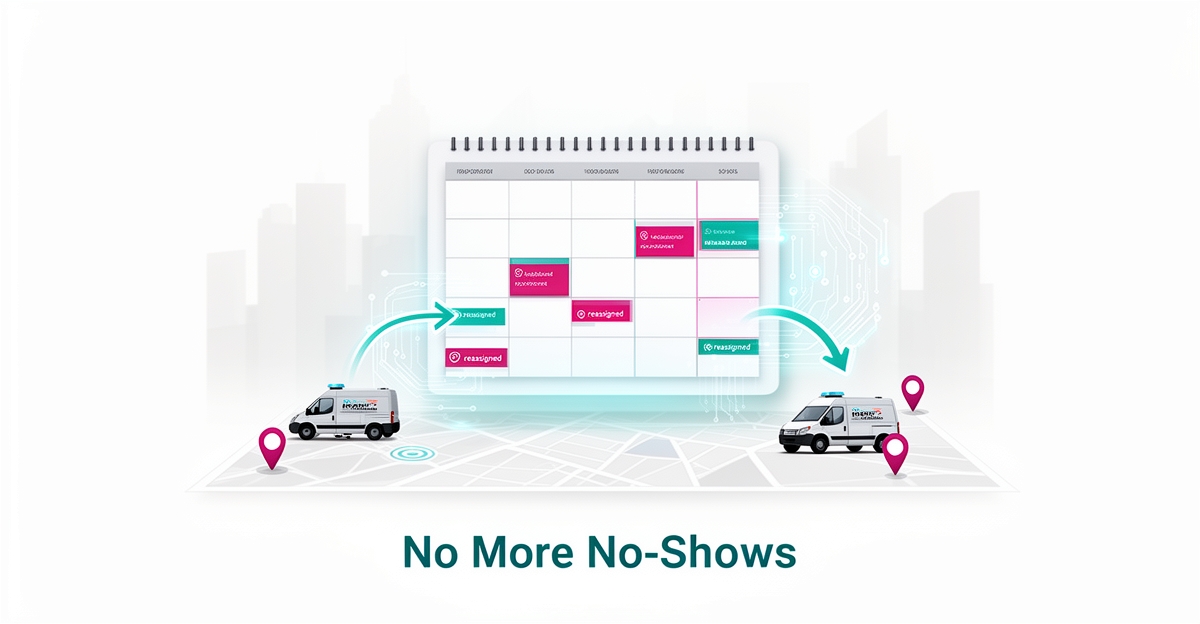
- Instant reassignment when conflicts arise, such as cancellations, delays, or skill mismatches
Reminders are the first line of defense. Instead of a single call the day before, the system sequences SMS, email, and voice prompts and adjusts based on customer response. Availability tracking prevents overbooking. The system reads live location, job duration estimates, and technician certifications to build realistic routes.
Reassignment is where automation delivers the biggest impact. When a job is canceled or delayed, the AI finds the next best fit and notifies all parties without dispatcher intervention. This removes the lag that turns a small disruption into a missed appointment.
For teams that want coverage without a build project, AIQ Labs also offers AI Employees — managed AI staff like dispatchers and work order managers across 99+ roles, at roughly 80% less cost than a human hire. For businesses ready to go further, an AI Operating System connects dispatch, scheduling, and customer communication into one owned operating layer.
The result is fewer gaps, faster recovery, and more completed jobs per day. For field services where 60% of meetings are happening as ad hoc calls or quick chats outside the pre-scheduled day-to-day, structured automation restores control to the schedule.
By pairing augmentation with automation, teams keep decision authority while the system handles reminders, tracking, and reassignment continuously.
Implementing AI Work Order Automation: From Assessment to Owned Systems
Many service businesses struggle with missed appointments due to fragmented scheduling and manual follow-up processes. AI-powered work order automation offers a practical path to reduce no-shows by combining intelligent reminders, real-time availability tracking, and dynamic task reassignment—all while preserving human oversight where it matters most.
Implementation starts with identifying where the workflow leaks. Research shows that 8 in 10 of the global workforce report lacking enough time or energy to do their work, often due to inefficient task switching and ad hoc interruptions. In service operations, this manifests as missed calls, delayed confirmations, and poor visibility into technician availability—direct contributors to missed appointments. By mapping these friction points—such as inconsistent reminder timing or lack of real-time schedule visibility—businesses can target automation where it will have the greatest impact.
From there, AIQ Labs offers three entry points depending on how far you want to go. AI Employees place managed AI staff—a dispatcher, a work order manager, a receptionist—into your operation to send personalized reminders via SMS or email, detect scheduling conflicts, and reassign tasks when cancellations occur. This aligns with the finding that 43% of AI use is automation, where AI completes tasks with little human involvement. For deeper change, an AI Workflow Build rebuilds the dispatch workflow itself at a fixed price, in phases, with deep integration into your existing CRM, calendar, and field service tools.
Finally, integration with existing tools ensures the AI system operates within the current operational ecosystem rather than replacing it. This approach supports seamless adoption, as 57% of AI use is augmentation—meaning workers use AI as a collaborator to refine and improve their work. By connecting AI work order automation to platforms like Google Calendar, Stripe, or industry-specific dispatch software, businesses maintain continuity while gaining intelligent automation. And with the Own It Outright payment model, the system you end up with is yours—code, data, and all—without vendor lock-in or ongoing subscription dependency. To explore how this applies to your operations, take the 2-minute Fit Check and book a free 30-minute strategy call to identify your highest-impact automation opportunity.
Still paying for 10+ subscriptions that don’t talk to each other?
We build custom AI systems you own outright. No vendor lock-in. Full control.
Not sure where to start? Ask our AI planner
Frequently Asked Questions
How does an AI work order system actually reduce missed service appointments?
Is using AI for work order automation about replacing my team or helping them?
What specific tasks does AI automate in a work order system to prevent no-shows?
Why are missed appointments so costly beyond just wasted time?
Do I need to replace my current scheduling tools to use an AI work order system?
How do I know if my field service business is ready for AI-powered work order automation?
Turning Missed Appointments Into Managed Capacity
Missed service appointments are rarely just a scheduling problem—they are a capacity, revenue, and morale problem that compounds across the entire operation. As we've seen, the solution lies not in adding more administrative burden to already stretched teams, but in deploying AI work order systems that handle the coordination humans cannot sustain. By automating reminders, tracking real-time availability, and instantly reassigning tasks when conflicts arise, these systems close the gap between scheduling and execution. With 43% of AI use focused on task automation, the technology exists today to recover lost billable hours without replacing human judgment. For field service leaders ready to move from reactive rescheduling to proactive capacity management, the first step is understanding where your current workflow leaks revenue. AIQ Labs helps businesses identify these friction points and build automation that fits existing operations—whether that starts with an AI dispatcher, a rebuilt dispatch workflow, or a full operating system. Take the 2-minute Fit Check to map your biggest bottleneck and determine if an AI work order system is the right fit for your team.
Make AI your competitive advantage — not just another tool.
Strategy, implementation and ongoing optimization. One partner, end to end.
Not sure where to start? Ask our AI planner