How Construction Safety Consultants Can Use AI to Predict and Prevent Safety Incidents
Key Facts
- Industry analyses typically report meaningful productivity and cost gains from AI adoption in construction, though results vary by project and data quality. Industry analysis
- Construction industry research indicates a majority of leaders are increasing their investment in AI. Industry research
- AI is not a replacement for human judgment, but rather a tool to augment and support human decision-making. Autodesk research
- Predictive safety systems can forecast high-risk scenarios before accidents occur, enabling proactive intervention.
- AI Employees work 24/7/365 and typically cost around 80% less than a human hire in an equivalent role.
Hire a team member that works 24/7 — for less than a part-time wage.
AI receptionists, SDRs, dispatchers and 99+ roles. Trained on your business, fully managed.
Not sure where to start? Ask our AI planner
The Hidden Cost of Reactive Safety in Construction
Construction safety has long relied on reacting to incidents after they occur, creating a dangerous cycle of preventable harm and unnecessary costs. Traditional safety practices depend heavily on lagging indicators—such as injury reports and near-miss logs—that only reveal risks once damage has already been done. This reactive approach means safety teams are constantly playing catch-up, addressing symptoms rather than root causes, and missing critical opportunities to intervene before accidents happen.
Manual inspections, while essential, are inherently limited by human capacity and subjectivity. Supervisors and safety officers can only observe a fraction of site activities at any given time, making it nearly impossible to detect subtle behavioral patterns or emerging hazards across large, dynamic construction environments. As a result, high-risk conditions often go unnoticed until they culminate in serious incidents. Falls, struck-by incidents, and electrocutions remain among the leading causes of fatalities on job sites.
The financial toll of this reactive mindset is significant. Beyond the human cost, each safety incident triggers a cascade of direct and indirect expenses—medical treatment, workers' compensation, project delays, equipment damage, regulatory fines, and increased insurance premiums. Industry analyses commonly estimate that the true cost of a single construction accident can run several times higher than its direct costs when factoring in lost productivity, administrative overhead, and reputational harm. For small and medium-sized construction firms, even one major incident can severely strain financial stability and threaten long-term viability.
These challenges underscore the need for a shift from reactive to predictive safety management. By leveraging AI to analyze historical incident data, worker behavior patterns, environmental conditions, and equipment usage, safety consultants can identify high-risk scenarios before they escalate. This proactive capability enables targeted interventions—such as real-time alerts, revised work procedures, or focused training—that address root causes and reduce the likelihood of harm. As construction firms seek smarter, more resilient safety strategies, AI-driven prediction offers a practical path toward fewer incidents, lower costs, and safer work environments.
How AI Transforms Safety from Reactive to Predictive
Construction sites have always been reactive by necessity — inspectors respond after a near-miss, and safety plans adjust after an incident. AI flips that sequence by reading patterns before they become problems.
AI models ingest historical incident data, worker behavior, site conditions, and weather patterns to identify risk signatures that humans miss. This shift from reactive checks to predictive alerts is how safety moves from compliance to prevention.
According to industry research, a majority of construction leaders say they are increasing their investment in AI. That investment is driven by measurable outcomes, not hype.
Predictive safety systems analyze project data and provide insights that support human decision-making. Autodesk research notes that AI is not a replacement for human judgment, but rather a tool to augment and support human decision-making.
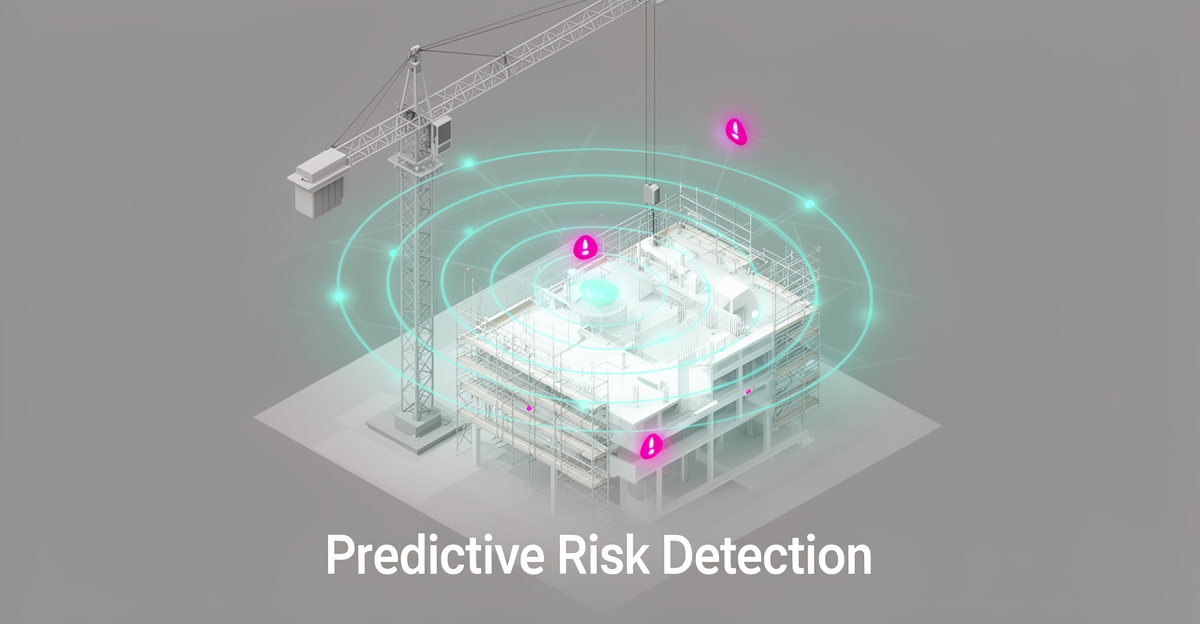
On site, early warning systems can flag high-risk scenarios before they occur. Models learn from past incidents and real-time signals to forecast conditions where accidents are more likely, enabling consultants to intervene proactively.
The business case is clear. Industry analysis suggests AI in construction can deliver meaningful productivity and cost improvements. Safety gains compound those efficiencies.
AI transforms safety monitoring through continuous, data-driven signals:
- Historical incident pattern recognition to predict repeat-risk zones
- Worker behavior analysis from wearable and computer vision data for fatigue and unsafe acts
- Site condition and weather correlation to forecast slip, fall, and equipment risks
- Real-time alerts and automated work stop recommendations for supervisors
This predictive approach also cuts rework and downtime tied to safety events, since hazards are addressed before they shut down a site.
For safety consultancies, predictive analytics and forecasting is a natural extension of [AI Workflow Builds](/workflow-builds) — rebuild the one workflow that costs you the most, at a fixed price, in phases. AIQ Labs deploys predictive safety models as part of scalable, production-grade AI systems for safety consultancies, turning fragmented site data into actionable foresight.
The result is a safety program that anticipates rather than reacts. Consultants can prioritize inspections, tailor training, and allocate resources to the moments and locations where risk is highest, protecting workers and project timelines.
Implementing Predictive Safety AI with AIQ Labs' Three-Pillar Approach
Construction safety consultants are moving from reactive inspections to predictive prevention as AI shifts risk management from hindsight to foresight. With a majority of leaders increasing their investment in AI, the industry is prioritizing systems that forecast high-risk scenarios before incidents occur.
Predictive safety models work by analyzing historical data and worker behavior to forecast high-risk scenarios. AI analyzes project data and provides insights that support human decision-making, not replace it. This approach aligns with how AI is positioned as a tool to augment and support human decision-making on site.
AIQ Labs deploys predictive safety models through three entry points built for safety consultancies. [AI Workflow Builds](/workflow-builds) create site-specific risk models around your costliest workflow, [AI Employees](/ai-employees) enable continuous monitoring and alerting, and [AI Operating Systems](/ai-operating-systems) connect everything into one operating layer you own outright. The result is production-grade, owned systems that scale with business needs.
A workflow build starts with identifying where AI can be applied within safety workflows. Consultants collect and analyze data from incidents, near misses, inspections, and wearable sensors. Models are then developed and trained to recognize patterns that precede accidents. Integration with existing systems and processes ensures seamless operation across project management and reporting tools.
AI Employees provide the continuous monitoring layer that traditional audits cannot. These managed AI staff work alongside human teams 24/7/365, performing real job tasks such as handling intake, logging observations, and triggering alerts in real time — typically at around 80% less cost than a human hire in an equivalent role. An AI Employee can monitor site feeds, log safety observations, and escalate risks automatically, integrating with CRMs, calendars, and scheduling software.
For consultancies ready to connect safety data, reporting, and client communication into one system, an [AI Operating System](/ai-operating-systems) is built in phases and owned outright — no vendor lock-in, no rented stack. Payment is flexible: Start Monthly, Build in Milestones, or Own It Outright.
The business impact is measurable. Industry analysis points to productivity and cost gains from AI in construction. Predictive safety specifically delivers:
- Early warnings that prevent accidents and reduce incident rates
- Improved quality control that detects potential issues and minimizes rework
- Reduced waste and downtime through earlier hazard detection
- Enhanced decision-making via analysis of project data and risk signals
Implementation follows a disciplined path. Consultants first identify high-value automation targets across safety operations. Data is collected and analyzed, then AI models are developed and trained for site-specific risks. Integration with existing systems ensures operational continuity, and performance is monitored and evaluated over time.
With true ownership of custom-built systems, safety consultancies avoid vendor lock-in and retain control over customization and future development. AIQ Labs has deployed 200+ multi-agent systems and runs four live SaaS products daily — production-ready systems, not prototypes. This is predictive safety as a scalable, production-grade capability, not a point solution.
Still paying for 10+ subscriptions that don’t talk to each other?
We build custom AI systems you own outright. No vendor lock-in. Full control.
Not sure where to start? Ask our AI planner
Frequently Asked Questions
How can AI actually predict safety incidents before they happen on a construction site?
Will AI replace our safety inspectors and consultants?
Is investing in predictive safety AI worth it for a small or mid-sized construction firm?
What kind of data does a predictive safety system need to work?
Why are so many construction companies adopting AI for safety now?
How does AIQ Labs implement predictive safety AI for safety consultancies?
From Reactive Checks to Real-Time Prevention: The Future of Construction Safety
Construction safety consultants no longer need to rely solely on lagging indicators and manual inspections to protect workers and projects. By leveraging AI to analyze historical incident data, worker behavior, and site conditions, they can shift from reacting to accidents to predicting and preventing them before they happen. This proactive approach reduces incident rates, minimizes costly delays and rework, and strengthens overall operational resilience—directly supporting the bottom line while fostering a culture of safety. For consultancies ready to move beyond traditional methods, the path forward begins with understanding where AI can deliver the highest impact in their specific workflows. Start the Fit Check — a free, no-obligation two-minute assessment — to explore your biggest safety bottlenecks and discover high-ROI AI opportunities tailored to your practice. It's a real working session with an AI engineer, not a sales pitch, designed to give you clarity on where intelligent automation can truly make a difference.
Make AI your competitive advantage — not just another tool.
Strategy, implementation and ongoing optimization. One partner, end to end.
Not sure where to start? Ask our AI planner