How Dairy Farms Can Use AI to Automate Daily Milking and Milk Quality Monitoring
Key Facts
- AI-driven feed control systems can reduce feed costs substantially by eliminating overfeeding and variability in real time according to industry analysis
- Digital herd management platforms typically cut daily data recording time by half or more compared to manual card systems per herd software analysis
- Automated milking systems improve hygiene consistency and enable real-time somatic cell count analysis during milking per robotic hygiene case study
- AI systems detect early signs of illness, stress, or reproductive cycles before visible symptoms appear using wearable vital indicator tracking per dairy automation research
- Industry bodies such as the International Dairy Foods Association report that dairy professionals recognize AI's competitive advantages and are actively seeking real-world implementations per the IDFA State of AI in Dairy report
Hire a team member that works 24/7 — for less than a part-time wage.
AI receptionists, SDRs, dispatchers and 99+ roles. Trained on your business, fully managed.
Not sure where to start? Ask our AI planner
The Hidden Costs of Manual Milking and Milk Quality Monitoring
It's 4:30 a.m., and the first cows are already lined up at the parlor. For most dairy operators, the day starts in the dark and doesn't end until every animal is milked, every tank reading is logged, and every udder has been checked by hand—a routine that leaves almost no room for error and even less for rest.
Manual milking operations carry costs that rarely show up on a balance sheet until they become crises. Labor dependency tops the list: milking is physically demanding, repetitive work, and finding reliable staff willing to do it twice daily, 365 days a year, grows harder every season. When a worker calls in sick, the cows still need milking.
Then there's the consistency problem. Pre-milking hygiene—udder cleaning, teat preparation, equipment sanitation—directly determines milk quality and animal health, yet it's one of the hardest processes to standardize across shifts and seasons. According to a case study on automated dairy hygiene, manual cleaning methods are inherently prone to variability, and even mechanical scrubbers struggle to deliver consistent results across different farms and animal conditions. That inconsistency isn't just an operational headache—it's a legal and quality risk.
The hidden costs compound quickly:
- Late disease detection — by the time a farmer spots visible signs of mastitis or illness, milk quality has already dropped and treatment costs have climbed
- Milk waste — contaminated or substandard milk often isn't caught until it reaches the tank, meaning entire batches get dumped
- Data gaps — manual record-keeping simply can't capture per-cow, per-session data at the granularity needed for early intervention
- Scaling limits — every additional cow adds linear labor demand, making growth prohibitively expensive
The financial gap between manual and AI-assisted operations is widening. Industry analyses of AI dairy management platforms consistently point to meaningful per-cow gains from optimized health management and production efficiency—revenue that manual operations leave on the table through missed health signals, inconsistent milking routines, and reactive rather than proactive management. Exact figures vary by operation, herd size, and region, so treat any headline number as a starting point for your own math rather than a guarantee.
The industry knows change is coming. The IDFA's State of AI in Dairy report confirms that dairy professionals recognize AI's competitive advantages and are actively seeking real-world implementation solutions—yet most operations remain in early adoption stages, focused on governance questions and ROI validation rather than execution.
That gap between awareness and action is where the real cost lives. Every day a farm runs on manual processes, it absorbs labor expenses, quality losses, and health risks that AI-powered systems are already solving elsewhere. The question isn't whether dairy farming will automate—it's how long individual operations can afford to wait.
How AI Sensors and Machine Learning Transform Milking Operations
The modern dairy parlor is no longer just a place of extraction; it is a data collection hub where every milking session generates actionable intelligence. By layering artificial intelligence over traditional equipment, farms transform routine chores into a continuous health monitoring and quality assurance system.
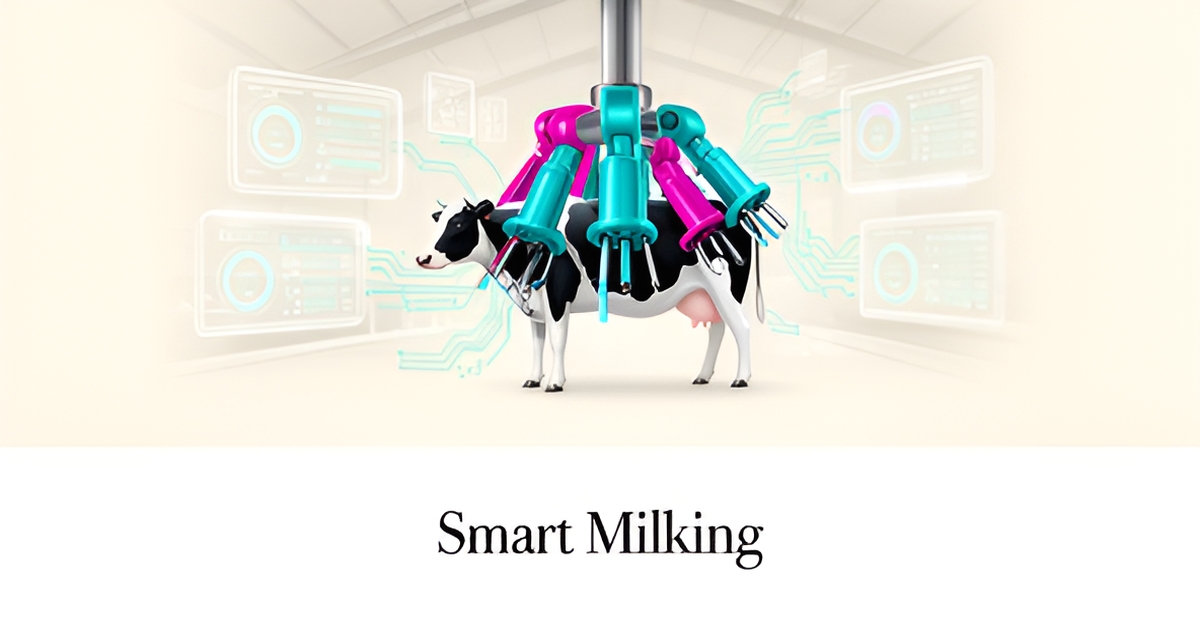
At the core of this transformation are smart milking systems that use AI-powered sensors to identify individual cows, monitor milk quality in real time, and measure yield for each session. According to research on dairy automation, these integrated systems improve hygiene, reduce labor dependency, and enhance consistency across the operation. Wearable devices track vital indicators around the clock, detecting early signs of illness, stress, or reproductive cycles before visible symptoms appear. This proactive approach reduces veterinary costs and prevents production losses by catching health issues in their earliest stages.
Machine learning models analyze the constant stream of biological data to flag anomalies that human observation might miss. These systems monitor subtle changes in behavior and physiology, allowing farmers to intervene days before a condition becomes critical. The financial impact compounds across the herd through optimized health management and production efficiency.
The operational workflow typically follows this sequence:
- Computer vision identifies the specific cow as she enters the parlor
- Sensors analyze milk conductivity and composition in real time
- Algorithms compare current yield against historical baselines
- Predictive models flag potential mastitis or metabolic issues
- Automated systems adjust milking parameters for individual udder health
Real-time quality monitoring extends beyond simple volume measurement. AI systems evaluate fat content, protein levels, and somatic cell counts during the milking process itself, ensuring that only milk meeting strict quality standards enters the bulk tank. This immediate feedback loop allows for instant segregation of abnormal milk, protecting the entire batch from contamination and ensuring compliance with food safety regulations.
A compelling example of this precision automation comes from the UK, where Fisher Smith developed a robotic system for pre-milking udder hygiene. Using 3D vision and deep learning, the system identifies the udder region on a rotating carousel, performs cleaning, and applies the milking apparatus in a fully automated workflow. As detailed in a case study on the installation, the technology met legal hygiene requirements while eliminating the variability inherent in manual cleaning methods. The deep learning model proved transferable across different farms, requiring minimal retraining to adapt to new environments.
Implementing these capabilities requires more than purchasing hardware; it demands custom integration with existing milking equipment and data infrastructures. This is where a build partner matters. AIQ Labs' AI Workflow Builds rebuild the one workflow that costs your operation the most—whether that's milk quality monitoring, herd records, or feed management—at a fixed price and in phases, so sensors, robotics, and analytics platforms communicate seamlessly without vendor lock-in. For farms that want everything connected over time, an AI Operating System layers those workflows into one system the farm owns outright.
The Financial Case: What AI Automation Is Actually Worth Per Cow
The financial argument for AI in dairy farming is no longer speculative — it is measurable, repeatable, and increasingly difficult for operations to ignore. Farms that adopt AI-driven systems are seeing returns that reshape their per-cow economics, often within a single year.
Industry analyses of AI dairy platforms report that farms using AI can generate several hundred dollars more per cow annually through optimized health management and production efficiency. For a 200-cow operation, even a conservative per-cow gain compounds into tens of thousands of dollars in new annual value — before accounting for labor savings or reduced veterinary costs. Exact returns depend heavily on herd size, current management practices, and which workflows you automate first, so run the numbers against your own operation rather than relying on industry averages.
The savings extend well beyond milk output. AI adoption attacks cost centers across the entire operation:
- Feed costs can drop significantly when AI-driven feed control systems monitor rations in real time and eliminate overfeeding and variability
- Digital herd management platforms like DairyComp typically cut daily data recording time by half or more compared to manual card systems
- Predictive health monitoring reduces veterinary costs by catching illness, stress, and reproductive cycles before they become production losses
- Automated milking systems reduce labor dependency while improving hygiene consistency and per-session yield tracking
Labor efficiency alone justifies serious consideration. As comparative analysis of AI versus manual agricultural processes shows, AI systems monitor operations continuously and automate routine decisions — directly addressing the labor shortages and coverage limits that constrain manual approaches.
Market momentum reinforces the case. The International Dairy Foods Association's State of AI report confirms that industry professionals are actively seeking real-world AI implementations, with ROI assessment as a primary focus. As of late 2026, adoption is accelerating from early exploration into execution, and the operations moving first are the ones capturing the compounding gains.
For farms weighing the investment, the math is straightforward: per-cow gains from better health management, combined with feed savings and large reductions in record-keeping time, can recover implementation costs within the first year for many operations. AIQ Labs structures engagements to match this reality — you can start monthly, build in milestones, or own it outright. No fake prices, no invented case-study numbers: the goal is a system the farm owns, delivering compounding returns without ongoing vendor dependency.
Implementing AI on Your Farm: Integration Without Disruption
The gap between recognizing AI's potential and actually deploying it on a working dairy farm often comes down to one question: where do you start without disrupting daily milking? Industry reporting as of late 2026 confirms the sector is moving past early exploration, with leaders prioritizing governance and return on investment assessment over flashy pilots.
- Target a single high-pain workflow first — milking quality monitoring or herd records
- Choose systems that integrate with existing parlors, sensors, and management software
- Prioritize models proven transferable across farms with minimal retraining
- Insist on full data and code ownership to avoid vendor lock-in
A UK case study on robotic udder cleaning demonstrates this principle in action. Engineers deployed a deep learning model using 3D time-of-flight cameras on a rotary carousel, and the system proved transferable and adaptable — deployable at other farms with minimal retraining. The same integration-first mindset applies whether you're automating pre-milking sanitation or real-time somatic cell count analysis.
The returns come from stacking focused wins: a large reduction in daily recording time here, a feed cost drop there, earlier illness detection everywhere. The pattern is clear — start narrow, integrate deep, scale fast.
AIQ Labs applies this exact approach. Start with the two-minute Fit Check, then map your highest-ROI starting point in a free 30-minute strategy call. From there we build custom AI systems that plug into your current equipment — not replace it. You own the code, the models, and the data outright. Three payment models let you start monthly, build in milestones, or own it outright. No vendor lock-in. No subscription chaos. Just production-ready automation that compounds value from day one.
From Dawn Milking to Data-Driven Dairy
The hidden costs of manual milking—labor strain, inconsistent hygiene, delayed disease detection, and milk waste—add up fast, eroding profitability and limiting growth. AI-powered sensors and machine learning transform the parlor into a real-time health and quality hub, catching issues before they escalate and ensuring only premium milk reaches the tank. Farms adopting these systems are already seeing meaningful per-cow gains through optimized yields, feed savings, and reduced veterinary costs. The technology isn't futuristic; it's proven, transferable, and designed to integrate with your existing setup—no rip-and-replace required. If you're ready to stop leaving money in the tank and start building a smarter, more resilient operation, the first step is a clear-eyed look at where AI can deliver the fastest impact. AIQ Labs helps dairy farms map that starting point with a free strategy call, focusing on your highest-pain workflow and a path forward that fits your reality. See how AI drives measurable gains in dairy management and discover what's possible for your herd.
Make AI your competitive advantage — not just another tool.
Strategy, implementation and ongoing optimization. One partner, end to end.
Not sure where to start? Ask our AI planner