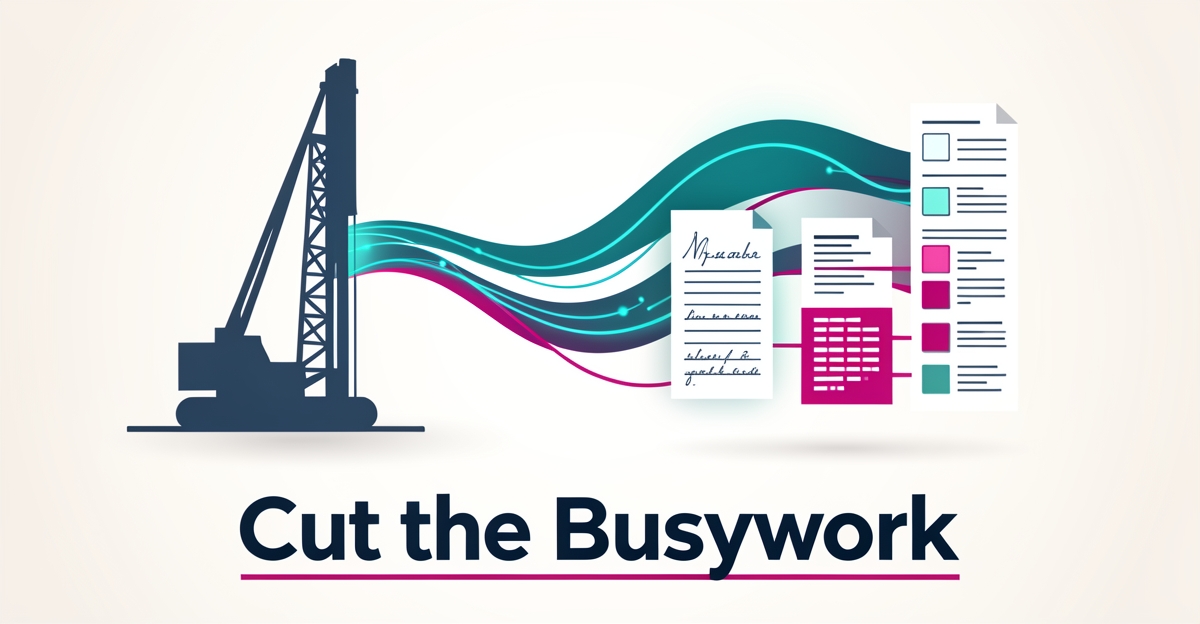
How Drilling Contractors Can Reduce Administrative Burden with AI-Powered Data Entry
Key Facts
- Field supervisors routinely spend hours each week transcribing handwritten notes instead of overseeing operations
- Manual transcription errors cascade into reports, billing, and compliance documentation
- OCR, Intelligent Document Processing, and NLP can turn photographed field notes into database records in seconds
- Phased rollouts, pilot one workflow, validate with human review, then expand, avoid operational disruption
- Custom systems trained on drilling-specific formats outperform generic tools on mud logs, surveys, and daily drilling reports
Hire a team member that works 24/7 — for less than a part-time wage.
AI receptionists, SDRs, dispatchers and 99+ roles. Trained on your business, fully managed.
Not sure where to start? Ask our AI planner
The Hidden Cost of Manual Data Entry in Drilling Operations
Every drilling contractor knows the drill: skilled field supervisors spending hours transcribing handwritten notes into spreadsheets, project managers drowning in email threads, and administrative staff manually entering the same data into multiple systems. What many don't realize is that this administrative burden isn't just an inconvenience, it's a measurable drain on operational efficiency and profitability.
The pattern shows up across knowledge work: documentation, scheduling, and data management pull skilled workers away from their core responsibilities. The parallel to drilling operations is direct, field engineers and site supervisors lose significant time transferring information from field notes, emails, and site logs into corporate databases, time that adds no value to the operation itself.
The financial impact compounds quickly. Manual data entry introduces errors that cascade through operations, incorrect drilling parameters logged, safety incidents miscategorized, equipment hours miscalculated. Each error requires correction time, creates potential compliance risks, and delays critical decision-making. In manual environments, reporting cycles that should take days often stretch into weeks, delaying invoicing and clouding cash-flow visibility.
The oil and gas sector is recognizing this challenge. As of late 2026, industry analyses consistently project substantial AI investment and impact across the energy sector, and much of that value comes from eliminating exactly the kind of repetitive data handling that consumes drilling contractors' administrative capacity.
Consider what manual data entry actually costs your operation:
- Time drain: Field supervisors spend hours weekly transcribing notes instead of overseeing operations
- Error propagation: Manual transcription introduces mistakes that flow into reports, billing, and compliance documentation
- Delayed insights: Critical drilling data sits in notebooks and emails instead of informing real-time decisions
- Duplicate work: The same information gets entered multiple times across disconnected systems
- Staff frustration: Skilled professionals waste expertise on repetitive typing instead of problem-solving
For drilling contractors, the question isn't whether administrative burden exists, it's how much longer operations can afford to carry it. AIQ Labs works with field services companies to deploy AI systems that automatically extract data from field notes, emails, and site logs, training these systems on drilling-specific formats and terminology. The technology exists today to eliminate this hidden tax on operational efficiency.
How AI Transforms Data Entry: From Field Notes to Database in Seconds
Imagine a roughneck finishing a shift and snapping a photo of handwritten field notes. By the time they reach the trailer, that data is already sitting in the company database, no typing, no scanning, no delays. This is the reality of modern AI-powered data entry, and it's transforming how drilling contractors handle administrative work.
The technology driving this transformation combines three core AI capabilities. Intelligent Document Processing (IDP) automatically extracts and organizes data from files, photos, and scanned documents. Optical Character Recognition (OCR) reads text from images, whether it's a photographed drilling report or a scanned site log. Natural Language Processing (NLP) interprets unstructured text from emails and notes, understanding context and extracting relevant information.
In practice, these systems follow a simple pattern: capture the document, extract the data, validate the information, and update records automatically. A photographed daily report becomes structured database entries. An emailed drilling summary gets classified, parsed, and filed without anyone opening a spreadsheet. Companies running these workflows typically report saving hours of tedious work each week, often within the first month of deployment.
For drilling contractors, this technology addresses specific pain points:
- Field notes photographed on-site are instantly transcribed and entered into databases
- Email attachments containing drilling reports are automatically processed and filed
- Site logs are digitized without manual data entry
- Information flows seamlessly between field operations and office systems
The error reduction is equally significant. Manual data entry is inherently prone to mistakes, but AI-powered systems apply the same extraction rules every time, flagging anomalies for human review instead of silently passing errors downstream. The result is improved data quality, less rework, and better operational decisions.
AIQ Labs builds custom systems trained on drilling-specific data formats, understanding the unique terminology, report structures, and workflow requirements of the industry. Rather than forcing contractors to adapt to generic software, these tailored solutions integrate into existing processes without requiring new logins or parallel workflows.
The technology exists today and typically delivers measurable results within weeks, not months. Drilling contractors no longer need to choose between accurate data and operational efficiency, AI delivers both simultaneously.
Proven Results: What AI Automation Delivers for Operations Teams
The impact of AI workflow automation extends beyond theoretical efficiency gains. Organizations that deploy these systems for document-heavy processes consistently report faster processing, fewer errors, and lower administrative costs, providing a clear picture of what drilling contractors can expect from similar investments.
Document extraction and reporting are the first places results show up. When AI handles intake, classification, and data capture, report preparation that once took days of assembly typically compresses to hours. Invoice and expense processing follows the same pattern: automated capture and routing dramatically reduces handling time compared to manual keying and approval chains.
Financial operations see particularly meaningful improvements. Reporting and close cycles that stretch across weeks in manual environments can typically be compressed to a fraction of the time through intelligent workflow automation. For drilling contractors managing complex project accounting and field data reconciliation, this acceleration means faster invoicing and improved cash flow visibility.
The operational benefits extend to error reduction and resource optimization:
- Dramatically fewer transcription errors through consistent, automated data extraction with human review on exceptions
- Typically 20+ hours per week reclaimed from manual data entry tasks
- Substantially faster invoice processing with automated capture and routing
- Administrative staff shifted from typing to analysis and exception handling
These gains translate directly to drilling operations where field data flows into back-office systems. When AI handles the extraction of information from daily reports, equipment logs, and safety documentation, administrative teams stop being transcriptionists and start being analysts. The technology works continuously without fatigue, ensuring that critical operational data reaches decision-makers without the delays inherent in manual transcription.
AIQ Labs has deployed 200+ multi-agent systems and runs four live SaaS products daily, so these patterns are proven in production, not slideware. Systems integrate directly with existing drilling management platforms, trained specifically on industry documentation formats to ensure accuracy from day one. Rather than forcing teams to adapt to generic software, these solutions adapt to established workflows, typically delivering measurable ROI within weeks rather than months. The question for operations leaders is no longer whether AI automation delivers value, but how quickly they can capture these efficiencies within their own administrative workflows.
Implementation Roadmap: Getting Started Without Disrupting Operations
Manual data entry is quietly draining drilling crews. Field notes, emails and site logs pile up in back offices where hours turn into errors and delays. A phased rollout keeps operations running while automation takes over the repetitive work.
Start by mapping the highest-impact targets. Field note transcription, email processing and site log entry are the repetitive tasks that consume significant time and resources with high potential for error. Identifying these first creates quick wins and builds team confidence before broader expansion.
Choose tools that match the data type. OCR technology automatically extracts and organizes data from files, photos or scanned documents, ideal for field notes and reports from drilling sites. NLP handles email and text analysis for unstructured site communications. Scalability and integration capabilities matter more than feature lists.
Design for invisible integration. Solutions that fit naturally into current processes prevent staff from learning new systems or juggling multiple logins. A common failure mode in AI implementations is adding work instead of removing it, the automation should happen behind the scenes.
A practical first phase looks like this:
- Pilot on one workflow, such as daily site log entry, with OCR extraction into the existing database
- Connect email intake to a classification and data capture agent that updates records without manual copy-paste
- Validate accuracy with human-in-the-loop review before full auto-posting
- Expand to additional crews only after error rates and time savings are measured
Integration is the make-or-break point. Create connections between databases and applications so information updates across platforms without manual re-entry. Connect drilling data systems, email platforms and reporting tools for seamless data flow. This is exactly the kind of single-workflow rebuild AIQ Labs handles as a fixed-price, phased Workflow Build, start with the one process that costs the most, prove the numbers, then expand.
Training and monitoring sustain adoption. Provide training focused on data analysis, critical thinking and problem-solving so crews can leverage AI and contribute to continuous improvement. Regularly monitor productivity, cost savings, customer satisfaction and data accuracy to identify adjustments.
The oil and gas sector is already moving. AI investment across the energy industry continues to grow as of late 2026, and early adopters are reporting meaningful improvements in staff wellbeing and operational efficiency. Waiting doesn't preserve the status quo, it widens the gap with competitors who are already automating.
AIQ Labs deploys custom AI systems trained on drilling-specific data formats, building solutions that businesses own and control. With seamless integration that doesn't require new logins, teams keep their normal workflows while administrative burden drops.
Building vs. Buying: Custom AI Solutions for Drilling-Specific Data
Drilling contractors face unique data challenges when trying to automate administrative tasks, as generic AI tools often struggle with industry-specific terminology, handwritten field note formats, and specialized reporting requirements. Off-the-shelf solutions may capture basic text but fail to interpret critical drilling data like mud logs, directional surveys, or daily drilling reports with the precision needed for operational decision-making. This limitation leads to extraction errors, manual corrections, and workflows that still require significant human oversight.
Custom-built AI systems trained on a contractor's own historical data formats deliver substantially higher accuracy by learning the nuances of drilling operations, including technical jargon, abbreviations, and context-specific data relationships. For example, AI models can be trained to distinguish between similar-sounding terms like "kick" and "kill" in well control scenarios or correctly parse varying date formats used across international drilling sites. These tailored systems eliminate the need for constant retraining and reduce reliance on vendor-specific platforms that may not evolve with changing operational needs.
AIQ Labs builds custom AI data entry solutions that clients own outright, ensuring the system understands drilling-specific workflows while avoiding long-term vendor lock-in. Depending on your situation, that might mean managed AI Employees handling intake and data processing around the clock, a fixed-price Workflow Build for your costliest process, or a phased AI Operating System that connects field data, back office, and reporting into one layer you own. Payment models are straightforward: Start Monthly, Build in Milestones, or Own It Outright. By developing purpose-built tools that integrate directly with existing field reporting software, accounting systems, and compliance databases, contractors gain a scalable asset that improves over time with continued use. This approach transforms data entry from a bottleneck into a streamlined process where field teams spend less time on paperwork and more time on critical drilling activities. Start with a free 30-minute strategy call to explore how a custom AI system can be built for your drilling data workflows.
Still paying for 10+ subscriptions that don’t talk to each other?
We build custom AI systems you own outright. No vendor lock-in. Full control.
Not sure where to start? Ask our AI planner
Frequently Asked Questions
How much time are my field crews actually losing to manual data entry?
Can AI really read messy handwritten field notes and emails from site?
Will adding AI mean my team has to learn new logins and workflows?
What kind of time savings do drilling contractors see with AI data entry?
Is off-the-shelf AI good enough for drilling-specific reports and terminology?
How do we start without disrupting operations?
From Field Notes to Competitive Edge
The administrative burden drilling contractors carry today is measurable in lost hours, repeated data entry, and errors that cascade into billing and compliance. AI-powered data entry changes that equation by automatically extracting information from field notes, emails, and site logs with OCR and NLP, reducing manual transcription to seconds and freeing supervisors to focus on operations instead of paperwork. The results across industries show faster reporting cycles, fewer errors, and teams shifted from typing to analysis. For drilling-specific workflows, the advantage comes from systems trained on your formats and terminology rather than forcing your crews to adapt to generic software. Start by mapping one high-impact workflow, such as daily site log entry, and pilot automation with human-in-the-loop validation before expanding. If you want a clear view of where AI can remove the most friction in your operation, start the 2-minute Fit Check at https://aiqlabs.ai/apply for a free 30-minute strategy call with AIQ Labs to map your biggest bottleneck and identify high-ROI automation opportunities. Every month the paperwork keeps piling up is a month your competitors may be automating it away.
Make AI your competitive advantage — not just another tool.
Strategy, implementation and ongoing optimization. One partner, end to end.
Not sure where to start? Ask our AI planner