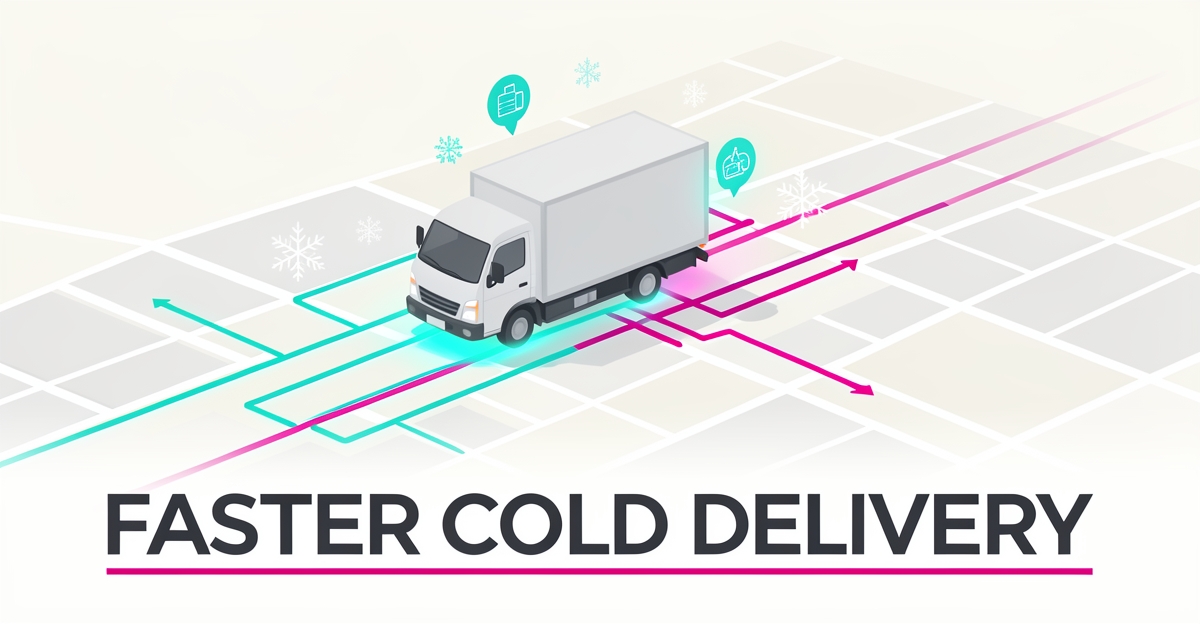
How Frozen Food Brands Can Improve Delivery Times with AI-Driven Route Optimization
Key Facts
- Static routing has been associated with slower fulfillment and excess fuel consumption compared to optimized alternatives, according to industry research
- AI-driven route optimization has been reported to achieve up to 28% faster order fulfillment by avoiding traffic jams and weather delays
- Integrating AI for routing and packing workflows has been linked to significant labor cost reductions in frozen food operations, industry data suggests
- AI-powered route optimization can cut fuel bills by up to 20%, according to fleet research
- Predictive AI can reduce frozen food spoilage through better temperature control and faster transit, industry data shows
- AI routing has been credited with meaningful efficiency gains in frozen food logistics by minimizing idle time
- As of late 2026, AI adoption in frozen food logistics optimization continues to accelerate across the industry
Hire a team member that works 24/7 — for less than a part-time wage.
AI receptionists, SDRs, dispatchers and 99+ roles. Trained on your business, fully managed.
Not sure where to start? Ask our AI planner
The Cold Chain Delivery Crisis: Why Static Routes Fail Frozen Food
The cold chain delivery crisis is putting frozen food brands under sustained pressure. Narrow delivery windows, temperature-sensitive cargo, and rising fuel costs create a perfect storm where static routing falls short. Frozen products demand precision, any delay risks thawing, spoilage, and costly waste, turning logistics into a high-stakes operation where every minute counts.
Static routes fail because they ignore real-world variables that directly impact delivery performance. Traffic congestion, sudden weather shifts, and fluctuating inventory levels disrupt pre-planned paths, forcing drivers into detours or idle time. This inflexibility leads to measurable inefficiencies: industry research has associated static routing with slower fulfillment and excess fuel consumption compared to optimized alternatives. These aren't just operational hiccups, they translate directly to higher costs, missed SLAs, and eroded customer trust.
The consequences ripple across the business. Delayed deliveries increase the likelihood of temperature excursions, triggering spoilage and customer complaints. Extra miles driven burn unnecessary fuel, inflating expenses at a time when margins are already tight. Meanwhile, rigid schedules leave no room for adaptation when a storm hits or a warehouse runs low on stock, scenarios that are becoming more frequent in today's volatile supply chain environment.
AIQ Labs addresses this challenge through AI-powered route optimization that dynamically adjusts to changing conditions. By integrating real-time traffic, weather, and inventory data, our systems ensure frozen food deliveries stay on schedule and within safe temperature thresholds. This approach doesn't just improve efficiency, it builds resilience into the cold chain, helping brands protect product integrity while reducing waste and fuel use.
How AI-Driven Dynamic Routing Solves the Cold Chain Puzzle
Frozen food logistics faces a constant battle against time and temperature. Every minute delay risks product quality, and traditional static routing simply can't keep up with real-world chaos on the roads. AI-powered dynamic routing changes this by continuously recalculating the optimal path as conditions shift, turning reactive delivery into a proactive, precision operation.
This adaptability delivers measurable results. Industry statistics have reported up to 28% faster order fulfillment with AI-driven routing by avoiding traffic jams and weather delays before they impact schedules. Simultaneously, integrating real-time inventory data ensures vehicles are loaded efficiently and dispatched only when needed, reducing idle time and labor waste. Combined efficiencies like these are part of why industry data links AI routing and packing workflows to substantial labor cost reductions in frozen food operations.
Beyond speed and labor, dynamic routing directly tackles cold chain integrity. By adjusting for sudden storms, road closures, or unexpected demand spikes, AI maintains consistent transit times critical for frozen goods. Research suggests this approach yields a meaningful efficiency gain in frozen food logistics, as vehicles spend less time idling and more time moving product at optimal temperatures. The system also factors in vehicle load and fuel efficiency, further cutting operational costs while protecting product quality.
For frozen food brands, this means fewer rejected deliveries, lower spoilage rates, and happier customers who receive their orders intact and on time. AIQ Labs builds these intelligent routing systems as focused AI Workflow Builds, rebuilding the one workflow that costs you the most, at a fixed price, in phases. The result is a supply chain that doesn't just respond to disruption, it anticipates and neutralizes it before the first truck leaves the depot.
Inside the Tech: What Makes AI Routing Work for Frozen Logistics
Frozen food delivery lives or dies on minutes and temperature. AI routing closes the gap between dispatch plan and real-world conditions without adding headcount.
Production-grade systems start with real-time data ingestion. Traffic feeds, weather alerts, road incidents and live vehicle telemetry stream into the model so routes adapt before delays compound. Inventory levels and dock windows are ingested alongside carrier capacity, which lets the optimizer protect frozen integrity while keeping trucks full.
Multi-agent orchestration is what separates point tools from end-to-end control. Specialized agents handle forecasting, constraint solving, driver compliance and exception handling, then negotiate plans through a shared state graph. This architecture mirrors how AIQ Labs builds custom AI workflow and integration systems that unify CRM, accounting, project management and operations into a single source of truth.
MCP-style integrations connect the routing brain to dispatch and inventory systems. Instead of exporting CSVs, the AI reads live stock, order priorities and cold-chain requirements, then writes back optimized stops, ETAs and load plans. The result is dynamic routing that industry statistics have linked to faster order fulfillment and reduced delivery times.
For frozen logistics, the components that matter most are:
- Real-time ingestion of traffic, weather and road incidents to trigger immediate re-routing
- Multi-agent orchestration with graph-based workflows for reasoning, planning and execution
- Live integrations with dispatch, inventory and telematics for closed-loop control
- Validation layers and human-in-the-loop escalation for compliance and safety
Fuel and labor gains are measurable. AI-powered route optimization can cut fuel bills by up to 20%, as reported in fleet optimization research, and AI-assisted packing and routing workflows have been tied to labor cost reductions across the sector. Adoption keeps accelerating: as of late 2026, a large share of frozen food logistics optimization runs on AI, according to industry statistics.
AIQ Labs applies this stack through its AI Operating Systems work, building one connected operating layer for your logistics operation, delivered in phases and owned outright rather than rented as a subscription widget. The approach is production-ready from day one, with monitoring, failsafes and continuous optimization built in.
Implementation Roadmap: From Manual Dispatch to AI-Powered Fleet in 90 Days
Ninety days sounds ambitious for a fleet-wide AI rollout, but the frozen food brands that succeed don't treat it as one big-bang launch. They follow a phased path that proves value early, protects cold chain integrity at every step, and scales only what the data supports. The payoff justifies the discipline: dynamic routing research suggests AI-driven routing can cut delivery times by up to 28% while reducing fuel consumption meaningfully.
Days 1–15: Discovery and Data Audit
Start by mapping how dispatch actually works today, who plans routes, what data feeds those decisions, and where the bottlenecks live. Industry surveys have found that a majority of frozen food companies had not yet adopted AI for inventory management, which means most fleets still run on spreadsheets and dispatcher intuition. The audit should catalog route history, delivery windows, vehicle capacity, and cold chain telemetry quality, because AI optimization is only as good as the data underneath it.
Days 16–40: Integration with Existing Systems
Next comes connecting the AI layer to what you already run, your TMS, order management, and temperature monitoring tools. This is where deep two-way integration matters: the routing engine needs live inventory levels, reefer temperature feeds, and delivery constraints to make decisions that hold up in the real world. Cold chain AI deployments depend on this connectivity to balance route efficiency against product integrity, not one at the expense of the other.
Days 41–70: Pilot on High-Volume Routes
Deploy on your busiest corridors first, where the ROI math is easiest to validate. Run the AI's recommended routes alongside dispatcher-planned routes and compare on-time rates, fuel burn, and temperature excursions. A fleet study by HERE found AI route optimization can cut fuel bills by up to 20%, and a pilot gives you your own numbers instead of industry averages. Real-time adjustments for traffic, weather, and road incidents are tested here too.
Days 71–90: Scale with Governance
Once the pilot clears its benchmarks, expand to the full fleet with guardrails in place: human-in-the-loop overrides for edge cases, audit trails for compliance reviews, and clear escalation rules when the AI exceeds its authority.
A few priorities to lock in during scaling:
- Define which decisions dispatchers can override and which require review
- Set weekly performance reviews against baseline fuel and delivery-time metrics
- Establish data quality checks so route recommendations stay accurate as conditions change
- Train drivers and dispatchers on the new workflow before full cutover
The engagement model should match the risk profile. Some brands prefer a Build in Milestones approach, where the routing system ships in phases and each phase is approved and paid for as it delivers, stop anytime and keep everything built. Others choose Start Monthly, paying a flat monthly plan that covers the build, integrations, monitoring, and continuous improvements, with the ability to pause or adjust anytime. Larger operators often move toward Own It Outright, where the finished system is yours, no per-seat fees, no vendor lock-in. At AIQ Labs, all three models follow the same phased discipline: discovery first, integration second, pilot third, scale only with governance. If there isn't a clear win in the data, a good partner will say so before you spend a dollar on the build.
Measuring What Matters: KPIs That Prove ROI in Frozen Food Delivery
In frozen food logistics, success isn't just about moving product, it's about preserving quality while cutting waste and cost. The right metrics turn delivery data into actionable insights, revealing where AI-driven route optimization delivers real value. On-time delivery rate remains the gold standard for customer satisfaction, with industry research reporting that AI-powered routing can improve delivery times by up to 28%, directly boosting reliability. Fuel cost per case offers a clear window into operational efficiency, as AI optimization can cut fuel consumption by up to 20% by minimizing idle time and inefficient miles. Spoilage incidents, critical in cold chain logistics, tend to drop when routes adapt to real-time conditions, with predictive AI credited with reducing frozen food spoilage through better temperature control and faster transit.
- On-time delivery rate: Tracks percentage of deliveries arriving within the promised window, directly impacting customer retention and brand trust.
- Fuel cost per case: Measures fuel expenditure relative to product volume, highlighting efficiency gains from optimized routing.
- Spoilage incidents: Counts compromised units due to temperature excursions or delays, a key indicator of cold chain integrity.
- Driver hours logged: Monitors labor utilization to prevent overtime costs and ensure compliance with transportation regulations.
AIQ Labs' custom dashboards consolidate these KPIs in real time, pulling data from telematics, inventory systems, and weather feeds to create a live operational pulse. This visibility enables continuous refinement, adjusting routes mid-day for traffic spikes or rerouting around storm fronts, while providing stakeholders with clear, auditable proof of ROI. When every minute and degree matters, measuring what moves the needle turns optimization from a tactic into a measurable advantage.
Still paying for 10+ subscriptions that don’t talk to each other?
We build custom AI systems you own outright. No vendor lock-in. Full control.
Not sure where to start? Ask our AI planner
Frequently Asked Questions
How much faster can AI-powered route optimization make frozen food deliveries compared to static routing?
Can AI really reduce fuel costs for frozen food delivery fleets, and by how much?
What kind of data does AI routing use to adjust delivery routes in real time for frozen food?
Is it true that AI can reduce labor costs in frozen food logistics, and what's the basis for that claim?
How does AI help prevent spoilage in frozen food deliveries?
What's a realistic timeline for implementing AI route optimization in a frozen food delivery fleet?
From Frozen Risk to Competitive Edge
The cold chain doesn't forgive static plans. Traffic, weather, and inventory swings turn pre-set routes into spoilage, fuel waste, and missed SLAs, costs frozen brands can't absorb anymore. AI-driven dynamic routing closes that gap by continuously recalculating paths with real-time traffic, weather, and dock data, protecting temperature integrity while cutting delivery times, fuel use, and labor strain. The shift is measurable, with industry data reporting up to 28% faster order fulfillment and up to 20% lower fuel bills when routes adapt instead of react. For brands ready to move, start with a focused data audit of your busiest corridors, integrate live telematics and inventory feeds, and pilot AI routing alongside dispatchers to validate on-time rates and spoilage reduction before scaling with governance. AIQ Labs builds these owned, production-ready routing systems, as a focused AI Workflow Build or as part of a broader AI Operating System, embedding real-time adaptability directly into logistics. Start the 2-minute Fit Check at https://aiqlabs.ai/apply for a free 30-minute strategy call to map your biggest bottleneck and identify high-ROI automation opportunities, no pitch, just a working session with an engineer.
Make AI your competitive advantage — not just another tool.
Strategy, implementation and ongoing optimization. One partner, end to end.
Not sure where to start? Ask our AI planner