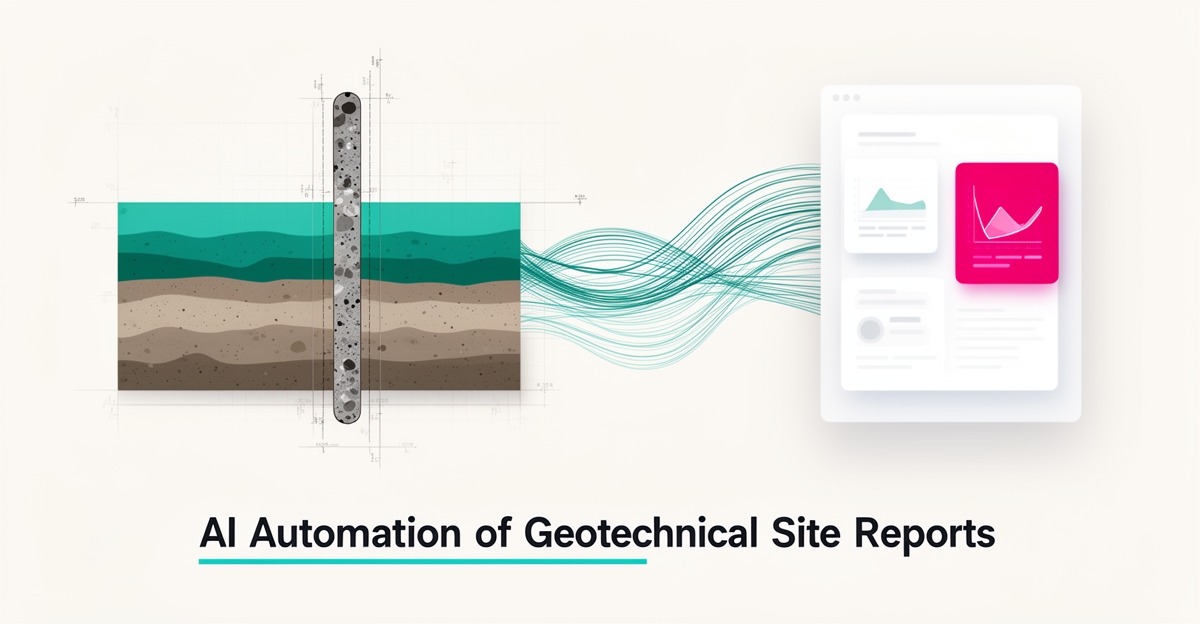
How Geotechnical Testing Companies Can Automate Site Report Generation with AI
Key Facts
- Geotechnical engineering is the branch of civil engineering concerned with the engineering behavior of earth materials, applying soil and rock mechanics to real-world design problems per Wikipedia's overview
- Geotechnical design determines subsurface characteristics through exploratory drilling at key points and site reconnaissance per the Georgia DOT Geotechnical Design Manual
- Subsurface investigation, foundation design, and soil mechanics are core geotechnical workflows that each generate distinct data artifacts per turn2engineering
- Geotechnical engineering focuses on how the ground beneath and around structures will perform under load, making data accuracy in reporting a safety-critical concern per ScienceInsights
- Free geotechnical glossaries, publications, and calculation references are widely available to standardize reporting terminology and formulas per the Geotechnical Information Website
Hire a team member that works 24/7 — for less than a part-time wage.
AI receptionists, SDRs, dispatchers and 99+ roles. Trained on your business, fully managed.
Not sure where to start? Ask our AI planner
The Manual Reporting Bottleneck in Geotechnical Testing
Field logs pile up, lab sheets arrive late, and a single site report still depends on someone retyping numbers from paper to a template. That handoff is where geotechnical teams lose time, consistency, and margin.
The standard geotechnical investigation process includes: "Desk Study" → "Field Investigation" → "Laboratory Testing" → "Data Interpretation & Reporting" according to industry guidance on geotechnical investigation. Each stage generates distinct artifacts that must be reconciled before a client-ready report can ship.
Field Investigation produces borehole logs with metrics that drive design decisions. Teams calculate TCR (Total Core Recovery) = (Core Length Recovered/Length Drilled) × 100, SCR (Solid Core Recovery) = (Solid Core Pieces/Length Drilled) × 100, and RQD (Rock Quality Designation) = (Core Pieces ≥10cm/Total Length) × 100 as defined in standard geotechnical calculation references. SPT N-Values for soil density assessment, UCS (Unconfined Compressive Strength) for rock strength classification, PLT (Point Load Test) with UCS ≈ 20-25 × Is50, and Weathering Assessment from Grade I (Fresh) → Grade VI (Residual Soil) are also logged in the same technical framework.
Laboratory Testing adds another layer of manual transcription. Results arrive as PDFs, scanned forms, or spreadsheets with different naming conventions. Engineers then interpret data and draft narratives, cross-checking field observations against lab values. The process is serial, not parallel, and delays compound when a single field sheet is misread or a lab value is entered incorrectly.
Manual reporting creates three persistent costs:
- Manual entry errors that propagate into interpretations and risk assessments
- Delayed turnaround as reports wait for the last data point to be typed and verified
- Inconsistent formatting and narrative quality across engineers and projects
These costs matter more in geotechnics than in most industries, because the discipline is fundamentally about how the ground beneath and around structures will perform under load per ScienceInsights' definition and scope overview. A transcription error in an RQD value or SPT N-value isn't just a formatting issue, it can ripple into foundation and stability decisions.
For geotechnical firms, the opportunity is to apply document automation principles to reporting. AI Document Processing & Management can automatically extract data from field logs, lab results, and inspection forms, reducing manual entry errors and turnaround time. AIQ Labs helps geotechnical firms build custom AI systems that process and summarize field data into professional reports, ensuring consistency and faster client delivery.
The manual reporting bottleneck is not a staffing problem. It is a workflow design problem where data capture, validation, and narrative generation remain disconnected.
How AI Extracts and Synthesizes Field and Lab Data
AI-powered data extraction transforms how geotechnical firms process field and lab information, turning raw borehole logs, test results, and inspection forms into structured, report-ready data with minimal manual effort. By automating the interpretation of key parameters like TCR, SCR, RQD, SPT N-Values, UCS, and PLT results, AI eliminates repetitive data entry and cuts update time from days to hours, enabling faster turnaround on site reports.
The technology excels at synthesizing disparate data sources into coherent technical narratives, ensuring consistency across reports while flagging anomalies for engineer review. AI systems can map the specific impact of each field measurement against established geotechnical benchmarks, identifying only the data points that provide maximum risk coverage for site stability assessment. This targeted approach reduces cognitive load on engineers, allowing them to focus on interpretation rather than data wrangling. For borehole logging specifically, AI automates calculations such as TCR = (Core Length Recovered/Length Drilled) × 100, SCR = (Solid Core Pieces/Length Drilled) × 100, and RQD = (Core Pieces ≥10cm/Total Length) × 100, ensuring standardized outputs that meet industry reporting requirements as documented in standard geotechnical calculation references.
Through real-time processing capabilities, AI enables geotechnical teams to generate preliminary insights during field operations, accelerating the path from data collection to client delivery. AIQ Labs helps firms implement these systems by building custom AI workflows that ingest field logs, lab results, and inspection forms, then synthesize them into professional reports with consistent formatting and technical accuracy. The result is a streamlined workflow where manual upkeep is substantially cut, and teams gain confidence in data integrity through automated validation layers that catch inconsistencies before reports are finalized. This approach not only shrinks reporting timelines but also enhances the reliability of geotechnical deliverables, supporting faster decision-making on infrastructure projects.
From Raw Data to Client-Ready Reports
Geotechnical firms spend weeks turning field logs, lab results, and inspection forms into client-ready reports, a bottleneck that delays decisions and introduces transcription errors. AI changes this by ingesting raw data from borehole logs, SPT N-values, and laboratory indices like TCR, SCR, RQD, UCS, and PLT, then generating structured narratives that follow the standard investigation sequence from desk study through data interpretation per geotechnical engineering guidance, cutting turnaround dramatically.
- Automated extraction of borehole parameters and lab indices into report templates
- Consistent formatting across projects regardless of field team
- Real-time flagging of anomalous values for senior review
- Version-controlled drafts that track every data source
The leap from static documents to living intelligence fits where geotechnics is heading. Because the discipline centers on predicting how earth materials will behave under load per Wikipedia's overview of geotechnical engineering, reporting systems that surface early warning signs of slope instability or settlement risk while the report is being drafted give clients actionable insight before they even open the PDF. AIQ Labs builds these custom pipelines so firms own the logic, the data, and the output, no vendor lock-in, just faster delivery with engineering-grade rigor.
Building a Custom AI Reporting System with AIQ Labs
For geotechnical firms, the path from raw borehole logs to a finished client report is where days disappear. The practical question isn't whether AI can help, it's how to implement it without betting the business on an unproven tool.
The answer lies in a phased approach. These systems succeed when firms assess existing processes, pilot specific workflows, and scale gradually rather than attempting a firm-wide overhaul on day one. Geotechnical design itself is already a staged process, determining subsurface characteristics through exploratory drilling and reconnaissance per the Georgia DOT Geotechnical Design Manual, and automation should follow the same disciplined sequence.
A custom-built system for report generation typically works in stages:
- Data extraction agents process field logs, laboratory results, and inspection forms, capturing structured values like TCR, RQD, SPT N-values, and UCS classifications directly from source documents.
- Interpretation agents organize the extracted data into the standard reporting sequence, desk study, field investigation, laboratory testing, and data interpretation.
- Report generation agents draft the narrative sections, tables, and summaries, producing a complete document engineers can review and sign off.
- Validation layers check every extracted value before it enters the report, with human-in-the-loop review for anything flagged as uncertain.
This is where the build partner matters more than the software label. Generic tools extract text; a purpose-built system understands that an RQD calculation depends on core pieces measuring at least 10cm, or that a point load test index translates to UCS at roughly 20-25 times the Is50 value per standard geotechnical calculation references. AIQ Labs builds these systems on production-proven multi-agent architecture, the same framework the company runs in its own live products daily, spanning document processing, content generation, and voice applications.
Ownership is the other differentiator. Unlike subscription platforms that hold your data and workflows hostage, custom development means the firm owns the code, the agents, and the processed data outright. For a geotechnical firm, that means your reporting logic, your templates, and your quality standards stay yours, and evolve as your practice does.
The engagement model can match your risk tolerance. A Build in Milestones approach splits the build into phases, for example, extraction first, then report drafting, then full integration, with approval and payment per phase, and everything built to that point stays yours even if you stop. Firms preferring a lower-commitment entry can use Start Monthly, where a single automated reporting workflow ships with training, integrations, monitoring, and improvements included in a flat monthly plan. For a complete reporting and operations system, Own It Outright delivers full ownership of the code, agents, and data under one project price or a monthly Build Partnership.
The result is a reporting pipeline that turns days of manual transcription into a review-and-approve workflow, built once, owned permanently, and scaled as your project volume grows.
Still paying for 10+ subscriptions that don’t talk to each other?
We build custom AI systems you own outright. No vendor lock-in. Full control.
Not sure where to start? Ask our AI planner
Frequently Asked Questions
How does AI actually extract data from geotechnical field logs and lab reports?
Will AI-generated reports maintain the technical accuracy our clients expect?
How much time can AI automation actually save on report generation?
What happens to our data and reports if we stop using the AI system?
Can AI flag potential site stability issues while generating reports?
Do we need to automate our entire reporting process at once, or can we start small?
Turn Reporting From Bottleneck Into Competitive Advantage
The manual reporting bottleneck in geotechnical testing isn't a staffing problem, it's a workflow design problem where data capture, validation, and narrative generation remain disconnected. Automating extraction of TCR, SCR, RQD, SPT N-Values, UCS and PLT results, then synthesizing those inputs into consistent, version-controlled reports, removes repetitive transcription, flags anomalies early, and lets engineers focus on interpretation instead of data wrangling. That shift matters because geotechnical engineering is fundamentally about predicting the behavior of earth materials per Wikipedia's overview, and accurate, timely data is the foundation of that prediction. For firms ready to act, start by mapping one high-impact workflow, pilot extraction and report drafting for a single project type, and measure turnaround and error rates before scaling. AIQ Labs helps geotechnical firms build custom AI systems that process and summarize field data into professional reports with ownership retained by the firm. Start the Fit Check at https://aiqlabs.ai/apply for a free 30-minute strategy call to map your biggest bottleneck and identify a high-ROI automation path, or chat live with an AI Transformation Agent at https://aiqlabs.ai/chat for instant answers.
Make AI your competitive advantage — not just another tool.
Strategy, implementation and ongoing optimization. One partner, end to end.
Not sure where to start? Ask our AI planner