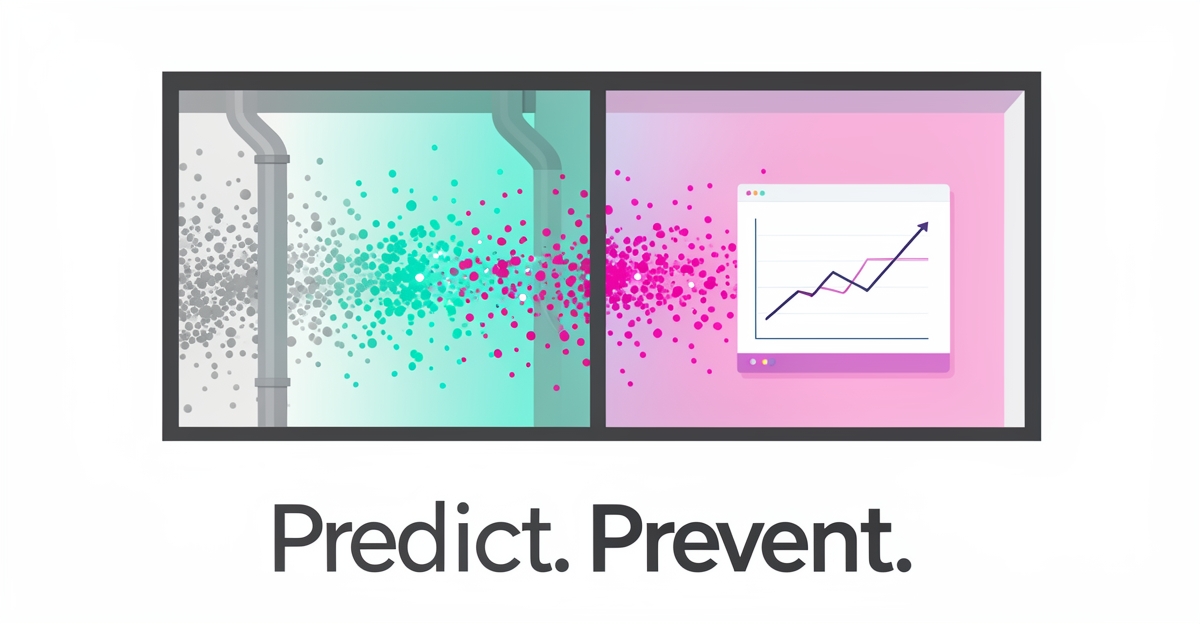
How IAQ Firms Can Use AI to Predict and Prevent Air Quality Deterioration
Key Facts
- Static threshold alerts only fire after conditions have already deteriorated, prediction requires learning from history
- Predictive models combine sensor readings, weather data, occupancy patterns, and building operations to flag precursor signals
- Models retrained regularly with fresh building data typically sustain prediction accuracy far better than static rules, which degrade as conditions change
- Multi-source data pipelines generally outperform single-source approaches for forecasting air quality events
- A lean pilot-to-scale roadmap lets IAQ firms validate predictive capability without a large upfront investment
Hire a team member that works 24/7 — for less than a part-time wage.
AI receptionists, SDRs, dispatchers and 99+ roles. Trained on your business, fully managed.
Not sure where to start? Ask our AI planner
The IAQ Prediction Gap IAQ Firms Face Today
Most IAQ firms still operate in a fundamentally reactive posture: sensors record conditions, thresholds trigger alerts, and technicians respond after occupants have already breathed compromised air. By the time a static alarm fires, the deterioration has already happened.
This gap between detection and prediction is where client relationships and reputations quietly erode. Consider the scenarios every IAQ professional knows well: post-construction off-gassing that spikes VOCs weeks after a project closes, seasonal humidity shifts that push mold risk past safe levels, or a sudden occupancy change that overwhelms a building's ventilation design. Rule-based alerts catch none of these in advance because they can only respond to conditions that already exist.
The core limitation is structural. Static thresholds cannot learn from history, they treat every building, season, and occupancy pattern as identical. Rule-based systems, while simple to implement, have a limited ability to adapt to changing conditions. A threshold set for a quiet office in April says nothing useful about that same space in August, or after a floor renovation.
Meanwhile, the broader business world has moved decisively toward prediction. As of late 2026, most organizations use AI in at least one business function, and investment in applied AI continues to climb across industries. Yet IAQ remains in the early stages of this shift, which means firms that build predictive capability now gain a genuine first-mover advantage.
What does the prediction gap actually cost an IAQ firm in practice?
- Client complaints arrive before your alerts do, damaging credibility
- Post-construction air quality events surface weeks too late for cheap intervention
- Seasonal deterioration repeats annually but is never anticipated
- Occupancy-driven ventilation failures are discovered through complaints, not data
Closing this gap requires a different kind of system, one trained on historical sensor data, weather patterns, and building-specific behavior to flag deterioration before it crosses a threshold. That's the work AIQ Labs does with firms in measurement-heavy industries: building custom forecasting models trained on real-world data from client buildings, so early warnings replace after-the-fact apologies. For firms that want to start smaller, a single high-cost workflow can be rebuilt first, see AI Workflow Builds.
The firms that thrive over the next five years won't be the ones with the most sensors. They'll be the ones whose systems saw the problem coming.
Predictive AI for IAQ: Patterns, Signals and Early Warning
Predictive AI transforms how IAQ firms anticipate air quality issues by analyzing historical patterns across sensor readings, weather data, and building operations. Instead of reacting to problems after they occur, these systems detect subtle shifts that precede deterioration, like rising CO₂ levels before occupancy spikes or humidity changes ahead of seasonal transitions, giving IAQ specialists critical lead time to intervene.
The power of predictive AI lies in its ability to uncover complex, non-linear relationships that rule-based systems miss. While fixed thresholds might trigger alarms only after particulate matter exceeds dangerous levels, machine learning models identify precursor signals, such as specific HVAC cycling patterns combined with outdoor pollen counts, that reliably predict indoor allergen surges hours in advance. The result is fewer false alarms and earlier detection of genuine risks, making interventions both more precise and less disruptive.
For IAQ firms, this means shifting from scheduled maintenance to condition-based actions guided by data-driven insights. Predictive models continuously learn from each building's unique environment, adapting to factors like renovation schedules, occupancy changes, or local construction projects that affect air quality. AIQ Labs develops custom forecasting tools trained on real-world client data, enabling specialists to deliver targeted recommendations, like adjusting ventilation before a conference or scheduling filter changes ahead of high-pollen days, before occupants notice any discomfort. This proactive approach not only protects health but also builds trust through demonstrable prevention rather than reactive fixes.
From Model to Client Action: Building a Predictive IAQ System
Creating an effective predictive IAQ system starts with selecting the right data sources, combining real-time sensor readings, historical occupancy patterns, weather data, and building operational logs to capture the full picture of indoor conditions. Systems that integrate multiple data streams typically achieve meaningfully higher forecasting accuracy than single-source approaches, because the model learns from contextual triggers like HVAC cycling, outdoor pollution spikes, or renovation activities that precede deterioration.
Next, IAQ firms should develop and train machine learning models using this multi-dimensional dataset, focusing on algorithms that detect subtle anomalies before they become visible to occupants or standard monitoring tools. Techniques like time-series forecasting and anomaly detection enable the system to predict pollutant surges, such as PM2.5 or VOC buildup, hours or even days in advance. Once validated, the model is deployed into the firm's operational workflow, triggering automated alerts to facility managers when risk thresholds are approached. Continuous refinement is critical: as new data flows in, the model retrains to adapt to seasonal shifts, equipment aging, or changes in building use, maintaining predictive reliability over time. Models updated regularly with fresh building data typically sustain high prediction accuracy, outperforming static rule-based systems that degrade quickly in dynamic environments. AIQ Labs supports this end-to-end process by building custom forecasting models trained on real-world client data, ensuring predictions reflect actual building behavior rather than generic assumptions.
Implementation Roadmap for IAQ Firms
Implementing AI for predictive IAQ starts with a focused, practical roadmap that addresses real-world constraints. Many firms begin by auditing their existing sensor data streams, temperature, humidity, CO₂, and particulate levels, to identify gaps in coverage or consistency that could undermine model accuracy. Even as AI adoption becomes widespread across industries, IAQ specialists often face unique hurdles due to the temporal and spatial complexity of indoor environmental data. Starting small with a pilot zone, such as a single client building or HVAC zone, allows teams to validate data pipelines and model performance before scaling.
The next phase involves selecting or developing a forecasting model suited to IAQ's specific patterns, like seasonal shifts or post-construction off-gassing events. AIQ Labs supports this through custom AI development, where models are trained on a client's own historical data to capture building-specific behaviors. Models grounded in real-world operational data, rather than generic templates, tend to detect anomalies far more reliably. Crucially, this step includes embedding data validation rules to flag sensor drift or missing readings early, directly addressing data quality concerns before they undermine trust in the system.
Finally, deployment must prioritize security, compliance, and usability from day one. Models are integrated into existing client dashboards or alerting systems via secure APIs, ensuring predictions trigger actionable warnings, like recommending increased ventilation before pollutant thresholds are breached, without overwhelming staff with false positives. Throughout this process, AIQ Labs helps firms establish governance frameworks for responsible AI use, including audit trails and human-in-the-loop checks for high-stakes decisions. By following this lean path, pilot, prove, scale, IAQ firms turn predictive insights into preventive action while building internal expertise and trust in the system. Firms ready to connect prediction to the rest of their operation can explore a connected AI Operating System, built in phases and owned outright.
Still paying for 10+ subscriptions that don’t talk to each other?
We build custom AI systems you own outright. No vendor lock-in. Full control.
Not sure where to start? Ask our AI planner
Frequently Asked Questions
How is AI prediction different from the sensor alerts my IAQ firm already uses?
How much more accurate is predictive AI compared to traditional monitoring methods?
What data do I need to build a predictive IAQ system?
Do AI prediction models stay accurate over time, or do they degrade like rule-based systems?
How should an IAQ firm get started with AI without a huge upfront investment?
Is AI adoption in air quality really worth it, or is it just hype?
From Reactive Alerts to Predictive Advantage
The gap between detection and prediction is where IAQ firms lose credibility, revenue, and the chance to prevent problems before occupants feel them. Static thresholds can't learn from history, while predictive AI can analyze sensor readings, weather, occupancy and building operations to flag deterioration hours or days early, reduce false alarms, and turn maintenance from scheduled to condition-based. Building that capability starts with clean multi-source data, building-specific models trained on real-world client buildings, and a lean pilot-to-scale roadmap that prioritizes security, compliance and usability. Firms that move now gain a first-mover advantage as the broader market accelerates toward prediction. If you're ready to shift from after-the-fact apologies to demonstrable prevention, start with a focused assessment of your data and use cases. Complete the 2-minute Fit Check at aiqlabs.ai/apply to book a free 30-minute strategy call with AIQ Labs and map your biggest bottleneck and highest-ROI predictive opportunities. The question is no longer whether to adopt prediction, but how fast you can make it yours.
Make AI your competitive advantage — not just another tool.
Strategy, implementation and ongoing optimization. One partner, end to end.
Not sure where to start? Ask our AI planner