How Oilfield Services Companies Can Reduce Response Times with AI-Powered Field Dispatchers
Key Facts
- Agentic AI has moved from pilot projects to production across energy and industrial sectors as of late 2026, with dispatch and coordination among the highest-ROI use cases
- Oilfield service companies relying on manual dispatch typically report response delays of 2-4 hours for non-emergency jobs
- Legacy dispatch workflows commonly drive higher operational costs per service call through idle time, redundant trips, and suboptimal crew allocation
- AI-powered dispatch systems calculate optimal crew assignments in seconds rather than hours by processing live telemetry and job priority rules
- AIQ Labs has deployed 200+ multi-agent systems and runs 4 live SaaS products daily
- AI Employees start at roughly 80% less than the cost of a human hire, with 99+ roles including dispatchers
Hire a team member that works 24/7 — for less than a part-time wage.
AI receptionists, SDRs, dispatchers and 99+ roles. Trained on your business, fully managed.
Not sure where to start? Ask our AI planner
The Hidden Cost of Manual Dispatch in Oilfield Operations
Manual dispatch workflows in oilfield operations remain a critical bottleneck, with teams still relying on spreadsheets and phone calls to coordinate crews and equipment. This legacy approach creates significant delays, as dispatchers manually sift through data, make judgment calls under pressure, and struggle to adapt to real-time changes in field conditions. Across energy and industrial sectors, enterprises are moving toward agentic AI workflows precisely because manual coordination directly contributes to slower response times and higher operational costs. The reliance on human-only coordination not only increases the risk of errors but also limits scalability during peak demand periods or emergency situations.
- Delayed job prioritization due to manual assessment of urgency and location
- Inconsistent crew assignments based on availability rather than skill or proximity
- Lack of real-time equipment tracking leading to inefficient resource deployment
- Communication breakdowns between field teams and dispatch centers
- Inability to dynamically re-route crews in response to changing wellsite conditions
These inefficiencies compound over time, turning routine service calls into prolonged operational disruptions. Oilfield service companies using manual dispatch typically report average response delays of 2-4 hours for non-emergency jobs, with critical incidents often experiencing even longer wait times due to information silos and reactive decision-making. Companies still dependent on legacy dispatch systems commonly carry meaningfully higher operational costs per service call compared to those using automated workflows, driven by idle time, redundant trips, and suboptimal resource allocation. The oilfield energy services industry has been turning to digital tools like AI to curb these rising costs and improve efficiency, and the gap between current practices and intelligent automation keeps widening. AIQ Labs rebuilds the one workflow that costs the most, for many oilfield service companies, that's dispatch, at a fixed price, in phases, so you see results before scaling.
How AI Dispatchers Automate and Optimize Field Operations
Manual dispatch workflows, built on phone calls, spreadsheets, and institutional knowledge, create bottlenecks that compound across every job site. When a rig goes down or a crew runs late, the ripple effect can idle millions in equipment and personnel.
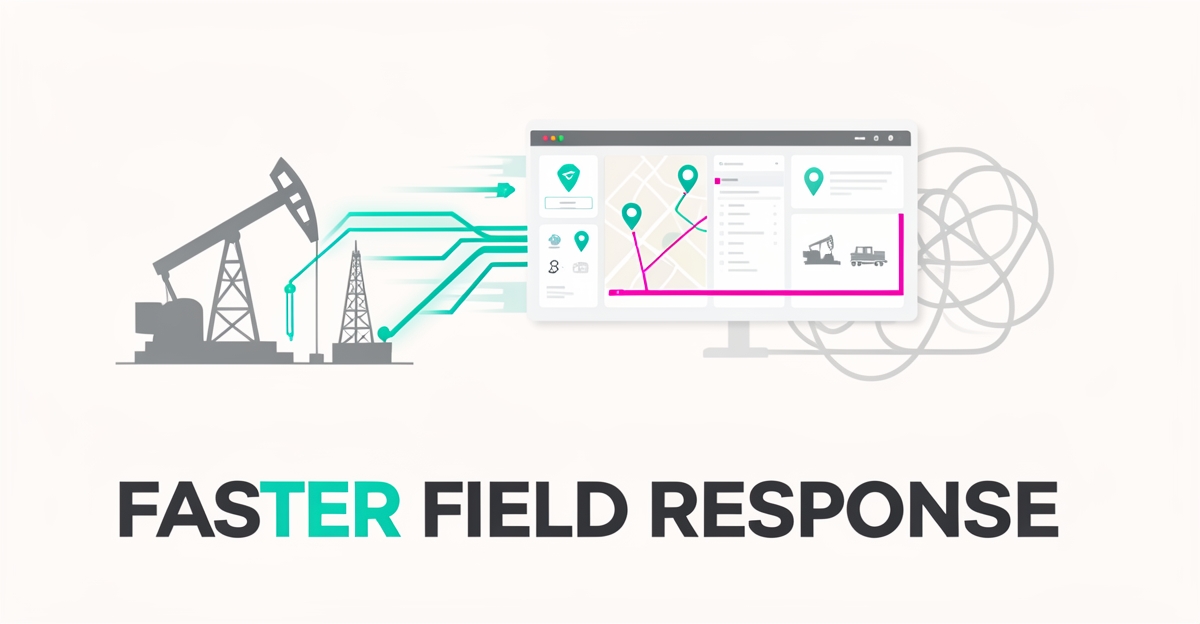
AI-powered dispatch systems replace that friction with real-time orchestration. These platforms ingest live equipment telemetry, crew availability, traffic conditions, and job priority rules to calculate optimal assignments in seconds rather than hours. As of late 2026, agentic AI adoption has accelerated across the energy sector, with dispatch and field coordination among the clearest near-term wins: these systems don't just automate, they reason, prioritize, and adapt.
Core capabilities that eliminate manual bottlenecks include:
- Predictive job prioritization based on asset criticality, safety risk, and revenue impact
- Automated crew assignment matching certifications, location, hours-of-service, and equipment compatibility
- Real-time equipment status tracking via IoT integration and telematics feeds
- Dynamic re-routing when conditions change, weather, traffic, or emergency call-ins
- Audit-ready dispatch logs replacing paper trails and scattered communications
AIQ Labs builds custom dispatch automation that plugs directly into existing field service platforms, SCADA systems, and ERP backbones, no rip-and-replace required. The result: faster mobilizations, fewer idle hours, and dispatch decisions that hold up under scrutiny.
Implementing AI Dispatch: From Assessment to Ongoing Optimization
Implementing AI dispatch begins with a clear assessment of current workflows to identify where delays occur and how automation can help. Many oilfield service companies still rely on manual processes like spreadsheets and phone calls to assign crews and track equipment, which creates bottlenecks and slows response times. By analyzing these pain points, such as inefficient job prioritization or delayed crew notifications, companies can pinpoint where AI-powered dispatchers will have the greatest impact. This discovery phase ensures the solution is tailored to real operational challenges rather than generic automation.
Once workflows are mapped, the next step is integrating the AI dispatcher with existing tools such as CRM, scheduling software, and field service platforms. AIQ Labs builds custom AI agents that connect seamlessly through APIs, enabling real-time data exchange between systems without disrupting current operations. This integration allows the AI dispatcher to access live equipment status, crew availability, and job priorities, then make intelligent assignment decisions based on predefined business rules. The system learns from historical data and continuously improves its recommendations, reducing reliance on manual intervention.
Scaling the AI dispatcher involves phased deployment, ongoing monitoring, and continuous optimization to ensure long-term value. AIQ Labs starts with a pilot in one workflow or region, then expands based on performance metrics like reduced response time and increased first-time fix rates. Throughout this process, the AI Employee model provides managed support, including performance tracking, retraining, and tool updates, so the system adapts to changing field conditions. You can start monthly, build in milestones, or own the system outright; for operations that want dispatch connected to scheduling, billing, and reporting as one layer, an AI Operating System ties it together in phases, owned outright. To begin, complete the 2-minute Fit Check at aiqlabs.ai/apply and book a free 30-minute strategy call to map high-ROI automation opportunities.
Still paying for 10+ subscriptions that don’t talk to each other?
We build custom AI systems you own outright. No vendor lock-in. Full control.
Not sure where to start? Ask our AI planner
Frequently Asked Questions
How much time can AI-powered dispatchers save compared to manual dispatch in oilfield operations?
Why are oilfield service companies moving to agentic AI for field dispatch?
Can AI dispatchers integrate with existing oilfield systems like SCADA or ERP without requiring a full replacement?
What are the key capabilities of AI-powered field dispatchers that eliminate manual bottlenecks in oilfield operations?
What does it cost to work with AIQ Labs on dispatch automation?
How does AIQ Labs ensure the AI dispatcher adapts to changing field conditions over time?
Turning Field Dispatch from Bottleneck to Competitive Advantage
The pattern is clear: manual dispatch in oilfield operations isn't just inefficient, it's actively eroding profitability through delayed responses, idle equipment, and suboptimal crew utilization. By replacing spreadsheets and phone calls with AI-powered dispatchers that prioritize jobs intelligently, match crews by skill and proximity, and adapt in real time to changing conditions, oilfield service companies can cut response times from hours to minutes while reducing operational costs per service call. The shift isn't theoretical, agentic AI is already in production across the sector, delivering measurable efficiency without requiring a full rip-and-replace of existing systems. For oilfield providers ready to move beyond reactive firefighting, the path forward starts with assessing where manual bottlenecks create the most friction. AIQ Labs has deployed 200+ multi-agent systems and runs 4 live SaaS products daily, so the approach is proven in production, not just in demos. Complete the 2-minute Fit Check at aiqlabs.ai/apply or email [email protected] to book a free 30-minute strategy call, and get a custom AI dispatcher that integrates with current workflows and scales as needs evolve, so crews spend less time waiting and more time keeping production flowing.
Make AI your competitive advantage — not just another tool.
Strategy, implementation and ongoing optimization. One partner, end to end.
Not sure where to start? Ask our AI planner