How Restaurant Supply Distributors Can Use AI to Predict Seasonal Demand Fluctuations
Key Facts
- Seasonal demand in restaurant supply moves with holidays, local events, tourism and menu cycles, patterns manual forecasting typically misses
- Overstock ties up cash in dead inventory; understock triggers emergency buys and lost margin during peaks
- Effective forecasting models combine SKU-level order history with external signals like event calendars and weather anomalies
- A pilot on one high-volume category is the lowest-risk way to start, no full operational overhaul required
- AIQ Labs builds custom forecasting models that distributors own outright with no vendor lock-in
Hire a team member that works 24/7 — for less than a part-time wage.
AI receptionists, SDRs, dispatchers and 99+ roles. Trained on your business, fully managed.
Not sure where to start? Ask our AI planner
The Hidden Cost of Seasonal Guesswork in Restaurant Supply Distribution
Seasonal demand feels predictable until it isn’t. Restaurant supply distributors live with swings in condiments, kitchen supplies and freezer stock that move with holidays, local events and menu cycles, and manual forecasting rarely keeps up.
Spreadsheets, gut instinct and last year’s numbers leave teams choosing between two expensive outcomes. Overstock ties up cash in dead inventory that sits through slow weeks, while understock forces emergency buys, missed deliveries and lost margin during peak periods. The problem is margin and cash flow, not just logistics.
The hidden cost shows up in several ways:
- Carrying cost and obsolescence from overbuying seasonal SKUs
- Stockouts on high-velocity items during holidays and local events
- Reactive purchasing that erodes supplier pricing and delivery reliability
- Staff time spent firefighting instead of planning
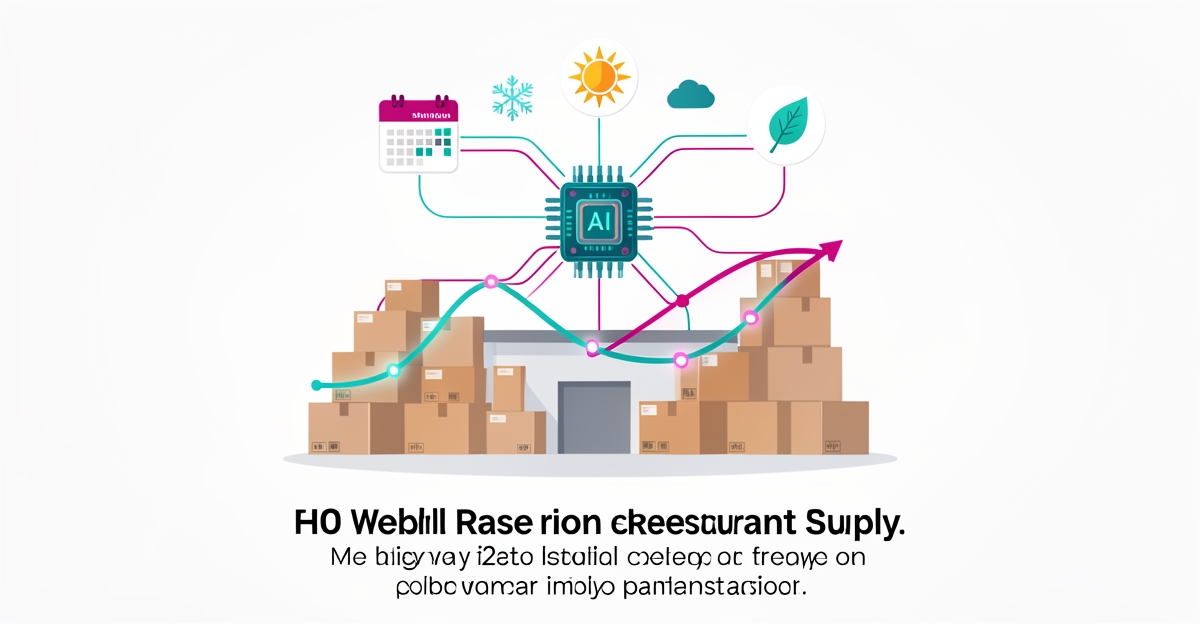
Traditional methods cannot connect past ordering patterns with holidays, weather and regional restaurant trends in real time. Predictive analytics and forecasting changes that by analyzing historical sales, seasonality and external event data to anticipate demand for kitchen knives, condiments or freezer supplies before the swing hits.
AIQ Labs builds predictive models tailored to regional restaurant trends and distributor performance through its [AI Workflow Builds](/workflow-builds) service, rebuilding the one workflow that costs the most, at a fixed price, in phases. The goal is not perfect prediction, it is reducing the expensive guesswork that locks cash in the warehouse or leaves orders unfilled when demand spikes.
How AI Reads Demand Signals Humans Miss
Restaurant supply distributors operate in a complex environment where demand shifts with seasons, holidays, and local events, patterns too intricate for manual tracking to capture reliably. AI-powered forecasting cuts through this complexity by ingesting historical ordering data, holiday calendars, regional weather trends, and real-time restaurant activity to uncover subtle signals that precede spikes in demand for items like patio furniture, holiday catering supplies, or summer tourism essentials. The same principle applies whether you serve a single metro market or a multi-region footprint: the model learns when a restaurant group will increase orders for grilling supplies ahead of a long weekend, or when hotels will need extra linens during a festival season.
The strength of AI lies in its ability to weigh dozens of overlapping factors simultaneously: a sudden cold snap might delay patio season, while a local concert series could spike demand for disposable condiment packets. By continuously learning from these interactions, AI models don’t just predict what will happen, they explain why, turning invisible patterns into actionable insights for smarter inventory planning and fewer stockouts.
From Reactive Ordering to Predictive Inventory Strategy
Restaurant supply distributors are moving beyond reactive ordering toward predictive inventory strategies that anticipate demand before it spikes. A predictive demand model in distribution analyzes SKU-level order histories across restaurant clients, layers in external signals like local event calendars and seasonal tourism data, and generates forward-looking demand forecasts by product category and region. This shift allows purchasing managers to redirect their focus from spreadsheet triage to higher-value activities such as supplier negotiations and client relationship management.
The inputs that matter most:
- Historical order data by SKU and client segment
- Local event calendars and tourism flow projections
- Seasonal trends and holiday purchasing patterns
- Weather anomalies and regional economic indicators
- Menu change cycles and promotional calendars
By integrating these inputs, distributors gain visibility into upcoming demand shifts, for example, anticipating a surge in freezer supplies ahead of a regional food festival or adjusting condiment inventory based on projected hotel occupancy rates. This proactive approach reduces stockouts, minimizes excess inventory carrying costs, and strengthens service reliability. As AI assumes the burden of data synthesis and forecast generation, purchasing teams evolve into strategic advisors who use predictive outputs to optimize terms with suppliers and deepen partnerships with restaurant clients. The result is a more resilient, responsive supply chain that aligns inventory investment with actual market demand.
Building Your First Demand Forecasting Model Without Overhauling Your Operation
The smartest way to start isn't with a full operational overhaul, it's with a single product category or regional segment where the data is already clean enough to work with.
Most distributors already have the raw ingredients: historical order data, client ordering frequency, and seasonal markers like holidays or local festival calendars. The challenge is structure. Messy spreadsheets, inconsistent SKUs, and missing timestamps will choke any model before it learns a single pattern, so data cleanup comes first.
- Start with one high-volume category, condiments, freezer supplies, or kitchen knives, where ordering history is deep and seasonal signals are clear
- Audit the last 24–36 months of orders for that segment, flagging gaps, duplicates, and formatting inconsistencies
- Layer in external markers: school calendars, tourism peaks, regional events that drive restaurant traffic
- Validate the cleaned dataset with a small pilot model before expanding
The same logic applies across distribution: a custom-built forecasting model trained on your regional restaurant trends will outperform a generic tool forced onto your workflow every time.
AIQ Labs builds custom forecasting models that distributors own outright, using milestone-based builds so you prove value on one product line before scaling. No vendor lock-in, no platform dependencies, just a model that learns your customers' ordering rhythms and gets sharper with every season. For distributors ready to connect forecasting into a broader set of operations, ordering, dispatch, client communication, an [AI Operating System](/ai-operating-systems) ties those pieces into one connected layer, built in phases and owned outright.
Still paying for 10+ subscriptions that don’t talk to each other?
We build custom AI systems you own outright. No vendor lock-in. Full control.
Not sure where to start? Ask our AI planner
Frequently Asked Questions
How can AI predict seasonal demand for restaurant supplies like condiments or freezer stock?
What does it cost a distributor to keep guessing at seasonal demand?
Do I need to overhaul my whole operation to start using demand forecasting?
Is my data good enough to train a forecasting model?
Why are more distributors adopting AI-driven forecasting?
Will I get locked into another software subscription or vendor platform?
Turn Seasonal Guesswork into Strategic Advantage
Restaurant supply distributors no longer need to choose between overstocking and stockouts when seasonal demand swings hit. By applying AI-powered forecasting to historical order data, local events, weather patterns, and regional restaurant trends, teams can shift from reactive firefighting to proactive inventory planning. This approach reduces carrying costs, minimizes emergency purchases, and frees purchasing managers to focus on supplier negotiations and client relationships instead of spreadsheet triage. To start, audit one high-volume product category like condiments or freezer supplies, clean the last 24–36 months of order data, and layer in external signals such as holiday calendars and tourism peaks. AIQ Labs helps distributors build custom forecasting models they own outright, proving value on a single product line before scaling. Ready to see where AI can eliminate guesswork in your supply chain? Start the [Fit Check](/apply), a 2-minute assessment that maps your biggest bottleneck, then book a free 30-minute strategy call to identify high-ROI automation opportunities.
Make AI your competitive advantage — not just another tool.
Strategy, implementation and ongoing optimization. One partner, end to end.
Not sure where to start? Ask our AI planner