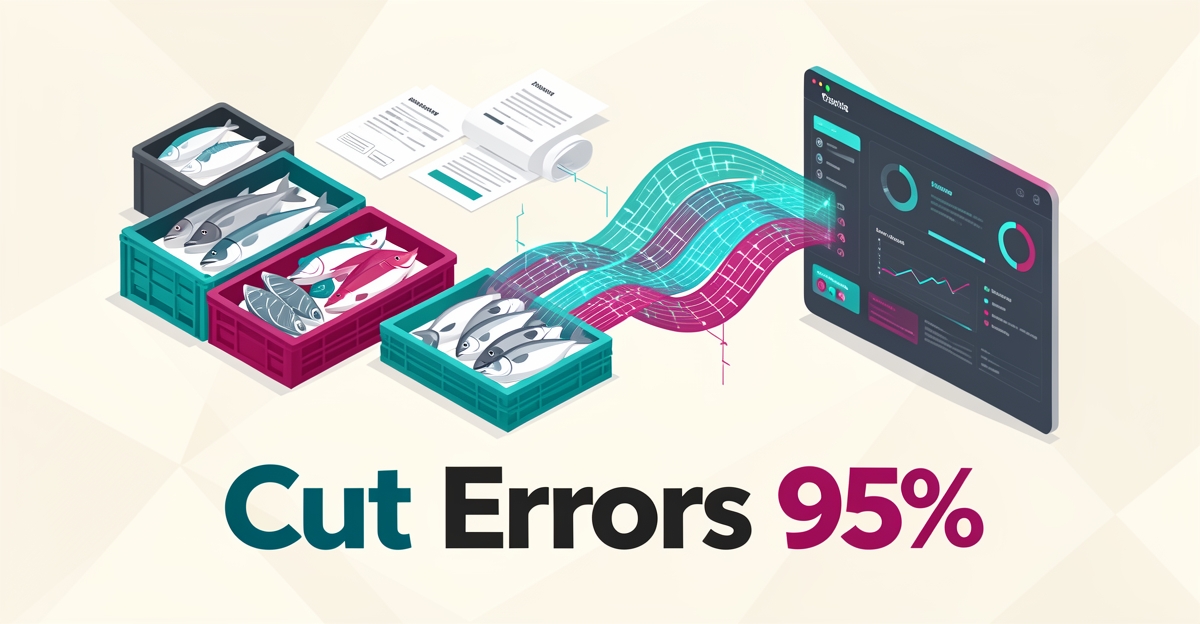
How Seafood Processors Can Reduce Manual Data Entry Errors with AI Document Processing
Key Facts
- Publicly listed seafood processors have historically averaged pre-tax margins well below the 10% benchmark often cited as healthy, leaving little room for documentation errors.
- Temperature control failures, often worsened by delayed or incorrect manual logging, can mean thousands of dollars in spoiled inventory per incident.
- Automating food safety compliance documentation can meaningfully reduce administrative workload, freeing staff for higher-value work.
- Industry analyses consistently identify "error-prone, patchy, and disconnected" data across systems as a core barrier to efficiency and traceability in seafood processing.
- AIQ Labs has deployed 200+ multi-agent systems and runs 4 live SaaS products daily, document automation is a proven, production-ready use case.
Hire a team member that works 24/7 — for less than a part-time wage.
AI receptionists, SDRs, dispatchers and 99+ roles. Trained on your business, fully managed.
Not sure where to start? Ask our AI planner
The Hidden Cost of Manual Data Entry in Seafood Processing
Despite the high stakes of accuracy in seafood processing, many facilities still rely on manual data entry for raw material receipts, quality certificates, batch records, and compliance documentation, a practice that introduces costly errors and delays. This reliance on human input creates vulnerabilities across the supply chain, where even small inaccuracies in traceability data can trigger compliance risks, spoilage, or rejected shipments. Industry analyses have repeatedly flagged that publicly listed seafood processors operate on pre-tax margins well below what's considered healthy, which means operational inefficiencies like manual data entry hit profitability hard.
The financial toll of these inefficiencies is real. Temperature control failures, which can stem from delayed or incorrect logging of refrigeration data due to manual entry, can mean thousands of dollars in spoiled inventory per incident. And a large share of administrative effort in many processors is tied to manually handling records that could be automated. These burdens slow operations and increase the likelihood of human error during high-volume processing periods.
- Manual entry of raw material receipts increases the risk of mislabeled or misrouted inventory, compromising traceability from harvest to consumer.
- Errors in quality certificate data entry can lead to false compliance assumptions, increasing exposure to regulatory penalties.
- Inconsistent batch record logging disrupts production planning and complicates recall readiness when issues arise.
- Delayed processing of compliance documents creates bottlenecks in shipping approvals, tying up inventory and increasing storage costs.
- Rework from data entry corrections consumes staff time that could be redirected toward quality improvement or process optimization.
These challenges are compounded by the fragmented nature of data in many seafood facilities, where information sits in disconnected formats across multiple systems, what industry observers describe as "error-prone, patchy, and disconnected" data. AIQ Labs helps processors overcome this with AI Workflow Builds that target the one workflow costing you the most, often document processing, rebuilding it at a fixed price and in phases, with automatic capture, classification, and validation of data from invoices, manifests, and quality control records. By eliminating these avoidable sources of error and delay, processors can protect margins, improve compliance confidence, and redirect labor toward higher-value operational tasks.
How AI Document Processing Automates Capture, Classification and Validation
Seafood processors are drowning in paperwork that breeds costly errors. Manual data entry on invoices, manifests, certificates of analysis, and QC records creates a cascade of problems, from traceability gaps to compliance risks, that directly impact already-thin margins.
AI document processing changes this by using computer vision and machine learning to automatically capture, classify, and validate critical documentation. Instead of staff manually keying data from paper or PDFs, intelligent systems extract key fields like batch numbers, supplier IDs, temperature readings, and test results with high accuracy. This automation eliminates transcription errors while accelerating processing speed from minutes per document to seconds per batch.
The technology handles diverse document formats common in seafood operations, scanned paper manifests, digital certificates of analysis, and handwritten quality logs, through adaptive OCR and layout-aware models. Once extracted, data is automatically classified by document type and validated against business rules (e.g., checking if a certificate of analysis matches the received lot, or if temperature logs stay within safe thresholds). This end-to-end automation creates a single source of truth for raw material receipts, quality checks, and batch records.
AI-driven document processing delivers measurable operational improvements: faster processing, fewer errors requiring rework, and real-time data that enables proactive decisions, like rerouting inventory based on imminent shelf-life constraints or triggering QC holds when documentation flags potential issues. The exact savings vary by operation, but processors consistently report lower inspection costs and reduced waste through better inventory visibility.
- Automated data extraction from invoices, manifests, and certificates of analysis
- Real-time validation against quality and compliance rules
- Batch processing acceleration for high-volume documentation flows
- Enhanced traceability through linked digital records
- Reduced administrative workload for food safety documentation
By replacing error-prone manual entry with intelligent document understanding, seafood processors gain not just efficiency but the reliable data foundation needed for AI-powered inventory optimization, predictive maintenance, and full supply chain traceability, turning documentation from a liability into a strategic asset.
From Paper to Production-Ready: Implementation Steps for Processors
For seafood processors, the journey from paper-based documentation to AI-powered production systems begins with understanding exactly where manual processes create the most friction. A detailed workflow audit reveals the specific documents, raw material receipts, quality checks, batch records, and compliance forms, that consume staff time and introduce error risks. This assessment is critical because even companies with digital systems often have data that is "error-prone, patchy, and disconnected" across multiple software platforms, undermining AI accuracy from the start.
The next step is mapping high-impact documentation flows where AI automation delivers the fastest returns. Processors should prioritize documents tied to food safety, traceability, and inventory accuracy, such as certificates of analysis, temperature logs, and supplier invoices, where manual entry errors can trigger costly recalls or compliance failures. Once priorities are set, assessing current data quality ensures the foundation exists for reliable AI extraction.
With workflows audited and data readiness confirmed, processors can choose an implementation path aligned with their scale and budget. AIQ Labs offers three entry points: start with AI Workflow Builds to rebuild the single workflow that costs the most (fixed price, phased delivery), bring in AI Employees to handle document intake and validation at a fraction of the cost of a human hire, or go all the way to an AI Operating System, one connected layer across your operation, built in phases and owned outright. Payment models are flexible: Start Monthly, Build in Milestones, or Own It Outright. Successful deployment requires integration with existing ERP, inventory, and quality control systems, followed by role-specific workforce training and continuous optimization to maintain accuracy as documentation formats evolve. This structured approach transforms paper trails into production-ready data flows that support faster decisions, fewer errors, and stronger compliance.
Why Custom AI Beats Off-the-Shelf for Seafood Operations
Manual data entry errors in seafood processing create ripple effects that undermine quality, compliance, and profitability. With margins historically well below healthy benchmarks, processors have little room for costly documentation mistakes. Industry analyses consistently identify error-prone, patchy, and disconnected data across systems as a core barrier to efficiency, directly impacting traceability and increasing the risk of compliance violations.
AI document processing addresses this by delivering consistent, low-error extraction from raw material receipts, quality checks, and batch records. Unlike manual entry, which varies by operator and slows under volume, AI systems maintain algorithm-driven consistency and scale with processing demands. This shift reduces labor-intensive rework while ensuring data integrity across interconnected systems like ERP and inventory management, where disconnected workflows currently amplify error rates and delay critical information flow.
Custom AI solutions outperform off-the-shelf tools by embedding directly into existing seafood processing workflows without requiring disruptive overhauls. AIQ Labs builds production-ready systems that clients own outright, eliminating vendor lock-in and enabling deep two-way integrations with the platforms you already run. This approach ensures AI enhances rather than interrupts operations, delivering measurable gains in accuracy and speed while preserving operational continuity.
- Eliminates hours of manual data entry every week
- Cuts operational errors from transcription and miskeying
- Scales operations without adding headcount
By owning their AI infrastructure, seafood processors gain full control over customization, future development, and intellectual property, turning automation into a sustainable competitive advantage rather than a recurring subscription dependency. This ownership model, combined with end-to-end partnership from strategy through optimization, allows SMBs to implement production-grade document processing that evolves with their needs. The result is a unified, intelligent system where data flows accurately from receipt to record, supporting compliance, traceability, and margins strained by manual inefficiencies.
Still paying for 10+ subscriptions that don’t talk to each other?
We build custom AI systems you own outright. No vendor lock-in. Full control.
Not sure where to start? Ask our AI planner
Frequently Asked Questions
How much can seafood processors save by automating manual data entry with AI document processing?
What financial losses can result from temperature control failures due to manual data entry delays?
How long does it typically take to implement AI document processing for seafood processing workflows?
Can AI document processing reduce administrative workload for food safety compliance?
Is AI document processing scalable for high-volume seafood processing operations?
What makes custom AI document processing better than off-the-shelf tools for seafood processors?
Turning Paper Trails into Profitable Precision
Seafood processors operate on thin margins, where manual data entry errors in raw material receipts, quality certificates, and batch records don't just slow operations, they erode profitability through spoilage, compliance risks, and wasted labor. AI document processing changes that by automating capture, classification, and validation across fragmented systems, cutting inspection costs and reducing waste through better inventory visibility. By replacing error-prone manual entry with intelligent systems that integrate directly with existing ERP and quality platforms, processors gain reliable data for traceability, faster decision-making, and labor redirected toward higher-value work. The path forward starts with a clear view of your biggest documentation bottlenecks. Take the 2-minute Fit Check, then book a free 30-minute strategy call to map your highest-ROI automation opportunities and see if AI document processing is the right next step for your operation.
Make AI your competitive advantage — not just another tool.
Strategy, implementation and ongoing optimization. One partner, end to end.
Not sure where to start? Ask our AI planner