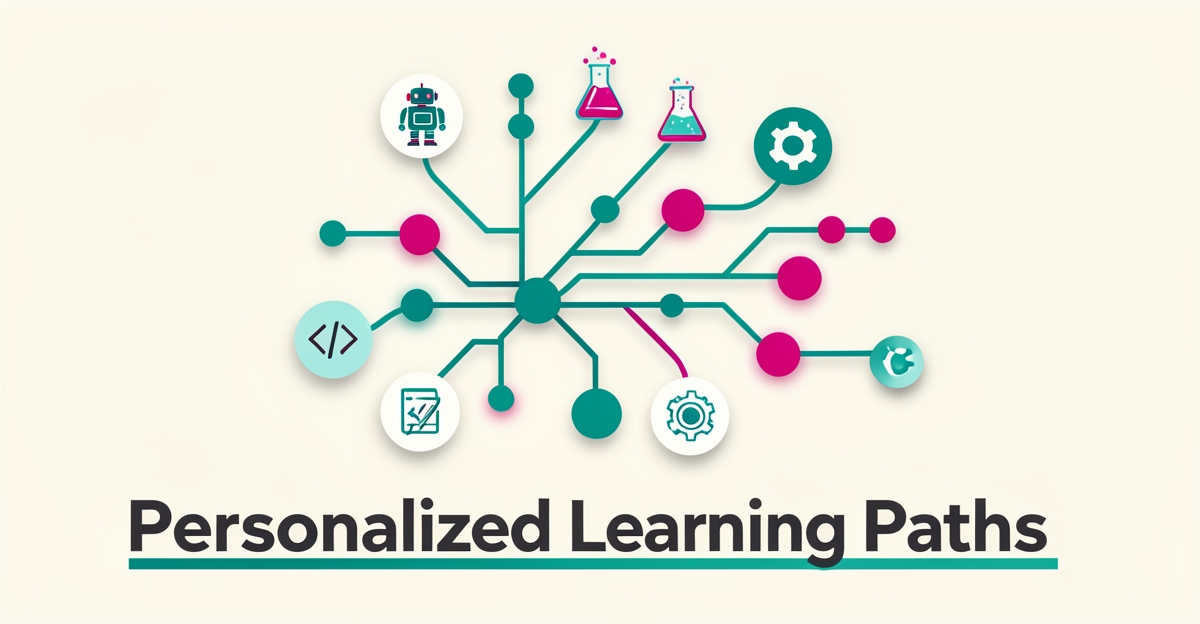
How STEM Camps Can Use AI to Personalize Learning Experiences for Students
Key Facts
- STEM camps struggle with high student-to-instructor ratios limiting one-on-one attention.
- Established education standards, such as the ISTE Standards for Educators, call for authentic, learner-driven activities that accommodate learner variability.
- Effective AI systems need clear written instructions, records of student interactions, and connected data to produce useful recommendations.
- AI in education requires human oversight to address data quality, bias, and fairness issues.
- One-size-fits-all STEM curricula leave advanced students bored and struggling students behind.
- AI can generate customized learning pathways, activity recommendations, and project ideas for each camper.
Hire a team member that works 24/7 — for less than a part-time wage.
AI receptionists, SDRs, dispatchers and 99+ roles. Trained on your business, fully managed.
Not sure where to start? Ask our AI planner
Why STEM Camps Struggle to Personalize Learning at Scale
STEM camps are designed to ignite curiosity, yet many deliver the same curriculum to every student, regardless of their starting point or passions. This one-size-fits-all approach usually stems from practical constraints, limited staff and resources, making true personalization feel out of reach.
The core issue is a mismatch between educational goals and operational capacity. Educators want to meet students where they are, but manually designing individual pathways for dozens of campers is impossible. That forces a compromise where the curriculum targets a hypothetical "average" student, leaving some bored and others overwhelmed.
This compromise works against established best practices in education. Standards like the ISTE Standards for Educators emphasize designing authentic, learner-driven activities that use technology to accommodate learner variability. In a resource-strapped camp environment, consistently achieving that level of personalization for every student is a monumental challenge.
The consequences are predictable. When learning isn't tailored, engagement drops and outcomes suffer. Students who aren't challenged or connected to the material lose interest, undermining the camp's entire purpose.
The key challenges that prevent personalization at scale include:
- A high student-to-instructor ratio that limits one-on-one attention.
- Lack of time and tools to assess individual skill levels and interests dynamically.
- Difficulty sourcing or creating a wide variety of projects and activities.
- The administrative burden of tracking individual progress across multiple domains.
This operational reality leads to disengagement and uneven learning outcomes. Advanced students are held back, while those needing more support fall further behind, a frustrating experience for everyone involved.
Even when camps adopt technology, it often fails to solve the core problem. A system's effectiveness is constrained by its inputs: AI tools need high-quality data and clear instructions to function. Without a system designed for educational personalization, technology alone can't bridge the gap.
Ultimately, the inability to personalize learning at scale means STEM camps aren't fully delivering on their promise. They risk becoming a passive experience rather than a transformative one, failing to equip every student with the skills and confidence they need to succeed.
How AI Enables Personalized Learning Pathways in STEM Education
Imagine a STEM camp where every student's learning journey is built around their own interests, past performance, and project preferences, automatically. That is what AI-driven personalization makes possible, and as of late 2026 it's a practical reality for educators willing to embrace new tools.
The foundation of any effective AI personalization system is structured input. A successful system needs three key ingredients: a set of written instructions, records of student interactions and progress, and relevant student data, such as skill levels and project histories, fed directly into the system. Translated into a STEM camp context, that means clearly defined pedagogical goals, documented engagement over time, and connected data that gives the AI context beyond any single conversation.
When these inputs are in place, AI can generate genuinely useful outputs. Camp instructors can receive suggestions for customized learning pathways, recommended activities, and project ideas that match each student's growth goals. The same logic that lets AI systems support customer-facing scenarios, matching needs to next steps, can be repurposed for learning: matching a robotics enthusiast with an advanced build challenge, or suggesting a coding activity that builds on a student's earlier struggles with loops and logic.
The pedagogical framing matters as much as the technology. Standards like the ISTE Standards for Educators call on teachers to design authentic, learner-driven activities that use technology to accommodate learner variability. AI supports this by making learner variability visible and actionable, rather than leaving instructors to guess at each student's needs.
To put this into practice, camps can follow a structured approach:
- Write clear instructions that teach the AI what actions to suggest and when those actions are needed throughout a student's learning journey.
- Create records documenting how students engage with activities, instructors, and peers over time.
- Connect relevant student data, interests, past performance, project preferences, so the AI has context beyond any single interaction.
- Design authentic learning activities that let students apply their knowledge in real, meaningful projects.
Of course, AI is a tool, not a replacement for educators. Research on AI in education highlights persistent challenges, including data quality and availability, bias and fairness in AI decision-making, and the need for human oversight and intervention. Camp leaders should treat AI suggestions as recommendations for instructors to review, not autonomous decisions about a child's learning path.
This is where implementation experience counts. AIQ Labs builds AI systems designed around these constraints, combining multi-agent architectures with human-in-the-loop controls and audit trails, deployed through services like AI Workflow Builds for a single high-impact workflow or AI Operating Systems when a camp wants one connected layer across everything. The camps that succeed with AI personalization will be those that pair capable technology with thoughtful educators who stay actively involved in every student's growth.
Practical Steps for STEM Camps to Implement AI-Powered Personalization
STEM camps looking to personalize learning can start by clearly defining educational objectives that align with both student interests and curriculum goals. AI systems can then analyze student input data, past activity preferences, skill assessments, and engagement patterns, to generate tailored recommendations for projects and learning pathways. This supports differentiated instruction while keeping learning relevant and motivating for each participant.
To implement this effectively, camps should gather diverse data points including student surveys, real-time interaction logs, and performance metrics from hands-on STEM challenges. AI models can process this information to suggest age-appropriate experiments, coding tasks, or engineering designs that match individual readiness levels. For example, a student showing strong interest in robotics but needing foundational coding support might receive guided block-based programming activities before advancing to text-based languages.
Human oversight remains critical to ensure AI-generated recommendations are fair, educationally sound, and free from bias. Educators should review AI suggestions for alignment with standards like ISTE, particularly those emphasizing learner-driven activities and responsible technology use. By combining AI's scalability with educator expertise, camps can maintain instructional integrity while adapting to individual needs. AIQ Labs supports this balance by building transparent, auditable systems rooted in pedagogical best practices, with clear milestone-based delivery so camps know exactly what they're getting at each phase.
Finally, camps should establish feedback loops where students and instructors can refine AI outputs over time. Continuous improvement ensures the system evolves with student growth and changing camp goals, making personalization a sustainable, impactful part of the STEM learning experience.
Still paying for 10+ subscriptions that don’t talk to each other?
We build custom AI systems you own outright. No vendor lock-in. Full control.
Not sure where to start? Ask our AI planner
Frequently Asked Questions
How can AI personalize learning in STEM camps when there are limited staff and resources?
What are the key inputs needed for an AI system to generate useful learning suggestions in a STEM camp setting?
How does AI-powered personalization align with educational standards like the ISTE Standards for Educators?
Can AI replace teachers in personalizing learning at STEM camps?
What steps should STEM camps take to implement AI-powered personalization effectively?
What challenges should educators be aware of when using AI for personalized learning in STEM education?
From One-Size-Fits-All to Every Student's Own Path
STEM camps can't keep delivering the same curriculum to every camper and still ignite real curiosity. The bottleneck isn't intent, it's capacity: high student-to-instructor ratios, limited time to assess skills dynamically, and the administrative load of tracking progress across domains. AI changes that equation by making learner variability visible and actionable, turning student interests, past performance, and interaction records into tailored pathways, activity recommendations, and project ideas while keeping educators in control. Success starts with clear pedagogical instructions, structured records of engagement, and connected student data, paired with human oversight to ensure fairness and alignment with standards like ISTE. Camps that pair thoughtful design with scalable technology can move from passive experiences to transformative ones. If you're exploring how to personalize learning without adding staff, start with a clear objective and a small pilot workflow, AIQ Labs' AI Workflow Builds are built for exactly that, at a fixed price and in phases. Take the two-minute Fit Check at https://aiqlabs.ai/apply, then book a free 30-minute strategy call at https://aiqlabs.ai/book to map your biggest bottleneck.
Make AI your competitive advantage — not just another tool.
Strategy, implementation and ongoing optimization. One partner, end to end.
Not sure where to start? Ask our AI planner