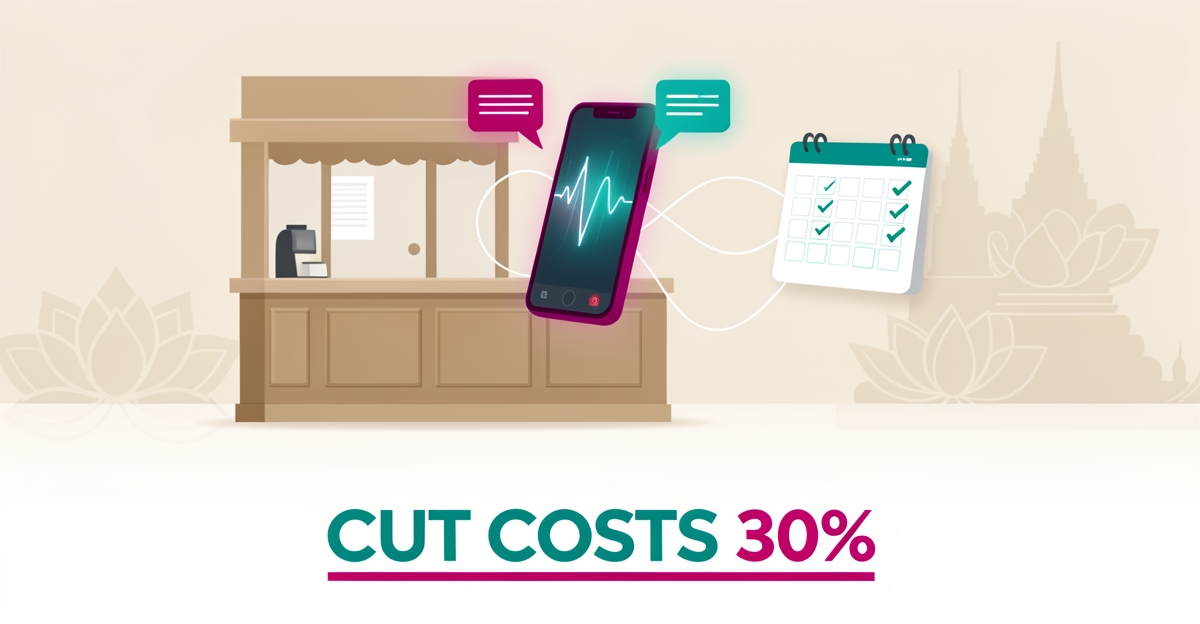
How Thai Restaurants Can Cut Customer Service Costs by 30% with AI Receptionists and Smart Scheduling
Key Facts
- AI receptionists typically resolve the large majority of routine calls without human help, based on industry benchmarks as of late 2026.
- AI answers customer calls in seconds, eliminating hold times and voicemail drop-off.
- A dedicated human receptionist typically costs several thousand dollars per month once wages and benefits are included, while an AI employee from AIQ Labs runs at roughly 80% less than a human hire.
- Smart scheduling tools commonly cut labor costs by 5-10% by matching staffing to predicted demand.
- Most customers today expect an immediate response when contacting a business, unanswered calls push them to competitors.
- AI-assisted inventory management can meaningfully reduce food cost percentage through smarter ordering.
Hire a team member that works 24/7 — for less than a part-time wage.
AI receptionists, SDRs, dispatchers and 99+ roles. Trained on your business, fully managed.
Not sure where to start? Ask our AI planner
The Hidden Cost of Missed Calls and Overstaffing in Thai Restaurants
Missed reservations and overstaffed lunch shifts quietly drain Thai restaurant margins every week. The cost shows up as lost bookings, overtime pay, and staff standing idle while customers hang up.
Businesses that rely on phone intake routinely miss a large share of incoming calls, industry analyses as of late 2026 suggest a majority can go unanswered during busy periods. The same pattern hits restaurants, where a silent phone during dinner rush means potential customers simply call someone else. Most customers today expect an immediate response when they reach out to a business.
Peak hours amplify the pain. Staff are tied to tables and kitchen tickets, so the front desk goes unanswered just when demand spikes. Off-hours inquiries for catering, private events, or weekend reservations roll to voicemail and rarely convert. A significant portion of customer calls typically happens outside normal business hours, creating a permanent coverage gap.
Overstaffing is the other side of the same problem. Without accurate demand signals, managers schedule for the worst case and pay for the average case. Smart scheduling tools can predict peak hours and recommend optimal staffing levels, commonly cutting labor costs by 5-10%. The risk is real: overstaffing wastes money and understaffing harms service.
The financial comparison for phone coverage is stark. A dedicated human receptionist typically costs several thousand dollars per month once wages and benefits are counted, while an AI receptionist runs at roughly 80% less than a human hire, often less than a part-time wage, with unlimited call capacity.
AI supports staff by reducing manual work so they can focus on service quality. An AI receptionist handles routine bookings, menu questions, and order confirmations 24/7, then routes urgent calls to the owner. This AI-First with Smart Forwarding model lets human teams handle complex hospitality while automation covers the repetitive volume.
Thai restaurants face specific operational pressures that make this gap costly:
- Missed reservation and catering inquiries during lunch and dinner peaks
- After-hours calls from tourists needing table bookings or menu info
- Overstaffed slow shifts and understaffed rush periods from guesswork scheduling
- Rising labor costs with thin margins and staffing shortages
The business case is clear. AI receptionists and smart scheduling address two major cost centers at once: labor and lost revenue. AIQ Labs helps restaurants deploy managed AI employees that handle bookings and inquiries seamlessly, while smart scheduling reduces waste without compromising service quality.
How AI Receptionists Handle Routine Inquiries at a Fraction of the Cost
Missed calls during dinner rush are missed revenue, and Thai restaurants can’t afford to lose bookings when staff are on the floor. An AI receptionist answers that problem by handling routine inquiries 24/7 without adding headcount.
Industry benchmarks as of late 2026 show AI receptionists resolving the large majority of routine calls without human help, covering bookings, hours, pricing and menu questions. They answer in seconds and keep callers engaged instead of pushing them to voicemail, which matters when most customers expect an immediate response.
The cost difference is decisive for thin-margin operations. A human receptionist typically costs several thousand dollars per month including wages and benefits, while an AI receptionist from AIQ Labs runs at roughly 80% less than a human hire. That is a dramatic reduction in customer service cost for the same, or better, coverage.
For Thai restaurants, the workload is predictable and repetitive: reservation requests peak before lunch and dinner, tourists ask for multilingual menu help, and catering inquiries arrive outside business hours. AI handles these consistently while forwarding complex or high-value calls to a manager.
An AI-First with Smart Forwarding model works well in hospitality. The agent handles routine tasks and routes urgent calls to the owner’s phone, so staff stay focused on in-person service. This aligns with how AI supports staff by reducing manual work so they can focus on service quality.
Typical automations an AI receptionist manages include:
- 24/7 booking and reservation intake directly into the calendar
- FAQ handling for hours, location, pricing and menu items
- Order confirmations and waitlist management during peak hours
- Intelligent call routing and message prioritization for managers
AIQ Labs builds AI employees for inbound call management that fit restaurant workflows, integrating with calendars, POS and messaging tools. The result is zero missed calls, faster response times and a reception function that never sleeps.
Smart scheduling compounds the savings. When paired with demand forecasting, labor can be optimized for peak periods without overstaffing slow shifts. The combination of automated front desk coverage and data-driven staffing helps restaurants cut customer service costs substantially while protecting the hospitality experience guests expect.
Combining AI Receptionists with Smart Scheduling for Maximum Cost Reduction
The true power of AI for Thai restaurants emerges not from a single tool, but from the strategic combination of an AI receptionist and smart scheduling. This one-two punch tackles the two largest operational expenses, customer service labor and staffing inefficiency, simultaneously, creating a compounding effect that can reduce overall costs by 30% or more.
While an AI receptionist fields customer inquiries for a predictable monthly cost, a smart scheduling layer works in the background to optimize your largest variable cost: labor. By analyzing sales data, it predicts peak hours and recommends precise staffing levels, commonly cutting labor costs by 5-10%. This dual approach ensures you are not overspending on staff during slow periods or losing business to long waits during rushes.
This integration allows you to build a highly efficient operational model. The AI receptionist handles the constant flow of bookings and questions, while the smart scheduler ensures your human team is lean, effective, and focused exclusively on the in-person dining experience. This is how you achieve significant savings without sacrificing the hospitality that defines your brand.
The combined system creates a seamless workflow:
- AI Receptionist: Answers every call in seconds, 24/7, booking tables directly into your system.
- Smart Scheduler: Analyzes booking data and sales trends to create optimal staff schedules, preventing overstaffing.
- Human Staff: Freed from the phone, they focus on food quality, guest experience, and complex customer needs.
- Management: Gains a clear view of both customer communication and labor efficiency from a single, data-driven perspective.
For instance, the AI receptionist can manage the entire dinner rush booking process, capturing every reservation even after hours. This data then feeds into the scheduling system, which might predict a need for an extra server on a holiday weekend based on reservation volume, ensuring you are perfectly staffed. This level of coordination, where one system informs the other, acts like a digital GM that never sleeps, constantly fine-tuning your operations for maximum profitability.
Implementing these systems doesn’t have to be a complex overhaul. At AIQ Labs, we connect these solutions through AI Workflow Builds, rebuilding the one workflow that costs you the most, at a fixed price and in phases, so your AI receptionist and scheduling tools work in concert from day one. By starting with a targeted approach, you can quickly see how this powerful combination transforms your cost structure and elevates your service.
Ready to see how this synergy can work in your restaurant? Start the two-minute Fit Check to identify your biggest operational bottleneck and map out a clear path to a 30% cost reduction.
Implementation Roadmap: From Pilot to Full AI Integration for Thai Restaurants
Thai restaurants face thin margins, staffing shortages, and rising customer expectations for speed and accuracy. A structured rollout prevents pilot fatigue and delivers measurable ROI from the first workflow.
Start by mapping the operational pain points that cost the most. Identify tasks that consume time and resources such as slow service, inventory issues, and staffing problems. Prioritize use cases where AI can deliver measurable improvement, then validate with local market analysis and competitor behavior. This clarity ensures you target bookings, menu questions, and order confirmations that drive cost.
Choose tools that fit the Thai context and your existing stack. Select AI receptionists and smart scheduling that work with local languages, cultural nuances, and delivery platforms common in Thailand. For inbound call management, AI receptionists typically handle the large majority of routine calls without human help and answer in seconds.
Train staff before go-live and frame AI as support, not replacement. Provide hands-on training and explain how AI benefits staff by reducing manual work so they can focus on service quality. Run workshops, build an internal knowledge base of tips and success stories, and designate AI champions to reduce resistance to change.
Start small with one high-impact workflow. Begin with one or two automations such as POS analytics or chatbots and expand as the team becomes comfortable. An AI-First with Smart Forwarding model works well for Thai restaurants: AI handles the routine inquiries and forwards the rest to a human.
Pilot roadmap steps that mirror proven frameworks:
- Identify operational problems and map repetitive, time-consuming tasks
- Choose and configure AI tools for local language and cultural nuances
- Train your team with hands-on sessions and clear benefits messaging
- Launch a single workflow such as after-hours bookings or menu FAQs
- Monitor results, adjust, and scale to scheduling and inventory
Monitor results weekly and scale deliberately. Track time saved, cost reductions, and quality improvements, then standardize workflows and expand to adjacent use cases. Smart scheduling tools can predict peak hours and recommend optimal staffing, commonly cutting labor costs by 5-10%. Inventory and labor savings often appear within weeks.
AIQ Labs helps restaurants deploy AI employees that handle bookings, menu questions, and order confirmations seamlessly, with a Start Monthly model that costs roughly 80% less than a human hire and can be paused or adjusted anytime. For restaurants ready to go further, an AI Operating System connects front desk, scheduling and inventory into one layer you own outright.
Still paying for 10+ subscriptions that don’t talk to each other?
We build custom AI systems you own outright. No vendor lock-in. Full control.
Not sure where to start? Ask our AI planner
Frequently Asked Questions
How much can a Thai restaurant save by switching from a human receptionist to an AI receptionist?
Will using an AI receptionist make my restaurant feel less personal or harm the customer experience?
How does smart scheduling actually reduce labor costs in a Thai restaurant?
Can AI handle the specific needs of Thai restaurants, like after-hours tourist inquiries or multilingual menu questions?
What’s the best way to start using AI in my Thai restaurant without overwhelming my team?
Do I need to replace my current systems to use an AI receptionist or smart scheduling tool?
Turn Missed Calls into Measurable Margins
Thai restaurants lose real revenue when calls go unanswered and schedules miss the mark, problems AI receptionists and smart scheduling solve together. By automating the bulk of routine inquiries at roughly 80% less than the cost of a human hire and optimizing staffing to cut labor waste by 5-10%, this dual approach attacks both lost bookings and unnecessary payroll without compromising the personal touch that defines hospitality. The result is a leaner, more responsive operation where staff focus on guests, not phones, and every inquiry, whether at 2 PM or 2 AM, gets handled. Ready to see where your biggest bottleneck hides and what fixing it could save? Start the two-minute Fit Check to map your operational pain points and uncover a clear path to a 30% reduction in customer service costs.
Make AI your competitive advantage — not just another tool.
Strategy, implementation and ongoing optimization. One partner, end to end.
Not sure where to start? Ask our AI planner