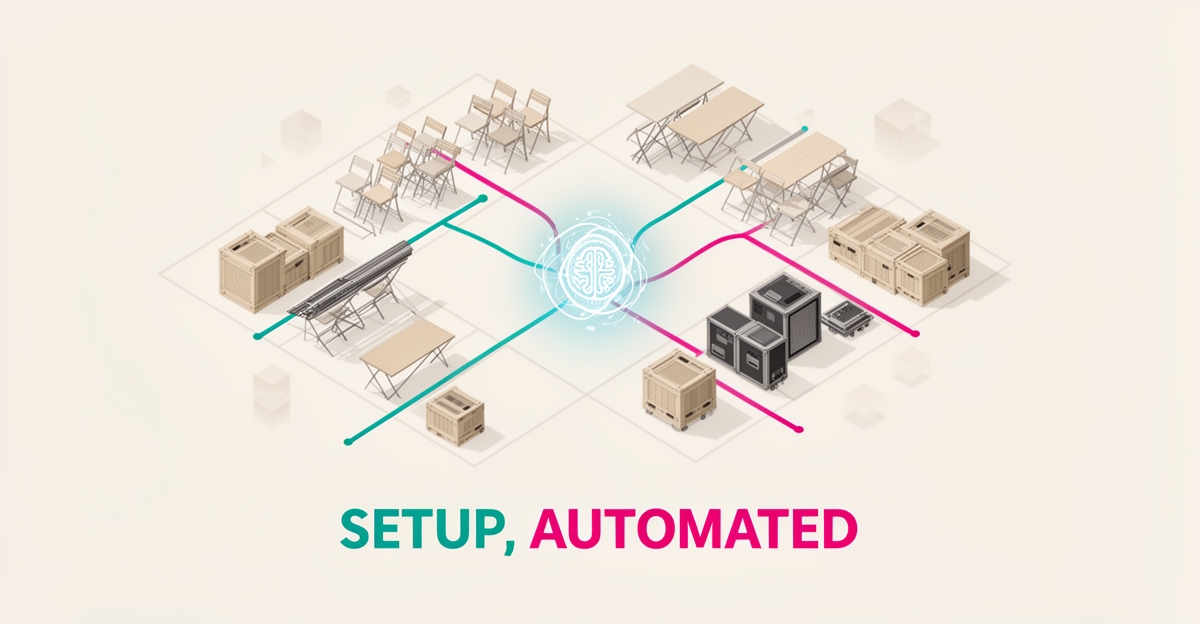
How to Automate Event Setup & Breakdown with AI-Powered Rental Coordination
Key Facts
- Manual dispatch processes typically consume well over a full workday each week per coordinator, creating operational bottlenecks in event rental companies.
- Off-the-shelf event apps often see wide adoption but low user satisfaction, showing that superficial digitization rarely fixes core workflow problems.
- AI-powered rental coordination can meaningfully cut crew idle time by dynamically adjusting dispatch based on traffic, availability, and equipment readiness.
- Companies must map existing AI usage before deploying new tools to gain visibility into shadow AI adoption across workflows.
- Treating AI as an operational service requires monitoring, escalation paths, and accountability similar to managing critical vendors.
- Centralized AI adoption delivers better governance and control compared to decentralized approaches that risk shadow AI.
- AIQ Labs offers a free two-minute Fit Check to identify automation opportunities and high-ROI AI solutions for event setup and breakdown.
Hire a team member that works 24/7 — for less than a part-time wage.
AI receptionists, SDRs, dispatchers and 99+ roles. Trained on your business, fully managed.
Not sure where to start? Ask our AI planner
The Hidden Cost of Manual Event Setup and Breakdown
The hidden cost of manual event setup and breakdown often goes unnoticed until it erodes profitability. Event rental companies relying on paper checklists, spreadsheets, and fragmented communication face significant operational drag. Manual dispatch processes alone typically eat a full workday or more each week per coordinator, creating bottlenecks that delay crew arrivals and extend on-site timelines. These inefficiencies directly inflate labor costs while increasing the risk of equipment misplacement or incorrect staging.
Off-the-shelf event apps illustrate the limits of superficial digitization. Many see wide adoption yet struggle with user satisfaction, because they layer a digital interface on top of broken workflows rather than fixing the coordination itself. Teams still juggle multiple platforms, leading to version control issues and delayed updates that cascade into setup errors.
Common pain points in manual workflows include:
- Last-minute crew reassignment due to no-shows or miscommunication
- Equipment tracking gaps causing missing items during breakdown
- Timeline overruns from poor sequencing of delivery and pickup
- Inconsistent documentation leading to billing disputes
- Reactive problem-solving instead of preventive planning
These issues compound during peak seasons when rental volume strains limited administrative staff. Without real-time visibility into equipment location and crew status, companies resort to costly overtime or last-minute subcontractor hiring. The absence of predictive scheduling means teams constantly fight fires rather than optimizing routes and load sequences. These reactive patterns not only raise immediate expenses but also damage client trust through avoidable delays and errors.
Breaking this cycle requires moving beyond basic digitization toward intelligent workflow automation. Systems that dynamically adjust dispatch based on traffic, crew availability, and equipment readiness can meaningfully reduce idle time. Automated timeline adherence checks prevent cascading delays, while AI-driven crew matching ensures the right skills are assigned to complex setups. The goal isn't just to replace manual steps but to create a self-correcting operation where setup and breakdown become predictable, cost-controlled processes.
How AI-Powered Rental Coordination Solves Setup and Breakdown Bottlenecks
Imagine a world where event setup and breakdown are no longer logistical nightmares, but seamless, efficient processes. AI-powered rental coordination systems are making this a reality, transforming how party and event equipment rental companies operate.
These systems streamline operations and significantly reduce labor waste by automating equipment dispatch, optimizing crew assignments, and enforcing timeline adherence, so every event starts and ends efficiently. This intelligent workflow orchestration minimizes scheduling errors and frees up staff to focus on higher-value tasks.
AI excels at automating manual tasks, which not only boosts productivity but also enhances decision-making. AI systems can analyze historical data to predict equipment needs, allocate resources more effectively, and adjust schedules in real-time based on changing conditions. This level of automation and insight is crucial for managing the complexities of event logistics.
However, the rapid adoption of AI also brings challenges, particularly the emergence of "shadow AI" — the use of AI tools outside of centralized IT controls. This can lead to issues with governance and operational visibility. As of late 2026, industry observers consistently note that the speed of AI adoption is outpacing governance, highlighting the need for robust oversight.
To mitigate these risks, companies must adopt a governed, integrated approach to AI. This involves creating transparency into AI usage, setting responsible AI usage guidelines, and managing supplier risk. IT teams need to evolve, focusing on service integration, governance, and operational oversight. By treating AI as an operational service, businesses can ensure that AI tools are used responsibly and effectively.
AIQ Labs addresses these challenges head-on with three entry points. AI Employees provide managed AI staff—dispatchers, coordinators, and 99+ other roles—at roughly 80% less cost than a human hire. Workflow Builds rebuild the one workflow that costs you the most, at a fixed price and in phases. And AI Operating Systems connect everything into one operating layer you own outright. Each comes with the governance and integration needed to keep your setup and breakdown workflows efficient, secure, and compliant.
In contrast to decentralized AI adoption, which offers flexibility but risks "shadow AI," a centralized approach provides better governance and control. This is crucial for maintaining operational integrity and ensuring that AI tools are used in alignment with company policies and industry regulations. By adopting a governed AI strategy, event rental companies can achieve the right balance of innovation and control.
Ready to transform your event setup and breakdown processes? Start with a free, two-minute Fit Check to identify your biggest bottlenecks and explore high-ROI AI automation opportunities, then book a free 30-minute strategy call to map your next steps.
Implementing AI Workflow Automation Without Shadow AI Risks
The fastest way to lose control of AI in your rental operation is to let it spread informally—one crew coordinator using a chatbot for schedules, a warehouse lead plugging client data into an unapproved tool. This is "shadow AI," and the speed of AI adoption is widely outpacing governance across industries.
Avoiding that outcome starts with visibility, not software.
Step 1: Map how AI is already being used. Before deploying anything new, audit where AI tools have crept into your workflows—quote generation, crew scheduling, customer emails. Companies struggle with operational visibility, governance, and supplier risk precisely because adoption happens faster than oversight. You cannot govern what you cannot see.
Step 2: Define responsible usage guidelines. Establish clear rules for what AI can and cannot do in your setup and breakdown workflows: which data it may access, which decisions require human sign-off, and which tools are approved. This isn't bureaucracy—it's how you prevent a well-meaning dispatcher from pasting client contracts into an unvetted app.
Step 3: Integrate with your existing systems. AI delivers the most value when it connects directly to the tools you already run. For rental coordination, that means linking AI workflows to your CRM, scheduling software, and payment systems so equipment dispatch, crew assignments, and timeline adherence all draw from a single source of truth. AIQ Labs builds these integrations so clients own the system outright—no vendor lock-in, no data leaking through disconnected subscriptions.
Step 4: Treat AI as an operational service. Rather than a one-off experiment, manage AI the way you manage any critical vendor: with monitoring, escalation paths, and accountability. IT teams must evolve toward service integration, governance, and operational oversight—a shift in mentality, not just tooling.
Step 5: Make governance company-wide. Governance that lives only in IT silos fails. Building AI resilience isn't about using the most AI tools—it's about building governance, responsibility, and operational resilience into AI activity from the start. Loop in operations, warehouse leads, and event crews so everyone understands both the guardrails and the payoff.
There's a genuine trade-off to manage here. Centralized AI adoption delivers better governance and control, while decentralized adoption offers flexibility and innovation—but risks shadow AI entirely. The practical middle path: centralize the platform and guidelines, then let teams apply them creatively to their specific workflows.
Done well, this framework turns AI from a compliance liability into a coordinated capability—automating dispatch and crew assignments while every action remains visible, logged, and under your control.
Still paying for 10+ subscriptions that don’t talk to each other?
We build custom AI systems you own outright. No vendor lock-in. Full control.
Not sure where to start? Ask our AI planner
Frequently Asked Questions
How much time can AI-powered rental coordination save on manual event setup and breakdown tasks?
What are the main risks of using AI tools without centralized governance in event rental operations?
Why do some event rental apps fail to improve efficiency despite high download numbers?
How can event rental companies prevent AI from becoming a compliance liability?
What's the difference between centralized and decentralized AI adoption in rental coordination?
What's the first step to safely implement AI in event setup and breakdown workflows?
Turn Setup and Breakdown Into a Predictable Profit Center
Manual checklists, fragmented dispatch and reactive problem-solving quietly erode margins in event rental, especially when last-minute crew changes, missing equipment and timeline overruns compound during peak season. AI-powered rental coordination replaces that firefighting with dynamic dispatch, real-time crew matching and automated timeline adherence that makes setup and breakdown predictable and cost-controlled, while keeping teams focused on higher-value work. The upside comes with a governance challenge: without visibility, shadow AI spreads and creates risk. A governed approach — mapping current AI use, setting clear usage guidelines, integrating with CRM and scheduling systems, and treating AI as an operational service — lets you capture efficiency gains without losing control. AIQ Labs helps SMB rental companies build owned, integrated AI workflows for equipment dispatch, crew assignments and timeline adherence, with payment models that fit your pace: Start Monthly, Build in Milestones, or Own It Outright. Ready to see where the biggest ROI lives? Start the two-minute Fit Check at https://aiqlabs.ai/apply, then book a free 30-minute strategy call to map your bottlenecks — or reach the team directly at [email protected].
Make AI your competitive advantage — not just another tool.
Strategy, implementation and ongoing optimization. One partner, end to end.
Not sure where to start? Ask our AI planner