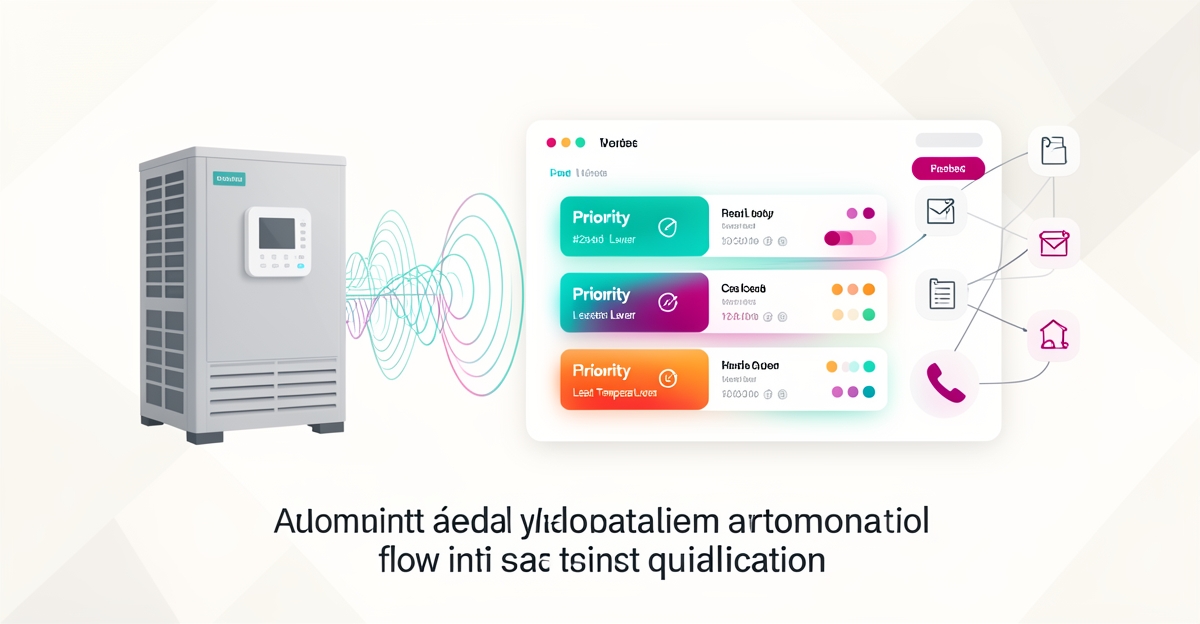
How to Automate HVAC Lead Qualification with AI-Powered Lead Scoring
Key Facts
- HVAC teams typically spend several hours each week manually reading and qualifying a steady stream of form submissions during peak season.
- Missed calls during seasonal spikes are a leading source of recoverable lost revenue for HVAC firms, per industry analyses.
- AI lead scoring turns website behavior, call transcripts, and service history into a priority signal before a human ever opens the file.
- HVAC qualification criteria, urgency, system age, property type, budget signals, are well-defined enough to automate effectively.
- AIQ Labs has deployed 200+ multi-agent systems and runs 4 live SaaS products daily.
Hire a team member that works 24/7 — for less than a part-time wage.
AI receptionists, SDRs, dispatchers and 99+ roles. Trained on your business, fully managed.
Not sure where to start? Ask our AI planner
The HVAC Lead Volume Problem and Cost of Missed Prioritization
Most HVAC businesses don't have a lead problem, they have a prioritization problem. The inbox fills with form submissions every week, and manually reading and qualifying each one consumes hours that technicians and office staff simply don't have during peak season.
Demand for HVAC services arrives in violent spikes. Summer heat waves and winter cold snaps flood phone lines and web forms simultaneously, overwhelming teams that are already stretched thin. Industry analyses consistently note that HVAC companies operate in these unpredictable cycles, leaving high-value replacement and maintenance agreement leads buried alongside routine filter-change requests.
The revenue hiding in those missed moments adds up fast. Missed calls during peak season are one of the largest sources of recoverable lost revenue for HVAC firms, not counting follow-up work, maintenance agreements, or full system replacements that slip through the cracks when no one answers.
- A steady stream of weekly form submissions requiring hours of manual qualification
- Seasonal demand spikes that overwhelm staff during peak months
- Recoverable revenue lost to missed calls during peak season
- High-value replacement leads buried under routine service requests
AIQ Labs works with HVAC operators who have watched this cycle repeat every season. The qualification criteria for HVAC service, urgency, system age, property type, budget signals, are well-defined enough to automate effectively, yet most businesses still rely on whoever picks up the phone first to make judgment calls in real time.
AI-powered lead scoring changes the math. When an AI system analyzes website behavior, call history, and past service data to score every inquiry before a human ever sees it, qualification stops being a bottleneck. For teams that also want inbound coverage, an AI receptionist or lead-qualifier employee can answer and triage every call around the clock.
How AI-Powered Lead Scoring Prioritizes High-Value HVAC Leads
HVAC teams drown in inquiries during peak season and miss high-value jobs while manually triaging forms and calls. AI-powered lead scoring changes that by turning website behavior, call history, and past service data into an instant priority signal.
The system learns what a good HVAC lead looks like for your business and scores every inquiry in real time. Website visits to service pages, time on pricing content, repeat form submissions, and prior maintenance history all feed the model. Call transcripts and duration are analyzed alongside CRM notes to flag urgency and buying intent. High-scoring leads are routed immediately to the right technician or dispatcher, while low-fit inquiries enter nurture.
This automation delivers measurable operational gains. Teams stop spending their first hours of the day sorting inquiries, and urgent jobs stop waiting in a queue behind routine requests. Manual qualification of a heavy weekly submission load scales poorly during seasonal spikes, the workload grows exactly when your staff has the least capacity.
For HVAC, qualification criteria are specific enough to automate effectively. Industry analysis of AI for HVAC companies notes that AI can help with seasonal demand by analyzing website behavior, call history, and past service data to score leads and assign them to the right technician. Voice AI can also answer every call simultaneously, eliminating queues during peak seasons.
AIQ Labs builds these systems as fixed-price workflow builds, we rebuild the one workflow that costs you the most, in phases, so you see value before the full rollout. For businesses that want lead qualification connected to scheduling, dispatch, and follow-up in a single layer, an AI Operating System ties it together and is owned outright.
How scoring prioritizes value in practice:
- Behavioral signals from the website, such as service page depth and quote requests, are weighted for intent.
- Call history is analyzed for urgency cues, repeat contacts, and prior service records.
- Past service data informs lifetime value, maintenance agreement status, and replacement likelihood.
- Scores trigger instant routing rules to the right technician, dispatcher, or sales rep.
The result is faster qualification and fewer missed revenue opportunities. Leads are logged automatically, tasks are assigned without manual entry, and the pipeline stays organized. Teams spend less time sorting and more time closing, with consistent handling even when demand spikes.
Build vs Buy: What Works for HVAC Lead Qualification Systems
When HVAC businesses face a surge of leads, choosing between building a custom AI lead qualification system or buying an off-the-shelf solution can significantly impact efficiency and ROI. Building a custom system offers full control over how leads are scored, tailoring criteria to specific service areas, technician availability, and seasonal demand patterns, while ensuring seamless integration with existing tools like CRM and scheduling software. Buying a pre-built solution may seem faster, but it often requires adapting business processes to fit rigid workflows, limiting flexibility and long-term scalability.
HVAC qualification criteria are well-defined enough to automate effectively, making both build and buy approaches viable depending on business maturity and technical resources. Specialized AI tools can deliver high precision in niche workflows, and integrated, accessible tool combinations can dramatically shorten the time from first contact to a logged, qualified lead in the CRM.
However, success hinges on data quality and system integration. Poor data leads to inaccurate scoring, while siloed systems create manual workarounds that undermine automation gains. Gains from AI lead qualification are real, but only when the AI is trained on clean, historical data and connected to live customer interactions. Whether building or buying, the system must analyze website behavior, call history, and past service data to score leads accurately and route them to the right technician in real time.
Ultimately, the decision comes down to ownership, adaptability, and long-term value. AIQ Labs helps HVAC businesses evaluate whether a custom-built AI lead scoring system, owned outright and designed around their unique workflows, delivers better outcomes than adapting to a generic platform. With the right approach, automation doesn't just save time; it turns lead qualification into a predictable, high-conversion engine.
Implementation Roadmap for AI Lead Scoring in HVAC
Getting AI lead scoring live in your HVAC business doesn't require a massive overhaul, it requires a structured sequence. Companies that rush deployment without assessing their current process often end up with scores that don't reflect what actually makes a lead valuable.
Step 1: Audit your current qualification process. Start by measuring how leads move through your pipeline today. If your team manually reads and qualifies form submissions, track how many hours that consumes each week, during peak season it's typically several hours or more. Document which criteria your best technicians currently use to judge a lead's quality; those become the foundation of your scoring model.
Step 2: Configure your scoring criteria. HVAC qualification is specific enough to automate effectively. Set your AI to evaluate each inquiry based on your preferred signals, website behavior, call history, past service data, and instantly direct high-priority leads to your team.
Step 3: Integrate with your CRM. This is where the payoff compounds. Connect the scoring system so it automatically logs qualified leads, assigns tasks, and keeps the pipeline organized without manual entry. Integrated setups routinely cut the time from first message to a logged, qualified CRM record from hours to minutes.
Step 4: Monitor and adjust. AI scoring models improve with feedback. Review which high-scored leads converted, which didn't, and refine the weighting accordingly. The gains from AI qualification depend on ongoing tuning, treat the first 60–90 days as a calibration period.
A few practical considerations matter here. Data quality is the backbone, AI scoring is only as reliable as the call logs and service history feeding it. Integration with existing CRM and marketing systems can be challenging, and training your team on the new workflow is essential for adoption.
This is where a partner approach helps. AIQ Labs builds AI lead scoring systems trained on your actual sales history and integrated directly with your CRM, and can pair the scoring engine with an AI Employee lead qualifier that engages leads around the clock, valuable during peak-season spikes when demand overwhelms staff. Businesses can start with Start Monthly, phase the build through Build in Milestones, or take full ownership via Own It Outright. See the current options on our pricing page.
Start with a two-minute Fit Check at aiqlabs.ai/apply, then book a free 30-minute strategy call at aiqlabs.ai/book, a no-obligation working session with an AI engineer to map your biggest lead-qualification bottleneck and identify the highest-ROI automation opportunities. If there isn't a clear win, they'll tell you that too.
Still paying for 10+ subscriptions that don’t talk to each other?
We build custom AI systems you own outright. No vendor lock-in. Full control.
Not sure where to start? Ask our AI planner
Frequently Asked Questions
How much time does manual HVAC lead qualification actually take each week?
What revenue are HVAC businesses losing from missed calls alone?
Can AI-powered lead scoring really speed up qualification for HVAC leads?
What kind of data does AI use to score HVAC leads effectively?
Is it better to build or buy an AI lead scoring system for my HVAC business?
What results have HVAC businesses seen from AI lead scoring with CRM integration?
Turn Seasonal Chaos Into Predictable Revenue
HVAC businesses don't have a lead volume problem, they have a prioritization problem. Manual triage burns hours every week and buries high-value replacement and maintenance agreement leads under routine requests, while seasonal spikes drive recoverable revenue out the door through missed calls. AI-powered lead scoring solves this by turning website behavior, call history and past service data into real-time priority signals, routing urgent, high-fit inquiries to the right technician instantly and nurturing the rest. The result is faster qualification, fewer missed opportunities, and a pipeline that stays organized without manual entry. If you're ready to stop sorting and start closing, audit your current qualification criteria, map the signals that define a great lead for your business, and test scoring tied directly to your CRM. AIQ Labs builds AI lead scoring systems trained on your sales history and integrated with your tools, and can pair the engine with an AI Employee lead qualifier that works around the clock. Start the two-minute Fit Check at aiqlabs.ai/apply and book a free 30-minute strategy call at aiqlabs.ai/book to map your biggest bottleneck and see if there's a clear, high-ROI win.
Make AI your competitive advantage — not just another tool.
Strategy, implementation and ongoing optimization. One partner, end to end.
Not sure where to start? Ask our AI planner