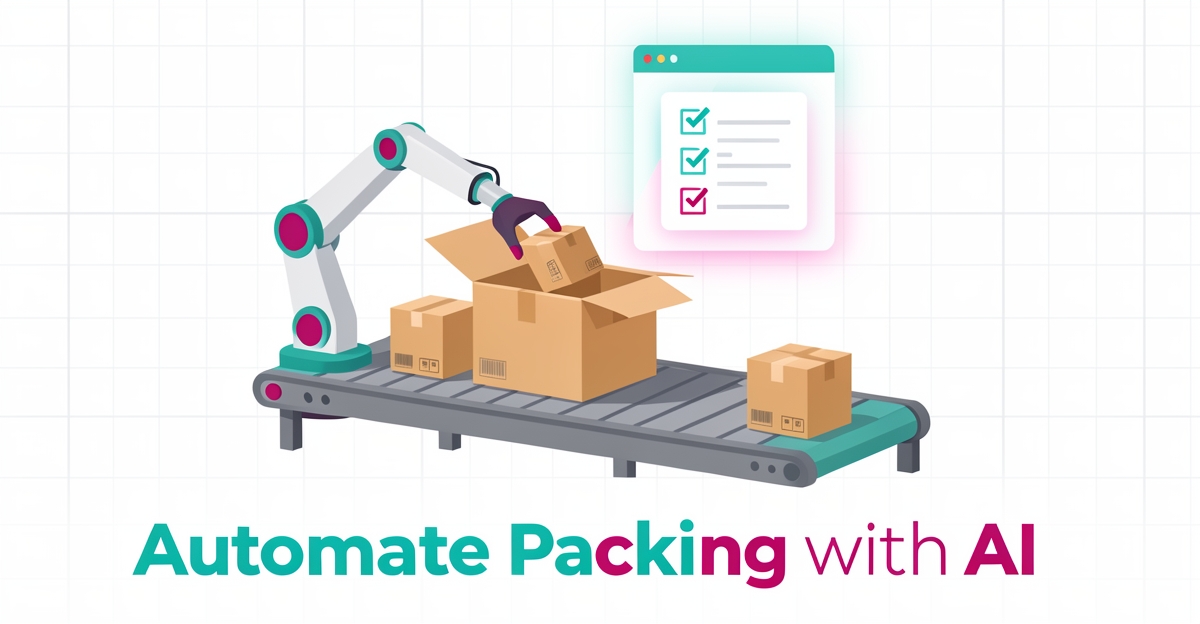
How to Automate Packing Instructions with AI in 5 Simple Steps
Hire a team member that works 24/7 — for less than a part-time wage.
AI receptionists, SDRs, dispatchers and 99+ roles. Trained on your business, fully managed.
Not sure where to start? Ask our AI planner
The Hidden Cost of Manual Packing Instructions
If you run a fulfillment or shipping operation, packing instructions are one of those tasks that looks small until you add it up. Someone on your team has to remember (or look up) how each product should be packed: which items need foam inserts, which are fragile, which can't be tilted, which need desiccant for humidity-sensitive goods. Multiply that by hundreds of SKUs and dozens of orders a day, and you get slow packing times, inconsistent notes, and the occasional damaged item that turns into a return, a refund, and an unhappy customer.
The real cost isn't just the minutes spent writing instructions. It's the errors that slip through when instructions are missing, vague, or copy-pasted from a similar product that packs differently. Every mis-packed order costs money twice: once in the return itself, and again in the customer's trust. Manual instruction-writing also doesn't scale. Add fifty new SKUs and your documentation burden grows linearly while your team's available time doesn't.
This is exactly the kind of repetitive, rules-based, detail-heavy work that AI handles well. Not by replacing your team's judgment, but by doing the first draft of the work so your people only review and approve instead of writing from scratch.
How AI Generates Accurate, Product-Specific Packing Notes
Modern AI language models, such as Anthropic's Claude, OpenAI's ChatGPT, and Google's Gemini, are good at turning structured product information into clear, usable instructions. The key is what you feed them. An AI model can't see your product on a shelf, but it can work extremely well from a structured input: product name, dimensions, weight, material, fragility rating, shipping method, and any special handling requirements.
Give the model that context and it can generate packing notes tailored to the item: cushioning recommendations, orientation warnings, temperature considerations, and step-by-step packing sequences written in plain language a warehouse temp can follow on their first day. Because the output is generated from your own product data rather than a generic template, the instructions stay specific instead of one-size-fits-all.
For higher-volume operations, this doesn't have to be a copy-paste exercise in a chat window. Tools like Microsoft Power Automate can connect your product database to an AI model, so instructions are generated automatically when a new SKU is added or when an order comes in. That's the difference between using AI as a writing assistant and building it into an actual workflow, and it's the difference between a nice trick and a system that holds up at scale.
Implementing AI-Powered Packing Instructions in 5 Steps
Here's a practical path from manual chaos to a repeatable system.
Step 1: Identify which products need tailored instructions
Don't try to automate everything at once. Start with the products where packing errors actually cost you money: fragile items, high-value goods, items with frequent damage complaints, and anything with regulatory or handling requirements. Rank them by return frequency and replacement cost. This gives you a shortlist where automation pays for itself fastest.
Step 2: Structure your product data
AI output is only as good as your input. For each product on your shortlist, capture the facts the model needs: dimensions, weight, materials, fragility, storage requirements, and any known failure modes ("arrives scratched," "crushed corners"). If this data lives in people's heads rather than in a system, that's the first bottleneck to fix, and it's worth fixing regardless of AI.
Step 3: Generate the first drafts with AI
Feed the structured data into an AI model with a clear prompt: who the instructions are for (warehouse staff, customer, or both), the format you want, and the tone. Ask for step-by-step packing sequences, materials lists, and handling warnings. Generate a draft for each product on your shortlist. This is the part that used to take hours per SKU and now takes minutes.
Step 4: Review and refine with the people who pack
Never ship AI-generated instructions without a human review. Your experienced packers know things the model doesn't: that a particular box runs small, that one supplier's foam is thinner than another's. Have them mark up the drafts, correct anything that doesn't match reality, and approve the final version. The AI does the bulk of the writing; your team supplies the judgment that makes it trustworthy.
Step 5: Build it into the workflow
Approved instructions should live where the work happens, printed at the packing station, embedded in your order management system, or triggered automatically when an order line includes a special-handling SKU. If you want the generation step itself automated (new SKU in, draft instructions out), that's a workflow build: connect your product database to an AI model through a platform like Power Automate or a custom integration. If that's more internal plumbing than you want to own, it's the kind of thing AI Workflow Builds handles, rebuilding the one workflow that costs you the most, at a fixed price, in phases.
Still paying for 10+ subscriptions that don’t talk to each other?
We build custom AI systems you own outright. No vendor lock-in. Full control.
Not sure where to start? Ask our AI planner
Frequently Asked Questions
How does AI help automate packing instructions for different products?
Do I still need to review AI-generated packing instructions before using them?
What are the key steps to implement AI for automating packing instructions?
Can AI completely replace human involvement in creating packing instructions?
What skills are needed to effectively use AI for generating packing or operational instructions?
Are there limitations to using AI tools for packing instruction generation?
Turn Packing Chaos into Clarity with AI
Automating packing instructions with AI isn't just about saving time, it's about consistency, fewer errors, and freeing your team to focus on work that actually moves the needle. Follow the five steps above: pick the products where errors hurt most, structure your data, generate drafts, review with the people who pack, and build the results into your workflow. The payoff is fewer returns, clearer operations, and documentation that scales as your catalog grows. If you'd rather not build and maintain that system yourself, AIQ Labs offers AI Employees for managed operational staff, AI Workflow Builds to rebuild the one workflow that costs you the most, and AI Operating Systems when you want everything connected, built on 200+ multi-agent systems deployed in production. Start with the free two-minute Fit Check to find your highest-impact opportunity, then book a free 30-minute strategy call to map out a clear path forward.
Make AI your competitive advantage — not just another tool.
Strategy, implementation and ongoing optimization. One partner, end to end.
Not sure where to start? Ask our AI planner