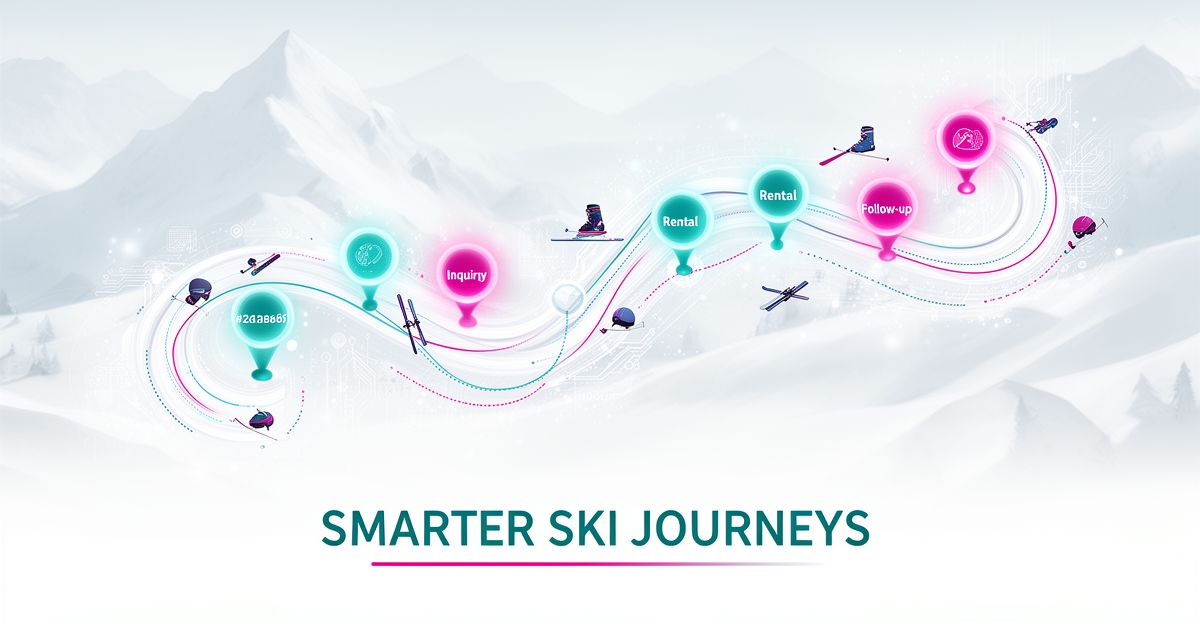
How to Build an AI-Driven Customer Journey for Your Ski Rental Shop
What if you could hire a team member that works 24/7 for $599/month?
AI Receptionists, SDRs, Dispatchers, and 99+ roles. Fully trained. Fully managed. Zero sick days.
Introduction: The Shift from Static to Predictive Rentals
The ski rental industry is at a tipping point. Shops still relying on static booking forms and generic email follow-ups aren't just behind the curve—they're invisible to the AI agents now guiding high-intent travelers from search to purchase.
Traditional rental journeys treat every customer the same: browse inventory, select dates, pick up gear. This linear model ignores the reality that 60–80% of conversion losses occur at just one or two stage transitions, such as boot sizing confusion or insurance upsell friction according to Loudscale. Most journey maps are "organizational mythology"—stories we tell ourselves that bear less resemblance to reality each quarter.
Common static-journey failure points: - Customers abandoning carts during boot-fit selection - No proactive weather-based gear recommendations - Post-rental feedback requests sent weeks too late - Zero visibility into why a loyal renter didn't return
AI flips the script from reactive to proactive. Instead of waiting for a search, predictive systems anticipate needs using weather forecasts, past rental history, and skill level. The payoff is measurable: AI-referred shoppers convert at a 54% higher rate than non-AI traffic and generate 14% higher average order values per Forbes. Meanwhile, 79% of consumers say they feel more confident in purchases made with AI assistance Forbes reports.
Mini case study: A Colorado shop integrated an AI agent that auto-suggested "Storm Day Packages" (wider skis + heated boot rentals) when forecasts predicted 12"+ snowfall. Weekend attachment rates for premium packages jumped 22% in one season.
Moving from static to predictive requires more than a chatbot widget. It demands a structural shift across three integrated pillars:
- Data Unification: Merge booking, POS, CRM, and inventory into a single customer view
- Agentic Commerce: Deploy AI agents that book, size, upsell, and follow up autonomously
- Operational Governance: Set hard guardrails so equipment recommendations stay safe and compliant
These pillars form the backbone of an AI-driven journey that compresses the path-to-purchase while building seasonal loyalty. Next, we’ll break down exactly how to implement each pillar in your shop.
The Problem: Why Traditional Ski Rental Journeys Leak Revenue Stalls
Traditional ski rental processes are plagued with inefficiencies that silently erode revenue. 60-80% of conversion losses happen at critical handoffs—like online booking to in-store pickup—where friction disrupts the customer experience. 56% of unhappy customers leave silently, never complaining but never returning either.
The root cause? Data silos and rigid workflows. When booking systems, CRMs, and inventory tools operate in isolation, businesses lose visibility into customer behavior. 89% of customers stay with brands that offer seamless omnichannel experiences, but most ski rentals still rely on fragmented, manual processes.
- 60-80% of lost conversions occur at specific transitions (e.g., cart abandonment during boot sizing).
- AI-referred traffic converts 54% higher than organic visitors, yet most ski shops lack AI-driven booking systems.
-
Example: A customer starts booking online but gets stuck selecting boot sizes—no AI assistant to guide them, so they abandon the process.
-
5% higher retention can boost profits by 25-95%, yet most ski rentals rely on generic email blasts.
- 89% of customers prefer brands with consistent omnichannel experiences, but ski shops often lack unified data.
-
Example: A repeat customer books online but gets a different experience in-store—no AI system recognizes them, leading to frustration.
-
60-80% of conversion losses happen at handoffs (e.g., online booking to in-store pickup).
- AI-driven journey mapping can identify and fix these friction points in real time.
- Example: A customer books skis online but arrives to find no record of their reservation—no AI system syncs data across touchpoints.
Without AI-driven personalization, ski rentals miss out on 54% higher conversion rates and 14% higher average order values from AI-referred shoppers. 79% of consumers feel more confident with AI assistance, yet most ski shops still rely on static FAQs and manual customer service.
The solution? An AI-driven customer journey that predicts needs, eliminates friction, and retains customers—before they even realize they’re leaving.
Next up: How AI can transform every stage of the ski rental journey—from first inquiry to post-rental feedback.
The Solution: Three AI Pillars for Ski Rental Growth
Data Unification: Streamlining the Customer Journey
- Challenge: Siloed data across booking platforms, CRM, and inventory systems leads to inconsistent customer experiences and inefficiencies.
- AIQ Labs Solution: Integrate all systems into a single, real-time data platform. This enables a seamless, personalized customer journey and optimizes operational efficiency.
- Benefit: A 360° customer view, ensuring consistent interactions and personalized offers across all touchpoints.
- Statistic: Companies with strong omnichannel engagement retain 89% of customers (Loudscale).
Agentic Commerce: Enhancing the Customer Experience
- Challenge: Manual processes and limited digital capabilities hinder ski rental shops from providing seamless, personalized customer experiences.
- AIQ Labs Solution: Deploy AI agents to actively participate in the customer journey, handling inquiries, bookings, and post-rental feedback.
- Benefit: AI agents compress the path-to-purchase, improving conversion rates and customer satisfaction.
- Statistic: AI-referred shoppers have a 36% lower bounce rate and convert at 54% higher rates than non-AI traffic (Forbes).
Operational Governance: Ensuring Safety and Accuracy
- Challenge: Automating critical processes without strict guardrails can lead to errors, safety issues, or poor customer experiences.
- AIQ Labs Solution: Implement a robust governance framework with clear boundaries for AI agents and human-in-the-loop oversight for complex issues.
- Benefit: Strict guardrails ensure AI recommendations are safe, accurate, and compliant with industry regulations.
- Statistic: Companies using AI-powered journey analytics see a 54% greater return on marketing investments (Loudscale).
By implementing these three AI pillars, ski rental shops can transform their customer journeys, driving growth, and gaining a competitive edge in the industry.
Implementation: A Phased Roadmap from Audit to Agentic Commerce
Transforming your ski rental shop into an AI-driven powerhouse requires more than just installing a chatbot; it demands a strategic, phased evolution from data unification to full agentic commerce. By following a structured roadmap, you can compress the path-to-purchase while ensuring every customer interaction feels personal and secure. This approach moves beyond theoretical mapping to create a living, breathing operational system that adapts in real-time.
The journey begins by shattering data silos that currently hide critical friction points in your rental process. Without a unified view of customer behavior across online booking, in-store POS, and inventory systems, any AI implementation rests on shaky ground. You must first integrate these disparate sources to create a single source of truth that powers accurate decision-making.
Once integrated, deploy AI-driven analytics to replace static journey maps with dynamic, real-time monitoring. Research reveals that traditional maps are often "organizational mythology" that bears little resemblance to actual customer behavior. Instead, focus on identifying specific stage transitions where 60-80% of conversion losses typically occur, such as confusion during boot sizing or insurance selection.
Key actions for this foundational phase include: * Integrating online booking, in-store POS, and CRM into one unified data platform. * Deploying real-time analytics to spot "stuck points" like cart abandonment during sizing. * Establishing baseline metrics for current conversion rates and customer retention. * Auditing existing content structures for AI readability and agent compatibility. * Defining clear data governance protocols to ensure privacy and trust.
According to LoudScale research, companies utilizing AI-powered journey analytics see a 54% greater return on marketing investments compared to those relying on traditional mapping methods. Furthermore, industry data shows that 89% of customers are retained by companies with strong omnichannel engagement, versus only 33% for weak performers.
Consider a scenario where a rental shop notices a spike in drop-offs when users select "advanced skis" but hesitate on binding settings. By unifying data, the owner sees this pattern instantly rather than waiting for monthly reports, allowing immediate intervention via a targeted pop-up or agent prompt.
With your data foundation solidified, you are ready to optimize your digital assets for the next generation of shoppers.
With clean data flowing, the next phase focuses on transforming your digital presence into a hub for agentic commerce. This means structuring your FAQs, equipment specs, and sizing guides so AI assistants can easily understand and recommend your specific rental packages. The goal is to enable AI agents from travel blogs or search engines to book your "Full Day Alpine Package" directly, bypassing tedious browsing.
This optimization capitalizes on a massive shift in consumer behavior where AI-referred shoppers convert at significantly higher rates than traditional traffic. By ensuring your content is machine-readable, you position your shop as a preferred partner for these intelligent assistants. This strategy effectively compresses the path-to-purchase, moving customers from intent to booking in seconds rather than hours.
Strategic steps to achieve agentic readiness include: * Structuring product data with clear tags for skill level, weather conditions, and package types. * Creating detailed, semantic content that answers specific technical questions about gear. * Enabling direct booking APIs that allow external AI agents to finalize reservations. * Testing your site with various AI models to ensure accurate interpretation of offerings. * Developing dynamic content that adjusts recommendations based on real-time weather forecasts.
The impact of this shift is profound, as Forbes reports that retail shoppers starting their journey on AI chats convert at a 54% higher rate than non-AI traffic. Additionally, these AI-referred shoppers generate 14% higher average order values, proving that intelligent recommendations drive premium sales.
Imagine a skier asking their personal AI travel assistant for gear recommendations based on tomorrow's snow forecast. Because your shop's data is optimized, the agent instantly books a premium powder ski package for them, securing a high-value reservation before the customer even visits your website.
Once your acquisition engine is running, the focus must shift to keeping these valuable customers coming back season after season.
The final phase implements proactive churn prediction and establishes strict human-in-the-loop governance to build lasting trust. Instead of waiting for customers to leave, use AI to analyze historical rental data and current trends to identify those at risk of churning. This allows you to launch personalized re-engagement campaigns, such as early-bird discounts or snow condition alerts, before dissatisfaction sets in.
Simultaneously, you must define clear boundaries for your AI agents to ensure safety and reliability. While AI handles routine tasks like hours, location, and standard sizing, complex issues require a seamless handoff to human staff. This human-in-the-loop approach ensures that specialized equipment requests or injury-related claims are managed with empathy and expertise, maintaining high customer confidence.
Critical components for this mature stage include: * Deploying sub-second churn-propensity scoring to flag at-risk customers immediately. * Automating personalized retention offers based on individual rental history and preferences. * Creating "stop conditions" where AI automatically escalates complex queries to humans. * Training staff to collaborate with AI agents rather than compete with them. * Monitoring agent performance continuously to refine decision-making logic.
The financial case for this proactive approach is compelling, as LoudScale notes that sub-second churn scoring improves retention by 20% in subscription-style models. Moreover, increasing customer retention by just 5% can boost profits by 25% to 95%, making this phase crucial for long-term viability.
For example, an AI system detects that a loyal family hasn't booked for the upcoming holiday week despite favorable snow forecasts. It automatically sends a customized offer for their usual gear setup, successfully re-engaging them before they consider a competitor.
By following this phased roadmap, your ski rental shop evolves from a reactive service provider into a predictive, AI-driven market leader. To accelerate this transformation with custom-built agents and strategic guidance, partner with AIQ Labs to architect your competitive advantage today.
Governance & Scale: Embedding AI into Your Operating Model
Building an AI-driven customer journey isn’t just about deploying chatbots or automation—it’s about scaling intelligence across your ski rental shop’s entire operation. Without a governance framework, even the most advanced AI systems can create inconsistencies, compliance risks, or inefficient workflows. AIQ Labs’ approach ensures seamless evolution from pilot projects to full transformation, embedding AI into your core operating model for long-term success.
Most businesses get stuck in the "Pilot Purgatory"—testing AI in isolated use cases but failing to scale. The AI maturity curve outlines five key stages:
- Exploration: Experimenting with AI tools (e.g., a basic chatbot for FAQs)
- Pilots: Limited trials (e.g., AI handling online bookings for a single location)
- Scaling: Expanding AI into multiple workflows (e.g., inventory forecasting + customer support)
- Optimization: Establishing governance, adoption, and efficiency improvements
- Transformation: AI becomes embedded in the operating model, driving strategic advantage
AIQ Labs’ role? Helping ski rental shops move up the curve with structured frameworks, change management, and scalable AI architectures.
Example: A ski shop might start with an AI receptionist handling calls, then scale to AI-driven inventory management that predicts demand based on weather forecasts—before finally embedding AI into end-to-end operations, from marketing to post-rental feedback.
AI in customer-facing roles—like equipment recommendations or rental agreements—requires guardrails to prevent errors, biases, or compliance risks. AIQ Labs implements six governance pillars to ensure responsible AI:
- Trust & Ethics Guidelines: Defining AI decision-making boundaries (e.g., when to escalate to a human for complex equipment fits)
- Data Security & Privacy: Protecting customer data (e.g., rental history, payment info) with encrypted storage and access controls
- Regulatory Alignment: Ensuring compliance with local business laws (e.g., rental agreements, liability waivers)
- Audit Trails: Logging all AI interactions for transparency and accountability
- Human-in-the-Loop Controls: Requiring human approval for high-stakes decisions (e.g., refunds, equipment damage claims)
- Fallback Systems: Graceful degradation if AI fails (e.g., switching to a live agent if the system can’t resolve a query)
Stat: Only 25% of call centers have successfully integrated AI into daily workflows, according to Loudscale—highlighting the need for structured adoption.
Actionable Insight: Start with low-risk, high-impact AI (e.g., automated sizing recommendations) before expanding to mission-critical functions (e.g., payment processing).
Even the best AI systems fail without buy-in. AIQ Labs’ change management strategy ensures smooth adoption:
- Role-Specific Training: Tailored programs for front-desk staff, managers, and technicians (e.g., how to override AI recommendations when needed)
- Stakeholder Communication: Clear messaging on AI’s role as an assistant, not a replacement (e.g., "This AI handles routine inquiries so you can focus on complex customer needs")
- Feedback Loops: Continuous user input to refine AI performance (e.g., tracking which queries get escalated to humans)
- Performance Metrics: Measuring AI’s impact on efficiency (e.g., reduced wait times, higher conversion rates)
Example: A ski shop using AIQ Labs’ AI Receptionist might see 90% of routine calls handled automatically, freeing staff to upsell add-ons (e.g., helmets, lessons) in person.
AIQ Labs doesn’t just build AI—it partners for long-term evolution. Their engagement models ensure sustainable scaling:
- AI Readiness Assessment: Evaluating your tech stack, data quality, and team capabilities
- Opportunity Mapping: Identifying high-ROI AI use cases (e.g., dynamic pricing for peak seasons)
-
Roadmap Development: A phased plan to avoid overwhelm
-
Custom AI Development: Building ski-specific AI agents (e.g., a chatbot that understands boot sizing charts)
- System Integration: Connecting AI to booking platforms, CRM, and inventory tools
-
Testing & Optimization: Ensuring 99%+ accuracy before full deployment
-
Performance Monitoring: Tracking conversion rates, customer satisfaction, and operational efficiency
- Continuous Training: Updating AI with new data (e.g., seasonal trends, customer feedback)
- Scaling Support: Expanding AI to new departments (e.g., marketing, supply chain)
Stat: Companies using AI-powered journey analytics see 54% greater ROI on marketing spend, per Loudscale—proving that scaling AI pays off.
Here’s how a real ski rental business might evolve with AIQ Labs:
- Phase 1 (Pilot): Deploy an AI chatbot to handle FAQs and basic bookings (e.g., "What are your hours?" or "Do you have size 10 boots?").
- Phase 2 (Scaling): Add AI-driven inventory forecasting to reduce stockouts and optimize rental pricing based on demand.
- Phase 3 (Optimization): Implement churn prediction to re-engage past customers with personalized offers (e.g., "Last season’s skis are back—book early for 10% off!").
- Phase 4 (Transformation): Embed AI into every touchpoint—from pre-arrival upsells (e.g., "Add a helmet for $15") to post-rental feedback analysis (e.g., identifying common complaints about boot comfort).
Key Takeaway: AI isn’t a one-time project—it’s a continuous evolution. AIQ Labs’ governance frameworks and engagement models ensure your ski rental shop scales intelligently, avoiding the pitfalls of fragmented or unsustainable AI adoption.
Next Step: Ready to embed AI into your operating model? AIQ Labs offers free AI audits to map your highest-impact opportunities—contact them today to start your transformation.
Conclusion: Your Next Move Toward an AI-Driven Rental Season
Conclusion: Your Next Move Toward an AI-Driven Rental Season As we conclude our journey through the world of AI-driven customer journeys for ski rental shops, it's clear that embracing AI is no longer a choice, but a necessity. With the potential to boost conversions by 54% and improve retention by 20%, AI is not just a competitive advantage, but a strategic imperative.
Key Takeaways: * Data unification is crucial for a seamless customer experience. * AI agents can significantly enhance the path-to-purchase. * Proactive churn prediction can help retain valuable customers. * Human-in-the-loop governance ensures trust and safety in AI-driven processes.
Your Next Steps: 1. Assess your current systems and identify areas where AI can add value. 2. Implement real-time journey mapping to pinpoint friction points. 3. Optimize your digital assets for AI agents to facilitate smoother customer interactions. 4. Deploy proactive retention campaigns based on AI-driven insights. 5. Establish clear governance to ensure AI recommendations are safe and accurate.
By following these steps and leveraging the power of AI, you can transform your ski rental shop's customer journey, enhancing experiences, improving efficiencies, and driving growth. Remember, the future of customer interaction is AI-driven. Stay ahead of the curve and make your move toward an AI-driven rental season today.
Ready to transform your business? Contact AIQ Labs to discover how to architect your competitive advantage with AI.
Ready to make AI your competitive advantage—not just another tool?
Strategic consulting + implementation + ongoing optimization. One partner. Complete AI transformation.